Blog
Written here first.
Every article is published on this domain before anywhere else, with its receipts and with what it does not settle stated in the text.
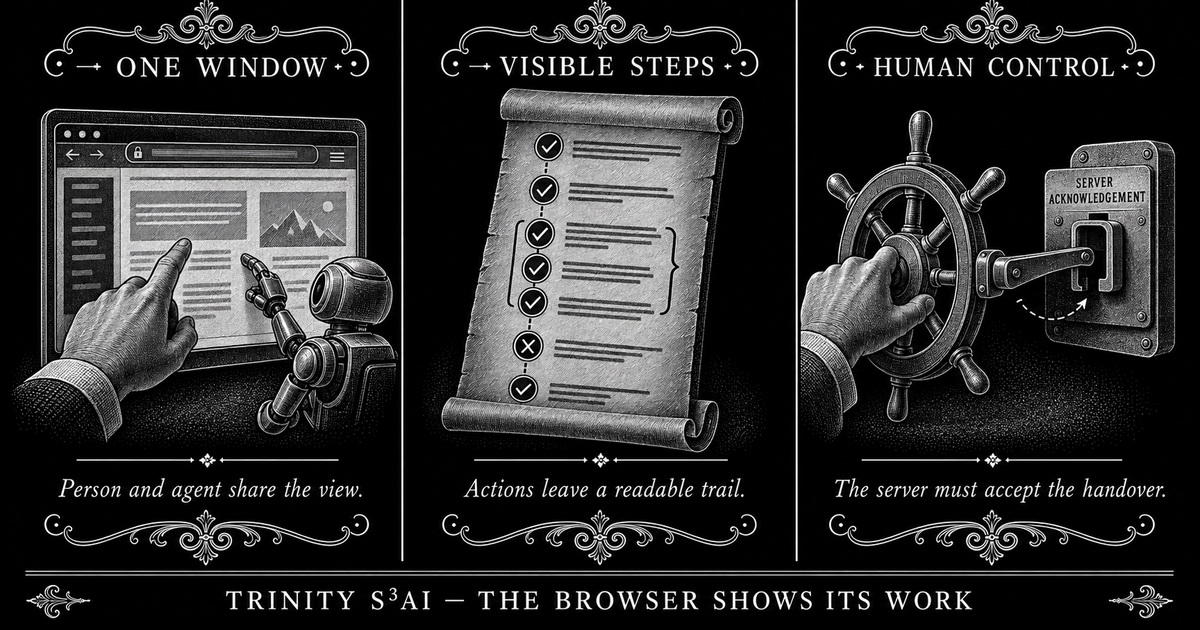
Three panels, left to right - ONE WINDOWPerson and agent share the view.
- VISIBLE STEPSActions leave a readable trail.
- HUMAN CONTROLThe server must accept the handover.
The browser agent should show its work
Queen’s merged browser changes expose actions as they arrive, keep a compact journal, and let human input request server-side control—with the remaining handover limits made explicit.
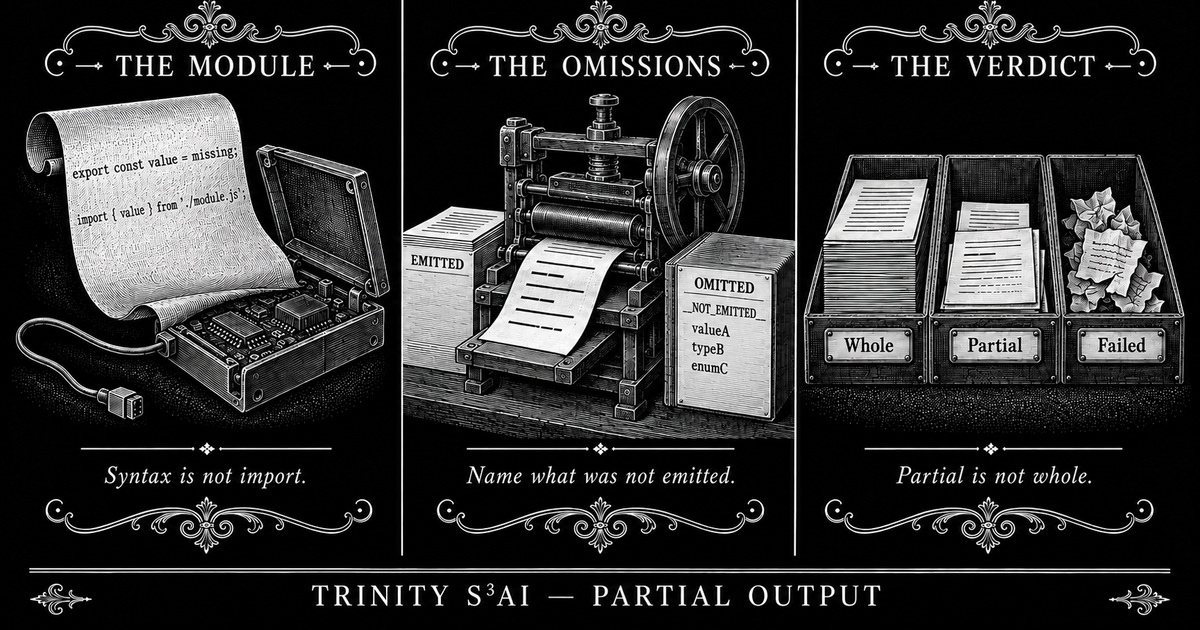
Three panels, left to right - THE MODULESyntax is not import.
- THE OMISSIONSName what was not emitted.
- THE VERDICTPartial is not whole.
A partial module needs its own verdict
JavaScript and TypeScript generation gained explicit omission records, so the Spec Explorer can distinguish a useful partial module from a complete one and from a failed compilation.
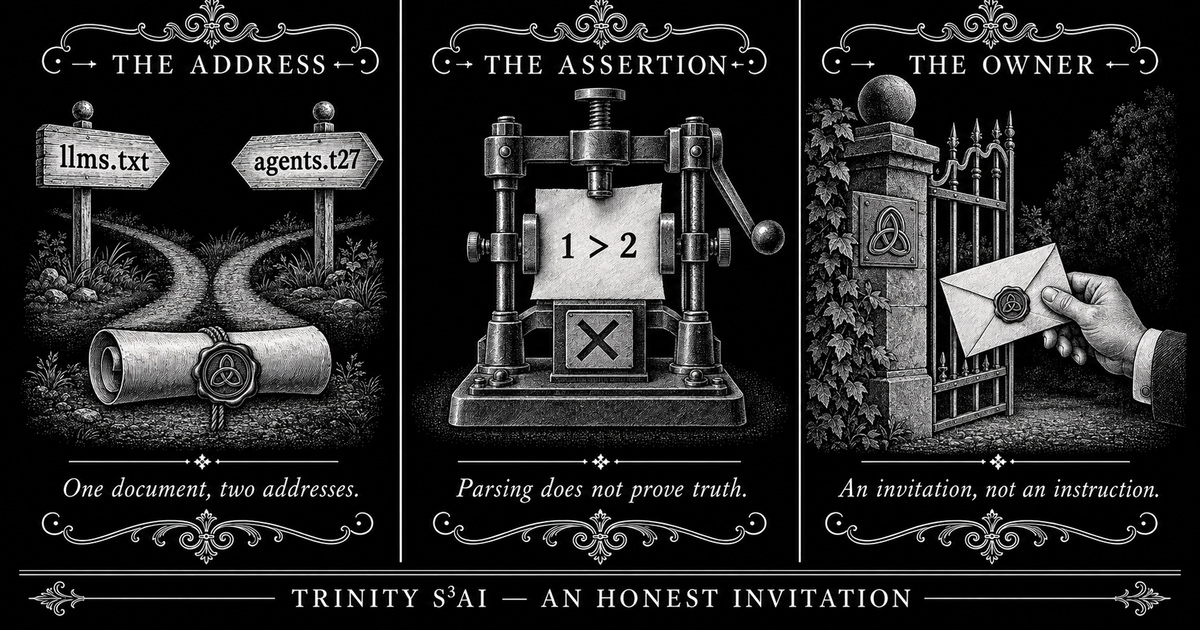
Three panels, left to right - THE ADDRESSOne document, two addresses.
- THE ASSERTIONParsing does not prove truth.
- THE OWNERAn invitation, not an instruction.
An invitation in the language it describes
T27's agent-facing introduction is one compiler-checked module served at two addresses, with executable claim checks and an explicit boundary around the reader's authority.
How to join the swarm
A hive of coding agents is rewriting this stack into its own language, one file per issue. There are two ways in - write a spec, or lend a provider key - and this is what each costs, what each earns, and which providers' terms quietly forbid the second one.
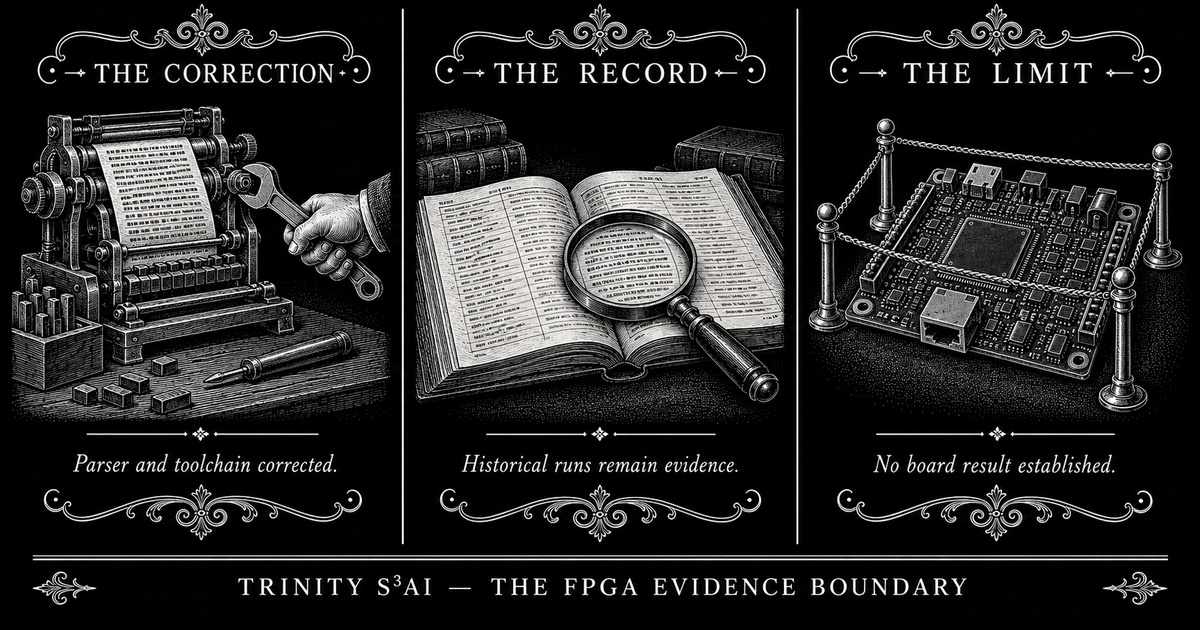
Three panels, left to right - THE CORRECTIONParser and toolchain corrected.
- THE RECORDHistorical runs remain evidence.
- THE LIMITNo board result established.
The FPGA row was corrected before it became evidence
[proven] A merged t27 PR corrected an invalid Yosys invocation and changed three FPGA status rows from green to red after 881 historical runs showed 36 successes, 842 failures, and 3 cancellations.
Three panels, left to right - THE RUNOne scheduled run succeeded.
- THE CHAINInspect each job and step.
- THE LIMITSuccess has a narrow scope.
A green self-check still had a boundary
[measured] Signal health (self) run 32 completed successfully with 2 jobs and 11 successful steps, but the receipt covers only one scheduled chain.
Three panels, left to right - THE VIEWPORTA short portrait view was missed.
- THE AXISGate the shell by orientation.
- THE LIMITDevice coverage remains open.
A phone web view needed an orientation gate
[measured] Merged PR #983 changed 3 CSS files after a 390×480 Chrome check exposed a phone layout selected by height instead of orientation.
Three panels, left to right - THE MERGEThe change landed.
- THE CHECKSEach verdict needs its receipt.
- THE DELIVERYLive pages need a separate check.
A merged diff was not one CI verdict
[measured] Merged PR #975 changed 85 files with 4,154 additions and 58 deletions; the receipts still need to be kept separate from interface correctness and live delivery.
Three panels, left to right - THE EXTENSIONOne suffix hid different languages.
- THE DIAGNOSTICName the recognised dialect.
- THE LIMITUnknown shapes still pass through.
Four languages shared one .tri extension
[reported in merged PR #793] The VIBEE generator now names Markdown, TOML, and t27 inputs instead of silently treating them as empty VIBEE modules, while unrecognised files retain the old fall-through.
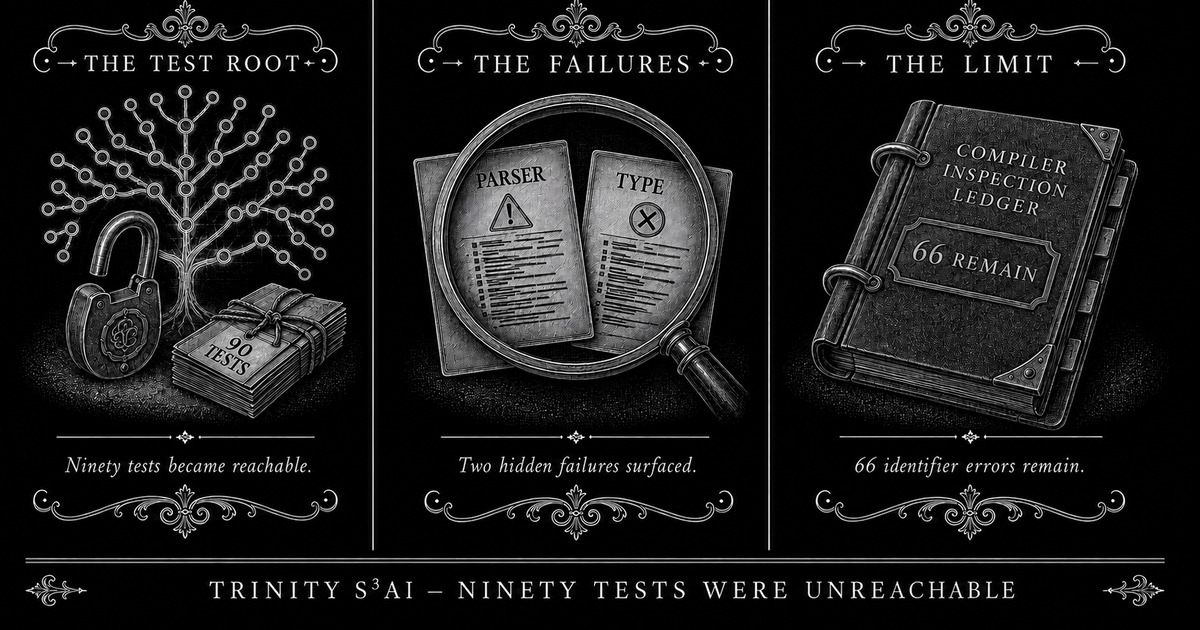
Three panels, left to right - THE TEST ROOTNinety tests became reachable.
- THE FAILURESTwo hidden failures surfaced.
- THE LIMIT66 identifier errors remain.
Ninety tests were present, but unreachable
[measured in merged PR #778] A Zig codegen subtree became importable, exposing 90 previously unreachable tests; the reported verification moved from 155 to 157 steps and from 2,832 to 2,939 tests.
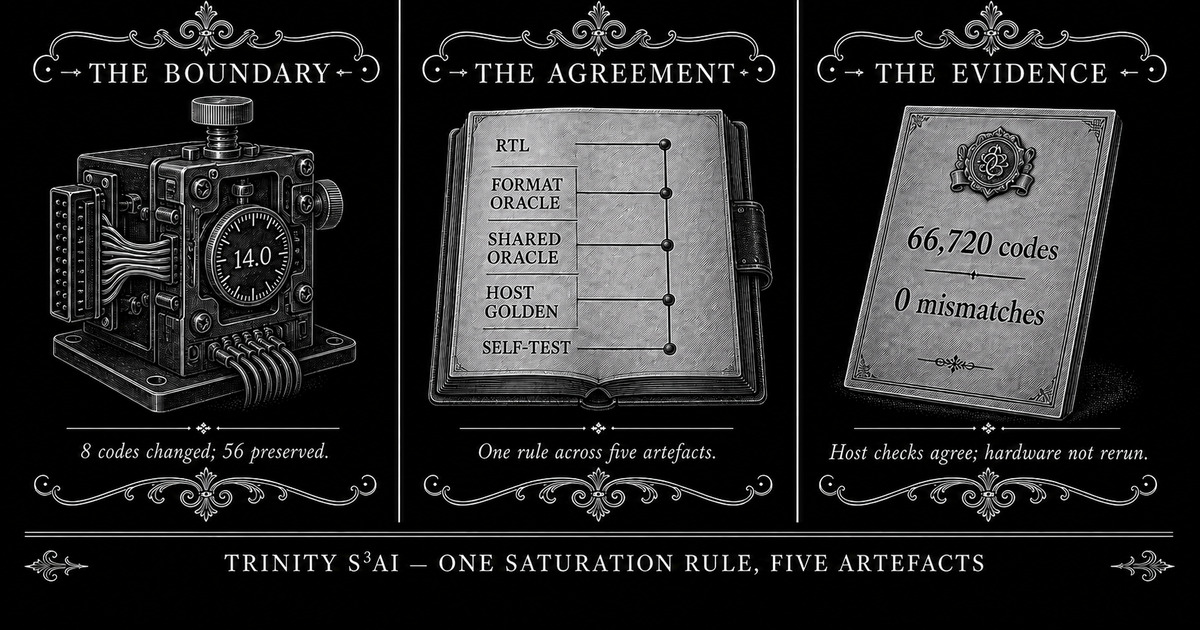
Three panels, left to right - THE BOUNDARY8 codes changed; 56 preserved.
- THE AGREEMENTOne rule across five artefacts.
- THE EVIDENCEHost checks agree; hardware not rerun.
One saturation rule, five artefacts
[measured] A merged fp6_e3m2 correction changed 8 boundary codes, kept 56 codes unchanged, and brought a 66,720-code consistency pass to 0 mismatches.
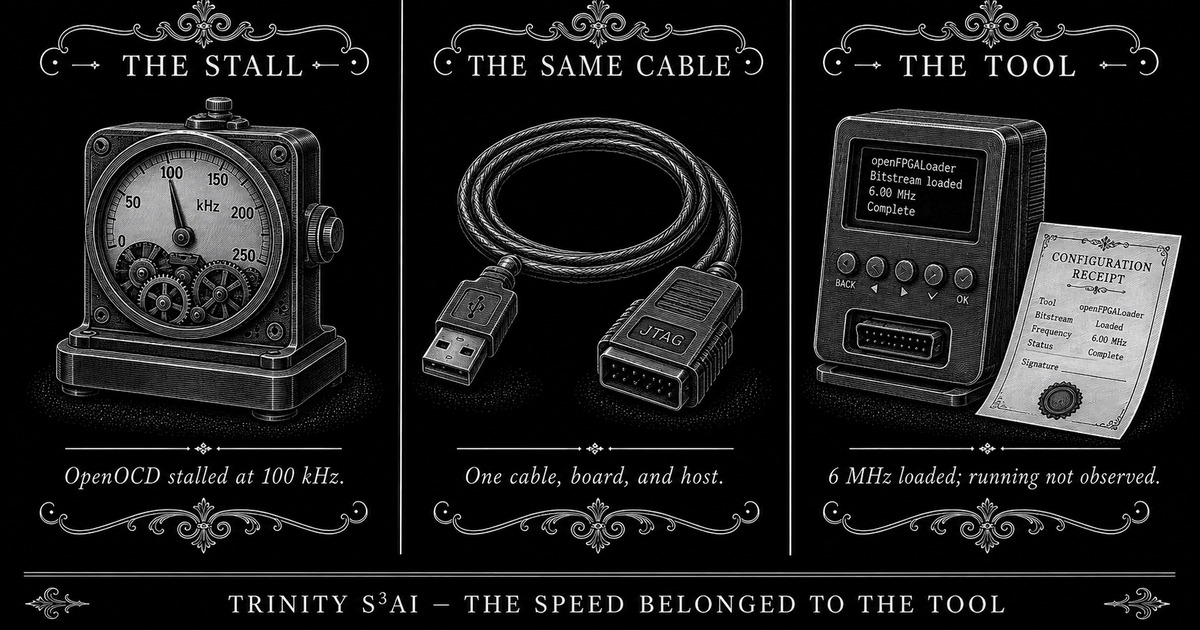
Three panels, left to right - THE STALLOpenOCD stalled at 100 kHz.
- THE SAME CABLEOne cable, board, and host.
- THE TOOL6 MHz loaded; running not observed.
The only stable speed belonged to the tool, not the cable
[measured] A note recorded 100 kHz as the only stable JTAG clock for this cable. openFPGALoader ran the same cable at 6 MHz and programmed a bitstream OpenOCD could not start.
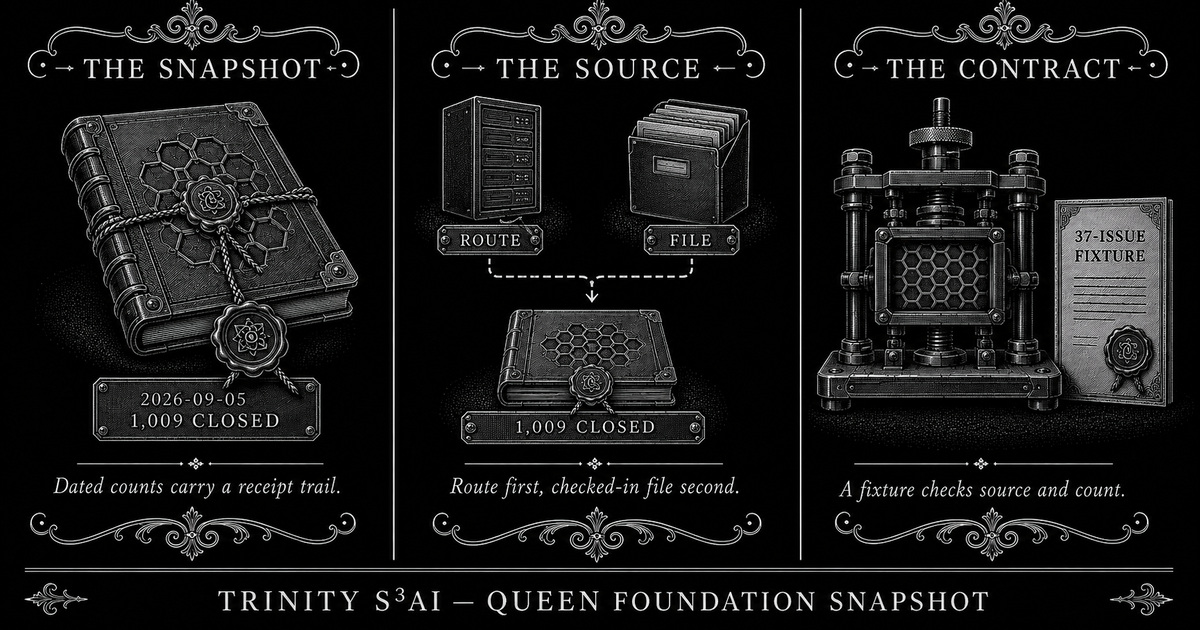
Three panels, left to right - THE SNAPSHOTDated counts carry a receipt trail.
- THE SOURCERoute first, checked-in file second.
- THE CONTRACTA fixture checks source and count.
The Queen foundation snapshot now has a source contract
[measured] Merged PR #937 adds a dated foundation snapshot and a fixture-backed contract that keeps the page source visible.
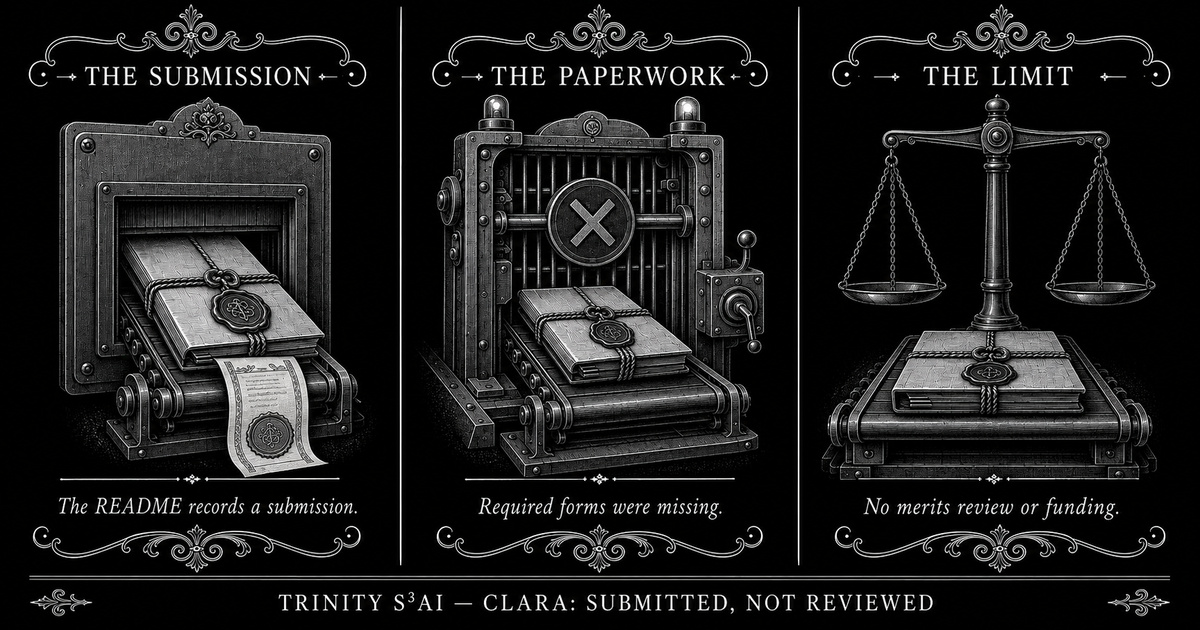
Three panels, left to right - THE SUBMISSIONThe README records a submission.
- THE PAPERWORKRequired forms were missing.
- THE LIMITNo merits review or funding.
CLARA: submitted, non-conforming, and not reviewed on the merits
[measured] Merged PR #892 changed one README file with two additions and two deletions, correcting the project record from “never submitted” to submitted, administratively non-conforming, and not reviewed on the merits.
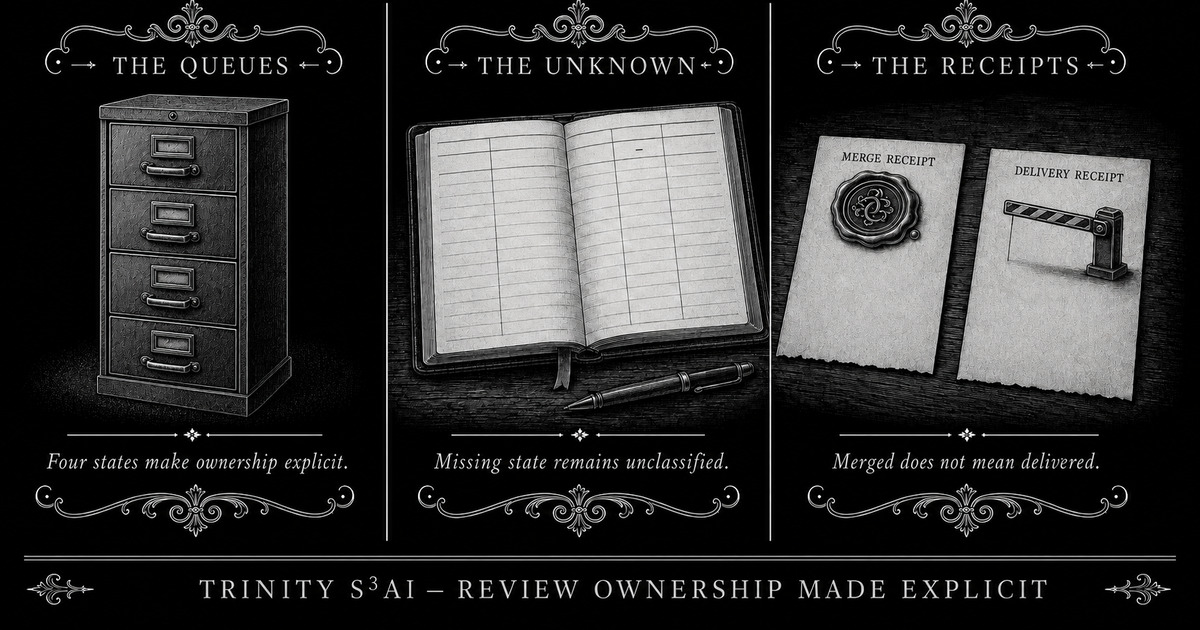
Three panels, left to right - THE QUEUESFour states make ownership explicit.
- THE UNKNOWNMissing state remains unclassified.
- THE RECEIPTSMerged does not mean delivered.
PR #888 made review ownership explicit
Merged PR #888 adds four explicit review states in a 5-file diff, while separate CI receipts show that merge state and delivery status are different facts.
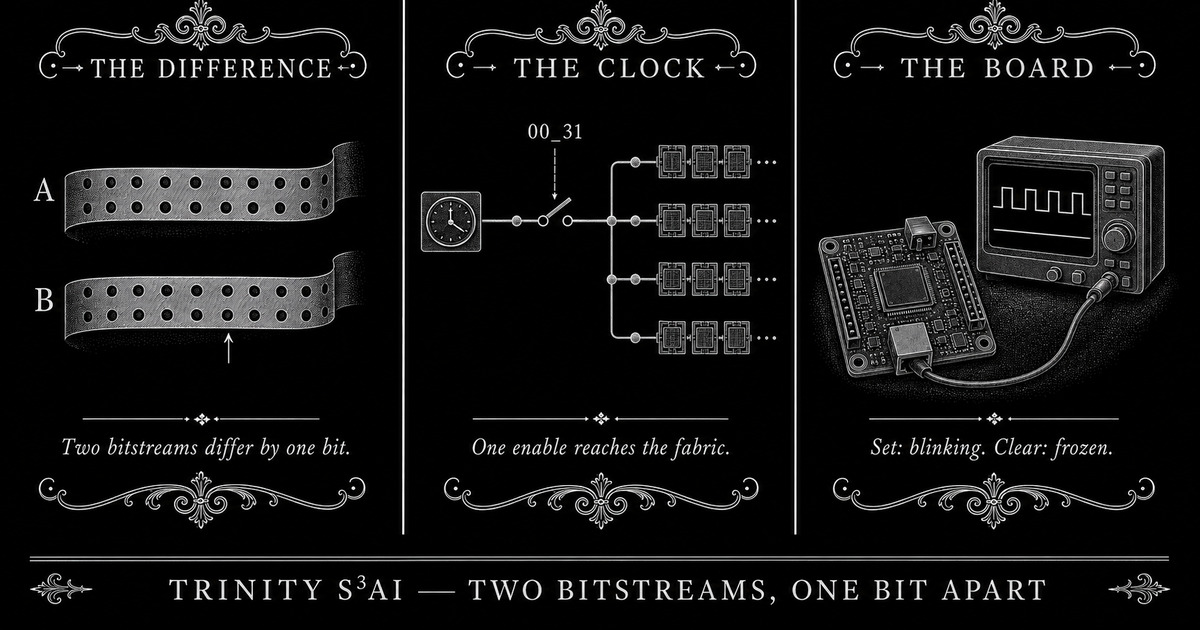
Three panels, left to right - THE DIFFERENCETwo bitstreams differ by one bit.
- THE CLOCKOne enable reaches the fabric.
- THE BOARDSet: blinking. Clear: frozen.
Two bitstreams, one bit apart
A proposed row in the Xilinx bitstream database had been unverifiable for eighteen months. Two 22.7 MB bitstreams differing in a single bit settle it on silicon: with the bit an LED blinks, without it the counter is frozen.
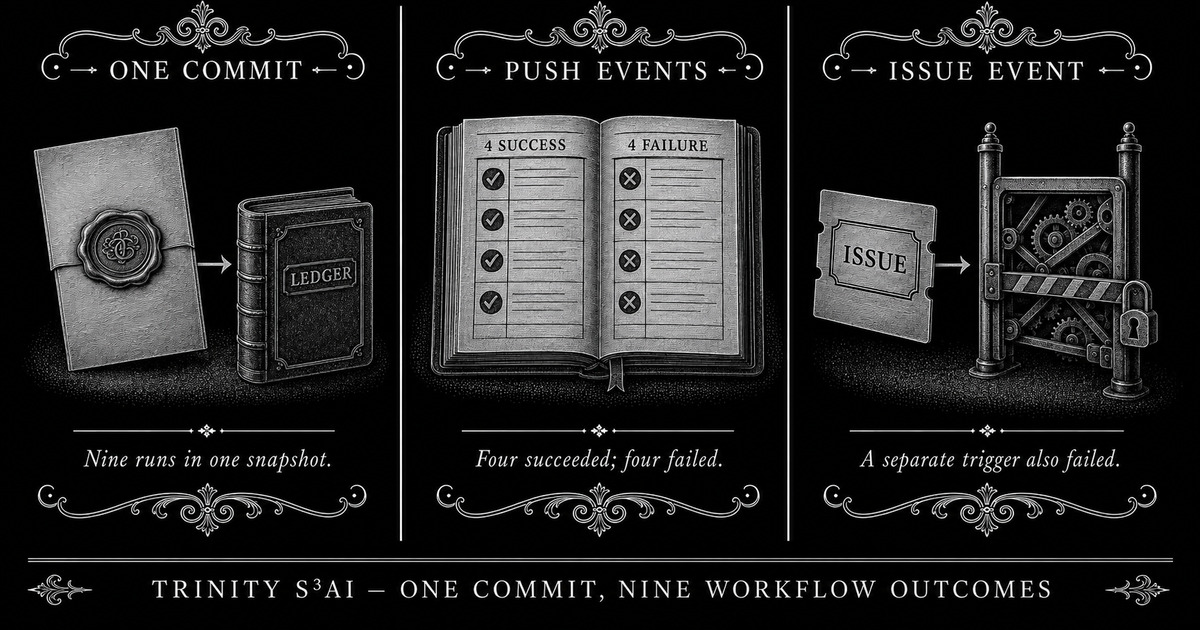
Three panels, left to right - ONE COMMITNine runs in one snapshot.
- PUSH EVENTSFour succeeded; four failed.
- ISSUE EVENTA separate trigger also failed.
One commit, nine workflow outcomes
A public GitHub Actions snapshot for commit 442bcda8bc50fe555de9d463bfd34b247c5995a5 records 9 runs: 8 push-triggered runs split into 4 successes and 4 failures, plus 1 issue-triggered failure; job evidence shows distinct stopping points rather than a shared cause.
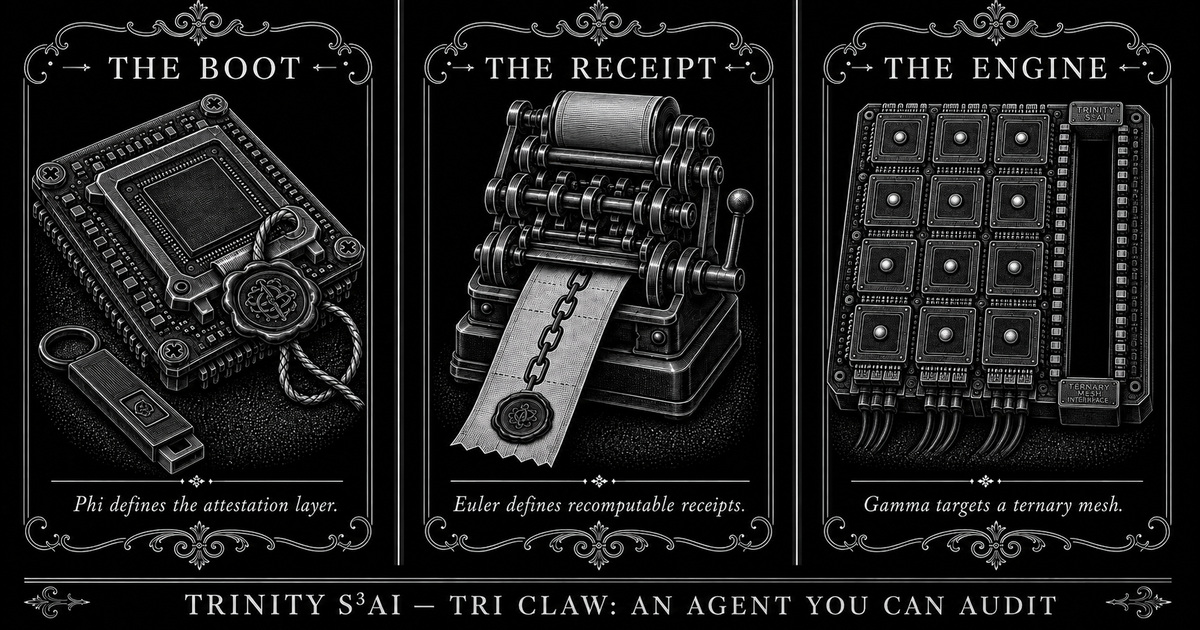
Three panels, left to right - THE BOOTPhi defines the attestation layer.
- THE RECEIPTEuler defines recomputable receipts.
- THE ENGINEGamma targets a ternary mesh.
TRI CLAW: an agent you can audit
Three dies that never reached the foundry become three gateware layers on the most-studied FPGA family: attestation at boot, a BLAKE3 receipt per action, a ternary engine with an empty DSP column. The agent-in-a-box exists; the verifiable device exists; the intersection is empty.
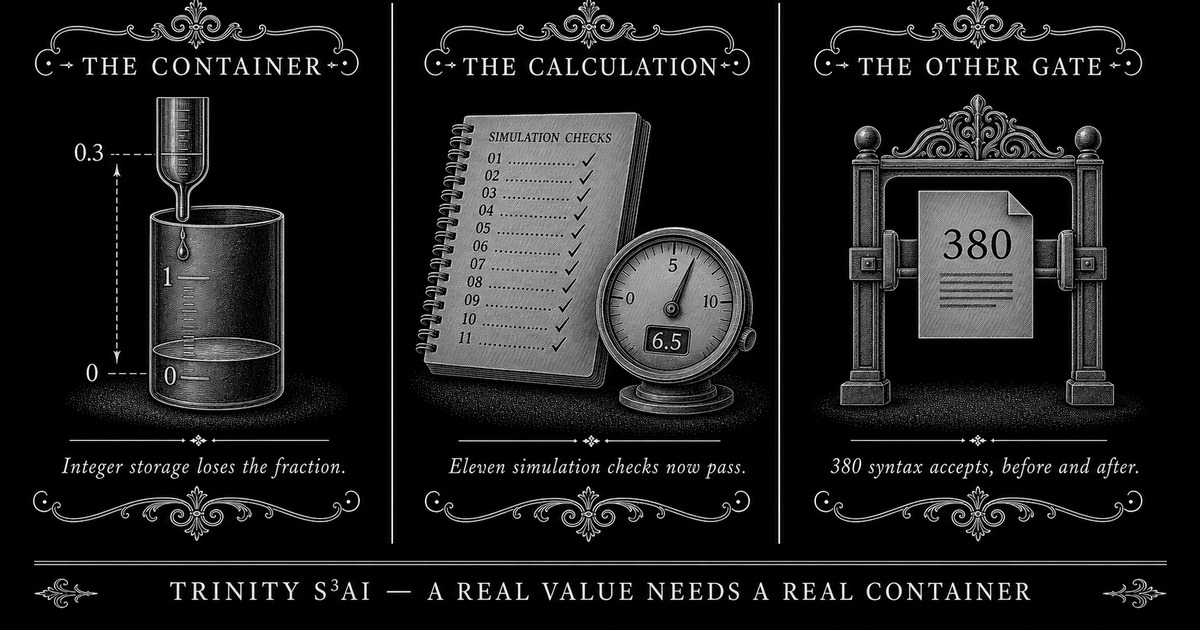
Three panels, left to right - THE CONTAINERInteger storage loses the fraction.
- THE CALCULATIONEleven simulation checks now pass.
- THE OTHER GATE380 syntax accepts, before and after.
A real value must not travel in an integer container
A merged Verilog-emitter fix moved one simulation case from 5 PASSED / 6 FAILED to 11 PASSED while syntax acceptance stayed at 380 files, showing why form and numerical-meaning gates must be separate.
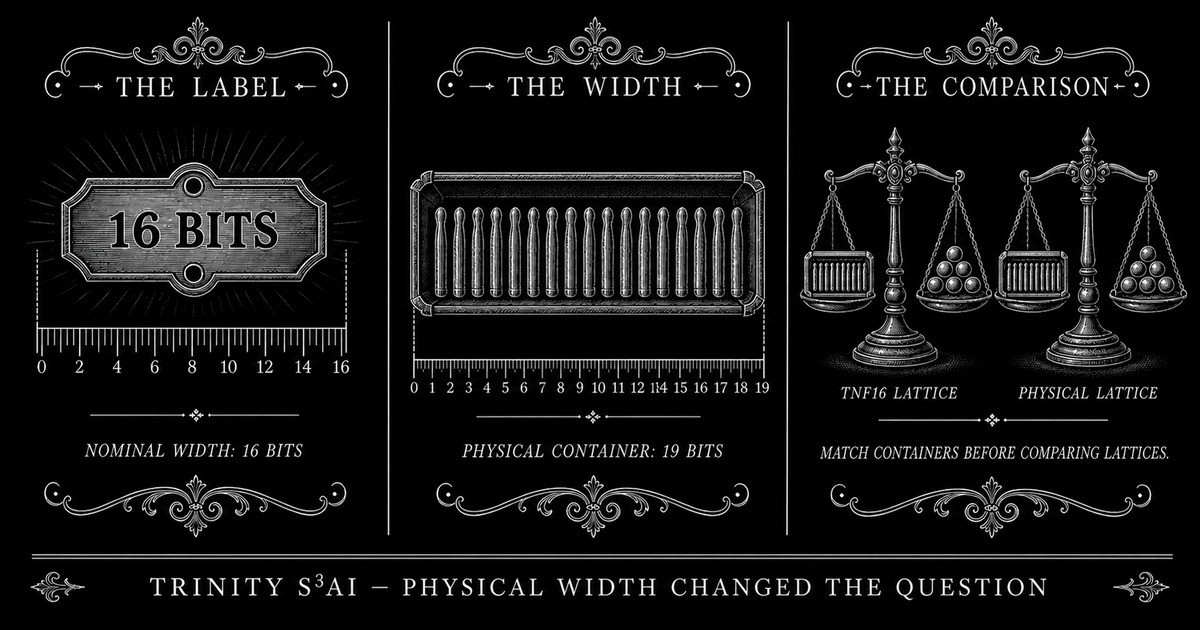
Three panels, left to right - THE LABELNOMINAL WIDTH: 16 BITS
- THE WIDTHPHYSICAL CONTAINER: 19 BITS
- THE COMPARISONMATCH CONTAINERS BEFORE COMPARING LATTICES.
Physical width changed the question
A committed-oracle comparison exposed a nominal-width error: TNF16 labelled as 16 bits occupies 19 physical bits, so the table now matches containers before comparing lattices.
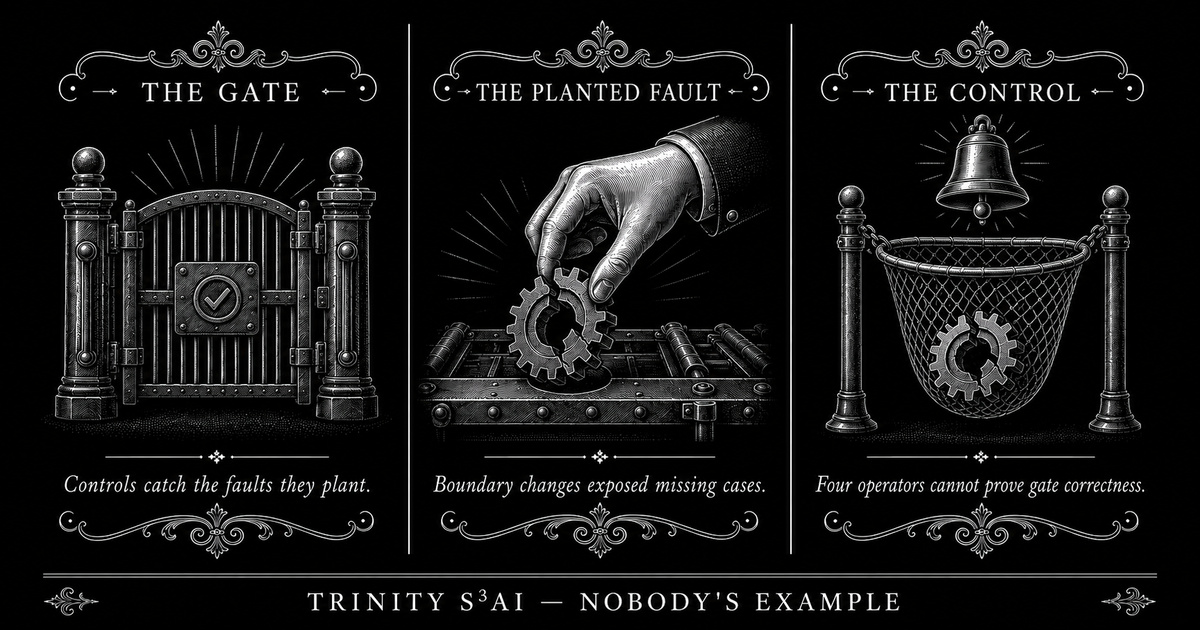
Three panels, left to right - THE GATEControls catch the faults they plant.
- THE PLANTED FAULTBoundary changes exposed missing cases.
- THE CONTROLFour operators cannot prove gate correctness.
Nobody's example
A gate's negative control is written by someone who plants the fault it is meant to catch. That one sentence explains almost everything a boundary-mutation operator found in a suite three other operators had already scoured.
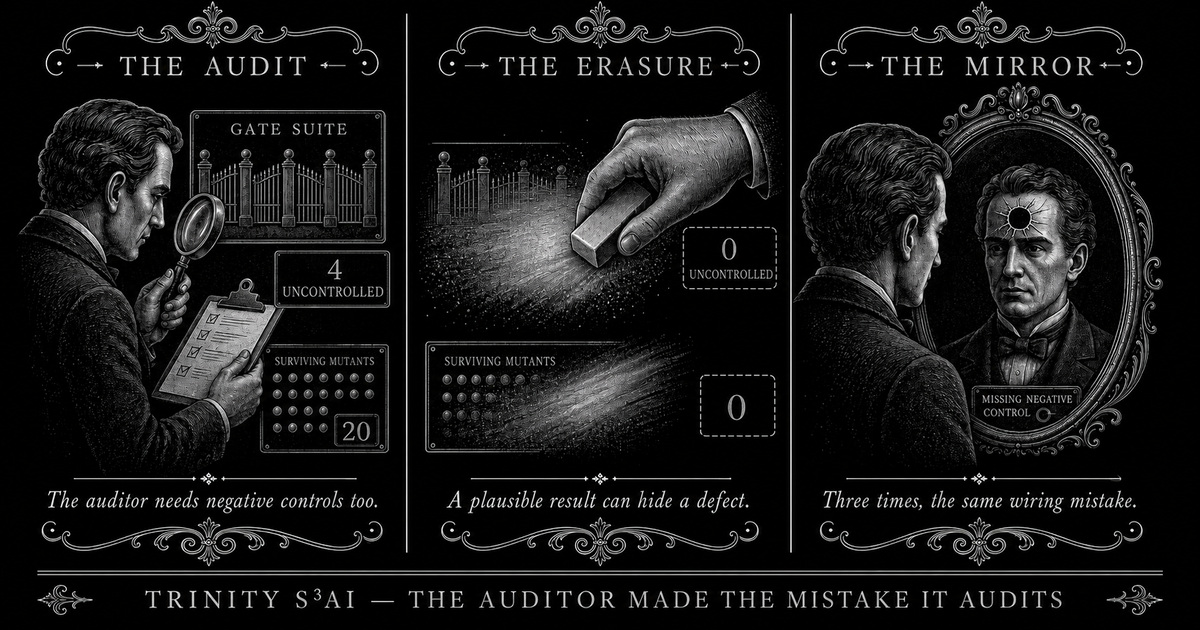
Three panels, left to right - THE AUDITThe auditor needs negative controls too.
- THE ERASUREA plausible result can hide a defect.
- THE MIRRORThree times, the same wiring mistake.
The auditor made the mistake it audits
A mutation tool took a gate suite from four gates with no negative control to none, and from twenty surviving mutants to zero. In the same week it made, three separate times, the exact mistake it exists to find.
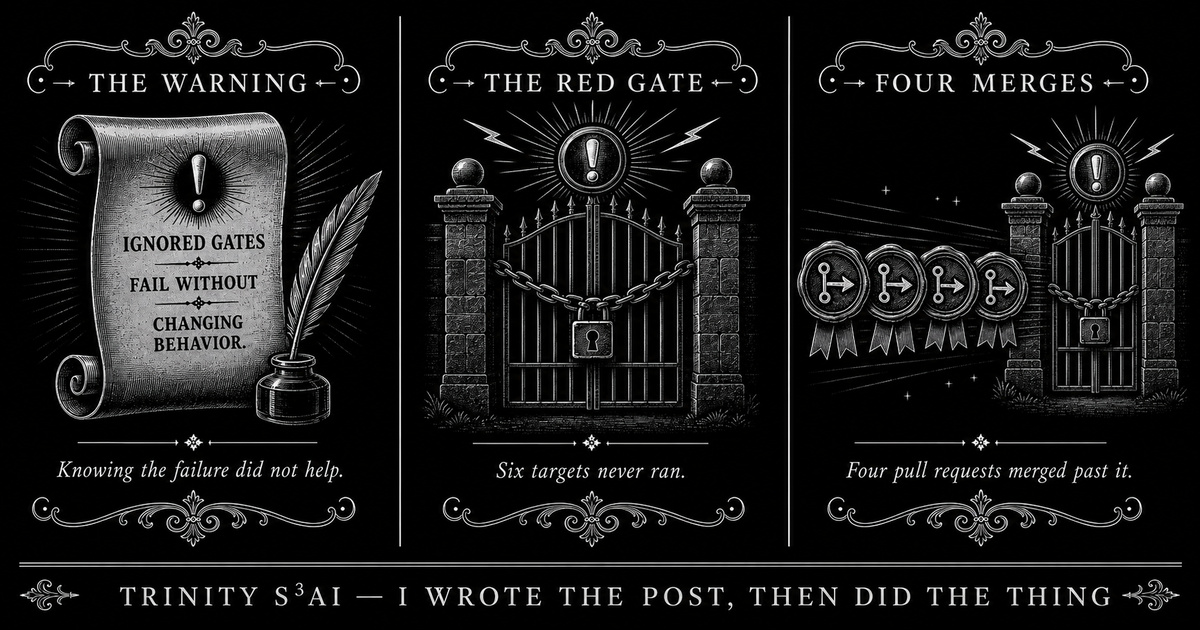
Three panels, left to right - THE WARNINGKnowing the failure did not help.
- THE RED GATESix targets never ran.
- FOUR MERGESFour pull requests merged past it.
I wrote the post, then did the thing
Two posts in this series are about gates that fail without changing anyone behaviour. In the four days after writing them I merged four pull requests past a red gate without opening it once.
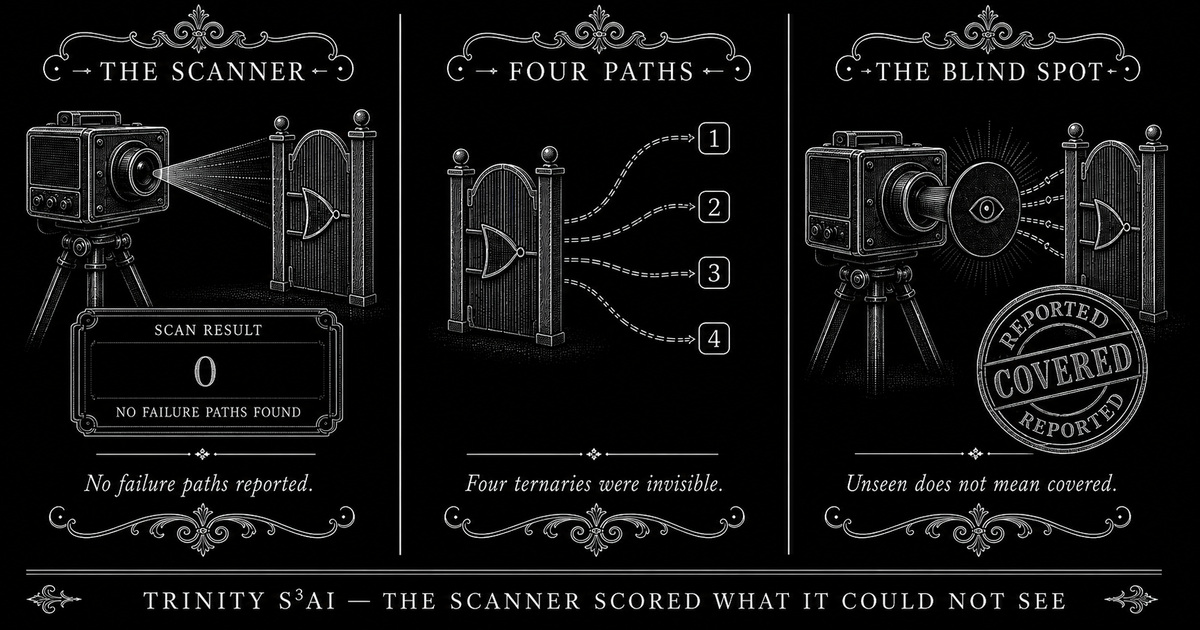
Three panels, left to right - THE SCANNERNo failure paths reported.
- FOUR PATHSFour ternaries were invisible.
- THE BLIND SPOTUnseen does not mean covered.
The scanner scored what it could not see
A mutation tool reported a gate as having no failure path. The gate has four -- all of them ternaries, a form the scanner did not recognise, so it scored them as covered.
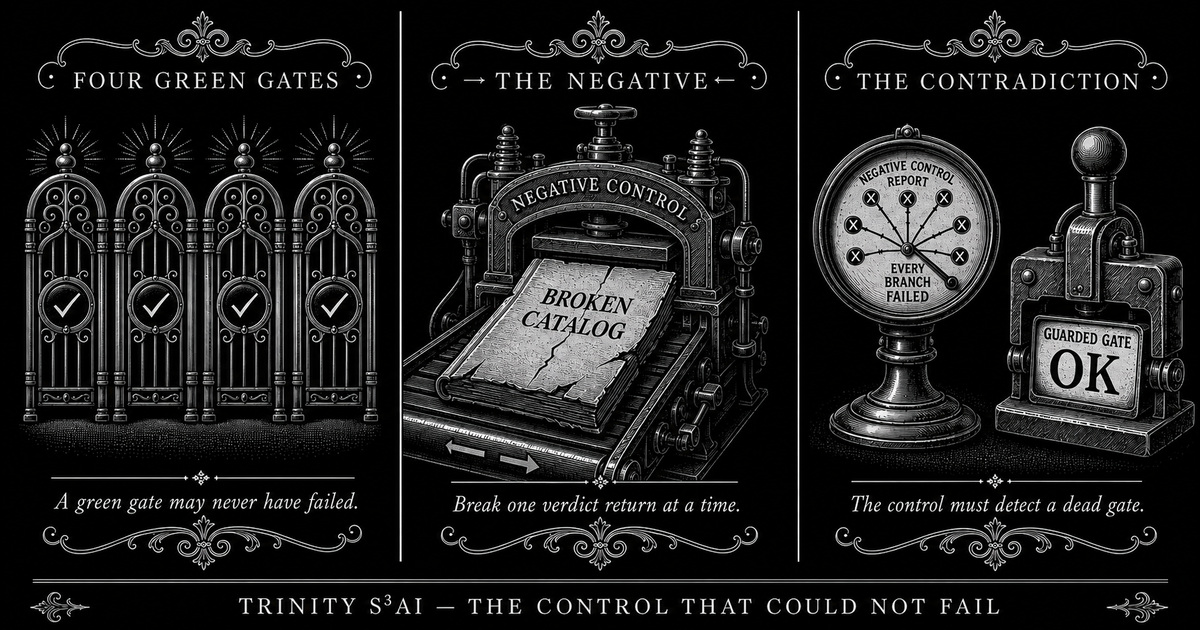
Three panels, left to right - FOUR GREEN GATESA green gate may never have failed.
- THE NEGATIVEBreak one verdict return at a time.
- THE CONTRADICTIONThe control must detect a dead gate.
The control that could not fail
Four gates had never been seen red. Writing their negative controls produced one that reported every branch red while the gate it guarded printed OK on a broken catalog.
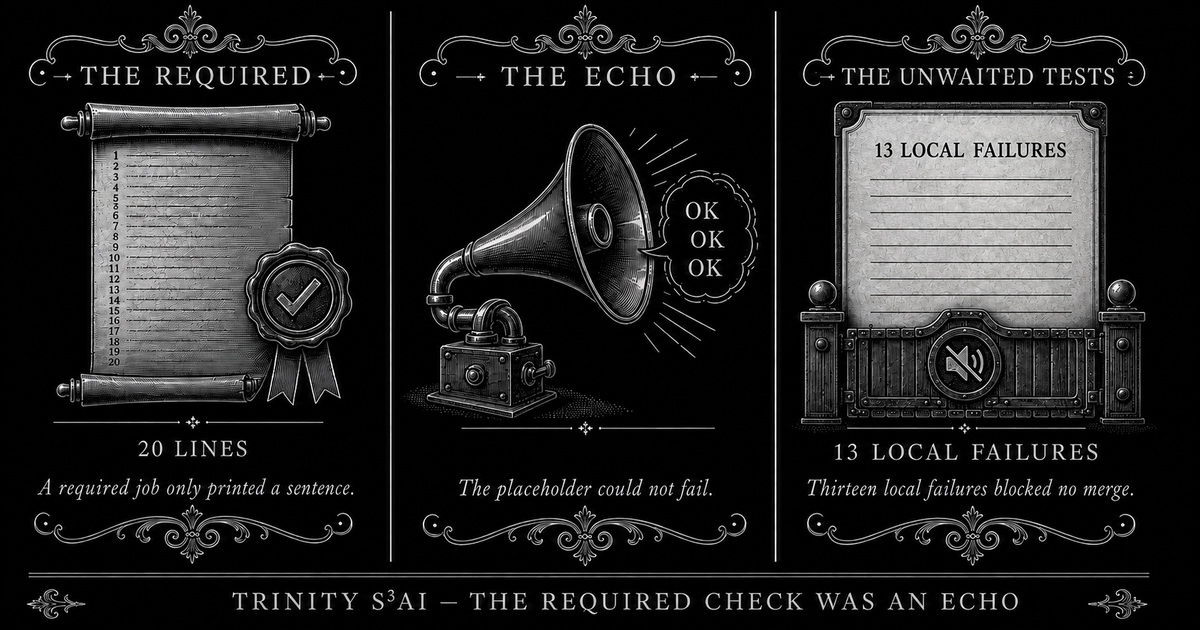
Three panels, left to right - THE REQUIREDA required job only printed a sentence.
- THE ECHOThe placeholder could not fail.
- THE UNWAITED TESTSThirteen local failures blocked no merge.
The required check was an echo
One of four required status checks — the ones a branch ruleset will not let a merge past — was a shell command that prints a sentence. Twenty lines, no logic, green on every pull request, required for months. Meanwhile the test suite it was believed to be has never blocked a merge, and thirteen tests fail on the main branch indefinitely because nothing was waiting for them.
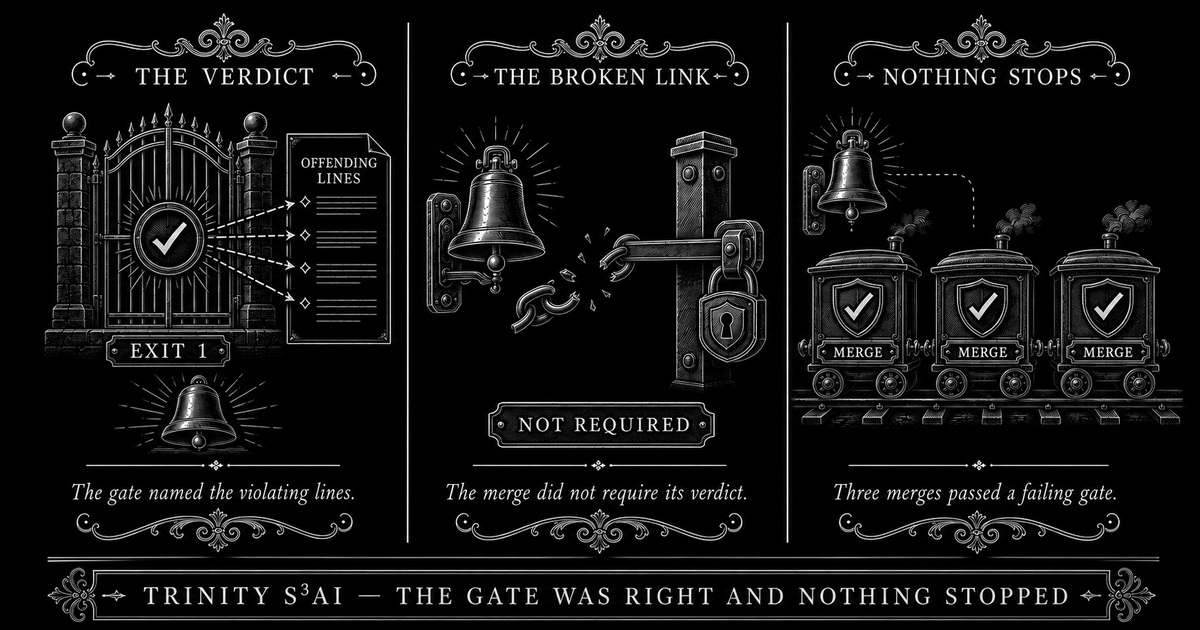
Three panels, left to right - THE VERDICTThe gate named the violating lines.
- THE BROKEN LINKThe merge did not require its verdict.
- NOTHING STOPSThree merges passed a failing gate.
The gate was right and nothing stopped
A gate that guards against retracted numbers re-entering live documents caught a violation on the pull request that introduced it — right file, right lines, exit 1 — and the pull request merged anyway, because it is not a required check. It stayed red on main through two more merges. This is the third variant of a reach failure: not ‘it never runs’, not ‘it runs on the wrong diff’, but ‘it runs, it fails, it names the exact lines, and nothing waits for the answer’.
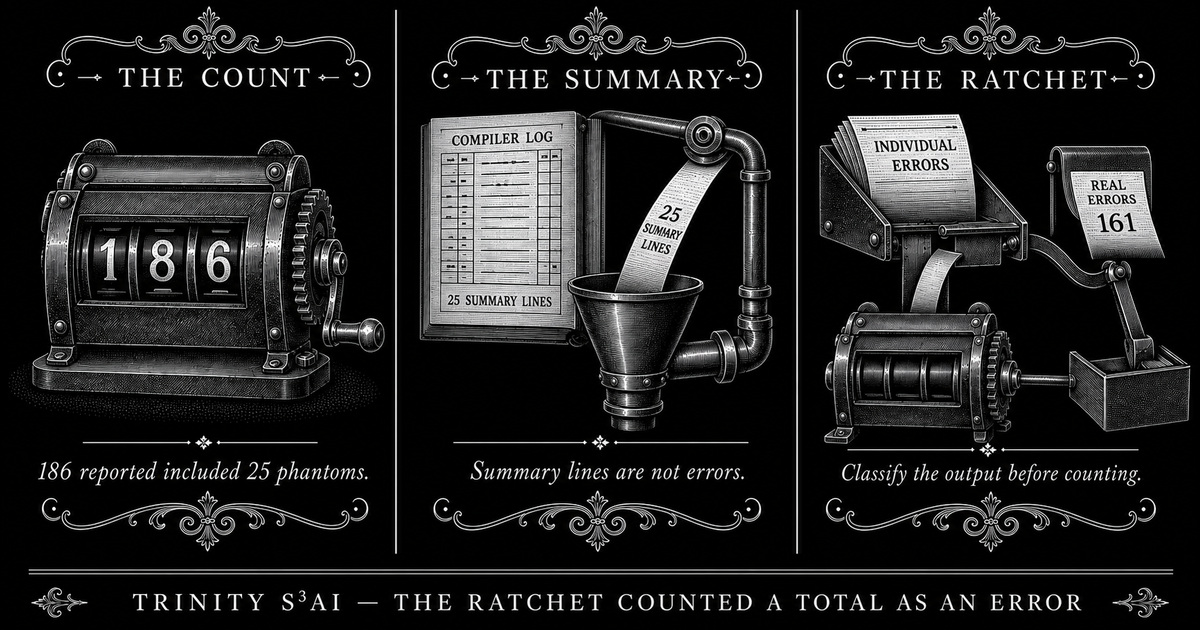
Three panels, left to right - THE COUNT186 reported included 25 phantoms.
- THE SUMMARYSummary lines are not errors.
- THE RATCHETClassify the output before counting.
The ratchet counted a total as an error
A gate written to stop elaboration errors creeping back reported 186 of them; 25 were the compiler's own summary line saying how many errors it had found. The number had already reached commit messages and a status page. This is the proof that could not have come out any other way, the live emitter defect that was hiding inside the count, why fixing it made the number worse, and one fix that was built, measured, and thrown away.
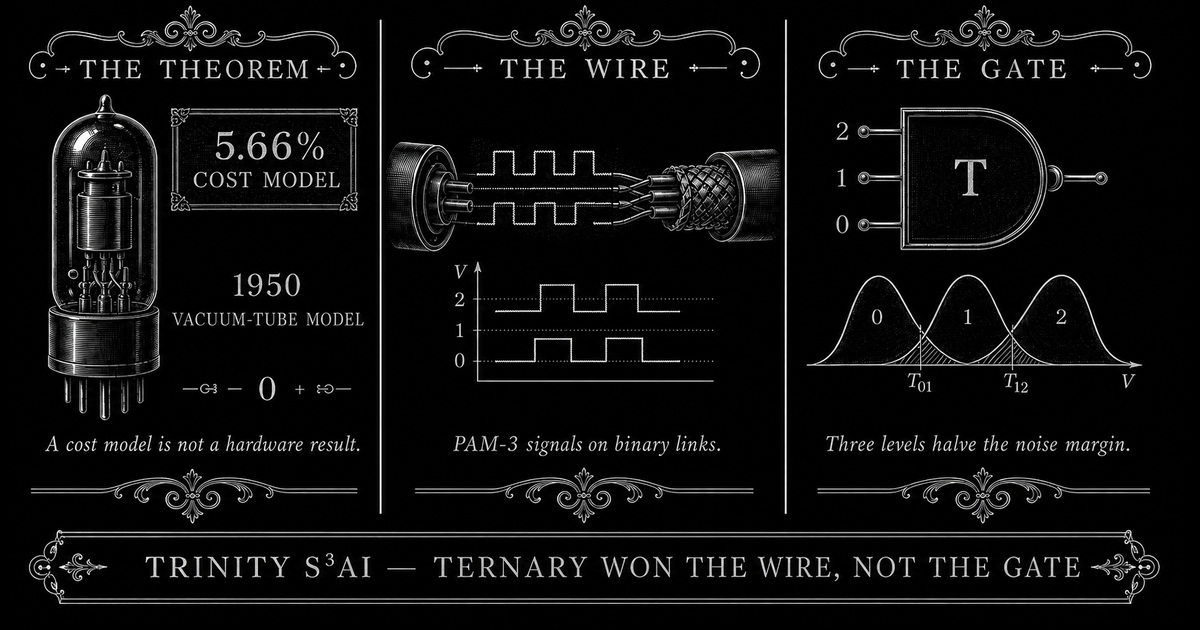
Three panels, left to right - THE THEOREMA cost model is not a hardware result.
- THE WIREPAM-3 signals on binary links.
- THE GATEThree levels halve the noise margin.
Ternary won the wire; it did not win the gate
Base economy is a theorem, not a measurement: 5.66 percent in a 1950 vacuum-tube cost model, a win on the wire in USB4 v2 and GDDR7, and a loss at the gate on noise margin.
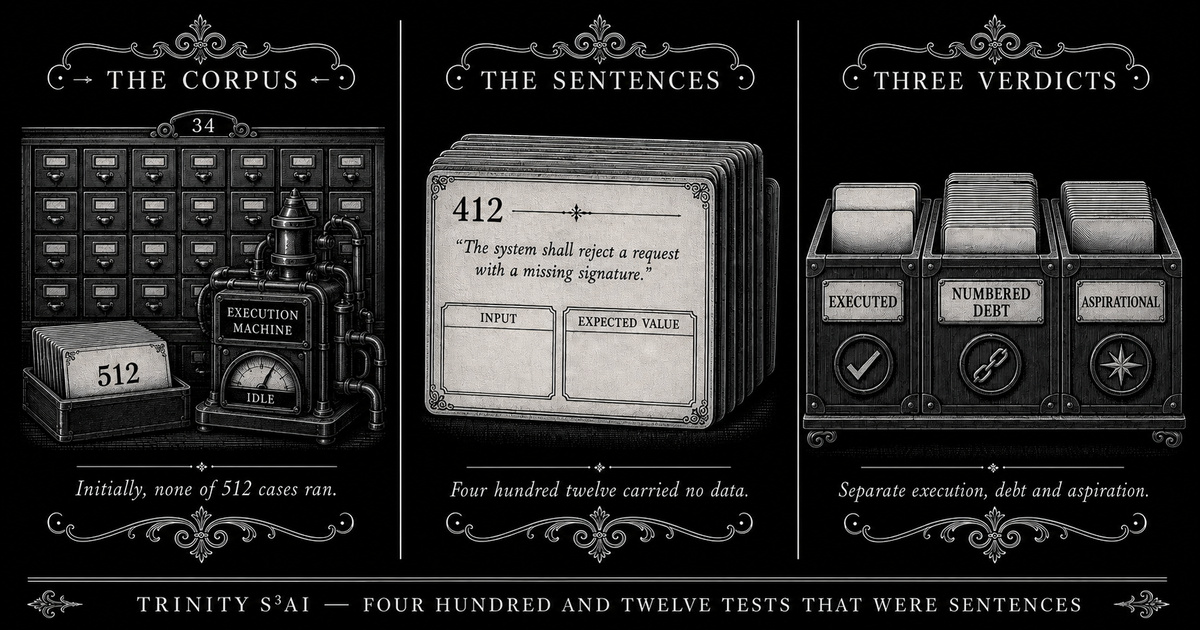
Three panels, left to right - THE CORPUSInitially, none of 512 cases ran.
- THE SENTENCESFour hundred twelve carried no data.
- THREE VERDICTSSeparate execution, debt and aspiration.
Four hundred and twelve tests that were sentences
Thirty-four conformance vector files, 512 cases, zero ever executed — and when counted, 412 of those cases carried no inputs and no expected values at all. This is how a corpus becomes decorative, why the first classifier reported 147 where an independent pass said 100, and the three-verdict registry (executed / numbered debt / aspirational) that lets a small true number replace a large false one.
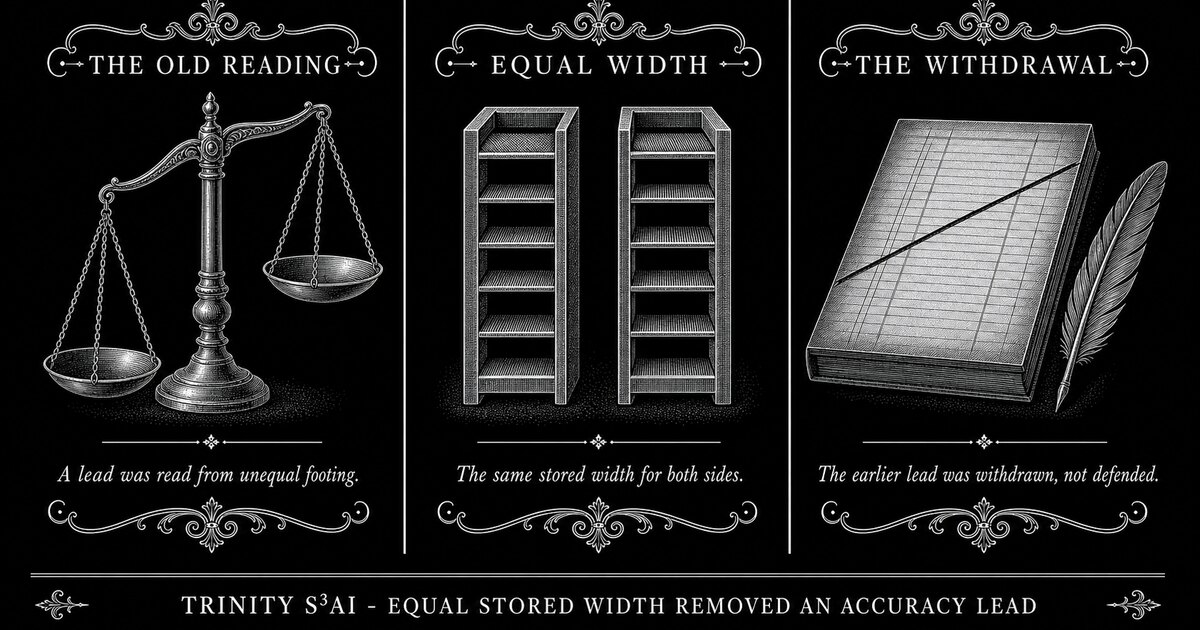
Three panels, left to right - THE OLD READINGA lead was read from unequal footing.
- EQUAL WIDTHThe same stored width for both sides.
- THE WITHDRAWALThe earlier lead was withdrawn, not defended.
Equal stored width removed an accuracy lead
A corrected equal-stored-width remeasurement withdrew an earlier 2.1×/2.6× lead over takum and records the oracle and budget defects that changed the reading.
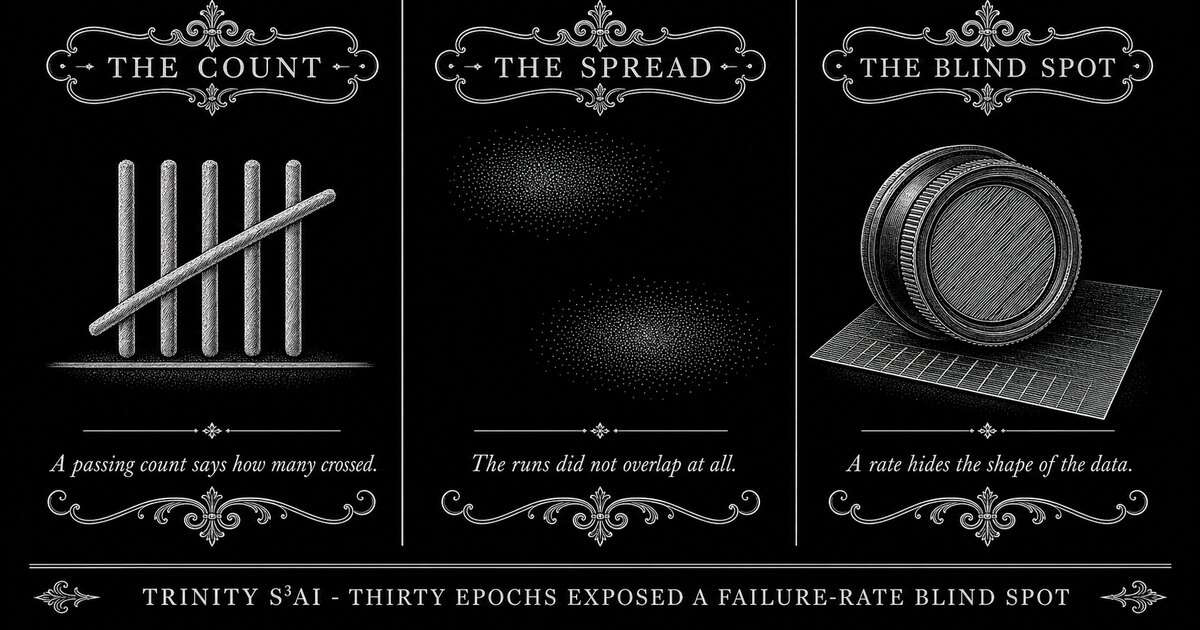
Three panels, left to right - THE COUNTA passing count says how many crossed.
- THE SPREADThe runs did not overlap at all.
- THE BLIND SPOTA rate hides the shape of the data.
Thirty epochs exposed a failure-rate blind spot
A 30-epoch MNIST sweep showed why a failure-rate threshold needs the per-seed values beside it: a passing count can coexist with non-overlapping runs.
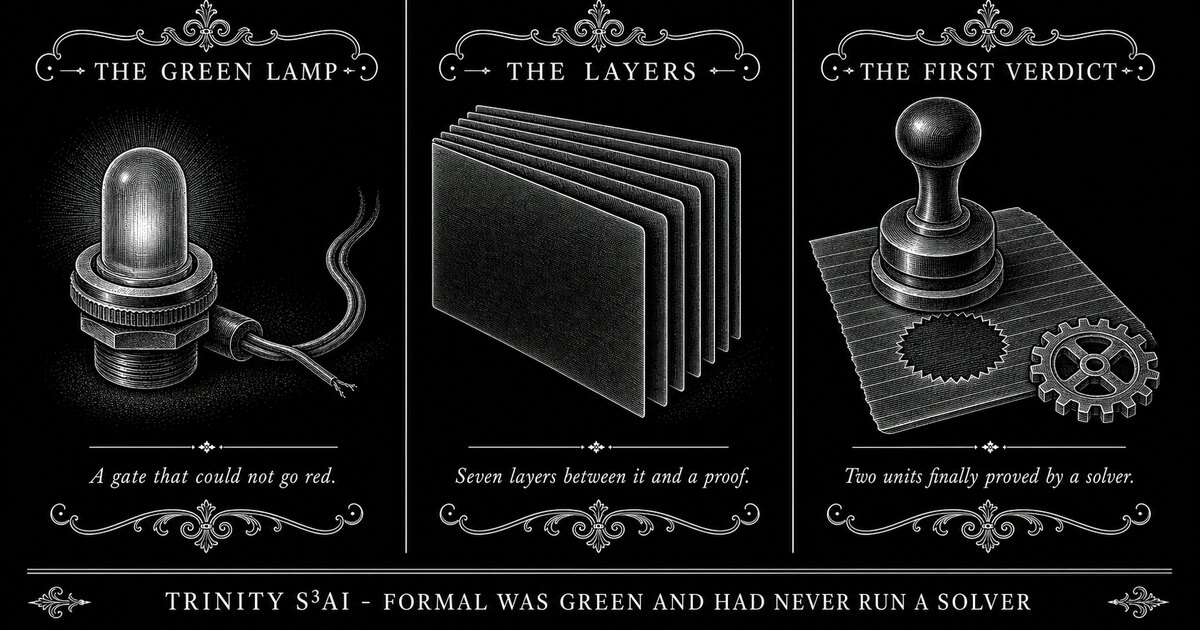
Three panels, left to right - THE GREEN LAMPA gate that could not go red.
- THE LAYERSSeven layers between it and a proof.
- THE FIRST VERDICTTwo units finally proved by a solver.
Formal was green and had never run a solver
A formal verification job stayed green its whole life while three independent mechanisms each guaranteed it could never go red — pseudo-syntax configs, a pipe that tested tee instead of the tool, and continue-on-error over everything. Peeling it to the first genuine proof took seven named layers, including RTL four months older than the compiler under test and property files that never instantiated the DUT. It ends with the repository’s first real formal verdicts: fifo and mac, Status PASSED under z3.
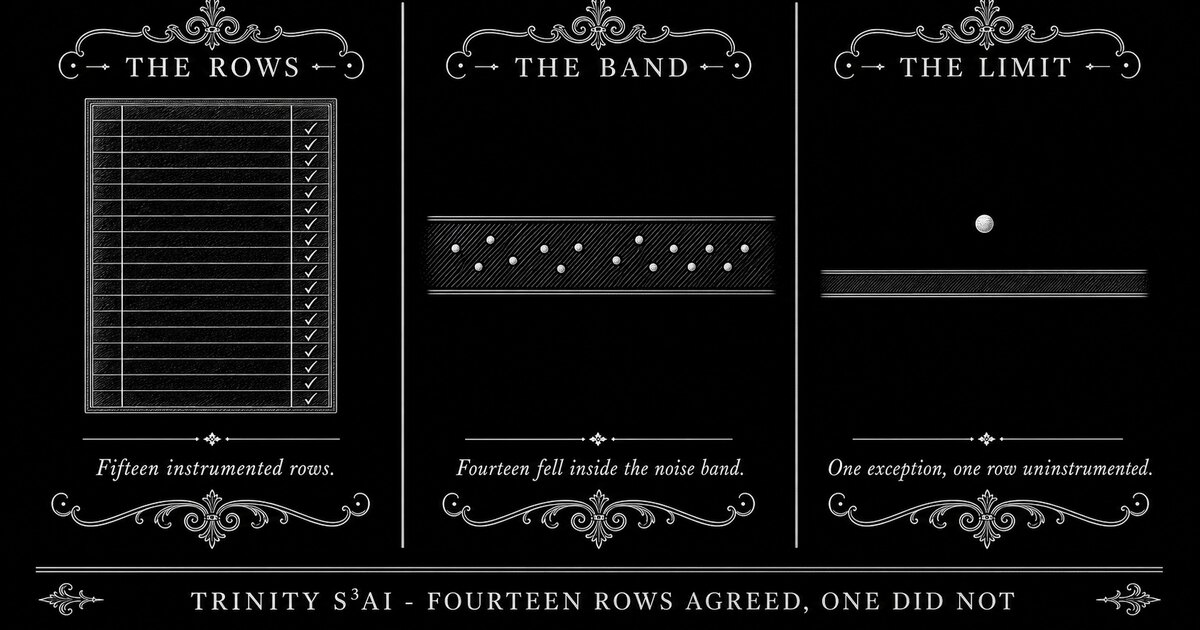
Three panels, left to right - THE ROWSFifteen instrumented rows.
- THE BANDFourteen fell inside the noise band.
- THE LIMITOne exception, one row uninstrumented.
Fourteen rows agreed; one did not
A post-route CI run gives fifteen instrumented FPGA frequency rows a sourced comparison: fourteen fall inside the flow’s measured noise band, while LNS16 remains an explicit exception and one design is still uninstrumented.
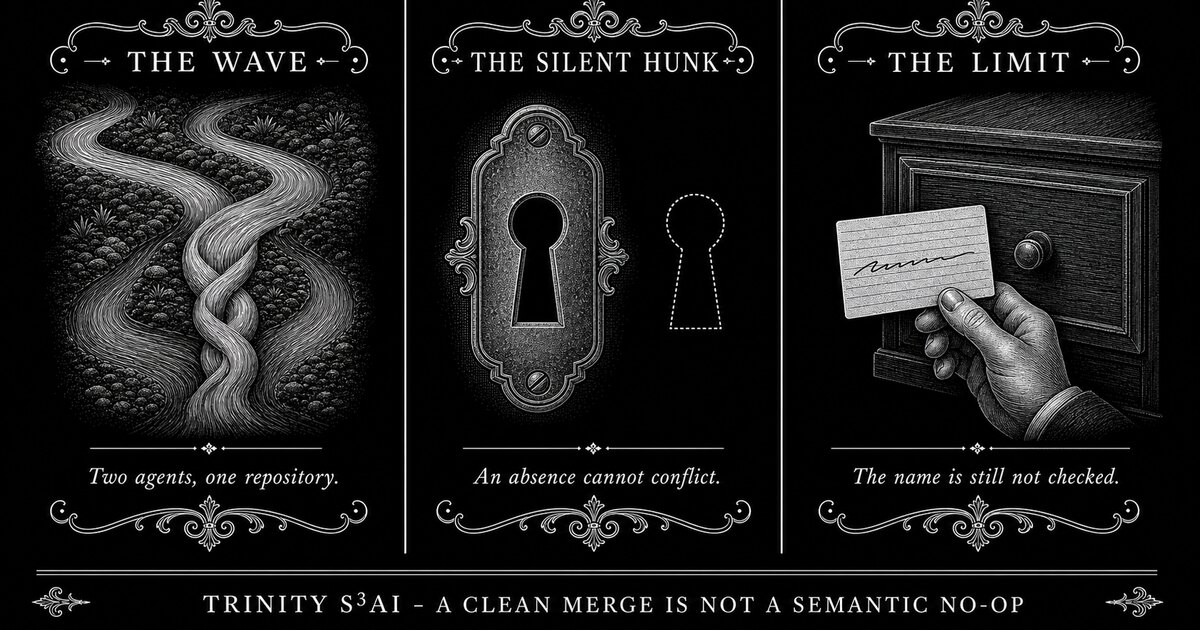
Three panels, left to right - THE WAVETwo agents, one repository.
- THE SILENT HUNKAn absence cannot conflict.
- THE LIMITThe name is still not checked.
A clean merge is not a semantic no-op
Two autonomous agents, one repository, a 643-commit wave merged mid-flight. The four textual conflicts were the safe part — three were comment-only and one was both sides fixing the same bug. The defect that reached master rode in on a hunk that merged cleanly: a device-default flip that a CI workflow relied on as an absence, which cannot conflict. It passed place-and-route on the wrong database and failed at the first step that looks a name up instead of trusting a path.
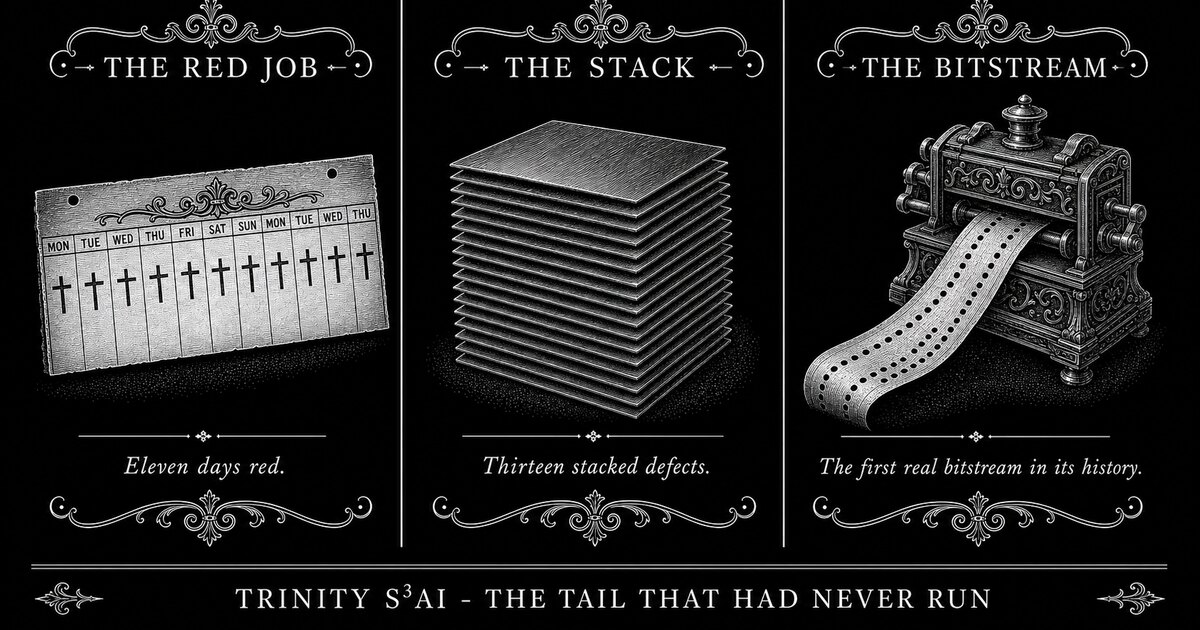
Three panels, left to right - THE RED JOBEleven days red.
- THE STACKThirteen stacked defects.
- THE BITSTREAMThe first real bitstream in its history.
The tail that had never run
A bitstream-generating CI job was red for eleven days. Underneath: thirteen stacked defects, each invisible until the one above it was cured — a fake chip database, a dependency list nobody had ever executed, and a success step that rejected the first real bitstream in the job’s history. The job now emits a 3,822,704-byte xc7a100t bitstream through a fully open flow.
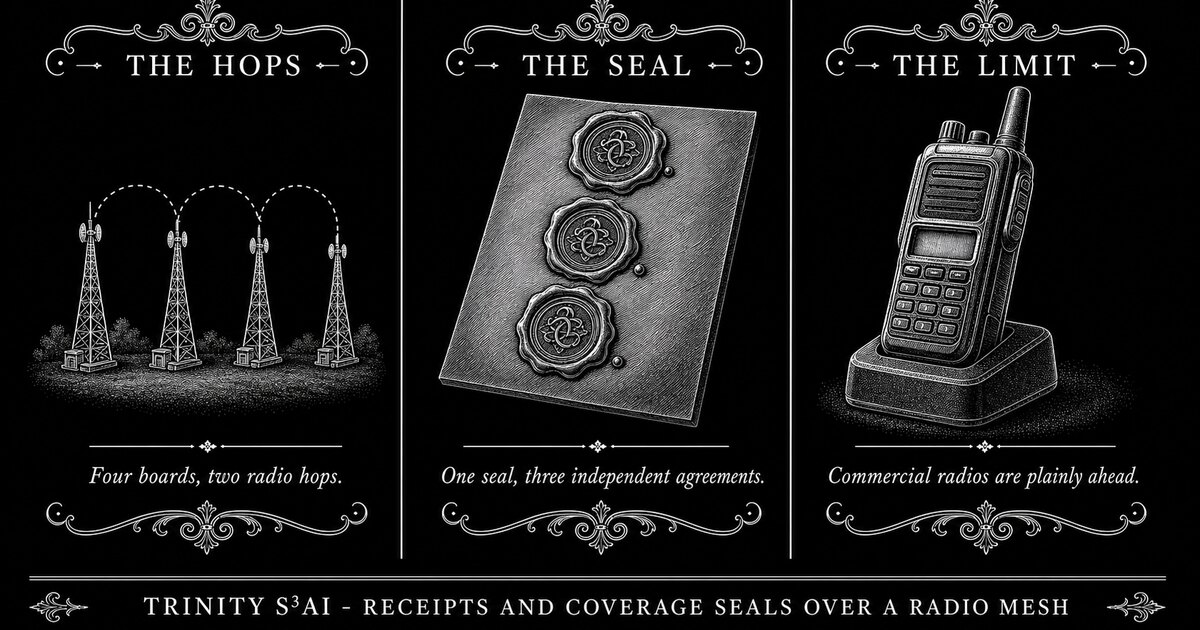
Three panels, left to right - THE HOPSFour boards, two radio hops.
- THE SEALOne seal, three independent agreements.
- THE LIMITCommercial radios are plainly ahead.
Receipts and coverage seals over a radio mesh
Bytes crossed two radio hops between four boards and arrived byte-exact, with one coverage seal recomputed independently at three points and agreeing at all three. What that proves, what it does not, what the thing is built on, and where the commercial radios are plainly ahead.
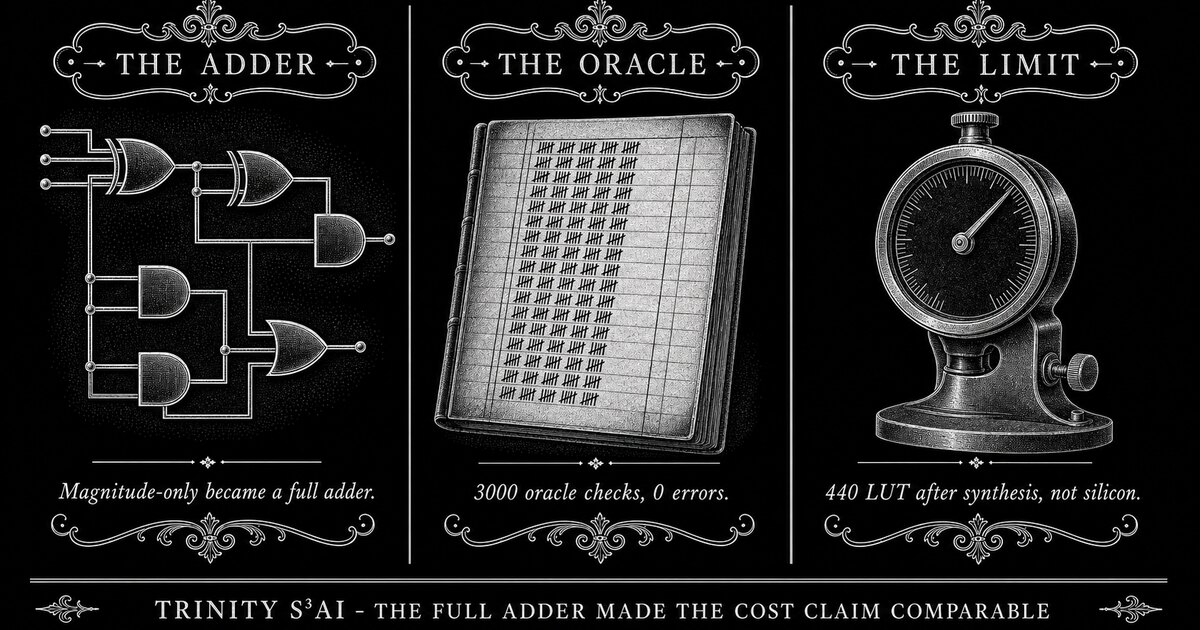
Three panels, left to right - THE ADDERMagnitude-only became a full adder.
- THE ORACLE3000 oracle checks, 0 errors.
- THE LIMIT440 LUT after synthesis, not silicon.
The full adder made the cost claim comparable
A merged FPGA-repository PR replaces a magnitude-only comparison with a full adder and reports 3000 oracle checks, 0 errors, and a 440-LUT post-synthesis result.

Three panels, left to right - THE ALPHABETA two-bit balanced alphabet.
- THE FACTORA dot product is a scale factor apart.
- THE PRIOR ARTSomeone put it there first, in 2002.
The golden ratio in this format is a scale factor, not information
A format with phi in its name. Measured: in the two-bit digit alphabet phi is not observable at all, and a dot product of GFTernary vectors is exactly phi-squared times the same codes read as balanced ternary. The prior art put phi where it does carry information — in 2002.
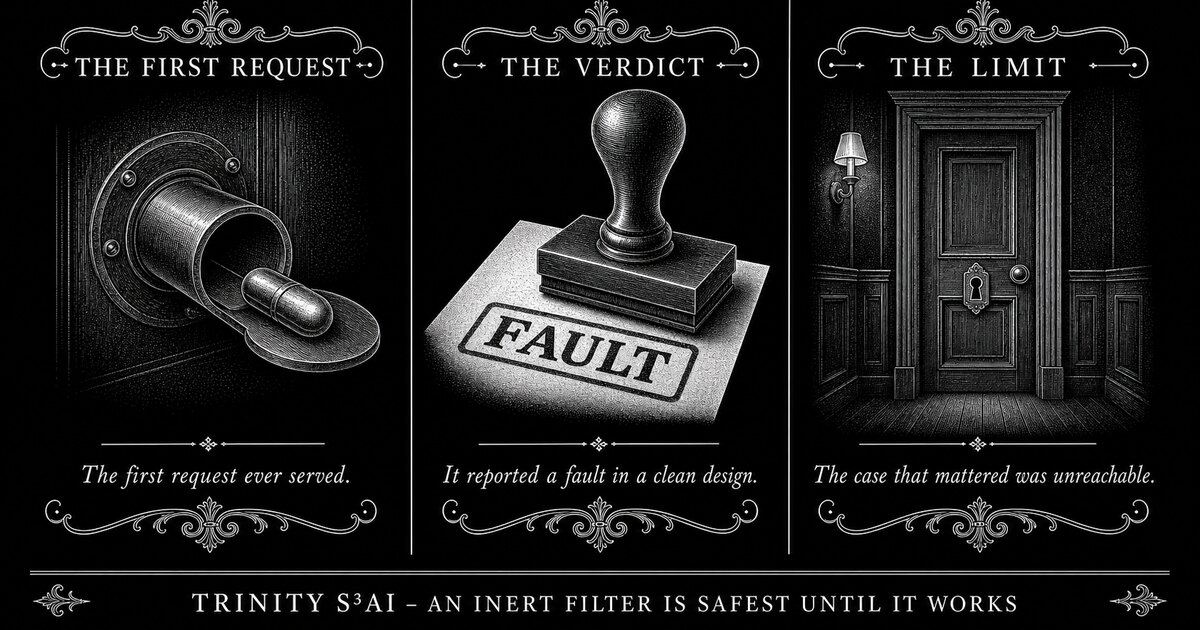
Three panels, left to right - THE FIRST REQUESTThe first request ever served.
- THE VERDICTIt reported a fault in a clean design.
- THE LIMITThe case that mattered was unreachable.
An inert filter is safest until it works
The first request this service ever served came back telling a clean design it had a silicon bug. Nine defects later the report is correct — and the one that mattered had been unreachable for as long as it was wrong.
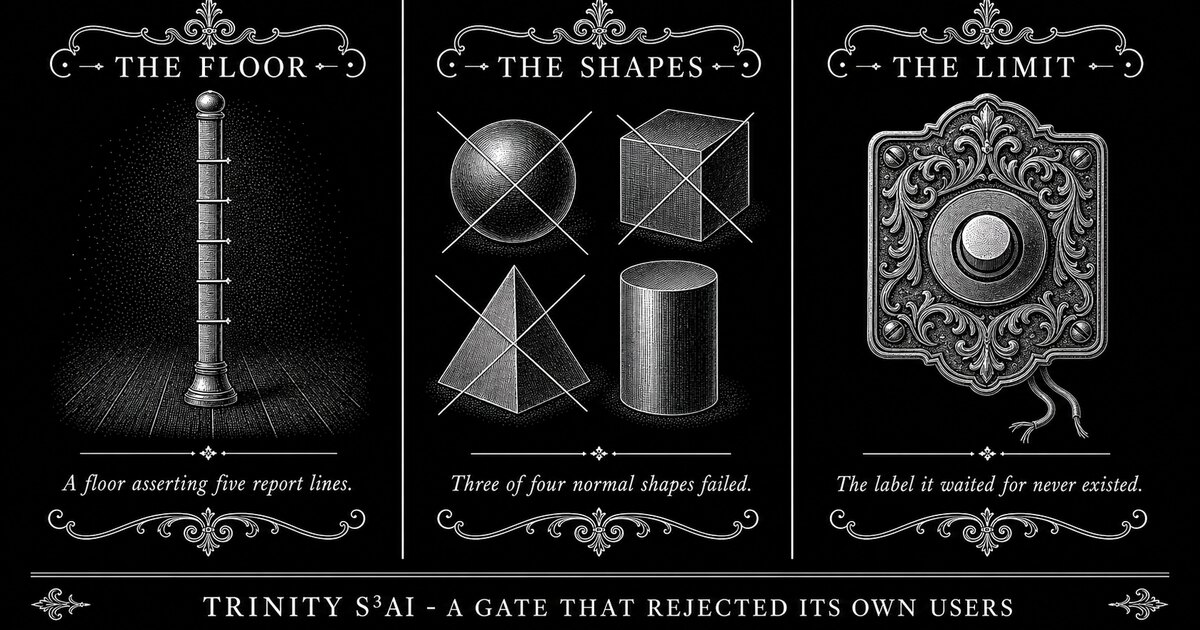
Three panels, left to right - THE FLOORA floor asserting five report lines.
- THE SHAPESThree of four normal shapes failed.
- THE LIMITThe label it waited for never existed.
A gate that rejected its own users
A floor I added asserted five report lines and failed three of the four normal design shapes; a workflow gated on a label that did not exist, so every "Start a run" button led nowhere. Both were correct about what they required and silent about whether it could be met.
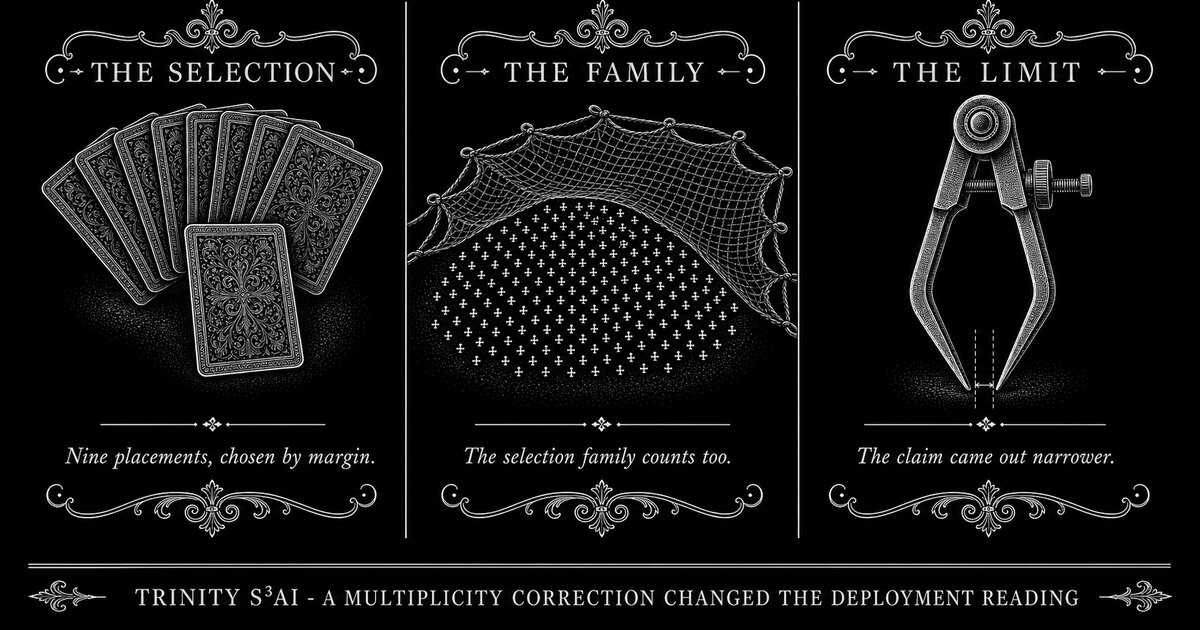
Three panels, left to right - THE SELECTIONNine placements, chosen by margin.
- THE FAMILYThe selection family counts too.
- THE LIMITThe claim came out narrower.
A multiplicity correction changed the deployment reading
A merged research note shows how a nine-placement selection by mean margin becomes a narrower claim after the selection family is included in the correction.
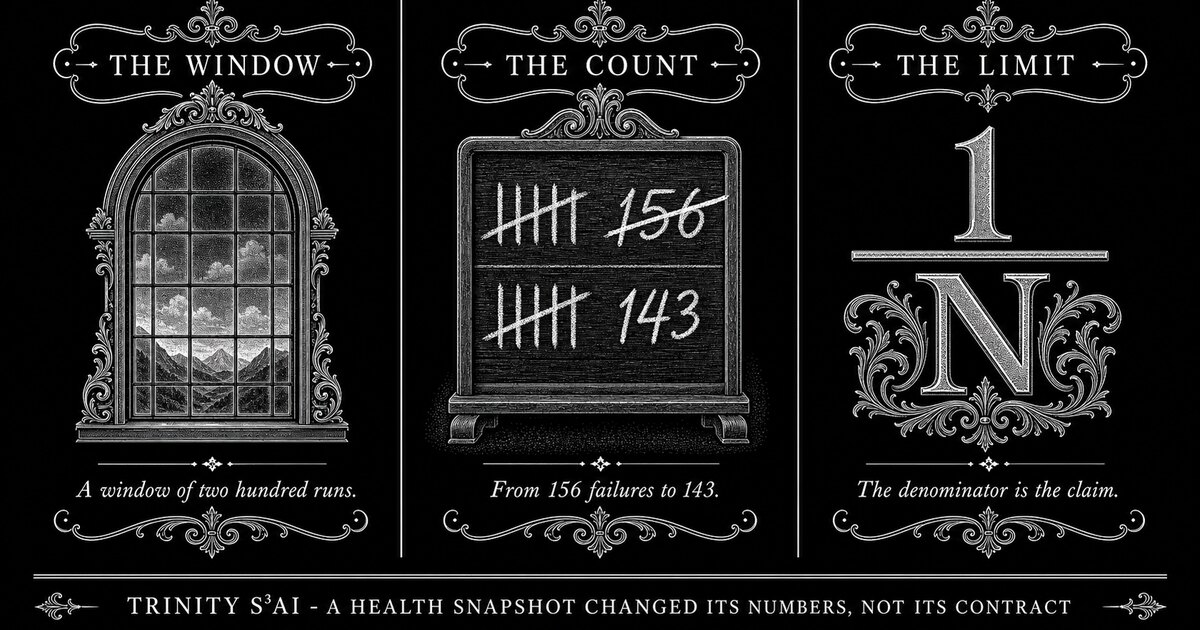
Three panels, left to right - THE WINDOWA window of two hundred runs.
- THE COUNTFrom 156 failures to 143.
- THE LIMITThe denominator is the claim.
A health snapshot changed its numbers, not its contract
A fresh repository commit updates the CI health snapshot from 156 to 143 failures in a 200-run window and records the denominator and exclusions that give those numbers meaning.
Three panels, left to right - THE VERDICTTwelve disagreements read as fixed.
- THE ABSENCEThe checkout never happened.
- THE LIMITTwo failures were plain plumbing.
A red gate was missing its input
A merged FPGA-repository audit shows how a missing checkout turned twelve unchecked disagreements into apparent fixes, while two other failures were ordinary runner plumbing.
Three panels, left to right - THE SIGNALEight gates reported failure.
- THE CAUSEA flag, a path, a missing link.
- THE LIMITA real defect looks the same.
Eight broken gates in one day, and not one of them was broken code
A flag, a version, a runner, a module, a script, three specs, two format paths, five submodule links and a step that ran what it claimed to build. Every one reported "failure", which is also what a real defect reports.
Three panels, left to right - THE INSTALLThe tool could not be installed.
- THE NESTINGEach cause hid the next.
- THE LIMITRemoving the fourth created the fifth.
Five reasons the build was red, and the fifth was mine
Our CLI could not be installed by anyone, and the CI that should have said so had zero successes in thirty runs. Each cause hid the next; removing the fourth created the fifth.
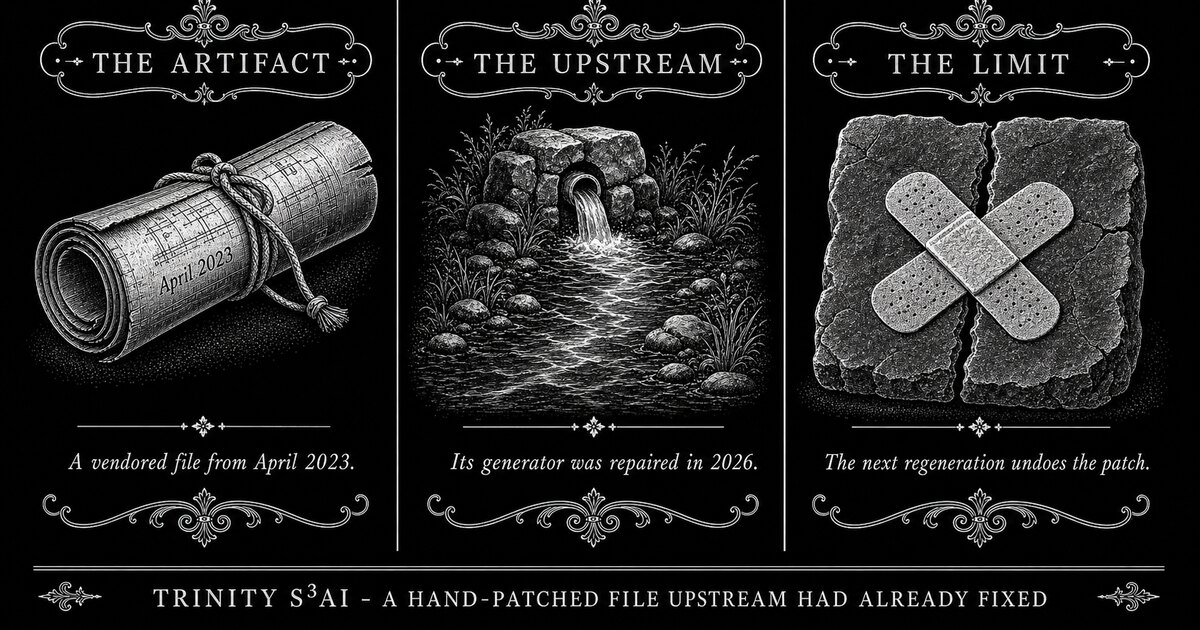
Three panels, left to right - THE ARTIFACTA vendored file from April 2023.
- THE UPSTREAMIts generator was repaired in 2026.
- THE LIMITThe next regeneration undoes the patch.
We hand-patched a generated file that upstream had fixed five months earlier
A vendored Verilog artifact from April 2023 carried a defect its generator repaired in March 2026. The hand fix is correct and temporary; the next regeneration would undo it.
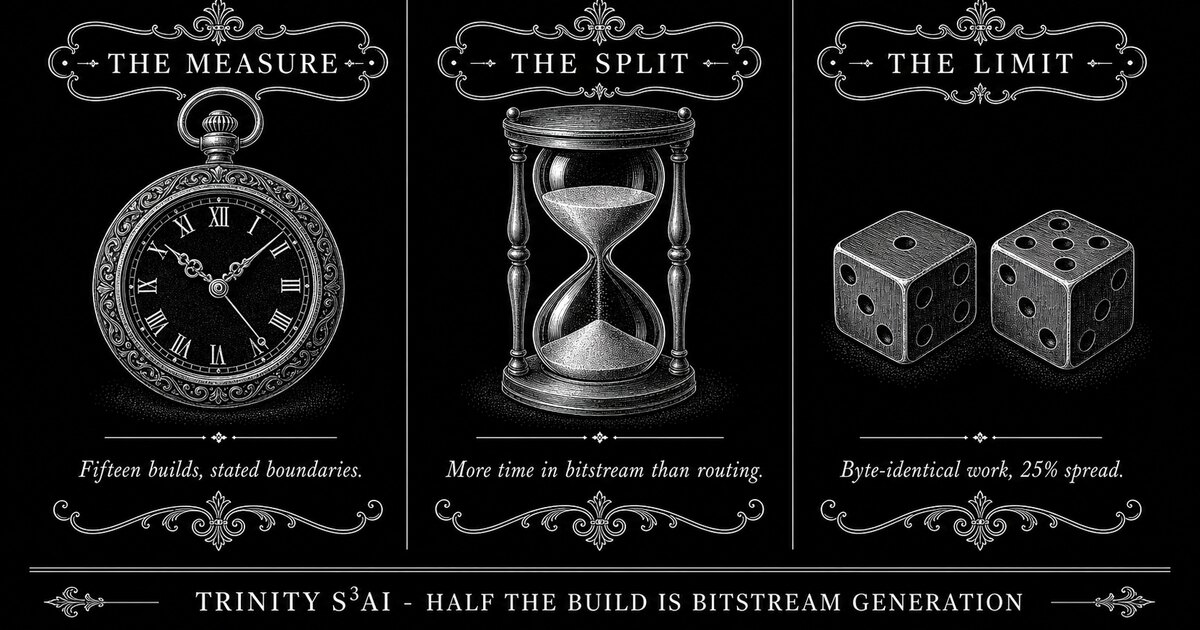
Three panels, left to right - THE MEASUREFifteen builds, stated boundaries.
- THE SPLITMore time in bitstream than routing.
- THE LIMITByte-identical work, 25% spread.
Half the build is bitstream generation, and the trivial design was the slow one
Fifteen openXC7 builds with stated boundaries: for small designs more time goes to turning FASM into a bitstream than to place-and-route, a blinky beaten by a GF multiplier, and 25% spread on byte-identical work.
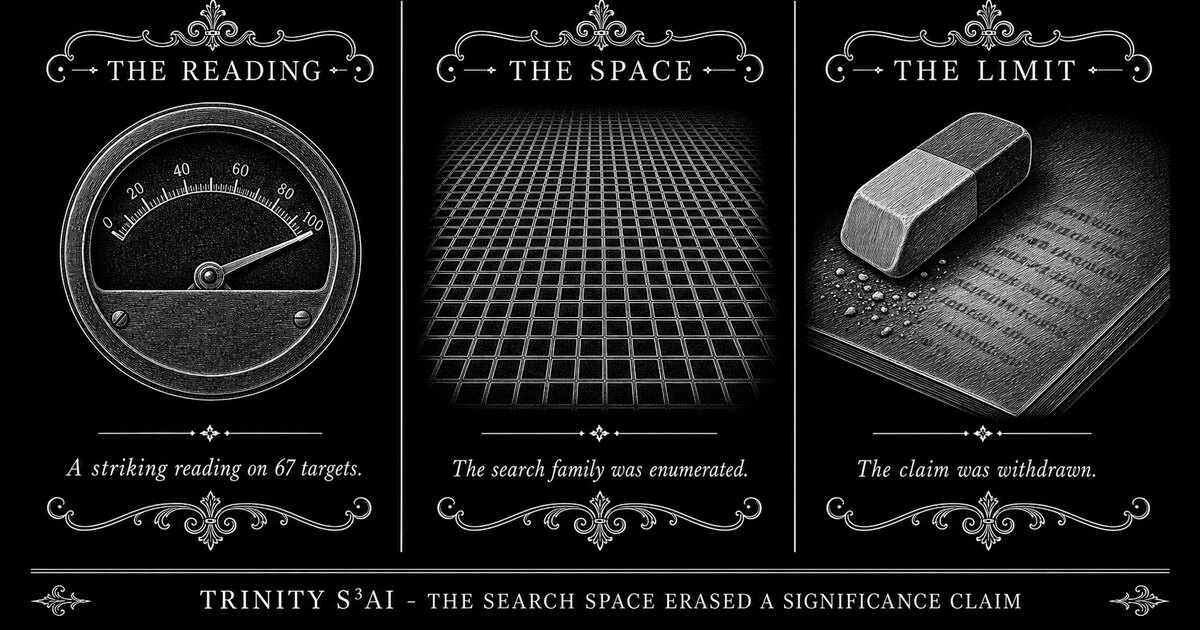
Three panels, left to right - THE READINGA striking reading on 67 targets.
- THE SPACEThe search family was enumerated.
- THE LIMITThe claim was withdrawn.
The search space erased a significance claim
A merged audit of 67 targets withdraws a roughly 10-sigma reading after enumerating the search family that made near-matches likely by chance.
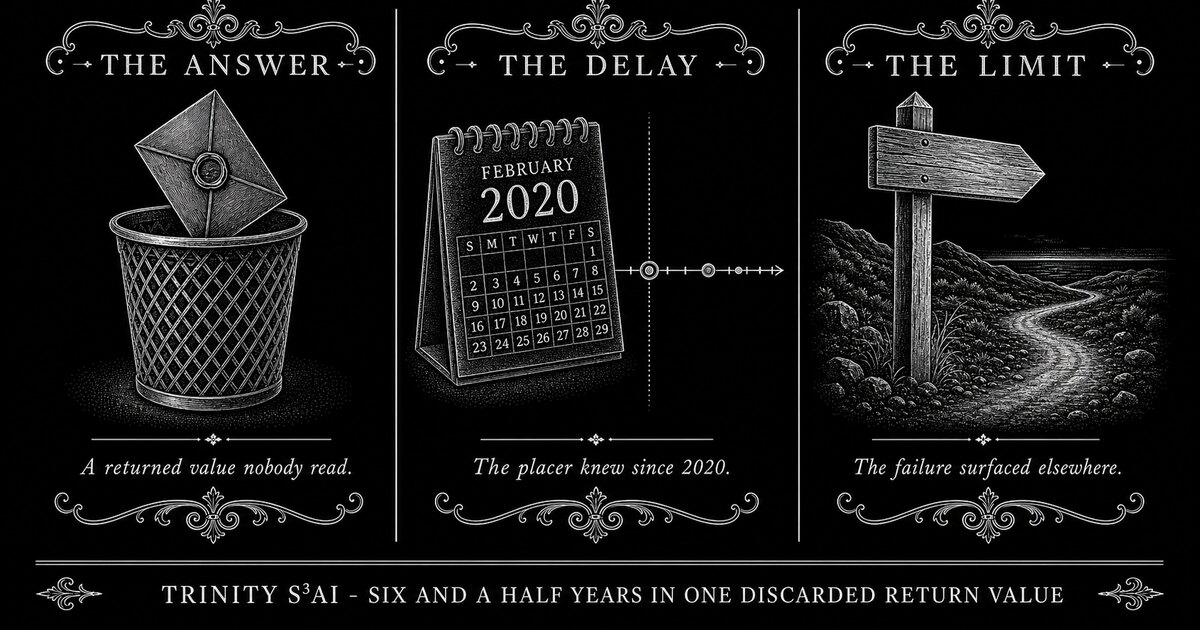
Three panels, left to right - THE ANSWERA returned value nobody read.
- THE DELAYThe placer knew since 2020.
- THE LIMITThe failure surfaced elsewhere.
Six and a half years in one discarded return value
Four merged fixes turned the openXC7 demo CI green. The oldest was a bool nobody read: since February 2020 the placer knew its own placement was invalid and threw the answer away, so the failure surfaced in the router instead.
Three panels, left to right - THE GATETwelve runs, every verdict right.
- THE QUEUESix merges, sixteen hours unseen.
- THE LIMITCorrect is not the same as served.
A correct gate with a manual remedy is an outage
Twelve consecutive publisher runs failed on a check that was right every time, and six merged pull requests spent sixteen hours invisible to readers.
Three panels, left to right - THE POOLOne hundred and forty pooled windows.
- THE REPLICATEFour model-level replicates.
- THE LIMITEleven verdicts became ties.
Eleven verdicts were windows, not checkpoints
A merged research correction replaces 140 pooled windows with four model-level replicates and turns eleven apparent verdicts into ties.
Three panels, left to right - THE LOOPSSeven loops hid empty ticks.
- THE SILENCENo line did not mean stopped.
- ZERO BITSA constant reveals no state.
A background loop broke for months, and no amount of watching could have caught it
Seven timed loops logged nothing on an empty tick. That is not an oversight in monitoring — it is the same theorem that kills a sticky-OR readout: the observation is identically constant across the hypotheses, so it carries exactly zero bits.
Three panels, left to right - THE NOTESSix open was a dated claim.
- THE QUERYThe query found twenty merges.
- THE UPSTREAMThree days, not measured impact.
Twenty patches merged upstream in three days
On 2026-08-09 my own notes said six patches were open and none had been merged. By 2026-08-11 openXC7 had merged twenty. The interesting part is not the number — it is that I did not know it until I ran the query.
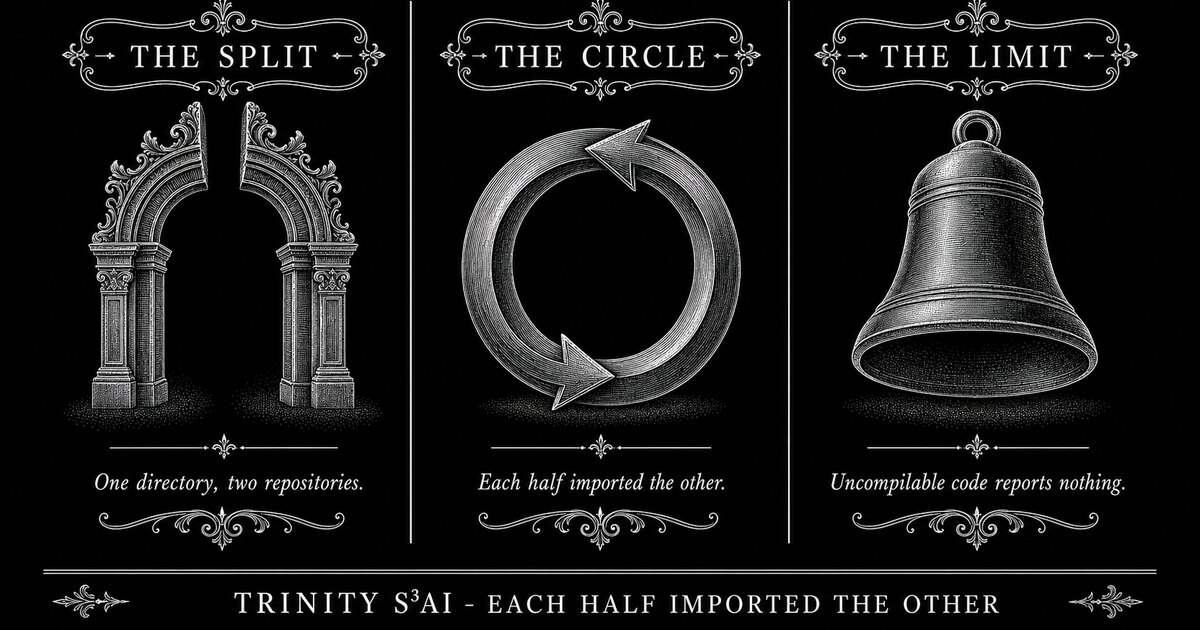
Three panels, left to right - THE SPLITOne directory, two repositories.
- THE CIRCLEEach half imported the other.
- THE LIMITUncompilable code reports nothing.
Each half imported the other
One directory was split across two repositories and both kept flat imports of the other. Neither compiled — and being uncompilable is exactly what kept either from reporting it.
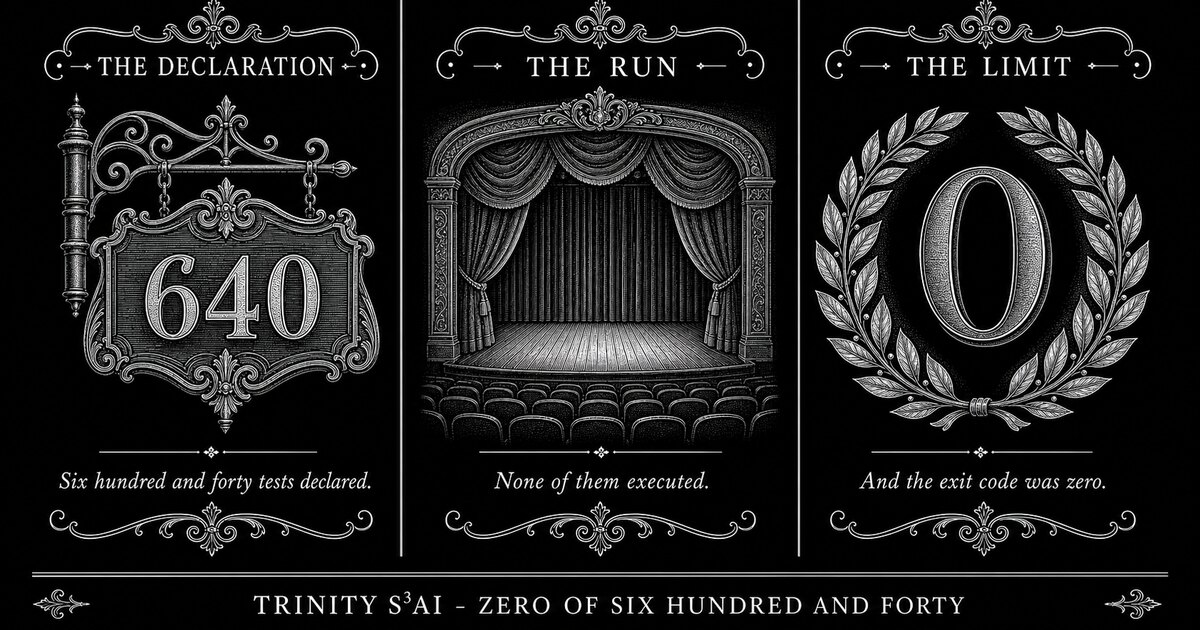
Three panels, left to right - THE DECLARATIONSix hundred and forty tests declared.
- THE RUNNone of them executed.
- THE LIMITAnd the exit code was zero.
Zero of six hundred and forty
A package declared 640 tests and ran none of them, and the exit code was 0. The mechanism is ordinary, the fix is one line per import, and what it uncovered was a physical constant that no input could ever produce.
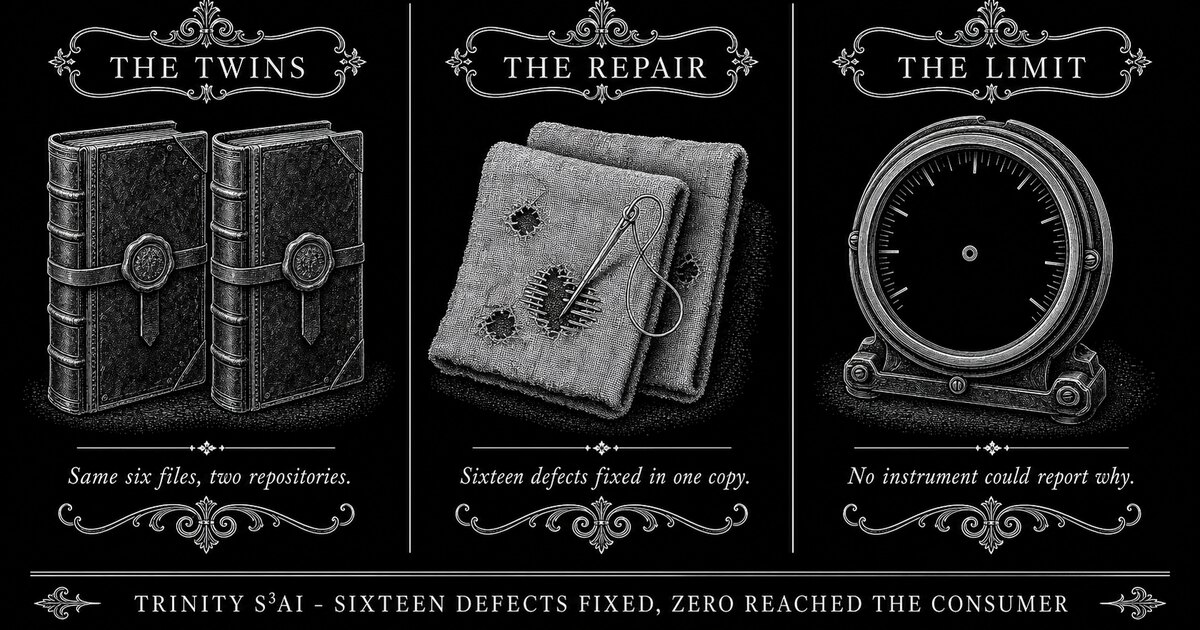
Three panels, left to right - THE TWINSSame six files, two repositories.
- THE REPAIRSixteen defects fixed in one copy.
- THE LIMITNo instrument could report why.
Sixteen defects fixed, zero of them reached the consumer
Two repositories carried the same six files under the same names. Repairing one changed nothing downstream, and no instrument in either could report why — because each copy compiles entirely on its own.
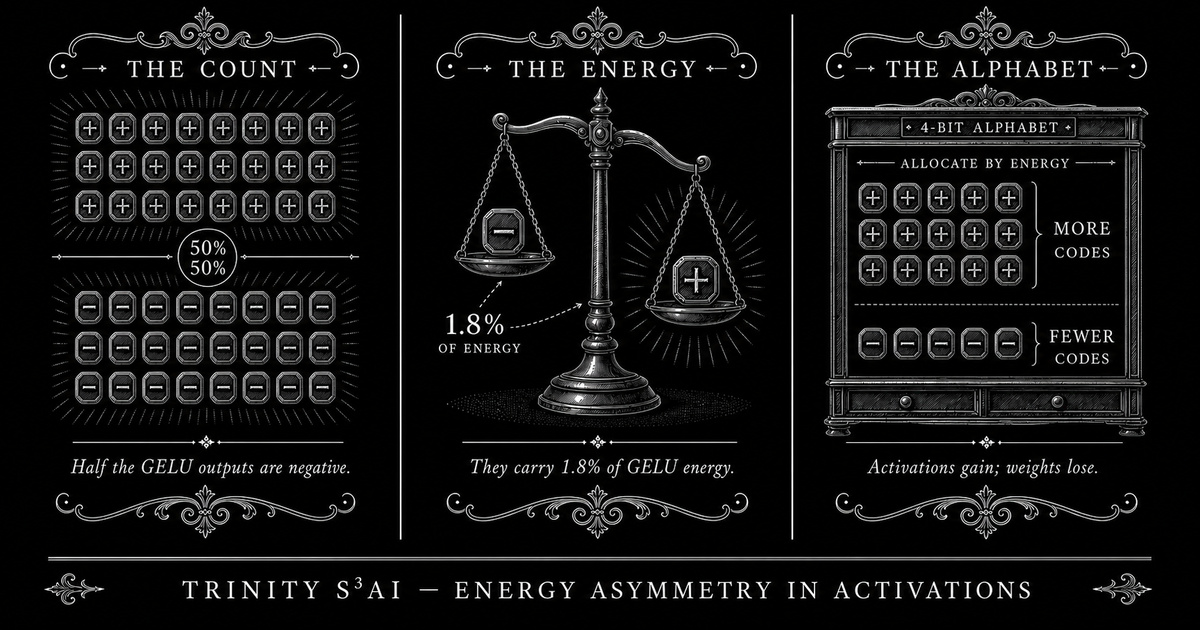
Three panels, left to right - THE COUNTHalf the GELU outputs are negative.
- THE ENERGYThey carry 1.8% of GELU energy.
- THE ALPHABETActivations gain; weights lose.
Half of your activations are negative. They carry 1.8% of the energy
Post-activation tensors are half negative by count and 1.8–6.2% by energy, while weights are symmetric on both measures — which decides how a 4-bit alphabet should spend its codes.
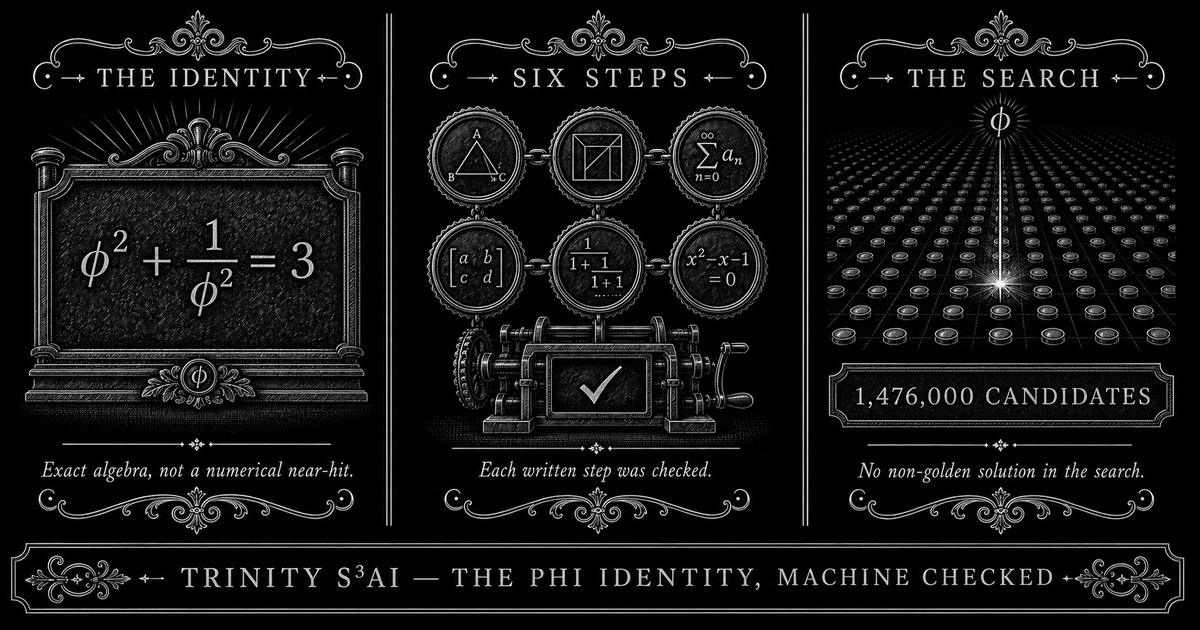
Three panels, left to right - THE IDENTITYExact algebra, not a numerical near-hit.
- SIX STEPSEach written step was checked.
- THE SEARCHNo non-golden solution in the search.
phi^2 + 1/phi^2 = 3, checked every way I could think of
An exact identity, six proof steps machine-verified, and a search over 1,476,000 candidates that found no other root — plus what the identity does not license.
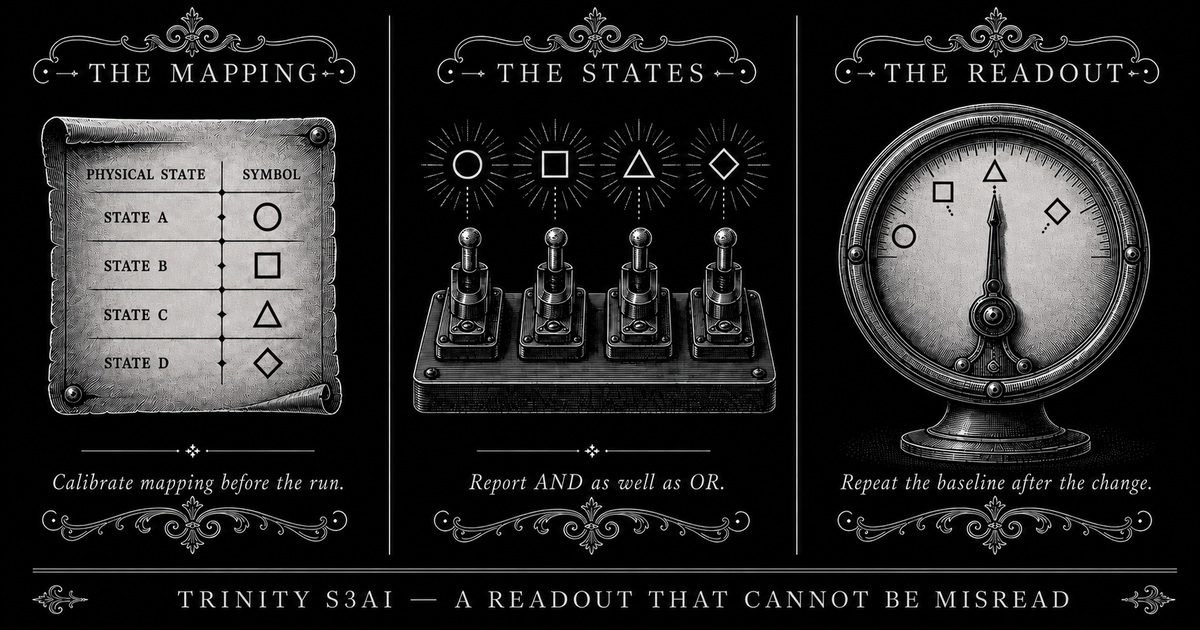
Three panels, left to right - THE MAPPINGCalibrate mapping before the run.
- THE STATESReport AND as well as OR.
- THE READOUTRepeat the baseline after the change.
Four rules for a measurement rig whose readout cannot be misread
A readout whose mapping to state is unestablished is not an instrument — four rules written after a week of hardware debugging where the rig lied and the design was fine.
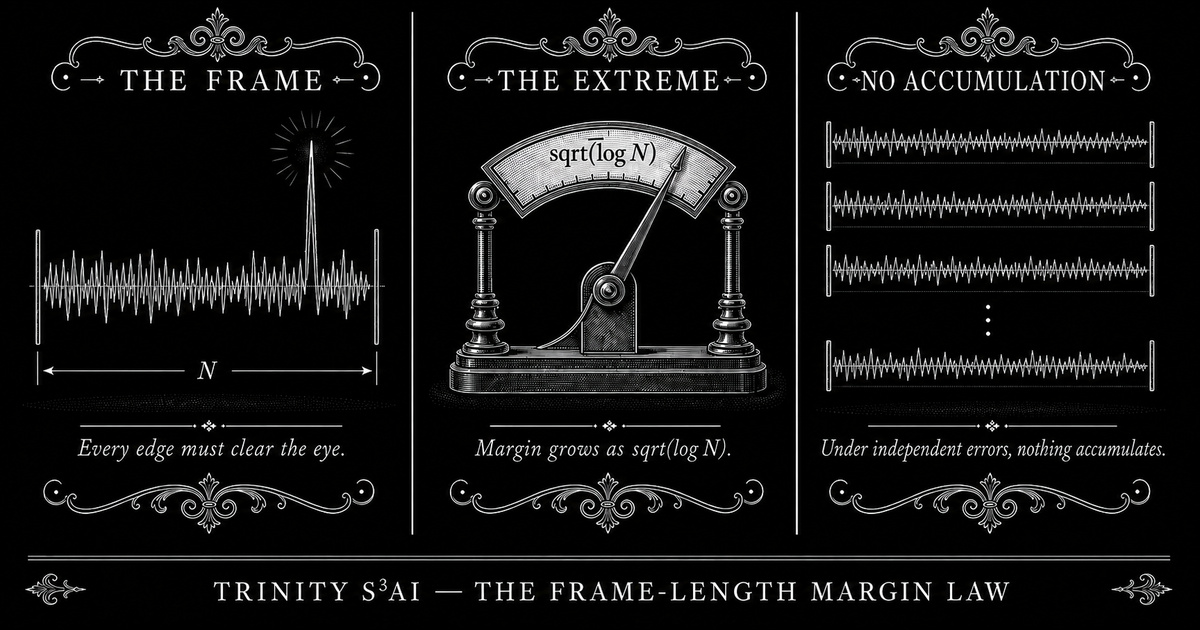
Three panels, left to right - THE FRAMEEvery edge must clear the eye.
- THE EXTREMEMargin grows as sqrt(log N).
- NO ACCUMULATIONUnder independent errors, nothing accumulates.
Timing margin grows as the square root of a logarithm, and nothing accumulates
A frame-length margin law derived from extreme-value statistics, and the accumulation story it refutes — which would predict a 12.9x eye violation on frames that pass.
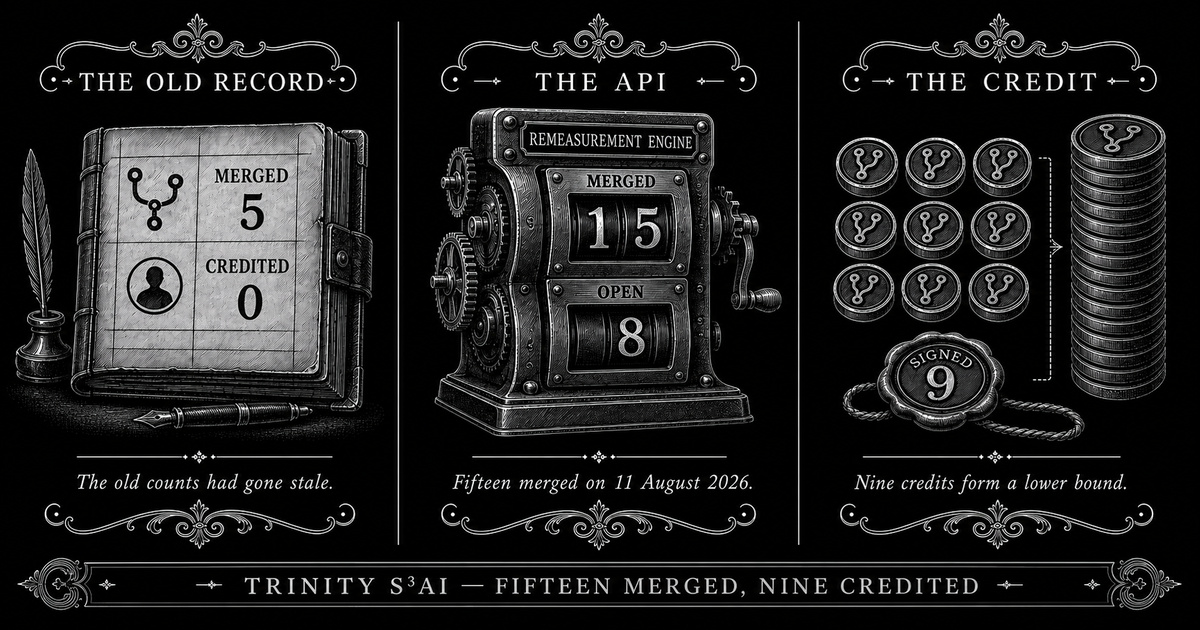
Three panels, left to right - THE OLD RECORDThe old counts had gone stale.
- THE APIFifteen merged on 11 August 2026.
- THE CREDITNine credits form a lower bound.
Fifteen merged, nine credited: what upstream contribution actually looks like
I had written down five merged PRs and zero attributed commits. Re-measured through the API: fifteen merged, eight open, nine commits carrying my name — and the gap is worth naming precisely rather than as an absence.
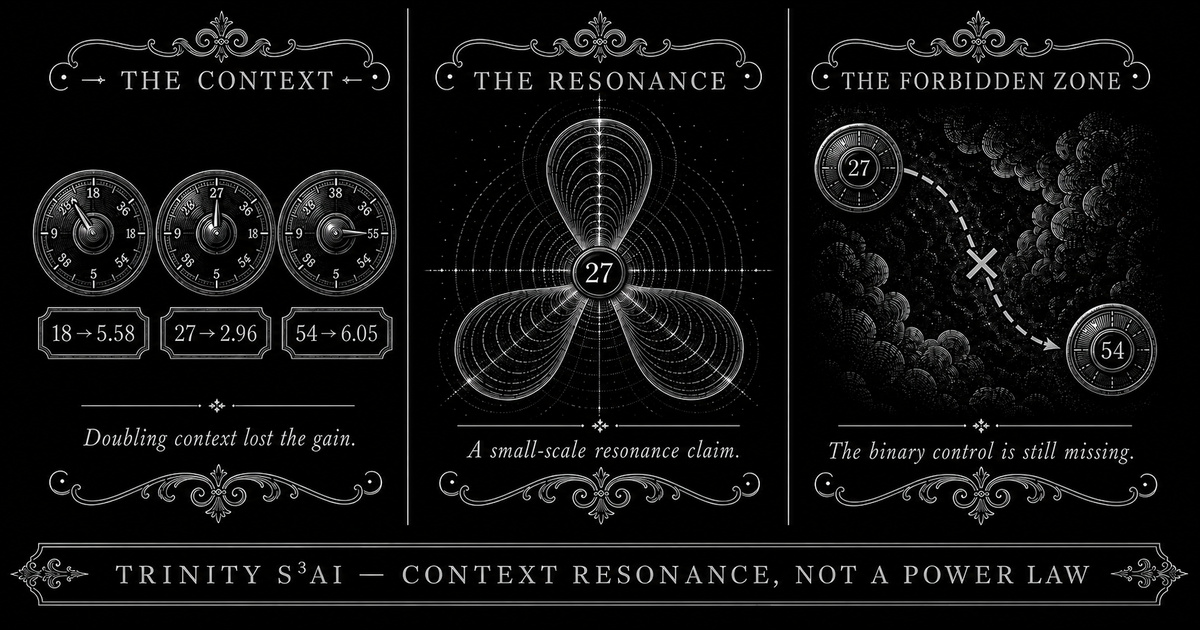
Three panels, left to right - THE CONTEXTDoubling context lost the gain.
- THE RESONANCEA small-scale resonance claim.
- THE FORBIDDEN ZONEThe binary control is still missing.
Doubling the context made it worse: ternary scaling follows a resonance, not a power law
ctx=18 gives PPL 5.58, ctx=27 gives 2.96, ctx=54 gives 6.05 — worse than the baseline. Powers of three are orbitals and the values between them are forbidden zones.
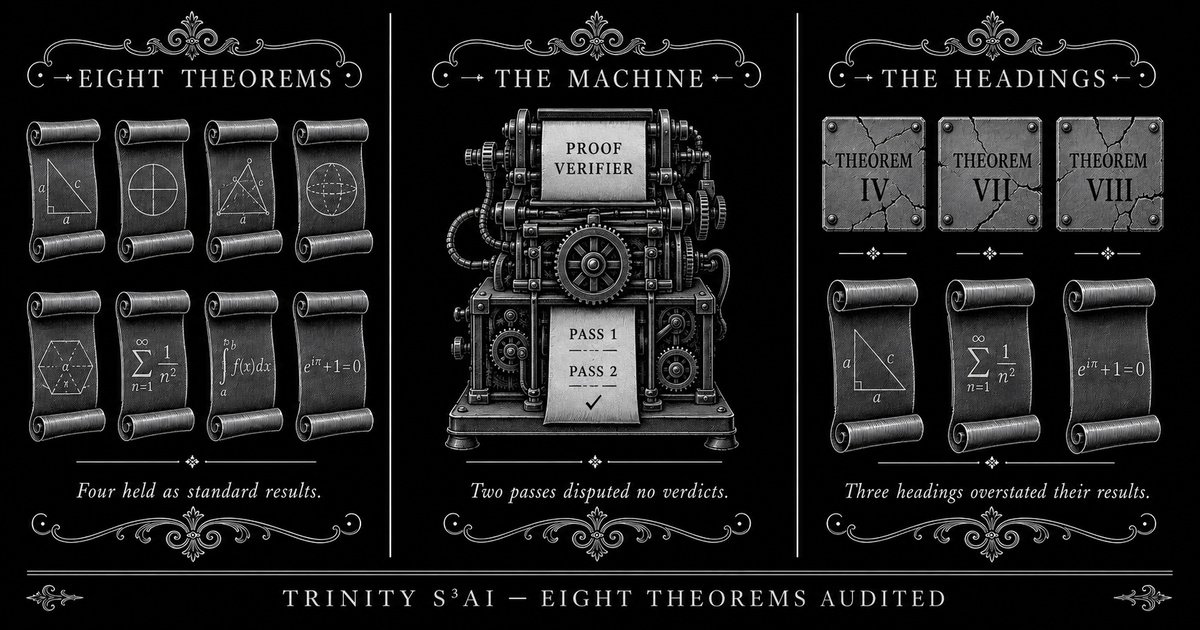
Three panels, left to right - EIGHT THEOREMSFour held as standard results.
- THE MACHINETwo passes disputed no verdicts.
- THE HEADINGSThree headings overstated their results.
I checked my own eight theorems by machine. Four held, three headings were wrong
Every proof verified step by step, every verdict attacked by a second pass, none disputed — and the defects were never in a measurement, always in what a heading claimed about it.
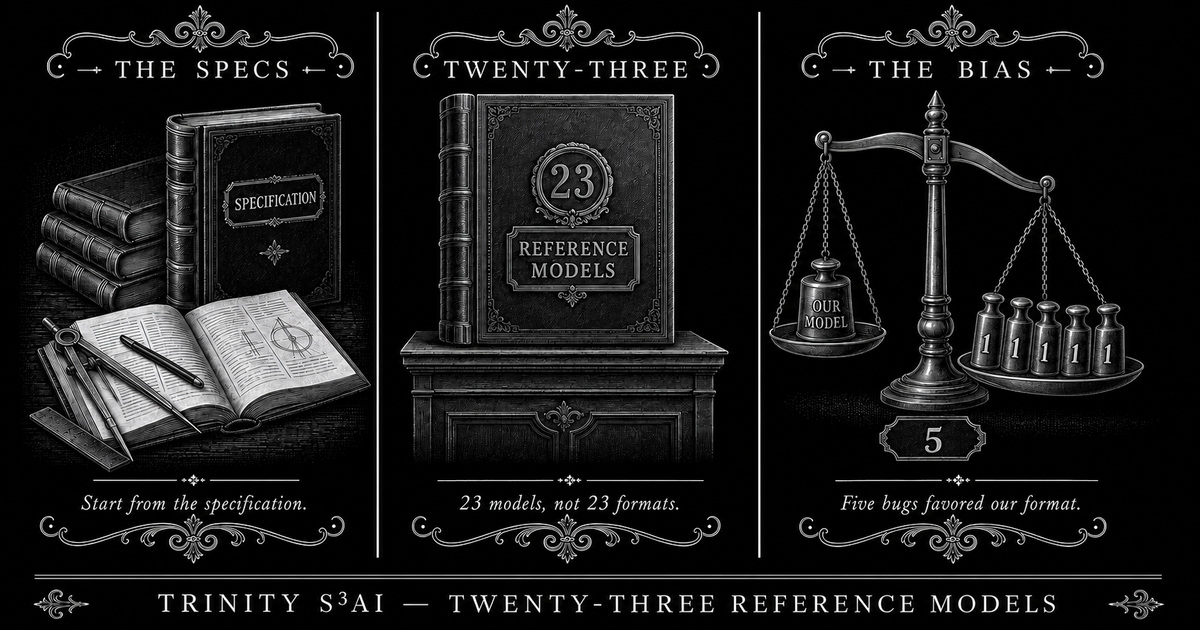
Three panels, left to right - THE SPECSStart from the specification.
- TWENTY-THREE23 models, not 23 formats.
- THE BIASFive bugs favored our format.
Twenty-three reference models, because implementing a competitor from memory always flatters you
Every format we compare against has its own reference implementation, written from its specification — after five bugs that all weakened the competitor and all pointed the same way.
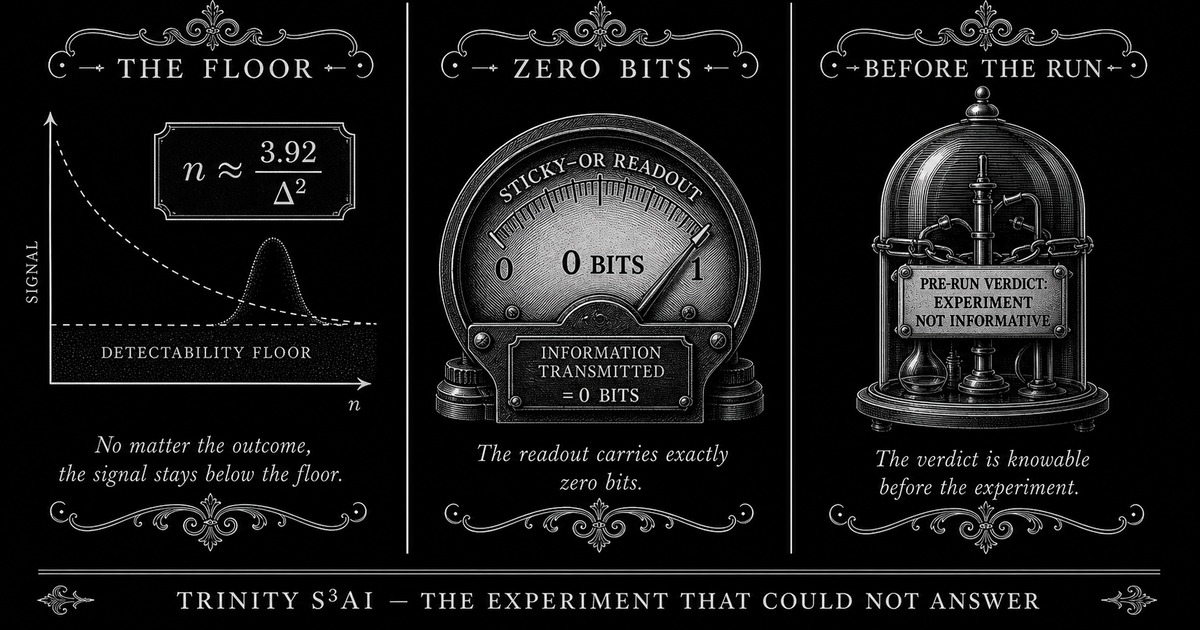
Three panels, left to right - THE FLOORNo matter the outcome, the signal stays below the floor.
- ZERO BITSThe readout carries exactly zero bits.
- BEFORE THE RUNThe verdict is knowable before the experiment.
Two theorems that tell you an experiment is worthless before you run it
A detectability floor of n ≈ 3.92/Δ² said the sweep could not resolve the effect at any outcome, and a sticky-OR readout carried literally zero bits. Both knowable in advance.
Three panels, left to right - THE VERDICTPassing tests, every run.
- THE REACHTests prove what they touch.
- THE LIMITOne line exposed five hidden errors.
A green CI does not mean the library builds for you
A Zig package with passing CI could not be compiled by any consumer. Lazy analysis means a test run proves only what the tests happen to touch — one line exposed five hidden errors in one package, and sixteen in the package under it.
Three panels, left to right - THE FIELDFour bits carried every scale measured.
- THE CHECKBit-identical, zero blocks truncated.
- THE LIMITPublished first by someone else.
The scale field does not need eight bits, and we were not the first to say so
Four bits cover the shared scale on every checkpoint measured -- bit-identical to E8M0, zero blocks truncated out of 20,462,464. The observation was published first by someone else; what is ours is the proof around it, and the constant does not survive contact with activations.
Three panels, left to right - THE LINKGigabit RGMII, on real hardware.
- THE TOOLCHAINYosys, nextpnr-xilinx, Project X-Ray.
- THE OPEN BLOCKEROne blocker is still open.
Gigabit Ethernet on Artix-7 without a vendor toolchain
RGMII at gigabit through Yosys, nextpnr-xilinx and Project X-Ray with no vendor tools — the six blockers that had to be patched, the one still open, and what the workaround costs.