Blog
Two theorems that tell you an experiment is worthless before you run it
A detectability floor of n ≈ 3.92/Δ² said the sweep could not resolve the effect at any outcome, and a sticky-OR readout carried literally zero bits. Both knowable in advance.
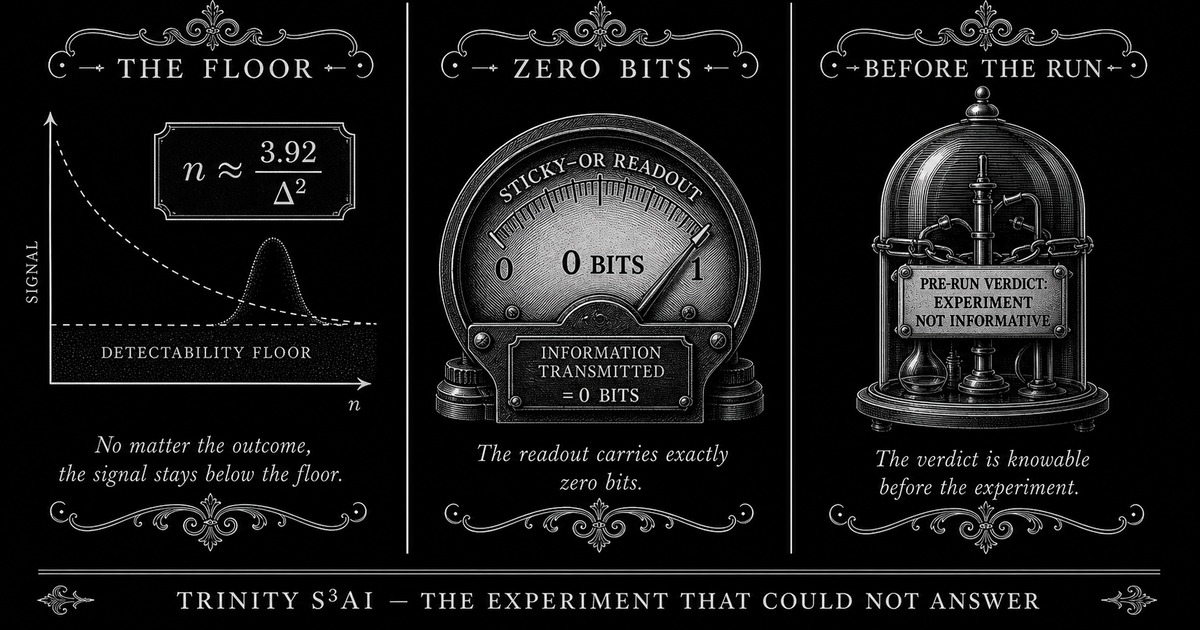
- THE FLOORNo matter the outcome, the signal stays below the floor.
- ZERO BITSThe readout carries exactly zero bits.
- BEFORE THE RUNThe verdict is knowable before the experiment.
Two results from a hardware bring-up, both provable on paper, both of which would have saved a week if applied before the runs instead of after.
1. The detectability floor
For a difference between two proportions at alpha = 0.05 and power 0.8, the sample size needed is roughly:
n ≈ 3.92 / Δ² so Δ_min ≈ √( 3.92 / n )The sweeps used 4 to 6 samples per arm. At n = 6 that puts the smallest resolvable difference at 81 points — while the entire plausible effect being looked for was under 30.
The experiment could not have produced a valid answer regardless of outcome, and that was knowable before any data was taken.
This is the useful shape of the result. It does not say the answer was wrong — it says no answer was available, so whatever came out was noise wearing a conclusion. Two numbers, a square root, and it costs nothing to check while the rig is still on the bench.
2. A saturating aggregator carries zero bits
A sticky-OR over a window — set a bit if any sample was high, read it at the end — is the natural way to catch a transient. If the window is long enough to contain at least one high sample under either hypothesis:
P(T=1 | H₁) = P(T=1 | H₂) = 1
Λ ≡ 1        I(T;H) = 0
The likelihood ratio is identically one, so the mutual information between the readout and the hypothesis is exactly zero. Not small. Zero. And repetition does not help: averaging N independent readings of a variable that carries no information gives no information.
The remedy costs one register
Report AND as well as OR over the same window:
| OR | AND | state |
|---|---|---|
| 0 | 0 | stuck low |
| 1 | 0 | toggling |
| 1 | 1 | stuck high |
| 0 | 1 | impossible — a check on the rig itself |
Initialise AND to 1 and OR to 0. The AND leaving 1 also proves the clock ran, which the OR cannot show. And the fourth row can never occur, so if it does the instrument is broken rather than the design.
Why these two belong together
One says the experiment cannot resolve the effect. The other says the readout cannot carry the answer even if it could. Both are properties of the setup rather than of the result, both are provable before any run, and both were discovered afterwards — which is the expensive way to learn either of them.
What this does not settle
- Both theorems come from the AX7203 bring-up of 2026-07-30 and are recorded there as proven. Published 2026-08-11.
- The 3.92 constant is for two proportions at alpha = 0.05 and power 0.8. Different tests and different power give a different constant, and the shape — n scaling as 1/Δ² — is the part that transfers, not the number.
- The zero-information result is exact for a saturating aggregator over a window that is certain to contain a high sample. Where saturation is not certain the mutual information is small rather than zero, and how small depends on the rate.
- Both theorems say an experiment cannot answer. Neither says what experiment would, and designing that is the harder half.
Work with me
Want this kind of check on your own design?
I audit RTL and build independent, bit-exact models, then take the result through synthesis and, when useful, onto an Artix-7 board. The first conformance module is free.