Blog
Sixteen defects fixed, zero of them reached the consumer
Two repositories carried the same six files under the same names. Repairing one changed nothing downstream, and no instrument in either could report why — because each copy compiles entirely on its own.
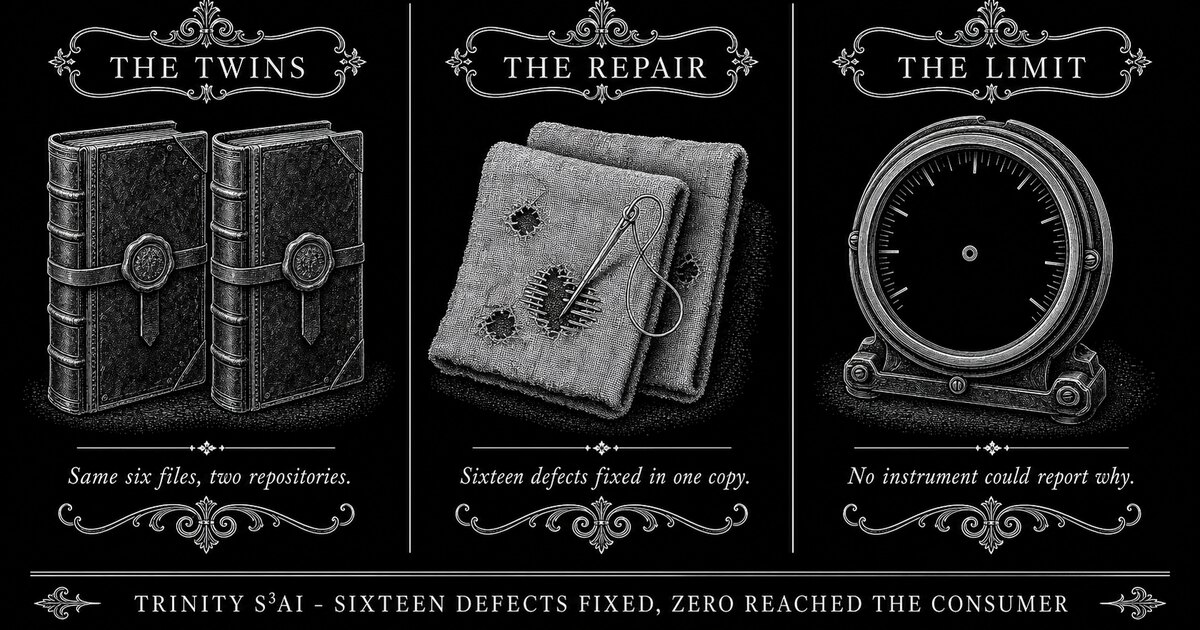
- THE TWINSSame six files, two repositories.
- THE REPAIRSixteen defects fixed in one copy.
- THE LIMITNo instrument could report why.
I spent a night repairing sixteen defects in a package, watched its CI go green for the first time in its life, re-pinned the package that depends on it — and the consumer did not improve by a single error. Not one.
The first explanation to reach for is a stale artefact. It was not that: pinning the exact merge commit produced the same hash the CDN had already served, so the bytes arriving were the repaired bytes.
Both repositories owned the same files
The consumer carried its own src/vsa/core.zig, common.zig, concurrency.zig, 10k_vsa.zig, hrr.zig and fpga_bind.zig. So did the package below it. Same names, same purpose, separate files, edited independently since the migration that split them apart.
The fixes went into different files with the same names. Nothing was wrong with the repair; it simply landed somewhere else.
That is why no instrument reported it. Each copy compiles on its own. The package below went green because its copies were repaired; the consumer stayed red because its copies were not; and neither build has any way to notice that the other exists.
The decision was arithmetic, not taste
Choosing which copy to keep looks like a judgement call, and it stopped being one after five minutes of measurement: comparing the two public surfaces symbol by symbol, they are identical apart from a single constant. Neither is more capable. Nothing is lost by keeping either — so the direction follows the dependency that already exists, and the copies that build and pass 267 tests win over the copies that do not.
Each duplicated file became a re-export rather than a deletion. Twenty-three relative imports across the consumer keep working unchanged, nothing else in the tree moves, and re-divergence stops being discouraged and becomes impossible: there is one implementation behind the path now.
What the deduplication then exposed
With one implementation in place and refAllDeclsRecursive forcing the whole public surface through the compiler, three more things surfaced, none of them caused by the change:
- src/vsa.zig re-exported concurrency.LockFreePool, a name that has never existed in either copy. It referred to nothing, and nothing complained, because lazy analysis never asked what it pointed at.
- The pin predated the repair, so the sixteen fixed defects were still arriving through the dependency.
- text_encoding.zig passed an allocator to bundle2 and to add at nine call sites, against an API that had moved without it, and bound a const where add needs a mutable pointer.
Every one of those had been in the repository for as long as the files had, invisible for the same reason: nothing referenced them, so nothing compiled them.
The general form
Parnas gave the criterion in 1972 and the reason he gave was changeability: each design decision should have exactly one home. The corollary is arithmetic. A decision living in n places must be repaired n times; the repairs do not propagate; and no instrument inside either copy reports the omission, because each compiles or fails entirely on its own.
So divergence is not a risk that duplication carries. It is what duplication is. The question a copy raises is not whether the two will drift but how long before somebody notices, and the answer here was four months and a consumer that could not build.
None of which makes vendoring wrong. A pinned copy is a deliberate trade — insulation from an upstream you do not control, paid for in repairs you now owe twice — and it is defensible when it is chosen and written down. What has no defence is duplication nobody decided on, which is exactly what a migration leaves behind when it copies rather than moves.
What this does not settle
- gHashTag/trinity, the consumer that started this, is still red. Its pin predates the repair and its own build has other causes, so nothing here claims that chain is finished.
- Listing re-exported names one by one has a cost this post does not pretend away: a symbol added upstream does not appear downstream until somebody adds it. usingnamespace, which would have avoided that, was removed in Zig 0.15.
- Whether the eighteen files that stayed behind should also live upstream was not decided. They have no counterpart there today; that is a fact about today, not an argument.
Receipts
Work with me
Want this kind of check on your own design?
I audit RTL and build independent, bit-exact models, then take the result through synthesis and, when useful, onto an Artix-7 board. The first conformance module is free.