Blog
Half of your activations are negative. They carry 1.8% of the energy
Post-activation tensors are half negative by count and 1.8–6.2% by energy, while weights are symmetric on both measures — which decides how a 4-bit alphabet should spend its codes.
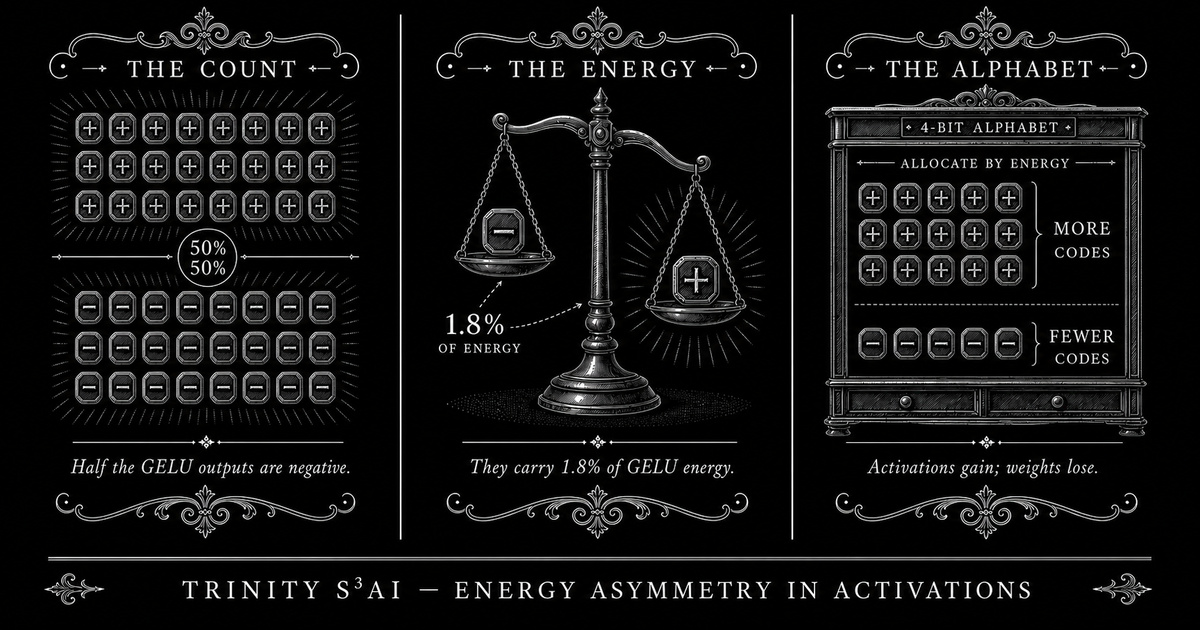
- THE COUNTHalf the GELU outputs are negative.
- THE ENERGYThey carry 1.8% of GELU energy.
- THE ALPHABETActivations gain; weights lose.
This is an observation about transformers, not about any particular numeric format. It takes two lines to check on a model you already have.
The table
| source | fraction < 0 | energy < 0 |
|---|---|---|
| ReLU | 0.0% | 0.0% |
| GELU | 49.9% | 1.8% |
| SiLU / SwiGLU | 50.1% | 6.2% |
| after LayerNorm | 49.8% | 50.3% |
| weights | 50.0% | 50.4% |
Two columns describing the same tensor. For weights they agree. For GELU outputs they differ by a factor of twenty-seven.
What it means
One-sidedness is a property of a tensor’s energy, not of its count. GELU passes almost half its values into the negative region, but they sit near zero: nearly everything carrying magnitude is positive.
The count view says the distribution is symmetric, so spend the sign bit evenly. The energy view says the negative half is nearly empty. A quantiser that allocates on the count spends half its code space on 2% of the signal.
Note where the disagreement stops. Weights and post-LayerNorm tensors are symmetric on both measures, so the rule is not “transformers are one-sided” but the sharper one: post-activation tensors are, and only by energy. The same network needs different treatment for weights and activations at the same layer.
It predicts a result, in both directions
An asymmetric 4-bit alphabet, compared against DialectFP4 using the codebook from that paper’s own Figure 4 and its scale rule, wins on every activation class and loses on weights:
| source | BlockDialect | asymmetric k=4 | advantage |
|---|---|---|---|
| GELU | 1.80× | 2.11× | 1.17× |
| SiLU / SwiGLU | 2.51× | 3.02× | 1.20× |
| ReLU | 1.64× | 2.39× | 1.46× |
| weights | 1.59× | 1.49× | 0.94× |
The loss is in the table on purpose. It wins exactly where the asymmetry exists and pays about 6% where it does not — which is a prediction landing, not a lucky sweep.
Check it on your own model
(x < 0).float().mean()              # fraction negative
(x[x<0]**2).sum() / (x**2).sum()    # energy share of the negative half
If the second number is much smaller than the first, you have the same asymmetry and your quantiser does not know about it. If they are equal — as they will be for weights — an asymmetric alphabet has nothing to offer you, and that is visible before you build one.
What this does not settle
- Measured on SmolLM2-135M and Qwen2.5-0.5B only. Two small models is not a general result, and nothing here shows the ratio holds at 7B or beyond.
- The energy share is reported for GELU and SiLU/SwiGLU. Other activations were not measured, and ReLU is trivially 0% because it has no negative outputs at all.
- The advantage on activations (1.17×–1.46×) comes with a loss on weights (0.94×). Whether a mixed alphabet — asymmetric for activations, symmetric for weights — is worth its control cost in hardware has not been measured.
Receipts
Work with me
Need arithmetic built for your constraints?
I design low-precision and ternary formats, synthesizable RTL, independent reference models and bit-exact vectors. Existing measured cores can also be licensed.