Blog
Ternary won the wire; it did not win the gate
Base economy is a theorem, not a measurement: 5.66 percent in a 1950 vacuum-tube cost model, a win on the wire in USB4 v2 and GDDR7, and a loss at the gate on noise margin.
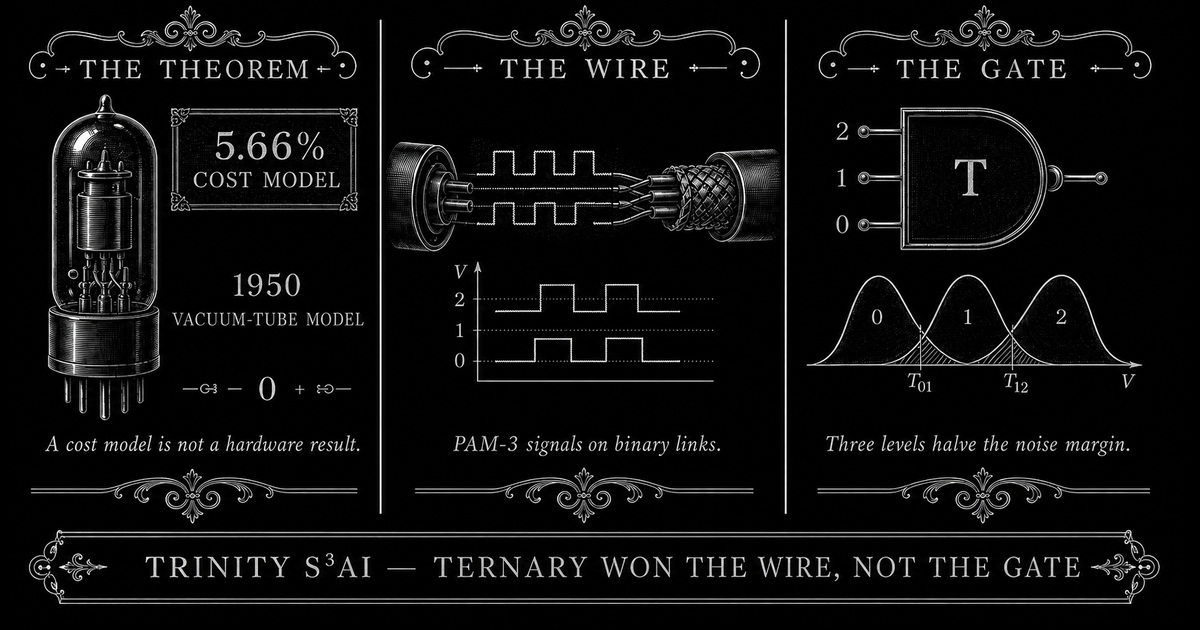
- THE THEOREMA cost model is not a hardware result.
- THE WIREPAM-3 signals on binary links.
- THE GATEThree levels halve the noise margin.
[Sources — not one measurement of ours] The case for base three arrives as one number: base 3 is more economical than base 2. The number is exactly right, and it says nothing about hardware, because it is a theorem and not a result. The measurement worth making is named at the end.
The optimum is Steiner’s, 1850; the 5.66 percent is arithmetic
In the classical metric the cost of representing N in base b is the digit count times the base: E(b, N) = b · ⌊log_b(N) + 1⌋, and E/ln(N) tends to b/ln(b). Over the reals that minimum sits at e; the problem was posed and solved by Jakob Steiner in 1850 (Journal für die reine und angewandte Mathematik, vol. 40, p. 208). The comparison of 2 against 3 is not his — it is one division.
| base b | b/ln b |
|---|---|
| 2 | 2.88539 |
| e | 2.71828 |
| 3 | 2.73072 |
| 4 | 2.88539 |
| 10 | 4.34294 |
2.88539 / 2.73072 = 1.0566: ternary is asymptotically more economical than binary by 5.66 percent — not by a factor. Base 2 and base 4 tie exactly, because 4 = 2². One line checks it:
python3 -c "import math; print([(b, round(b/math.log(b), 5)) for b in (2, math.e, 3, 4, 10)])"The metric describes a ring counter made of vacuum tubes
The model behind E(b, N) is explicit: a digit with b states costs exactly b units of hardware. It is Engineering Research Associates, High-Speed Computing Devices (McGraw-Hill, 1950): a ring counter on triodes, where base R needs R triodes per digit. Their tube count up to 10⁶ is 39.20 for base 2 against 38.24 for base 3 — 2.5 percent, not 5.66. The same pages carry a caveat the citing literature drops:
"the choice of 2 as a radix is frequently justified on more complete analysis" — ERA, High-Speed Computing Devices, 1950, pp. 84–87.
A CMOS transistor has no "b states at price b". Steve Weis recalls that the model already failed in the tube era: the IBM 650 used bi-quinary, seven triodes per decimal digit. Change the cost function and the optimum moves — Georgiou (arXiv:1611.03715) reports values from 1.42 to 3.83 across his parameters.
On small ranges binary is the economical one
| range of N | b = 2 | b = 3 | b = e |
|---|---|---|---|
| 1..6 | 4.7 | 5.0 | 4.5 |
| 1..43 | 9.3 | 9.5 | 9.0 |
| 1..182 | 13.3 | 13.1 | 12.9 |
| 1..5329 | 23.0 | 22.2 | 22.1 |
Averaged, not asymptotic, values (Wikipedia, Optimal radix choice): binary wins the first two rows outright, and ternary overtakes only at ranges of order hundreds.
Setun: what is known, and what does not agree
Moscow State University computing centre, Brusentsov’s laboratory, initiated by academician Sobolev; first unit 1958–1959. 200 kHz, about 4500 operations per second, a word of 9 or 18 trits, series production 1961–1965 in Kazan. How many were built is unsettled: 50 in the English Wikipedia, computer-museum.ru and Hayes, 46 in the Russian one. Why it stopped is unsettled too — a price unprofitable for the plant, an administrative decision, or no stated cause.
Hayes records the part that matters: each trit was a pair of ferrite cores, and two cores hold more than one trit. On paper 18 trits span 3¹⁸ = 387,420,489 at r·w = 54 against 58 for the binary equivalent — in the iron that margin went into the implementation. Setun-70 (April 1970) stayed a single unit; its instruction set later became DSSP, on binary machines.
Balanced ternary is beautiful arithmetic
- The range of n trits is symmetric, ±(3ⁿ−1)/2: ±193,710,244 for 18 trits, where two’s complement is asymmetric by one.
- The sign is the sign of the most significant non-zero digit; there is no sign bit.
- Negation is a digit-wise swap of 1 and T, with no carries.
- Truncation is round-to-nearest by construction.
- One number takes ln2/ln3 ≈ 63 percent of the binary digit count.
Knuth calls this notation perhaps the prettiest number system of all. But these are properties of a notation, not of devices.
Ternary won the wire
USB4 Version 2.0 (USB-IF, October 2022), Gen4: three levels, 25.6 GBd per lane, 11 bits into 7 trits because 2¹¹ = 2048 ≤ 3⁷ = 2187 — 99.1 percent of the ternary bound, and the error metric is named TER. GDDR7 followed: JESD239, 5 March 2024, the first JEDEC DRAM standard with PAM — 3 bits in 2 clocks where NRZ moves 2.
| standard | line code | levels |
|---|---|---|
| 100BASE-TX | MLT-3 | 3 |
| 100BASE-T4 | 8B6T | 3 |
| 1000BASE-T | 4D-PAM5 + trellis | 5 |
| 2.5G/5GBASE-T (802.3bz) | PAM-16 / 128-DSQ + LDPC | 16 |
| 100BASE-T1 (802.3bw) | PAM-3 | 3 |
| 1000BASE-T1 (802.3bp) | PAM-3, 750 MBd | 3 |
| 2.5/5/10GBASE-T1 (802.3ch) | PAM-4 | 4 |
| USB4 v2 Gen4 | PAM-3, 11b/7t | 3 |
| GDDR7 (JESD239) | PAM-3 | 3 |
Two rows close a common claim: 2.5GBASE-T and 5GBASE-T are not PAM-3 but a downclocked 10GBASE-T with PAM-16 and 128-DSQ, confused with the neighbouring 2.5GBASE-T1 (802.3ch, PAM-4). And PAM-3 is signalling on a wire, not computing: both ends of the link are binary.
It did not win the gate
With a swing Vpp and m equally spaced levels the spacing is Vpp/(m−1): two levels to three halves the noise margin, 6.02 dB, for a density gain of log₂3 = 1.58×. The USB-IF table: relative margin 1 for PAM-2, 0.5 for PAM-3, 0.33 for PAM-4. Ethernet shows the same coefficient — five-level 1000BASE-T needs roughly 6 dB more SNR than three-level 100BASE-T.
The second obstacle is the device. A CMOS gate is a switch with two rails and no static current; a middle level has to be manufactured, by a divider that burns current — as in the 2005 CNTFET ternary inverter, a resistive design that lives in HSPICE and not in silicon — or by multi-threshold devices outside mainstream CMOS. Then the field criticised itself: Etiemble (arXiv:2207.04839) puts it in his title, ternary and quaternary CNTFET full adders are less efficient than binary ones for carry-propagate adders; Takbiri and co-authors (CSSP, 2019) show published multi-valued noise margins were better than the transfer curves allow.
The third obstacle is the size of the prize: 5.66 percent asymptotically, against an industry that collected as much every few months from Moore scaling, without rebuilding Boolean algebra, EDA, compilers and IEEE 754.
BitNet is not a base
The only working ternary result in ML is BitNet b1.58 (arXiv:2402.17764, February 2024, Microsoft Research and UCAS): weights in {−1, 0, +1}, activations at 8 bits, and "1.58" is log₂3, the entropy of a trit. The zero is the working part — explicit feature filtering. The 2B4T model (arXiv:2504.12285) has 2 billion parameters.
| model | memory (non-embedding), GB | latency, ms (CPU decode) | energy, J (report estimate) |
|---|---|---|---|
| BitNet b1.58 2B4T | 0.4 | 29 | 0.028 |
| Gemma-3 1B | 1.4 | 41 | 0.186 |
| LLaMA 3.2 1B | 2.0 | 48 | 0.258 |
| Qwen2.5 1.5B | 2.6 | 65 | 0.347 |
- This is binary hardware with a three-valued weight set: no positional base-3 arithmetic in it, and what removes the multipliers is the set {−1, 0, +1}.
- 1.58 bits is the bound, not what sits in memory: four ternary values are packed into one int8, so 2 bits per weight, 26 percent over.
- The energy column is the report’s model estimate, not a wattmeter reading.
- Neighbouring terms are not ternary: TLC NAND is 3 bits and 8 levels, PAM-4 is four levels, a tri-state buffer in High-Z is a disabled driver.
What this does not establish
- No instrument was used here. Every number above is read off a source, and the post ends with the experiment that would replace them.
- The circulating "8,487 values where ternary loses to binary" count, and the "40× the transistors per trit" figure, have no primary source and are not used as facts.
- A 2019 Nature Electronics paper with a fabricated ternary CNTFET inverter was not found; the Nature 2019 carbon-nanotube RISC-V processor is binary.
- Whether 46 or 50 Setun machines were built is a disagreement between sources, and no RTL resolves it.
- PAM-3 in mainstream FPGA transceivers is unconfirmed: no mention in the checked AMD Versal and Altera Agilex material.
- Native ternary cannot be tested on an FPGA: LUTs and flip-flops are two-level, so a trit is stored as two bits — as in the 5500FP CPU and the Tiny Tapeout calculator. "Ternary is cheaper on FPGA" would measure the emulation penalty.
The honest position is narrow. Base economy is mathematics: exactly true, equal to 5.66 percent, denominated in the triodes of a 1950 ring counter. A result would be a cost function measured on components that exist — the thing Weis says nobody published. The experiment is small: a balanced-ternary adder of N trits at two bits per trit against a binary adder of ⌈N·log₂3⌉ bits of the same dynamic range, LUT, FF and Fmax after place-and-route, N = 9, 18, 24. That is a different currency from the ERA one, and saying so is half the work. The hypothesis is that ternary loses, forfeiting the hardware carry chain. A negative result is the more valuable one: it turns a 76-year-old argument from philosophical into measured.
That is the kind of measurement the Golden Foundry club at t27.ai/#/foundry runs and publishes — with the denominator, the conditions, and negative results set in the same size as positive ones. If the ternary adder loses, the number goes up anyway.
What this does not settle
- Nothing in this post is our measurement: it is a reading of sources, not an experiment on the ALINX AX7203 board and not a silicon result.
- The circulating "8,487 values" count and the "40× transistors per trit" figure have no primary source and are not used.
- A 2019 Nature Electronics fabricated ternary CNTFET inverter was not found; whether 46 or 50 Setun machines were built stays unresolved.
- PAM-3 in mainstream FPGA transceivers is unconfirmed in the checked AMD Versal and Altera Agilex material.
- It does not establish any FPGA or silicon cost comparison between ternary and binary arithmetic; the proposed adder experiment has not been run.
Receipts
- ERA, High-Speed Computing Devices (McGraw-Hill, 1950) — the cost model and its own caveat, pp. 84–87
- J. Steiner, Journal für die reine und angewandte Mathematik 40:208, 1850
- Optimal radix choice — Wikipedia (averaged E(b,N) table)
- Steve Weis — Revisiting Radix Economy
- Brian Hayes, Third Base, American Scientist 89(6):490, 2001 — ferrite-core pair per trit, 50 machines
- МЦВМ «Сетунь» — Виртуальный компьютерный музей
- USB-IF — USB 80G PHY background (PAM-3, 11b/7t, margin table)
- JEDEC JESD239 GDDR7 press release, 5 March 2024
- IEEE 802.3bz TF, Souvignier/Feyh, May 2015 — 2.5G/5GBASE-T is PAM-16 / 128-DSQ, not PAM-3
- arXiv:2402.17764 — The Era of 1-bit LLMs (BitNet b1.58)
- arXiv:2504.12285 — BitNet b1.58 2B4T Technical Report
- arXiv:2207.04839 — Etiemble, ternary and quaternary CNTFET adders less efficient than binary for CPAs
- Takbiri, Faghih Mirzaee, Navi, CSSP 38(9):4280–4301, 2019 — overstated noise margins in MVL
- The Register, 18 March 2026 — ternary CPU on FPGA (5500FP), two bits per trit
Work with me
Need arithmetic built for your constraints?
I design low-precision and ternary formats, synthesizable RTL, independent reference models and bit-exact vectors. Existing measured cores can also be licensed.