Blog
PR #888 made review ownership explicit
Merged PR #888 adds four explicit review states in a 5-file diff, while separate CI receipts show that merge state and delivery status are different facts.
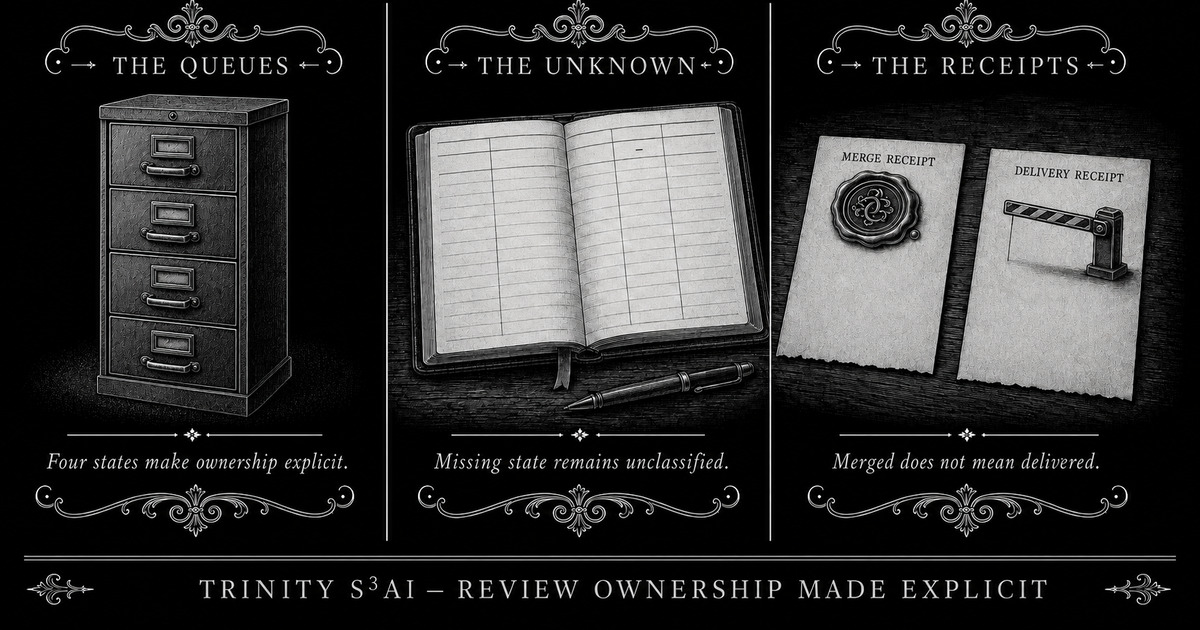
- THE QUEUESFour states make ownership explicit.
- THE UNKNOWNMissing state remains unclassified.
- THE RECEIPTSMerged does not mean delivered.
[measured] Merged PR #888 adds an explicit review lifecycle to the Queen page. The change landed in merge commit 6a4d6fb07670f99f16e4ffb67a12dee42caac3df as a 5-file diff with 375 additions and 29 deletions.
A review column is not one queue
[proven] The executable model names four review states: queenReviewPending, changesRequested, humanEscalation, and reconciliationAnomaly. The Queen page consumes that model instead of treating every card in the review column as Queen debt.
queenReviewPending
changesRequested
humanEscalation
reconciliationAnomaly
[proven] When the public ledger supplies reviewQueues, those counts remain authoritative. For a review card without reviewState, the model returns null: the card reads a dash, the queues read a dash while no review card states its queue, and the menu carries the unclassified total. An absent field is never printed as a ledger anomaly the wire did not state (changed 2026-09-04; until then it read reconciliationAnomaly).
Checks are separate receipts
[measured] On the same merge SHA, CI, Codegen Validation, and Website checks completed successfully. KOSCHEI Production Deploy stopped at Run all tests; S³AI Brain CI stopped at Run Brain Health Check; Site live gate stopped while comparing the build with the live site; and the manual deploy stopped at Checkout the deploy repo.
| Receipt | Observed outcome |
|---|---|
| PR #888 | merged |
| CI / Codegen Validation / Website checks | success |
| KOSCHEI / S³AI Brain / Site live gate / manual deploy | stopped at named steps |
MERGED is a state of the change, not a verdict on delivery.
What remains open
- Delivery of PR #888 to the live site is not proven: the Site live gate and manual deploy each stopped separately.
- The causes of the KOSCHEI and S³AI Brain stops are not established beyond the named steps.
- Correctness of every Queen route, the user-facing behavior of all queues, and the completeness of the public ledger are not established.
- This is a repository and CI result, not a measurement of FPGA hardware, a crystal, speed, energy, or downstream model quality.
For an engineering change, keep four fields beside one another: PR state, merge SHA, diff size, and workflow → job → step → conclusion. That passport preserves mixed evidence instead of collapsing it into one green or red label.
What this does not settle
- Delivery of PR #888 to the live site is not proven: the Site live gate and manual deploy stopped separately.
- The causes of the KOSCHEI and S³AI Brain stops are not established beyond the named steps.
- Correctness of every Queen route, the user-facing behavior of all queues, and the completeness of the public ledger are not established.
- This is a repository and CI result, not a measurement of FPGA hardware, a crystal, speed, energy, or downstream model quality.
Receipts
Work with me
Want this kind of check on your own design?
I audit RTL and build independent, bit-exact models, then take the result through synthesis and, when useful, onto an Artix-7 board. The first conformance module is free.