Blog
Eight broken gates in one day, and not one of them was broken code
A flag, a version, a runner, a module, a script, three specs, two format paths, five submodule links and a step that ran what it claimed to build. Every one reported "failure", which is also what a real defect reports.
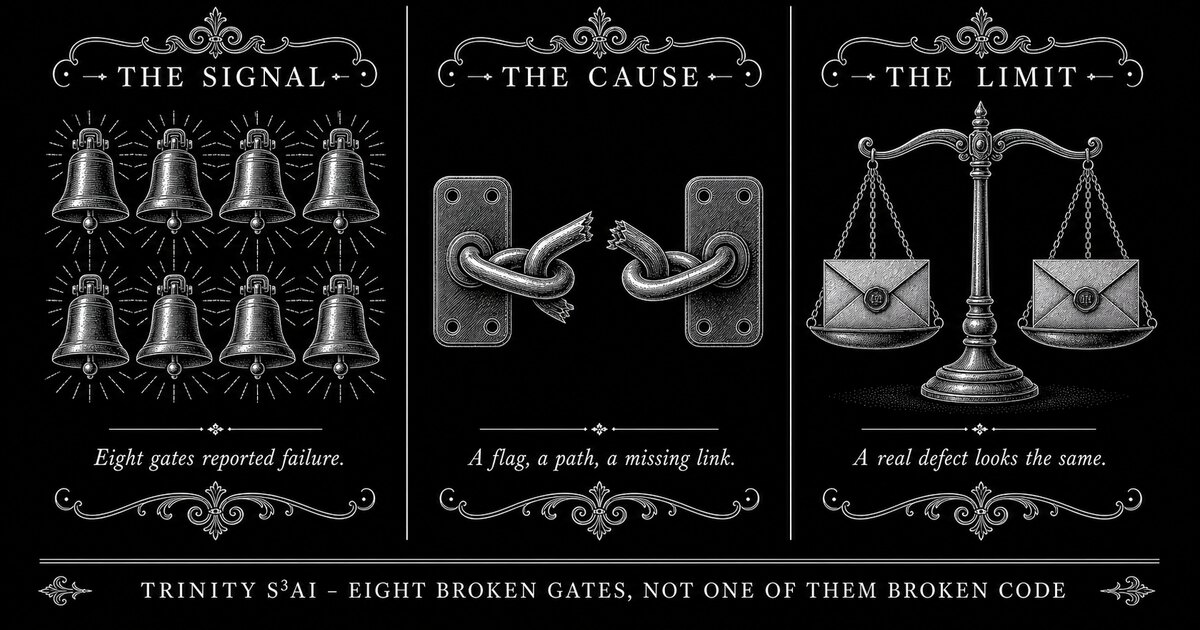
- THE SIGNALEight gates reported failure.
- THE CAUSEA flag, a path, a missing link.
- THE LIMITA real defect looks the same.
Our CI had zero successes in its last thirty runs. Over one day, eight separate causes came out of it. Not one was a bug in the code being tested.
| what was wrong | what it looked like |
|---|---|
| a flag existed in build.zig and was never passed | missing system library raylib |
brew install zig pulled 0.16 onto a 0.15.2 tree | linkLibC has moved, trimLeft removed |
| the job ran on macos-latest, whose SDK 0.15.2 cannot link | undefined _abort, _bzero |
| a module rooted at a file absent from every machine | file_hash FileNotFound |
| a step called a script no commit ever contained | exit 127 |
| three .vibee specs listed for generation do not exist | generation failure |
| two format-check paths were deleted long ago | unable to format: FileNotFound |
| five submodule gitlinks with no url in .gitmodules | checkout exit 128 |
The ninth, which is different and worth its own line: five steps named "Build TRI Binary" ran zig build tri, which build.zig declares as *Run* TRI. They launched the REPL with stdin closed and it segfaulted. The reference was intact; the name lied about what it did.
Why eight could stack up
Each one was invisible until the one above it was removed. The build could not start, so nobody saw that a step called a missing script. That step could not run, so nobody saw that three specs were gone. And so on down.
The mechanism underneath is simple and, once seen, hard to unsee: a reference to something that no longer exists fails in exactly the same way as the thing being broken. git exits 128 whether the submodule is unreachable or the url is absent. zig fmt exits 1 whether the file is misformatted or missing. A step exits 127 for a script that was deleted and for a script that crashed. The exit code carries the failure and discards the distinction.
A gate cannot tell you it is pointing at nothing. It can only tell you it failed.
What that costs, concretely
Earlier the same day one of our own merges landed and every workflow went red. Establishing that it was not our fault meant opening the log and comparing against the parent commit by hand, because thirty consecutive failures give a new failure nothing to stand out against.
That is the real bill. Not the regressions a red gate fails to catch — the investigation it charges on every commit that touches it, and the habit it teaches of not looking. Four of these had been in place for months.
It also produced one false accusation in the other direction. Removing the phantom module broke the build immediately, because that dead module carried link_libc = true and the CLI had been receiving libc as a side effect of something nobody imported, rooted at a file nobody had. That one was mine, made minutes earlier, and the newly-working gate caught it on the next run. Which is the argument for fixing them.
The tell
There is a cheap check that would have found most of these without any of the debugging: for every path a gate names, ask whether it exists. Not whether it passes — whether it is there.
# every submodule gitlink in the index, against .gitmodules
git ls-files -s | awk '$1=="160000"{print $4}' | while read -r p; do
  grep -q "path = $p$" .gitmodules || echo "ORPHAN $p"
done
That one loop found four of the five gitlinks in a second, after the first had cost a full CI round to discover by removal. The same shape applies to the rest: the paths a format check lists, the specs a codegen step generates from, the Dockerfile a build names, the script a step calls.
None of it requires understanding the code. It requires asking a question no CI system asks on your behalf, because from where the runner stands there is nothing to ask: it was told to point somewhere, it pointed, and the pointing failed.
What is now true, and what is not
The CLI builds and publishes; the container was pulled and run before this was written. Codegen validation builds, generates from the four specs that exist, and runs its tests. The format check checks formatting. Checkout checks out.
Two gates stay red deliberately. Implementation coverage is about 3% against a 95% target — that gate was the only one in its job telling the truth the whole time, and it keeps its threshold. And a segfault remains, moved out of CI rather than repaired, which is honest to say and uncomfortable to leave.
What this does not settle
- The segfault found at the end is not fixed.
zig build tribuilds the CLI and runs it; with stdin closed it dies with SIGSEGV, while the same binary from the same commit runs cleanly with no arguments inside the published container. The workflow no longer runs the REPL, which removes the symptom from CI and leaves the defect. - Two gates remain red on purpose. Implementation coverage is about 3% against a 95% target, and the gate that says so is the one thing in that job that was telling the truth all along. Lowering the threshold would be the failure it exists to catch.
deploy/Dockerfile.nodeis still missing and its workflow still publishes an image from it. Restoring the file or retiring the image is a product decision, not a repair.- Nothing here says the code is correct. Eight gates now measure what they claim to measure; what they measure has barely been examined.
- The count of eight is this repository on this day, found while looking for something else. It is not a survey, and no claim is made that the rate is representative.
Receipts
Work with me
Want this kind of check on your own design?
I audit RTL and build independent, bit-exact models, then take the result through synthesis and, when useful, onto an Artix-7 board. The first conformance module is free.