Blog
Five reasons the build was red, and the fifth was mine
Our CLI could not be installed by anyone, and the CI that should have said so had zero successes in thirty runs. Each cause hid the next; removing the fourth created the fifth.
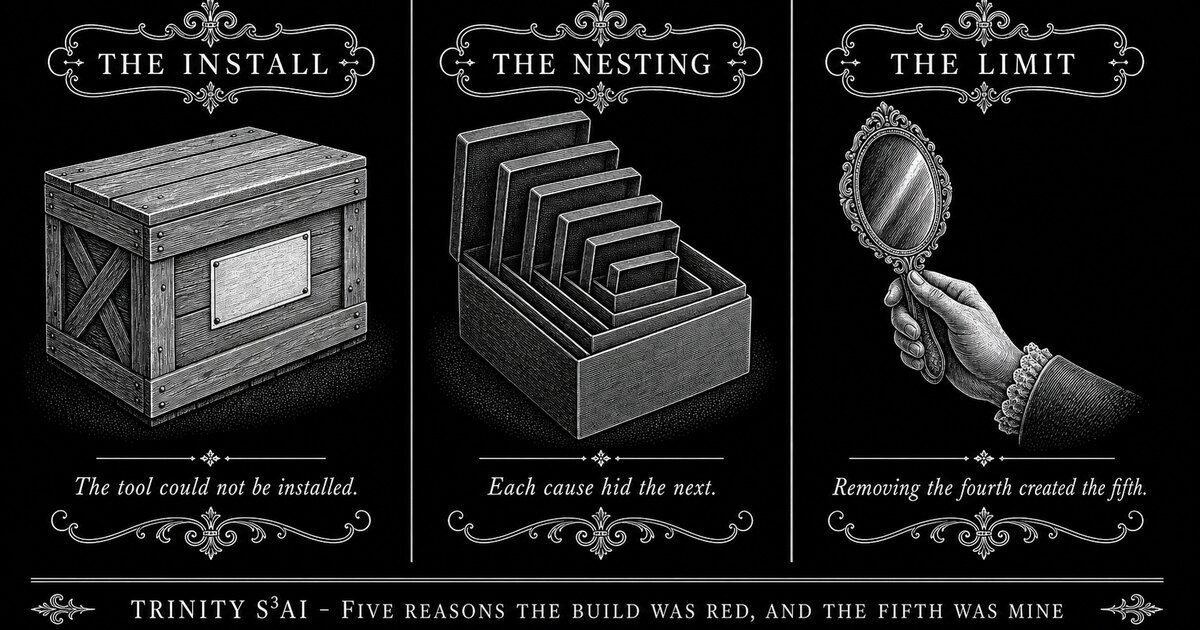
- THE INSTALLThe tool could not be installed.
- THE NESTINGEach cause hid the next.
- THE LIMITRemoving the fourth created the fifth.
Until yesterday our command-line tool could not be installed by anybody, including us. Not "was awkward to build" — zig build could not produce it from a clean clone on any machine. The CI job that exists to say so had been failing for thirty consecutive runs, which is the same as saying nothing at all.
Five causes, stacked. Each one hid the next, so every fix looked like it had not worked.
1. A flag that existed and was never passed
The build compiles four GUI targets that link raylib. The runner has no raylib and no reason to. build.zig had carried -Dci=true to skip exactly those since the option was added; the workflow never passed it. One word, and the error it produced — "unable to find dynamic system library" — pointed at a missing package rather than at a missing flag.
2. A version that was never pinned
A second workflow installed Zig with brew install zig, which gives whatever is current. Current is 0.16; this tree targets 0.15.2, which the other 28 workflows pin. On 0.16 build.zig does not compile at all: linkLibC has moved, and a vendored package still calls std.mem.trimLeft and std.process.getEnvVarOwned, both removed.
3. A runner whose SDK is too new
With the version pinned, the build still died — now on libSystem: undefined _abort, _bzero, ___availability_version_check. That job ran on macos-latest, whose SDK Zig 0.15.2 cannot link against. The same failure reproduces on a developer Mac running macOS 26, which is how it was recognised. Moved to ubuntu, where 116 of the repository's 127 jobs already run.
4. A module rooted at a file that exists nowhere
Then the honest error finally surfaced:
error: failed to check cache:
  'trinity-nexus/output/lang/zig/full-serve-v1.zig' file_hash FileNotFound
That path is gitignored, tracked by nothing, and absent from every checkout and cache on the machine. The spec it names as its source does not exist either — the directory holding it is empty. So the artifact could be neither fetched nor regenerated, and the build had been impossible for as long as the reference stood.
It was also imported by nothing. The single reference in the tree is a commented-out line. Removing it cost no functionality whatsoever.
5. The one I caused
Removing it broke the build immediately:
src/tri/env_loader.zig:8:12: error: dependency on libc must be explicitly specified in the build commandThe dead module carried .link_libc = true. The CLI genuinely needs libc, and had been receiving it as a side effect of a module nobody used, rooted at a file nobody had. Declaring it where it belongs took one line — and it only became visible because the thing masking it was gone.
This is the part worth keeping. Four of the five were other people's, accumulated over months. The fifth was mine, made minutes earlier, and the CI caught it in the next run. That is the difference a working gate makes, and it only started working after the fourth layer came off.
What a permanently red check costs
A check that is always red carries exactly as much information as one that is always green.
Earlier the same day, a merge of ours landed and every workflow went red. Establishing that it was not our fault meant opening the log and comparing against the parent commit by hand. No automation could say it, because the automation had been saying "failure" to everything for a month.
A red gate does not merely fail to catch regressions. It costs a manual investigation on every commit that touches it, and it trains everyone to stop looking — which is why four layers could stack up unremarked.
It installs now
The image CI published from that merge was pulled and run before this was written, which is the only reason any of it is stated here:
docker pull --platform linux/amd64 \
  ghcr.io/ghashtag/trinity:c7689530274d706fb0876b41e3ec0671ae16960d

docker run --rm --platform linux/amd64 \
  ghcr.io/ghashtag/trinity:c7689530274d706fb0876b41e3ec0671ae16960d blog
Two details that only doing it reveals. The image is amd64 only, so a bare pull on Apple Silicon fails with "no matching manifest for linux/arm64/v8". And pin the sha rather than :latest: two pushes fifteen seconds apart both published, the tag settled on the earlier one, and :latest currently lacks the newest subcommand while the sha tag has it.
What it runs is tri — the tool this blog is written with. tri blog check re-verifies every pull request state cited in a post against the GitHub API, because a state named in prose goes stale after publication; tri blog lint refuses a published post that carries no receipts or admits nothing. Both exist because both mistakes were made here first.
What this does not settle
- Only the container image was exercised end to end. npm shows @playra/tri exists and the Homebrew tap repository resolves; neither was installed and run, so neither is claimed to work.
- Three version numbers are in play for one tool: the README heading says v6.3.0, npm publishes 1.0.1, and the binary prints v5.1.0. Only the binary’s was measured. Which is authoritative is unresolved.
- The codegen workflow is still red, at a later step: it calls scripts/validate_codegen.sh, which no longer exists. That is a different problem and it is not fixed.
- The image is linux/amd64 only. It runs on Apple Silicon under emulation; no arm64 image is published and no timing on either was measured.
- The build works. Whether the CLI is correct is a separate question this says nothing about — a green compile is not a passing test suite, and the test suites remain red.
Receipts
Work with me
Want this kind of check on your own design?
I audit RTL and build independent, bit-exact models, then take the result through synthesis and, when useful, onto an Artix-7 board. The first conformance module is free.