Blog
phi^2 + 1/phi^2 = 3, checked every way I could think of
An exact identity, six proof steps machine-verified, and a search over 1,476,000 candidates that found no other root — plus what the identity does not license.
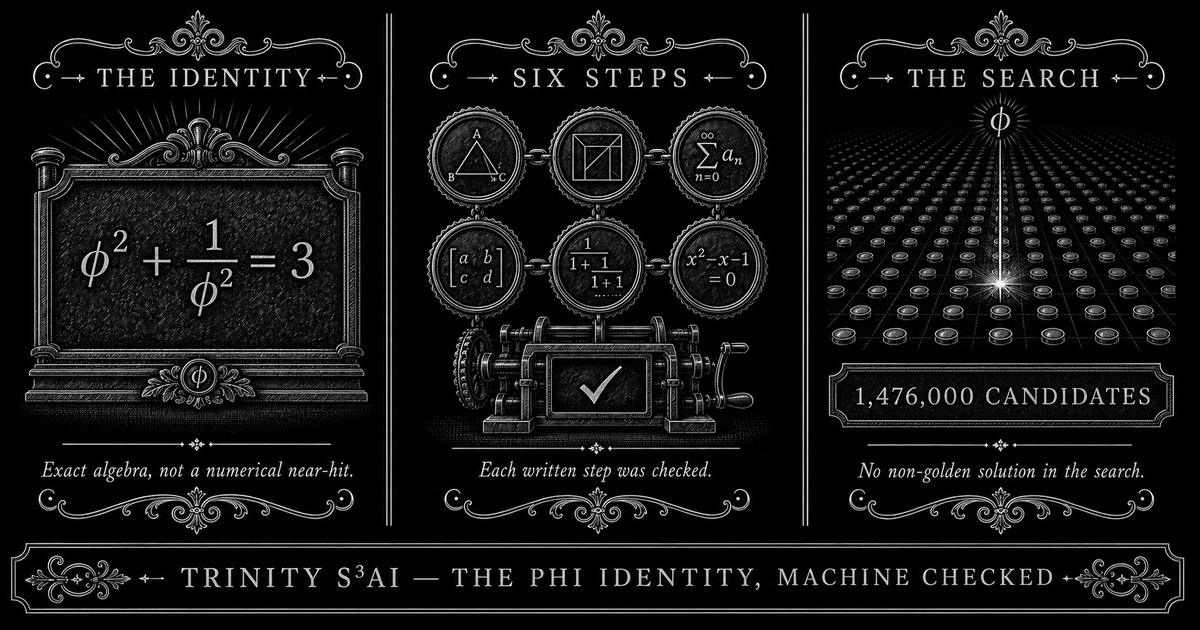
- THE IDENTITYExact algebra, not a numerical near-hit.
- SIX STEPSEach written step was checked.
- THE SEARCHNo non-golden solution in the search.
The identity is two lines from the definition. What follows is what happened when I stopped trusting that and checked it mechanically instead.
The identity
phi = (1 + sqrt(5)) / 2
phi^2 = phi + 1        (the defining quadratic)
1/phi = phi - 1
1/phi^2 = (phi-1)^2 = 2 - phi

phi^2 + 1/phi^2 = (phi + 1) + (2 - phi) = 3
phi cancels identically. This is exact algebra in Q(sqrt 5), not a numerical near-hit.
Checked four ways
- Decimal at 80 digits: the sum differs from 3 by 1e-79, which is the rounding of an irrational division and nothing else.
- mpmath at 60, 210 and 1000 digits: the difference is exactly 0.0 at every precision.
- sympy symbolically: simplify(phi2 + 1/phi2) returns the integer 3. There is no residual to hide at any precision.
- Every one of the six written steps verified independently — so the proof is not a correct conclusion reached by a broken argument.
And the converse, which is the part worth having
Solving x^2 + 1/x^2 = 3 gives exactly four roots: phi, 1/phi, -phi, -1/phi. Clearing denominators gives x^4 - 3x^2 + 1, which factors as (x^2-x-1)(x^2+x-1).
Since the expression is invariant under x -> -x and under x -> 1/x, phi is the unique solution up to the expression’s own symmetry group. The identity pins down phi rather than merely holding for it.
A numerical net was run as well — 1,476,000 candidates of the form (p + q*sqrt(d))/r across p, q, d, r ranges — and produced no non-golden solution, as the degree-4 factorisation requires.
What it does not license
The identity is logically equivalent to the definition, not additional to it: x^4-3x^2+1 factors into the two quadratics, so "x^2+1/x^2=3" and "x^2=x+1" are the same statement. It carries no information beyond how phi is defined.
And landing on a small integer is guaranteed. Every even power does: 3, 7, 18, 47, 123, 322, 843, 2207 — the Lucas numbers. The 3 is L(2), the trace of phi^2 over the rationals. It is not a number phi happens to reach.
So the identity is exact, the proof is sound, phi is pinned down, and none of that is evidence for anything about radix 3. Those are four separate statements and only the first three are established here.
What this does not settle
- Сhecked 2026-08-11 with sympy, mpmath at 60/210/1000 digits, and a 1,476,000-candidate numerical net. The identity itself is Euclid’s; only the verification is dated here.
- This is the n=1 case of the standard Lucas identity phi^(2n) + phi^(-2n) = L(2n). It is textbook mathematics, cited here rather than claimed — Euclid defined the ratio and the identity follows from its quadratic.
- Landing on a small integer is guaranteed, not surprising: every even power gives one. phi^2+phi^-2 through phi^16+phi^-16 are 3, 7, 18, 47, 123, 322, 843, 2207.
- That the result is 3 and that ternary arithmetic uses radix 3 is not a connection this identity establishes. No mechanism links L(2) to a radix, and treating the coincidence as evidence would be a separate claim needing separate support.
Receipts
Work with me
Want this kind of check on your own design?
I audit RTL and build independent, bit-exact models, then take the result through synthesis and, when useful, onto an Artix-7 board. The first conformance module is free.