Blog
The search space erased a significance claim
A merged audit of 67 targets withdraws a roughly 10-sigma reading after enumerating the search family that made near-matches likely by chance.
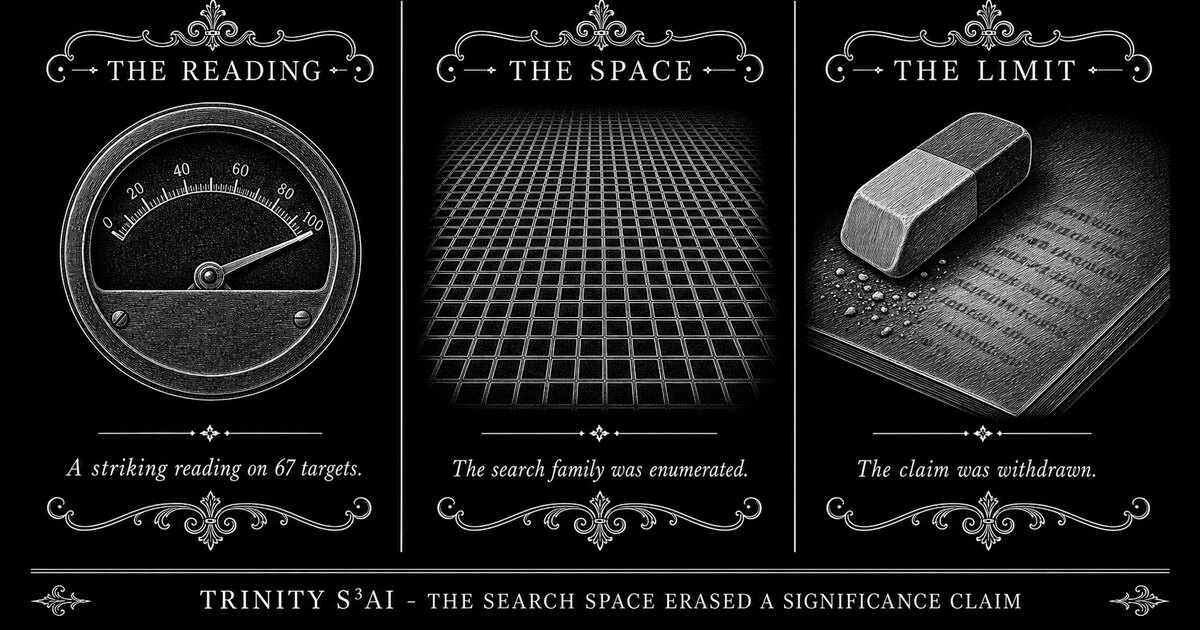
- THE READINGA striking reading on 67 targets.
- THE SPACEThe search family was enumerated.
- THE LIMITThe claim was withdrawn.
The claim changed when the search was counted
PR #738 is merged in gHashTag/trinity. It audits the statistical-significance section of sacred-formulas.md with a reproducible enumeration rather than accepting the probabilities printed in the document. The audit covers 67 factual targets and the family V = n · 3^k · π^m · φ^p · e^q around each one.
The important correction is not that a few formulas moved in the last decimal place. It is that the size and local density of the search family determine how surprising a near-match can be. A narrow numerical band is not evidence by itself when the search produces many candidates for every target.
Two enumerations, two corrected baselines
| Enumeration | Combinations | Printed probability | Recomputed probability | Corrected reading |
|---|---|---|---|---|
| Standard, m from −3 to 0 | 54,756 | 0.2% | 64.2% (minimum 33.2%) | near-matches are common |
| Extended | 123,201 | 2.9% | near 100% (minimum 88.4%) | the search is highly permissive |
For the extended enumeration, a probability near 100% per target implies roughly 67 expected hits among 67 targets. The document listed 32. Being below that chance expectation does not establish significance in either direction; it means the reported matches are not informative at the stated precision.
The audit therefore withdraws the earlier roughly 10-sigma and 3-sigma readings. For the extended family, a Šidák correction with M = 123,201 and α = 0.05 gives a threshold of 5.06σ, not 3σ. This threshold is a property of the declared multiplicity model, not a universal constant.
The correction is reproducible and asymmetric in the right way
The merged change adds executable checks and replaces several trusted numbers with values recomputed from the underlying rows. It also corrects the count of established constants from 75 to 70 and the EXACT class from 35 to 32. These are not new measurements of nature; they are corrected readings of the repository data.
One numerical comparison shows why arithmetic precision is not the main issue here. For the proton-to-electron mass ratio, the corrected target is 1836.152673426(32), while the document’s formula misses it by 6.3·10⁷σ when expressed in measurement-uncertainty units. The audit separately checks floating-point error and finds it far below the tolerance used by the calculation, so this discrepancy is not explained by rounding.
Before asking whether a match is surprising, enumerate what was allowed to match.
What the merged PR leaves visible
- The standard search bounds enumerate 54,756 combinations, while the document also prints 20,412; the inconsistency is flagged, not hidden.
- The shared factors make family members dependent, so the Šidák threshold is a reference calculation until that dependence is modelled.
- The width of the local-density window is supported by stability checks, not by a theorem.
- The result is a negative finding about evidential value: the declared matches do not support the former significance claim at the stated precision.
That is a useful outcome for a codebase that wants its numerical claims to remain inspectable. The audit does not declare the coincidences false. It makes the stronger and narrower statement that this search procedure makes them too easy to obtain for the old significance language to survive.
What this does not settle
- The Šidák threshold of 5.06σ assumes independent family members; the dependence created by shared factors was not estimated, so the actual threshold may be lower.
- The one-decade window used for local-density estimates was checked for stability, but it has no theoretical derivation in this audit.
- The document still records a mismatch between an announced standard search size of 20,412 and bounds that enumerate 54,756 combinations; the PR flags the discrepancy instead of silently choosing one.
- The corrected counts concern this document and its declared family of formulas; they do not establish a general statement about mathematical coincidences outside that family.
Receipts
Work with me
Want this kind of check on your own design?
I audit RTL and build independent, bit-exact models, then take the result through synthesis and, when useful, onto an Artix-7 board. The first conformance module is free.