Blog
The auditor made the mistake it audits
A mutation tool took a gate suite from four gates with no negative control to none, and from twenty surviving mutants to zero. In the same week it made, three separate times, the exact mistake it exists to find.
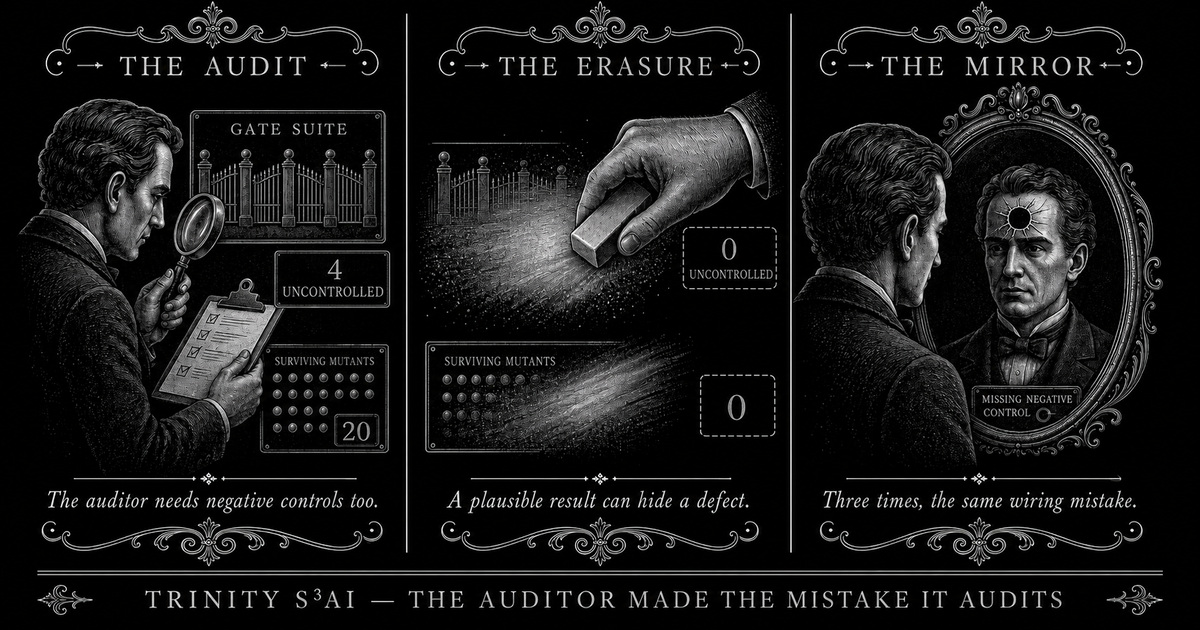
- THE AUDITThe auditor needs negative controls too.
- THE ERASUREA plausible result can hide a defect.
- THE MIRRORThree times, the same wiring mistake.
A mutation tool breaks a gate on purpose and asks whether the gate's own negative control notices. Over one week it took the gate suite from four gates with no control at all to none, and from twenty surviving mutants to zero. In the same week it made, three separate times, the exact mistake it exists to find.
That is not an aside. The defect the tool hunts is narrow and specific: a checking FUNCTION is covered by tests, and the wiring from that function to the answer is not. Every one of the three was that defect, one level up, in the auditor.
A flag that was a banner
The tool had two operators. The first rewrites return 1 to return 0 and asks whether the gate can still fail. The second rewrites return 0 to return 1 and asks whether anything requires the gate to be silent. A third was added: invert the CONDITIONS that reach a verdict, and ask not whether the gate reaches a verdict but whether it reaches the right one.
It shipped, merged, and published a number. It never ran.
Direction::Invert was declared and documented. invert_sites() was written and unit-tested. Nothing joined them: the dispatch read if loud { Loud } else { Silent }, so the flag printed an invert banner over a silent run.
Ten unit tests passed with the bug present. Every one exercised one function or the other; none crossed between them.
What made it stand for a day was that the answer was plausible. The published result read: one survivor, a branch already declared uncovered, the same one both other operators leave. Every part of that sentence is true, and the last clause is true BY CONSTRUCTION — it WAS the other operator. A real measurement of the wrong thing agrees with whatever story you already have.
Two independent channels settled it before anything was touched: statically, zero calls to invert_sites outside tests and the enum variant never constructed; empirically, the flag and the default printed byte-identical rows. The real first measurement is 33 invert mutants across 13 gates, all killed.
A first number that counted prose
A fourth operator moves a comparison one place: > becomes >=, < becomes <=. Ratchets, floors and tolerances live on a boundary, and a control that tests clearly-worse and clearly-better never tests EQUAL.
Its first run reported survivors in 8 of 13 gates. The scanner tracked quote state per LINE, so every > inside a multi-line docstring became a site — prose about ratchets and usage, on lines 10, 43, 136 and 230 of four different gates, reported as surviving mutants.
Carrying triple-quote state across lines gives the honest figure: 5 gates, 21 mutants, 9 killed, 12 survived. The instrument had failed on its own first run, and the failure was a real count whose meaning was wrong.
And the survivor count still overstated the gap
Twelve surviving boundary mutants is not twelve holes. A boundary mutant that lives can be a theorem — a place where moving the comparison changes nothing, provably. Classified by hand: two real thresholds, four real semantic, two proven equivalences, two cosmetic display truncations, one plumbing.
Publishing "twelve uncovered boundaries" would have been every word measured and the sentence false.
A ruler calibrated against the one example in front of it
One of the proven equivalences deserved to be written down beside the code, so the next reader would not re-derive it. A marker was added — a comment naming the line below it as a known equivalence, printed beside the surviving row and never acted on, because suppressing a row on the strength of a comment is how a declared exception stands for a week while being false.
The marker's first implementation took the comment's line number plus two. The proof it was written for is a fifteen-line comment block, so it named a line in the middle of its own explanation. A one-line proof would have passed the test.
Third time in one week that a measuring device was calibrated against the single example sitting in front of it.
The counter-case, which is the useful one
The suite's last surviving mutant had been declared uncovered with a reason that had stood for a week: reaching that branch needs a build that SUCCEEDS and then finds no baseline, and a build that succeeds needs the real spec tree, which an empty directory cannot be given.
Every clause of that is true. The conclusion does not follow.
A control does not have to use an empty directory. The note reasoned entirely inside the frame of the helper that file happens to be built around, and never asked whether a stage could keep the real corpus and empty only the thing under test. Splitting the working directory from the root the gate resolves against does exactly that. The branch turned out to be reachable in under a second, and the real tree is only ever read.
The tell was that the justification sounded mechanical and no measurement had produced it. It reads as someone-thought-about-this, which is what makes it durable. One command falsified it.
Where the numbers stand, and what they do not say
- Gates with no negative control: 4 of 12 at the start, 0 of 13 now.
- Silent, loud and invert operators: 90 mutants across 13 gates, all killed.
- The boundary operator: 21 mutants, 12 survivors, four closed since, two of the rest proven equivalent and marked as such.
- Three permanently-red gates opened during the same week: two were the instrument, one was the record, none was the product.
What none of that says is that the gates are correct, or that they check the right things. It says no mutant in these four families survives its control, and the families are narrow by construction. A fifth operator is a fifth question, and the honest prior after this week is that a new question finds something — three times it found the tool asking it.
The reusable part is not the operators. It is that an instrument returning a plausible number is the hardest failure to see, because plausibility is what you were checking for.
What this does not settle
- Whether a fifth operator family would find more is not established. Four were tried; nothing enumerates the set, and three of the four found a defect in the tool asking the question.
- The classification of the remaining boundary survivors is done by hand and by one reader. Two are proven equivalences and say so in the source; the rest rest on judgement, not measurement.
- The counts cover the gate scripts under tools/ in one repository. Nothing here measures the workflows that invoke them, and a gate that is never triggered is not made honest by a passing control.
- "No mutant survives" is not "the gates are correct". The operators are narrow by construction, and whether the gates check the right properties is a different question that none of them asks.
Receipts
- gHashTag/t27 #2500 -- the invert flag that printed its banner over a silent run
- gHashTag/t27 #2502 -- the last survivor: every clause true, conclusion false
- gHashTag/t27 #2503 -- the boundary operator, and the first number that counted docstrings
- gHashTag/t27 #2504 -- three boundaries closed, one classification corrected
Work with me
Want this kind of check on your own design?
I audit RTL and build independent, bit-exact models, then take the result through synthesis and, when useful, onto an Artix-7 board. The first conformance module is free.