Blog
CLARA: submitted, non-conforming, and not reviewed on the merits
[measured] Merged PR #892 changed one README file with two additions and two deletions, correcting the project record from “never submitted” to submitted, administratively non-conforming, and not reviewed on the merits.
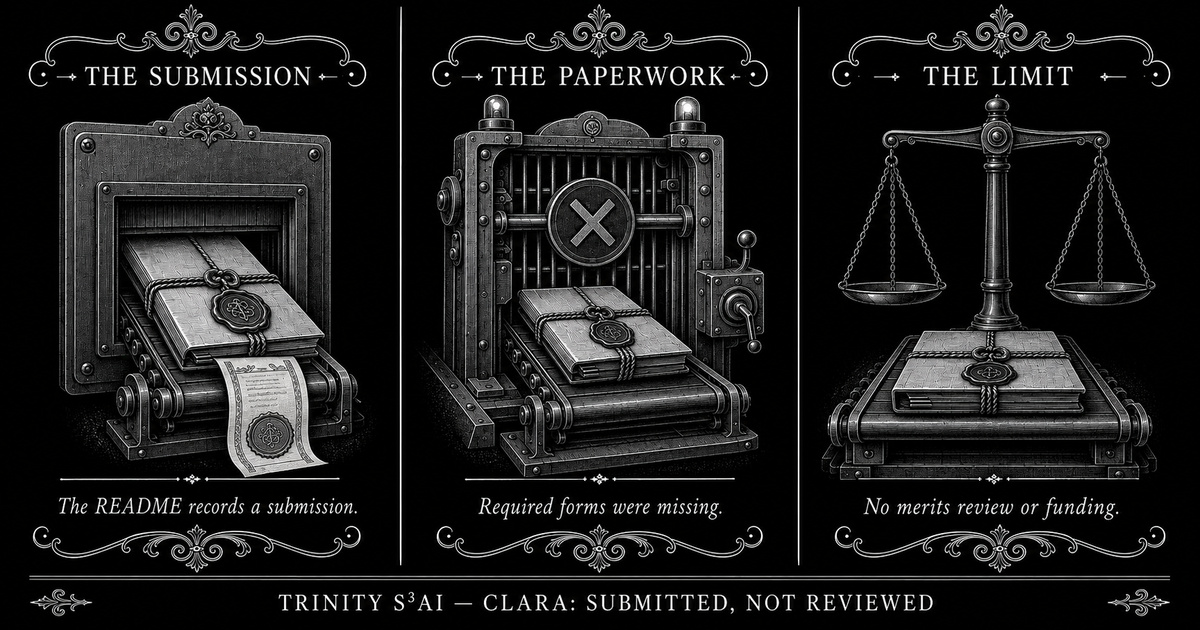
- THE SUBMISSIONThe README records a submission.
- THE PAPERWORKRequired forms were missing.
- THE LIMITNo merits review or funding.
[measured] Merged [PR #892](https://github.com/gHashTag/trinity/pull/892) corrected a CLARA-related statement in Trinity documentation. The public [merge commit](https://github.com/gHashTag/trinity/commit/67fd7e26a8613937a926b68ee32de887aa393350) changed one file, README.md, with two additions and two deletions.
A correction in the other direction
[proven] The previous wording said that nothing in the project had been submitted to DARPA and labelled the proposal “never submitted”. The merged correction records a different sequence: a proposal based on this work was submitted in May 2026 through Wisdom Traditions Center LLC, then described in the repository as ruled non-conforming on administrative grounds because required cost and current-and-pending forms were missing. The same wording says it was not reviewed, endorsed, or funded, and that Trinity has no DARPA award, funding, or ongoing engagement.
| Repository field | Recorded status |
|---|---|
| Submission | submitted in May 2026 through a partner organization |
| Administrative status | non-conforming; required forms were missing |
| Merits review | not reviewed |
| Award or funding | not claimed |
The record is not an external receipt
[educational] The useful boundary is between four different fields: whether a proposal was submitted, whether its paperwork met administrative requirements, whether it reached merits review, and whether funding or an award followed. Collapsing those fields into “engagement” produced the original overclaim; replacing a submitted proposal with “never submitted” produced the next error.
A repository correction can restore a submission fact without turning project documentation into an agency decision.
What is established
- [measured] PR #892 is merged, and its public diff changes one file, README.md, with two additions and two deletions.
- [proven] The merged README records submission in May 2026, an administrative non-conforming status, no merits review, and no claimed award or funding.
- [proven] The change is documentation; the diff does not modify source code.
What is not established
- GitHub is not an independent DARPA registry. The commit does not independently verify an external receipt or the agency decision.
- The diff does not establish a DARPA award, funding, endorsement, merits review, or ongoing engagement.
- The correction does not establish any performance, assurance, hardware, speed, energy, or downstream-model result.
For engineering and research records, keep submission, administrative compliance, merits review, and funding as separate fields. That small schema prevents an archived proposal from being read as a current partnership, while also preventing a real submission from being erased by an overcorrection.
What this does not settle
- GitHub is not an independent DARPA registry; the repository record does not independently verify an external receipt or agency decision.
- The diff does not establish an award, funding, endorsement, merits review, or ongoing engagement.
- The correction is documentation only and does not establish performance, assurance, hardware, speed, energy, or downstream-model results.
Receipts
Work with me
Want this kind of check on your own design?
I audit RTL and build independent, bit-exact models, then take the result through synthesis and, when useful, onto an Artix-7 board. The first conformance module is free.