t27c на настоящей машине
Вы узнаете
Тот же компилятор на настоящей машине, печатающий то, что он действительно печатает.
Плеер в уроке 7 запускает компилятор в вашем браузере. Эта запись — нативный t27c, написанный на Rust, запущенный на настоящей машине на том же hello_world.t27: он сообщает статус спеки, тесты и инварианты, которые выпускает, и модуль Verilog с параметрами. Каждый байт записи напечатала команда; инсценирован только набор текста.
Попробуйте
Найдите строку, где t27c печатает параметры модуля Verilog.
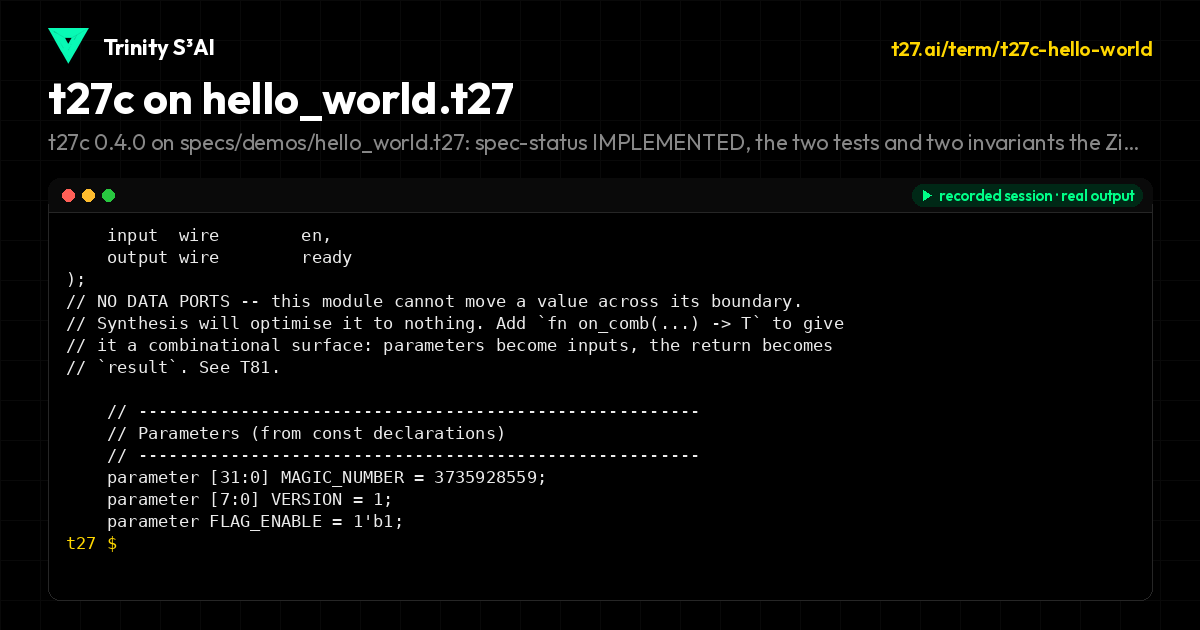
t27c 0.4.0 on specs/demos/hello_world.t27: spec-status IMPLEMENTED, the two tests and two invariants the Zig backend emits, and the Verilog module with its parameters.
specs/demos/hello_world.t27
// SPDX-License-Identifier: Apache-2.0
// Hello World Spec for T27 Language Explorer
// This spec demonstrates every major construct in the T27 language
// with explanatory comments about why each part is shaped the way it is.

// Module declaration: every T27 program lives in a module namespace.
// Modules provide encapsulation and prevent name collisions.
module HelloWorld {
    use base::types;

    // Public constant: specs must declare what reaches hardware.
    // Types are mandatory because the compiler needs to know memory layout
    // and hardware interface requirements at compile time.
    pub const MAGIC_NUMBER : u32 = 0xDEADBEEF;
    pub const VERSION : u8 = 1;
    pub const FLAG_ENABLE : bool = true;

    // Packed struct: memory layout is guaranteed to match hardware expectations.
    // The 'packed' keyword ensures no padding bytes are inserted between fields,
    // which is critical for hardware communication protocols and memory-mapped registers.
    pub struct ConfigPacked {
        pub width : u8,
        pub height : u8,
        pub depth : u8,
        pub enable : bool,
    }

    // Public function with explicit signature: every function must declare its
    // parameter types and return type. This is required for type safety and
    // hardware interface generation - the compiler needs to know exactly what
    // data moves between modules and what operations are valid.
    pub fn create_config(width : u8, height : u8, depth : u8) -> ConfigPacked {
        // Function body with explicit construction
        let config : ConfigPacked = ConfigPacked {
            width = width,
            height = height,
            depth = depth,
            enable = FLAG_ENABLE,
        };
        return config;
    }

    // Public function that demonstrates computation and type conversion.
    // Explicit signatures ensure type safety across hardware boundaries.
    pub fn calculate_area(config : ConfigPacked) -> u16 {
        // Type conversion is explicit: u8 * u8 -> u16 prevents overflow
        let area : u16 = cast(config.width) * cast(config.height);
        return area;
    }

    // Public function demonstrating conditional logic and early returns.
    // Explicit return type ensures the function always produces valid hardware data.
    pub fn is_config_valid(config : ConfigPacked) -> bool {
        // Early return with explicit type checking
        if config.width == 0u8 {
            return false;
        }
        if config.height == 0u8 {
            return false;
        }
        if config.depth == 0u8 {
            return false;
        }
        return config.enable;
    }

    // Test block: tests verify specific behaviors with concrete examples.
    // Tests are essential for regression checking and specification validation.
    test basic_config_creation
        let config = create_config(8u8, 16u8, 3u8)
        assert config.width == 8u8
        assert config.height == 16u8
        assert config.depth == 3u8
        assert config.enable == true

    // Test block demonstrating computation verification.
    // Tests catch logical errors and ensure the implementation matches specification.
    test area_calculation
        let small_config = create_config(5u8, 7u8, 2u8)
        let area = calculate_area(small_config)
        assert area == 35u16  // 5 * 7 = 35

    // Invariant block: invariants express properties that tests cannot verify.
    // While tests check specific cases, invariants declare general truths that
    // must hold across all possible executions - they are mathematical assertions
    // about the module's behavior that the compiler can leverage for optimization
    // and formal verification.
    invariant config_field_bounds
        // All numeric fields must be within reasonable hardware limits
        assert MAGIC_NUMBER <= 0xFFFFFFFFu32
        assert VERSION <= 255u8
        assert create_config(255u8, 255u8, 255u8).width <= 255u8

    // Invariant block demonstrating logical consistency.
    // Invariants can express complex relationships between data structures
    // that would be impossible to test exhaustively.
    invariant area_consistency
        // The calculated area must always be positive for valid configs
        let test_config = create_config(10u8, 20u8, 1u8)
        let area = calculate_area(test_config)
        assert area > 0u16
}Все уроки
Модуль 1 · Чип
Что такое FPGA, какой чип у нас и как его выводы встречаются с платой.
Модуль 2 · Числа в железе
Биты, триты и форматы чисел, и сколько стоит арифметика в логике.
Модуль 3 · Ваша программа на t27
Напишите спеку, проверьте её и увидьте, почему «компилируется» не значит «верно».
Модуль 4 · Внутри t27c
Как компилятор читает спеку и что он пишет, включая нативный t27b.
Модуль 5 · От спеки к железу
Verilog, который пишет t27c, ячейки, в которые он превращается, и что делает одна LUT.
Модуль 6 · Читаем синтез
Что yosys сообщает о вашем дизайне и какие предупреждения важны.
Модуль 7 · Размещение, трассировка, тайминг
Где ячейки оказываются на кристалле и успевает ли тактовая частота.
Модуль 8 · Битстрим
Как оттрассированный дизайн становится битами, которые загружает чип, без Vivado.
Модуль 9 · На плате
Спросите чип, кто он, загрузите биты и проверьте их.