Участки картинки
Вы узнаете
Почему сети читают картинку по участкам и что даёт окно 2 x 2, усреднённое по каждому участку.
Картинка это сетка чисел, и сети читают её небольшими участками, чтобы один и тот же детектор работал в любом её месте. Здесь окно 2 x 2 шагает по 2 по картинке 4 x 4, где в клетке i лежит i, и каждый выход это среднее своего участка: 2.5, 4.5, 10.5 и 12.5. При обратном проходе градиент каждого выхода делится поровну на его 4 клетки. Это усредняющий пулинг: свёртка взвешивала бы 4 клетки выученным ядром, и её спека, t27#10612, ещё не слита. Спека avgpool2d_layer.t27 вычисляет оба прохода.
Попробовать
Нажмите на каждый участок и проверьте его среднее на глаз; затем включите градиент и прочитайте, что получает каждая клетка окна 4.
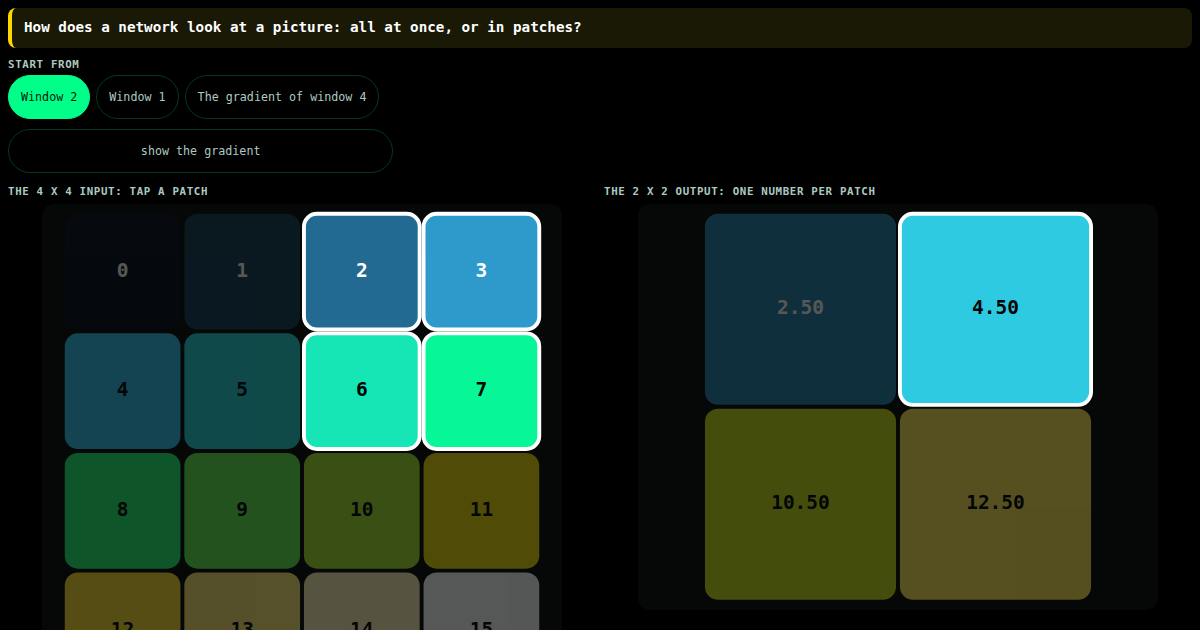
Tap a window on the 4 x 4 image: each output is the average of its 2 x 2 patch, two cells apart. Then switch to the gradient and see each output's blame shared out over its patch.
specs/ml/layers/avgpool2d_layer.t27
// SPDX-License-Identifier: Apache-2.0
// t27/specs/
// 2D average pooling formula | φ² + 1/φ² = 3 | TRINITY

// #8980: the kernel and stride were string constants typed `[]u32`, forward only
// asserted that its input was non-empty, and the tests asserted `true` or
// `result != undefined`. Average pooling now runs over one square H x H channel
// with the default 2 x 2 window and stride 2 and no padding, and each test checks
// numbers.

module Avgpool2d;
    use base::types;
    use math::constants;

    // ═══════════════════════════════════════════════════════════
    // 1. Constants
    // ═══════════════════════════════════════════════════════════

    const DEFAULT_KERNEL : u32 = 2;
    const DEFAULT_STRIDE : u32 = 2;

    // ═══════════════════════════════════════════════════════════
    // 2. Types
    // ═══════════════════════════════════════════════════════════

    pub const PoolConfig = struct {
        kernel_size : []u32,
        stride : []u32,
        padding : []u32,
    };

    pub const PoolShape = struct {
        batch : u32,
        channels : u32,
        height_in : u32,
        width_in : u32,
        height_out : u32,
        width_out : u32,
    };

    // ═══════════════════════════════════════════════════════════
    // 3. Core Functions
    // ═══════════════════════════════════════════════════════════

    // Output side for an input side n: (n - k) / stride + 1, and 0 when no window fits
    fn calc_output_size(height_in: u32) -> u32 {
        if (height_in < DEFAULT_KERNEL) {
            return 0;
        }
        return (height_in - DEFAULT_KERNEL) / DEFAULT_STRIDE + 1;
    }

    // output[oy][ox] = mean of the k x k window at (oy * stride, ox * stride) of a side x side
    // input; returns the number of outputs written
    fn forward(input: []const f32, side: u32, output: []f32) -> u32 {
        const n = calc_output_size(side);
        const area : f32 = @as(f32, @floatFromInt(DEFAULT_KERNEL * DEFAULT_KERNEL));
        var oy : u32 = 0;
        while (oy < n) {
            var ox : u32 = 0;
            while (ox < n) {
                var sum : f32 = 0.0;
                var ky : u32 = 0;
                while (ky < DEFAULT_KERNEL) {
                    var kx : u32 = 0;
                    while (kx < DEFAULT_KERNEL) {
                        sum = sum + input[(oy * DEFAULT_STRIDE + ky) * side + ox * DEFAULT_STRIDE + kx];
                        kx = kx + 1;
                    }
                    ky = ky + 1;
                }
                output[oy * n + ox] = sum / area;
                ox = ox + 1;
            }
            oy = oy + 1;
        }
        return n * n;
    }

    // backward: each window's gradient is shared equally by its k * k inputs
    fn backward(grad_output: []const f32, side: u32, grad_input: []f32) -> void {
        const n = calc_output_size(side);
        const area : f32 = @as(f32, @floatFromInt(DEFAULT_KERNEL * DEFAULT_KERNEL));
        var i : usize = 0;
        while (i < grad_input.len) {
            grad_input[i] = 0.0;
            i = i + 1;
        }
        var oy : u32 = 0;
        while (oy < n) {
            var ox : u32 = 0;
            while (ox < n) {
                var ky : u32 = 0;
                while (ky < DEFAULT_KERNEL) {
                    var kx : u32 = 0;
                    while (kx < DEFAULT_KERNEL) {
                        const idx = (oy * DEFAULT_STRIDE + ky) * side + ox * DEFAULT_STRIDE + kx;
                        grad_input[idx] = grad_input[idx] + grad_output[oy * n + ox] / area;
                        kx = kx + 1;
                    }
                    ky = ky + 1;
                }
                ox = ox + 1;
            }
            oy = oy + 1;
        }
    }

    // 4 x 4 input 0..15, row-major: windows average to 2.5, 4.5, 10.5, 12.5
    fn pool4_at(index: usize) -> f32 {
        var input : [16]f32 = [0.0] ** 16;
        var i : usize = 0;
        while (i < 16) {
            input[i] = @as(f32, @floatFromInt(i));
            i = i + 1;
        }
        var output : [4]f32 = [0.0] ** 4;
        _ = forward(&input, 4, &output);
        return output[index];
    }

    // forward over a 2 x 2 input (1, 2, 3, 4) or a 1 x 1 input (5); returns the outputs written
    fn pool_count(side: u32) -> u32 {
        const four : [4]f32 = [1.0, 2.0, 3.0, 4.0];
        const one : [1]f32 = [5.0];
        var output : [1]f32 = [-1.0];
        if (side == 2) {
            return forward(&four, 2, &output);
        }
        return forward(&one, 1, &output);
    }

    fn pool2_value() -> f32 {
        const four : [4]f32 = [1.0, 2.0, 3.0, 4.0];
        var output : [1]f32 = [-1.0];
        _ = forward(&four, 2, &output);
        return output[0];
    }

    fn backward4_at(index: usize) -> f32 {
        const grad_output : [4]f32 = [4.0, 8.0, 12.0, 16.0];
        var grad_input : [16]f32 = [9.0] ** 16;
        backward(&grad_output, 4, &grad_input);
        return grad_input[index];
    }

    fn valid_input() -> u32 {
        return calc_output_size(4);
    }

    // ═══════════════════════════════════════════════════════════
    // TDD: Tests (from .tri behaviors)
    // ═══════════════════════════════════════════════════════════

    test calc_output_size_basic_case
        given result = calc_output_size(4)
        then result == 2

    test calc_output_size_valid_input
        given input = 10
        when result = calc_output_size(input)
        then result == 5

    // A 1 x 1 input holds no 2 x 2 window
    test calc_output_size_small_input
        given input = 1
        when result = calc_output_size(input)
        then result == 0 and calc_output_size(2) == 1

    test calc_output_size_large_input
        given input = 1000
        when result = calc_output_size(input)
        then result == 500 and calc_output_size(1001) == 500

    test forward_basic_case
        given first = pool4_at(0)
        when last = pool4_at(3)
        then first == 2.5 and pool4_at(1) == 4.5 and pool4_at(2) == 10.5 and last == 12.5

    // A 2 x 2 input is one window: the mean of 1, 2, 3, 4
    test forward_non_empty_input
        given count = pool_count(2)
        when value = pool2_value()
        then count == 1 and value == 2.5

    test forward_single_element
        given count = pool_count(1)
        then count == 0

    // Each of a window's 4 inputs gets a quarter of its gradient
    test backward_spreads_the_gradient
        given corner = backward4_at(0)
        when last = backward4_at(15)
        then corner == 1.0 and backward4_at(5) == 1.0 and backward4_at(2) == 2.0 and last == 4.0

    // ═══════════════════════════════════════════════════════════
    // TDD: Invariants (from .tri constraints)
    // ═══════════════════════════════════════════════════════════

    // kernel_size[i] >= 1
    invariant avgpool2d_constraint_0
        assert DEFAULT_KERNEL >= 1

    // stride[i] >= 1
    invariant avgpool2d_constraint_1
        assert DEFAULT_STRIDE >= 1

    // stride[i] <= kernel_size[i]: windows tile the input without gaps
    invariant avgpool2d_constraint_2
        assert DEFAULT_STRIDE <= DEFAULT_KERNEL

    // name: avgpool_formula -- (n - k) / s + 1
    invariant avgpool2d_constraint_3
        assert valid_input() == 2

    // "Zeiler & Fergus (2014) - Visualizing and Understanding Convolutional Networks": pooling halves each side
    invariant avgpool2d_constraint_4
        assert calc_output_size(8) == 4

    // "He et al. (2016) - Deep Residual Learning for Image Recognition": a 7 x 7 map pools to 3 x 3
    invariant avgpool2d_constraint_5
        assert calc_output_size(7) == 3
Все уроки
Модуль 1 · Один нейрон
Нейрон складывает входы и изгибает сумму: ReLU, сигмоида и tanh, и где каждая перестаёт пропускать градиент назад.
Модуль 2 · Новые изгибы
Гладкие кривые нынешних моделей: GELU с провалом, Swish с ручкой и ELU с полом вместо обрыва.
Модуль 3 · Слой
Что окружает нейроны: softmax превращает оценки в выбор, эмбеддинг превращает слово в числа, dropout выключает нейроны.
Модуль 4 · Картинки
Чтение картинки по участкам: окно, усреднённое по участку, max pooling и пакетная нормализация признаков разного масштаба.
Модуль 5 · Ошибка
Насколько неверна догадка, одним числом: среднеквадратичная ошибка, перекрёстная энтропия для вероятностей и функция Хьюбера для выбросов.
Модуль 6 · Под гору
Спуск по функции потерь: градиентный спуск с моментом, RMSProp без оглядки на величину градиента и Adam, который соединяет оба.
Модуль 7 · Обучение
Откуда берутся градиенты и чего они добиваются: обратное распространение через слой, сеть, которая учит XOR, и LAMB для больших пакетов.
Модуль 8 · Память и внимание
Сети, которые читают последовательность: рекуррентная ячейка и её затухающее эхо, вентили LSTM и внимание ко всем позициям сразу.
Модуль 9 · Трансформер и награда
Части трансформера и агента: позиции как часы, один блок энкодера и PPO, который учится на награде без рывков.