The frame: start, data, stop
You will learn
How a UART frame is built bit by bit, and what the compiler emits for it.
A UART frame is the atoms of the bus: the line idles high, a start bit pulls it low, eight data bits follow, and a stop bit returns it high. The testbench spec of the last lesson of this module checks the idle itself -- uart_tb_tx_idle_high and uart_tb_rx_idle_high are two of its seven tests. The recording shows the compiler lowering the spec to synthesizable Verilog: the module ZeroDSP_UART, its clk, rst_n, en, data and ready ports, the datapath as wires.
Try it
In the recording, find the module name and its ports; then in the spec frame find the width and depth constants of the frame and the FIFO.
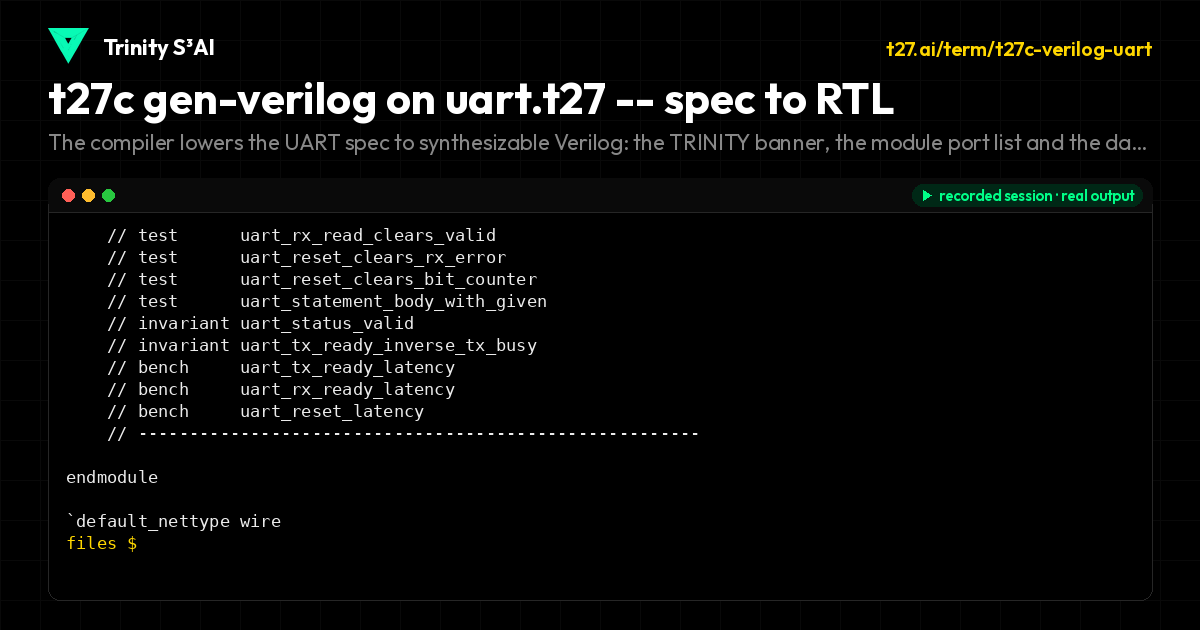
The compiler lowers the UART spec to synthesizable Verilog: the TRINITY banner, the module port list and the datapath as wires.
specs/fpga/uart.t27
// SPDX-License-Identifier: Apache-2.0
// t27/specs/fpga/uart.t27
// ZeroDSP FPGA UART Specification
// UART for debugging and communication
// φ² + 1/φ² = 3 | TRINITY

module ZeroDSP_UART {
    use base::types;
    use base::ops;
    use isa::registers;

    const UART_CLOCK_HZ : u32 = 100_000_000;
    const UART_BAUD_RATE : u32 = 115200;
    const UART_BIT_PERIOD : u32 = UART_CLOCK_HZ / UART_BAUD_RATE;

    const UART_WIDTH : usize = 8;
    const UART_FIFO_DEPTH : usize = 16;

    const STATUS_IDLE : u8 = 0;
    const STATUS_TX_BUSY : u8 = 1;
    const STATUS_RX_BUSY : u8 = 2;
    const STATUS_ERROR : u8 = 3;

    struct UARTState {
        tx_data : u8,
        tx_valid : bool,
        tx_ready : bool,
        rx_data : u8,
        rx_valid : bool,
        rx_error : bool,
        bit_counter : u8,
        status : u8,
    }

    var uart_state : UARTState = UARTState{
        .tx_data = 0,
        .tx_valid = false,
        .tx_ready = true,
        .rx_data = 0,
        .rx_valid = false,
        .rx_error = false,
        .bit_counter = 0,
        .status = STATUS_IDLE,
    };

    struct UARTConfig {
        baud_divisor : u32,
        parity_enable : bool,
        stop_bits : u8,
        fifo_enable : bool,
    }

    var uart_config : UARTConfig = UARTConfig{
        .baud_divisor = UART_CLOCK_HZ / (UART_BAUD_RATE * 16),
        .parity_enable = false,
        .stop_bits = 1,
        .fifo_enable = true,
    };

    fn uart_tx_ready() -> bool {
        return uart_state.tx_ready;
    }

    fn uart_tx_send(data: u8) -> bool {
        if (!uart_state.tx_ready) {
            return false;
        }
        uart_state.tx_data = data;
        uart_state.tx_valid = true;
        uart_state.tx_ready = false;
        uart_state.status = STATUS_TX_BUSY;
        return true;
    }

    fn uart_rx_ready() -> bool {
        return uart_state.rx_valid;
    }

    fn uart_rx_read() -> u8 {
        uart_state.rx_valid = false;
        return uart_state.rx_data;
    }

    fn uart_status() -> u8 {
        return uart_state.status;
    }

    fn uart_reset() -> void {
        uart_state.tx_data = 0;
        uart_state.tx_valid = false;
        uart_state.tx_ready = true;
        uart_state.rx_data = 0;
        uart_state.rx_valid = false;
        uart_state.rx_error = false;
        uart_state.bit_counter = 0;
        uart_state.status = STATUS_IDLE;
    }

    fn uart_configure(
        baud_divisor: u32,
        parity_enable: bool,
        stop_bits: u8,
        fifo_enable: bool,
    ) -> void {
        uart_config.baud_divisor = baud_divisor;
        uart_config.parity_enable = parity_enable;
        uart_config.stop_bits = stop_bits;
        uart_config.fifo_enable = fifo_enable;
    }

    test uart_initially_idle
        given status = uart_status()
        then status == STATUS_IDLE

    test uart_tx_ready_initially
        given ready = uart_tx_ready()
        then ready == true

    test uart_rx_not_valid_initially
        given valid = uart_rx_ready()
        then valid == false

    test uart_tx_send_returns_true_when_ready
        given result = uart_tx_send(0x55)
        then result == true

    test uart_tx_send_returns_false_when_busy
        given uart_tx_send(0x55)
        and   result = uart_tx_send(0xAA)
        then result == false

    test uart_reset_clears_status
        given uart_tx_send(0x55)
        and   uart_reset()
        and   status = uart_status()
        then status == STATUS_IDLE

    test uart_reset_restores_tx_ready
        given uart_tx_send(0x55)
        and   uart_reset()
        and   ready = uart_tx_ready()
        then ready == true

    test uart_configure_changes_baud_divisor
        given uart_configure(100, false, 1, true)
        then uart_config.baud_divisor == 100

    test uart_configure_parity_enable
        given uart_configure(54, true, 2, false)
        then uart_config.parity_enable == true
        and uart_config.stop_bits == 2
        and uart_config.fifo_enable == false

    test uart_bit_period_calc
        then UART_BIT_PERIOD == UART_CLOCK_HZ / UART_BAUD_RATE

    test uart_constants
        then UART_FIFO_DEPTH == 16
        and UART_WIDTH == 8
        and STATUS_IDLE == 0
        and STATUS_TX_BUSY == 1
        and STATUS_RX_BUSY == 2
        and STATUS_ERROR == 3

    test uart_tx_send_updates_state
        given result = uart_tx_send(0x42)
        then result == true
        and uart_state.tx_data == 0x42
        and uart_state.tx_valid == true
        and uart_state.tx_ready == false
        and uart_state.status == STATUS_TX_BUSY

    test uart_rx_read_clears_valid
        given uart_state.rx_data = 0x99;
        and   uart_state.rx_valid = true;
        given data = uart_rx_read()
        then data == 0x99
        and uart_state.rx_valid == false

    test uart_reset_clears_rx_error
        given uart_state.rx_error = true;
        and   uart_reset()
        then uart_state.rx_error == false

    test uart_reset_clears_bit_counter
        given uart_state.bit_counter = 7;
        and   uart_reset()
        then uart_state.bit_counter == 0

    test uart_statement_body_with_given
        given tmp = 1
        and   y = 2
        then tmp == y

    invariant uart_status_valid
        given status = uart_status()
        assert status == STATUS_IDLE or status == STATUS_TX_BUSY or
               status == STATUS_RX_BUSY or status == STATUS_ERROR

    invariant uart_tx_ready_inverse_tx_busy
        given status = uart_status()
        assert (uart_state.tx_ready) == (status == STATUS_IDLE)

    bench uart_tx_ready_latency
        measure: nanoseconds to uart_tx_ready()
        target: < 10ns

    bench uart_rx_ready_latency
        measure: nanoseconds to uart_rx_ready()
        target: < 10ns

    bench uart_reset_latency
        measure: nanoseconds to uart_reset()
        target: < 50ns
}

// W696: the hardware boundary, DERIVED -- not chosen.
//
// T187 measured an exact equivalence over 617 specs: a module gets a data
// port iff the spec declares `on_comb` or `on_clock`. Without one the
// compiler emits `NO DATA PORTS -- this module cannot move a value across
// its boundary`, and synthesis optimises the whole thing away.
//
// The standing rule is that the default must NOT be guessed. Here no guess
// was made: `t27c entry-points` found exactly ONE function in this spec that
// takes a parameter, returns a value, has a body, and whose types all have a
// known width. With one candidate the choice is forced, so this forwards and
// invents nothing. 11 of 387 port-less specs qualified.
fn on_comb(data: u8) -> bool { return uart_tx_send(data); }
All lessons
Module 1 · What a bus is
Why a bus exists at all: a conversation on wires, framed and addressed, and who is allowed to talk.
Module 2 · UART
The two-wire bus with no clock: the frame, the divisor that sets the rate, and the status a driver polls.
Module 3 · SPI
The clocked conversation: four modes, a prescaler ladder, and a chip select per servant.
Module 4 · APB
The register bus: PSEL and PENABLE, strobes and wait states, and how many address bits a peripheral count costs.
Module 5 · AXI4
The five channels: address, data and response in both directions, lite or full, bursts and IDs.
Module 6 · Memory
What sits on the far side of every bus: memory maps, port kinds, and latency that a wait state must cover.
Module 7 · Bridges
Why designs grow more than one bus, and the packet bridge that moves work between them.
Module 8 · Ethernet
Frames, the frame check sequence, RGMII timing, and the pre-registered steps of a real bring-up.
Module 9 · The bench
The discipline that guards real hardware: who holds the IO, taking and giving the lock, and what runs next.