Why bridges
You will learn
Why a design grows more than one bus, and what the bridge spec checks of its own state.
A design grows more than one bus because peripherals andcompute differ: a slow register bus for the knobs, a wide one for the data. The bridge spec, FPGA_Bridge, is the crossing of this design, and bridge_initially_idle and bridge_rx_buffers_empty are two of its twenty-one tests. The recording runs t27c check: 0 errors, 0 warnings.
Try it
In the recording, find the error and warning counts; then in the spec frame find the two idle tests and count the spec's tests.
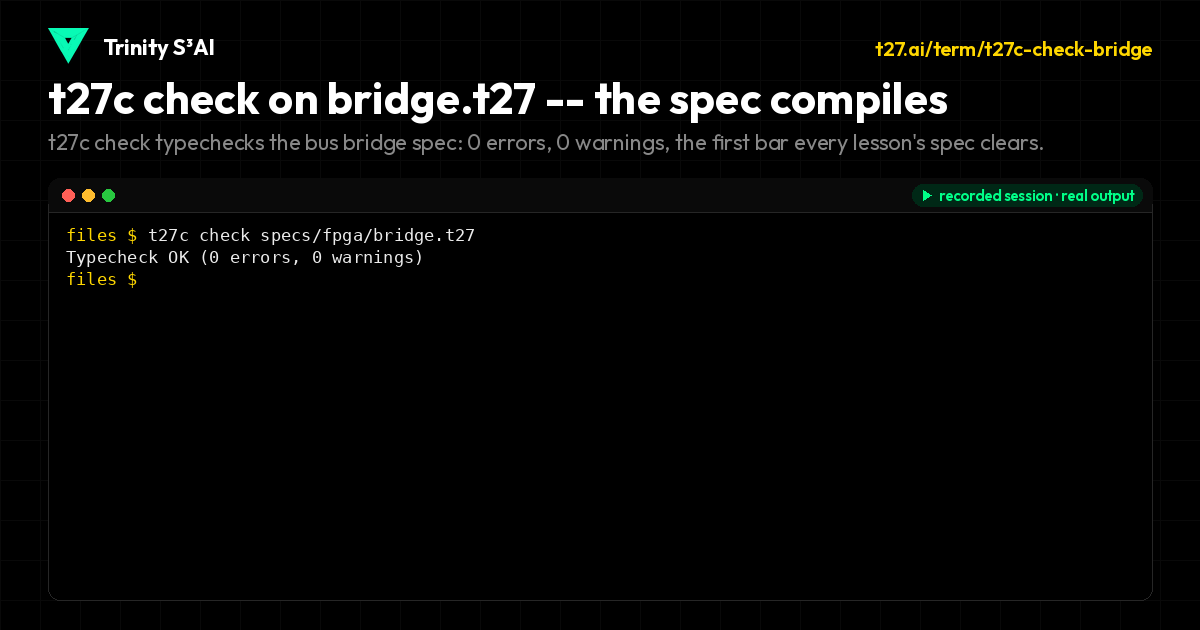
t27c check typechecks the bus bridge spec: 0 errors, 0 warnings, the first bar every lesson's spec clears.
specs/fpga/bridge.t27
// SPDX-License-Identifier: Apache-2.0
// t27/specs/fpga/bridge.t27
// FPGA Communication Bridge Specification
// Combines UART and SPI for host and peripheral communication
// φ² + 1/φ² = 3 | TRINITY

module FPGA_Bridge;
    // Import base types and submodules
    use base::types;
    use fpga::uart::UART_Bridge;
    use fpga::spi::SPI_Master;
    use fpga::mac::ZeroDSP_MAC;

    // ═══════════════════════════════════════════════════════════════
    // 1. Bridge Configuration
    // ═════════════════════════════════════════════════════════════════════════

    // Buffer configuration
    const RX_BUFFER_SIZE : usize = 256;       // UART RX buffer size
    const TX_BUFFER_SIZE : usize = 256;       // UART TX buffer size
    const SPI_BUFFER_SIZE : usize = 64;       // SPI transfer buffer

    // Protocol configuration
    const MAX_PACKET_SIZE : usize = 128;       // Max bytes per packet
    const PACKET_TIMEOUT : u32 = 10_000;    // 10ms timeout (cycles)

    // MAC operation codes (mirrors fpga::mac::ZeroDSP_MAC)
    const OP_MAC_MUL : u8 = 0;
    const OP_MAC_MAC : u8 = 1;
    const OP_MAC_MACC : u8 = 2;
    const OP_MAC_DOT : u8 = 3;
    const NUM_MAC_UNITS : usize = 8;

    // ═══════════════════════════════════════════════════════════════
    // 2. Bridge State
    // ═════════════════════════════════════════════════════════════════════════

    // Bridge state machine
    const BRIDGE_IDLE : u8 = 0;
    const BRIDGE_RX : u8 = 1;
    const BRIDGE_PARSE : u8 = 2;
    const BRIDGE_TX : u8 = 3;
    const BRIDGE_SPI : u8 = 4;
    const BRIDGE_MAC : u8 = 5;

    // Bridge unit state
    struct Bridge_Unit {
        state : u8,                    // Current state
        rx_head : usize,                // RX buffer head
        rx_tail : usize,                // RX buffer tail
        tx_head : usize,                // TX buffer head
        tx_tail : usize,                // TX buffer tail
        tx_bytes : [TX_BUFFER_SIZE]u8,    // TX ring storage (struct field: wasm + verilog both accept)

        // Packet state
        packet_len : u8,                // Current packet length
        packet_type : u8,              // Current packet type
        timeout_cnt : u32,              // Packet timeout counter

        // Mode selection
        spi_enabled : bool,              // SPI peripheral mode
        mac_enabled : bool,              // MAC operation mode
    }

    // Initialize bridge
    var bridge : Bridge_Unit = Bridge_Unit{
        .state = BRIDGE_IDLE,
        .rx_head = 0,
        .rx_tail = 0,
        .tx_head = 0,
        .tx_tail = 0,
        .tx_bytes = [0u8; TX_BUFFER_SIZE],
        .packet_len = 0,
        .packet_type = 0,
        .timeout_cnt = 0,
        .spi_enabled = true,
        .mac_enabled = true,
    };

    // ═══════════════════════════════════════════════════════════════
    // 3. Buffer Management
    // ═════════════════════════════════════════════════════════════════════════

    // RX and TX buffers
    var rx_buffer : [RX_BUFFER_SIZE]u8 = [0u8; RX_BUFFER_SIZE];

    // buffer_write(buf: []u8, size: usize, head: usize, data: u8) → bool
    // Write byte to circular buffer
    fn buffer_write(buf_in: []u8, size: usize, head: usize, data: u8) -> bool {
        // `head` was never checked against `size`, so a caller one past the end
        // wrote out of bounds: in the generated Rust that panics, and in C the
        // signature is `bool buffer_write(uint8_t* buf_in, size_t size, size_t
        // head, uint8_t data)` -- a bare pointer, so the write simply happens.
        // The sibling `buffer_read` in this same file guards its index; this
        // one did not, and an asymmetry inside one file is an oversight rather
        // than a convention.
        //
        // The bound uses `size`, not `buf_in.len`, deliberately: a `[]T` loses
        // its length at the C ABI, so a `.len`-based guard would exist in the
        // Rust and Zig outputs and be absent from C (#3428).
        if (head >= size) {
            return false;
        }
        const new_head = (head + 1) % size;
        if (new_head == 0 && head == size - 1) {
            return false;  // Buffer full
        }
        buf_in[head] = data;
        return true;
    }

    // buffer_read(buf: []u8, size: usize, tail: usize) → (u8, usize)
    // Read byte from circular buffer, return (data, new_tail)
    fn buffer_read(buf: []u8, size: usize, tail: usize) -> (u8, usize) {
        // `>=`, not `==`: the equality caught the one-past-the-end case and
        // let every larger index through to `buf[tail]`.
        if (tail >= size) {
            return (0u8, 0);
        }
        const data = buf[tail];
        const new_tail = (tail + 1) % size;
        return (data, new_tail);
    }

    // buffer_count(head: usize, tail: usize, size: usize) → usize
    // Count bytes in circular buffer
    fn buffer_count(head: usize, tail: usize, size: usize) -> usize {
        if (head >= tail) {
            return head - tail;
        } else {
            return head + size - tail;
        }
    }

    // bridge_rx_available() → usize
    // Get available bytes in RX buffer
    fn bridge_rx_available() -> usize {
        return buffer_count(bridge.rx_head, bridge.rx_tail, RX_BUFFER_SIZE);
    }

    // bridge_tx_space() → usize
    // Get available space in TX buffer
    fn bridge_tx_space() -> usize {
        return TX_BUFFER_SIZE - buffer_count(bridge.tx_head, bridge.tx_tail, TX_BUFFER_SIZE);
    }

    // ═══════════════════════════════════════════════════════════════
    // 4. Packet Protocol
    // ═════════════════════════════════════════════════════════════════════════

    // Packet types
    const PKT_UART_DATA : u8 = 0x00;
    const PKT_SPI_XFER : u8 = 0x10;
    const PKT_MAC_OP : u8 = 0x20;
    const PKT_STATUS : u8 = 0x30;
    const PKT_CONFIG : u8 = 0x40;

    // Packet format: [TYPE][LEN][DATA...][CRC]

    // bridge_parse_header() → bool
    // Parse packet header from RX buffer
    fn bridge_parse_header() -> bool {
        if (bridge_rx_available() < 2) {
            return false;
        }

        const ptype = buffer_read(rx_buffer, RX_BUFFER_SIZE, bridge.rx_tail);
        const plen = buffer_read(rx_buffer, RX_BUFFER_SIZE, ptype);
        bridge.rx_tail = plen;

        bridge.packet_type = ptype;
        bridge.packet_len = plen;

        // Validate packet
        if (plen > MAX_PACKET_SIZE) {
            return false;  // Invalid length
        }

        bridge.state = BRIDGE_PARSE;
        bridge.timeout_cnt = 0;
        return true;
    }

    // bridge_process_payload() → bool
    // Process packet payload based on type
    fn bridge_process_payload() -> bool {
        if (bridge_rx_available() < bridge.packet_len as usize) {
            // Wait for more data
            bridge.timeout_cnt = bridge.timeout_cnt + 1;
            if (bridge.timeout_cnt > PACKET_TIMEOUT) {
                // Timeout, reset to idle
                bridge.state = BRIDGE_IDLE;
                bridge.rx_tail = bridge.rx_head;  // Clear buffer
            }
            return false;
        }

        // Dispatch by packet type. Was a `match` STATEMENT, which the parser
        // has never supported -- the whole dispatch was silently DROPPED from
        // the generated Verilog (t27#1940 hardening surfaced it).
        if (bridge.packet_type == PKT_UART_DATA) {
            bridge_handle_uart_data();
        } else if (bridge.packet_type == PKT_SPI_XFER) {
            bridge_handle_spi_xfer();
        } else if (bridge.packet_type == PKT_MAC_OP) {
            bridge_handle_mac_op();
        } else if (bridge.packet_type == PKT_STATUS) {
            bridge_handle_status();
        } else if (bridge.packet_type == PKT_CONFIG) {
            bridge_handle_config();
        } else {
            // Unknown packet type
            bridge.state = BRIDGE_IDLE;
            bridge.rx_tail = bridge.rx_head;
            return false;
        }

        bridge.state = BRIDGE_IDLE;
        return true;
    }

    // ═══════════════════════════════════════════════════════════════
    // 5. Packet Handlers
    // ═════════════════════════════════════════════════════════════════════════

    // bridge_handle_uart_data() → void
    // Handle UART data packet (echo back)
    fn bridge_handle_uart_data() -> void {
        var i : usize = 0;
        while (i < bridge.packet_len as usize) {
             const result_read = buffer_read(rx_buffer, RX_BUFFER_SIZE, bridge.rx_tail);
             const data = result_read;
             bridge.rx_tail = result_read;

             // Echo back via TX
             if (bridge_tx_space() > 0) {
                 const ok = true;
                 const new_head = (bridge.tx_head + 1) % TX_BUFFER_SIZE;
                 bridge.tx_bytes[bridge.tx_head] = data;
                 bridge.tx_head = new_head;
             }
            i = i + 1;
        }
    }

    // bridge_handle_spi_xfer() → void
    // Handle SPI transfer packet
    fn bridge_handle_spi_xfer() -> void {
        if (!bridge.spi_enabled || spi_is_busy()) {
            return;
        }

        const cs_sel = buffer_read(rx_buffer, RX_BUFFER_SIZE, bridge.rx_tail);
        const data_l = buffer_read(rx_buffer, RX_BUFFER_SIZE, cs_sel);
        const data_h = buffer_read(rx_buffer, RX_BUFFER_SIZE, data_l);
        bridge.rx_tail = data_h;

        const data = (data_h as u32) << 8 | data_l as u32;
        if (spi_transfer(data)) {
            // Transfer started, will complete asynchronously
        }
    }

    // bridge_handle_mac_op() → void
    // Handle MAC operation packet
    // Packet format: [OP][UNIT][A_L][A_H][B_L][B_H]
    // OP: MAC opcode (0=mul, 1=mac, 2=macc, 3=dot)
    // UNIT: MAC unit index (0..7)
    // A_L,A_H: operand A (low/high byte of 16-bit value)
    // B_L,B_H: operand B (low/high byte of 16-bit value)
    fn bridge_handle_mac_op() -> void {
        if (!bridge.mac_enabled) {
            return;
        }

        if (bridge_rx_available() < 6) {
            return;
        }

        const op_byte = buffer_read(rx_buffer, RX_BUFFER_SIZE, bridge.rx_tail);
        bridge.rx_tail = op_byte;

        const unit_byte = buffer_read(rx_buffer, RX_BUFFER_SIZE, bridge.rx_tail);
        bridge.rx_tail = unit_byte;

        const a_l = buffer_read(rx_buffer, RX_BUFFER_SIZE, bridge.rx_tail);
        bridge.rx_tail = a_l;

        const a_h = buffer_read(rx_buffer, RX_BUFFER_SIZE, bridge.rx_tail);
        bridge.rx_tail = a_h;

        const b_l = buffer_read(rx_buffer, RX_BUFFER_SIZE, bridge.rx_tail);
        bridge.rx_tail = b_l;

        const b_h = buffer_read(rx_buffer, RX_BUFFER_SIZE, bridge.rx_tail);
        bridge.rx_tail = b_h;

        // Validate unit index
        if (unit_byte >= NUM_MAC_UNITS) {
            return;
        }

        // Reconstruct 16-bit operands
        const operand_a = (a_h as u16) << 8 | a_l as u16;
        const operand_b = (b_h as u16) << 8 | b_l as u16;

        // Dispatch MAC operation
        if (op_byte == OP_MAC_MUL) {
            mac_multiply(operand_a, operand_b, unit_byte);
        } else if (op_byte == OP_MAC_MAC) {
            mac_cycle(operand_a, operand_b, unit_byte, mac_get_accumulator(unit_byte));
        } else if (op_byte == OP_MAC_DOT) {
            mac_dot_product([operand_a], [operand_b], 1, unit_byte);
        }

        // Send result back via TX
        if (bridge_tx_space() >= 4) {
            const acc = mac_get_accumulator(unit_byte) as u32;
            bridge.tx_bytes[bridge.tx_head] = (acc & 0xFF) as u8;
            bridge.tx_head = (bridge.tx_head + 1) % TX_BUFFER_SIZE;
            bridge.tx_bytes[bridge.tx_head] = ((acc >> 8) & 0xFF) as u8;
            bridge.tx_head = (bridge.tx_head + 1) % TX_BUFFER_SIZE;
            bridge.tx_bytes[bridge.tx_head] = ((acc >> 16) & 0xFF) as u8;
            bridge.tx_head = (bridge.tx_head + 1) % TX_BUFFER_SIZE;
            bridge.tx_bytes[bridge.tx_head] = ((acc >> 24) & 0xFF) as u8;
            bridge.tx_head = (bridge.tx_head + 1) % TX_BUFFER_SIZE;
        }
    }

    // bridge_handle_status() → void
    // Handle status request
    fn bridge_handle_status() -> void {
        // Send status response
        const status = [
            if (bridge.spi_enabled) { 1u8 } else { 0u8 },
            if (bridge.mac_enabled) { 1u8 } else { 0u8 },
            0u8, 0u8,  // Reserved
        ];

        var i : usize = 0;
        while (i < 4) {
            if (bridge_tx_space() > 0) {
                bridge.tx_bytes[bridge.tx_head] = status[i];
                bridge.tx_head = (bridge.tx_head + 1) % TX_BUFFER_SIZE;
            }
            i = i + 1;
        }
    }

    // bridge_handle_config() → void
    // Handle configuration packet
    fn bridge_handle_config() -> void {
        const cfg_byte = buffer_read(rx_buffer, RX_BUFFER_SIZE, bridge.rx_tail);
        bridge.rx_tail = cfg_byte;

        // Bit 0: SPI enable
        // Bit 1: MAC enable
        bridge.spi_enabled = (cfg_byte & 0x01) != 0;
        bridge.mac_enabled = (cfg_byte & 0x02) != 0;
    }

    // ═══════════════════════════════════════════════════════════════════════════════════════════
    // TDD-Inside-Spec: Tests and Invariants for FPGA_Bridge
    // ═══════════════════════════════════════════════════════════════════════════════════════════

    test bridge_initially_idle
        given state = bridge.state
        then state == BRIDGE_IDLE

    test bridge_rx_buffers_empty
        given rx_avail = bridge_rx_available()
        then rx_avail == 0

    test bridge_tx_buffer_full_space
        given tx_space = bridge_tx_space()
        then tx_space == TX_BUFFER_SIZE

    test bridge_rx_write_success
        given result = buffer_write(rx_buffer, RX_BUFFER_SIZE, bridge.rx_head, 0xAA)
        then result == true

    test bridge_buffer_count_empty
        given count = buffer_count(0, 0, RX_BUFFER_SIZE)
        then count == 0

    test bridge_buffer_count_wrap
        given count = buffer_count(RX_BUFFER_SIZE - 1, 0, RX_BUFFER_SIZE)
        then count == RX_BUFFER_SIZE - 1

    test bridge_buffer_count_wrap2
        given count = buffer_count(0, RX_BUFFER_SIZE - 1, RX_BUFFER_SIZE)
        then count == 1

    test bridge_packet_types_defined
        given uart_pkt = PKT_UART_DATA
        and   spi_pkt = PKT_SPI_XFER
        and   mac_pkt = PKT_MAC_OP
        then uart_pkt == 0x00 and spi_pkt == 0x10 and mac_pkt == 0x20

    test bridge_max_packet_size
        given max_pkt = MAX_PACKET_SIZE
        then max_pkt == 128

    test bridge_timeout_defined
        given timeout = PACKET_TIMEOUT
        then timeout == 10_000

    test bridge_rx_tx_buffer_sizes
        given rx_size = RX_BUFFER_SIZE
        and   tx_size = TX_BUFFER_SIZE
        then rx_size == 256 and tx_size == 256

    test bridge_spi_enabled_by_default
        given spi_en = bridge.spi_enabled
        and   mac_en = bridge.mac_enabled
        then spi_en == true and mac_en == true

    test bridge_parse_header_requires_2_bytes
        given bridge_rx_available() == 1
        and   result = bridge_parse_header()
        then result == false

    test bridge_config_enables_spi
        given bridge.handle_config(0x01)
        then bridge.spi_enabled == true

    test bridge_config_enables_mac
        given bridge.handle_config(0x02)
        then bridge.mac_enabled == true

    test bridge_config_disables_spi
        given bridge.handle_config(0x00)
        then bridge.spi_enabled == false

    test bridge_mac_opcodes_defined
        given mul_op = OP_MAC_MUL
        and   mac_op = OP_MAC_MAC
        and   macc_op = OP_MAC_MACC
        and   dot_op = OP_MAC_DOT
        then mul_op == 0 and mac_op == 1 and macc_op == 2 and dot_op == 3

    test bridge_mac_unit_count
        given units = NUM_MAC_UNITS
        then units == 8

    test bridge_mac_handler_disabled_when_mac_off
        given bridge.mac_enabled = false
        and   bridge_handle_mac_op()
        then bridge.state == BRIDGE_IDLE

    test bridge_mac_handler_rejects_insufficient_data
        given bridge.mac_enabled = true
        and   bridge_rx_available() == 3
        and   bridge_handle_mac_op()
        then bridge.state == BRIDGE_IDLE

    test bridge_mac_handler_rejects_invalid_unit
        given bridge.mac_enabled = true
        and   bridge_rx_available() >= 6
        and   rx_buffer[bridge.rx_tail + 1] == 8
        and   bridge_handle_mac_op()
        then mac_get_accumulator(0) == 0

    invariant bridge_states_valid
        given state = bridge.state
        assert state == BRIDGE_IDLE or state == BRIDGE_RX or state == BRIDGE_PARSE
                or state == BRIDGE_TX or state == BRIDGE_SPI or state == BRIDGE_MAC

    invariant bridge_rx_tail_never_exceeds_head
        // Circular buffer invariant
        assert bridge.rx_head < RX_BUFFER_SIZE and bridge.rx_tail < RX_BUFFER_SIZE

    invariant bridge_tx_tail_never_exceeds_head
        assert bridge.tx_head < TX_BUFFER_SIZE and bridge.tx_tail < TX_BUFFER_SIZE

    invariant bridge_rx_available_bounds
        given avail = bridge_rx_available()
        assert avail <= RX_BUFFER_SIZE

    invariant bridge_tx_space_bounds
        given space = bridge_tx_space()
        assert space <= TX_BUFFER_SIZE

    invariant bridge_packet_length_bounds
        given plen = bridge.packet_len
        assert plen <= MAX_PACKET_SIZE

    invariant bridge_timeout_counter_increments
        given old_cnt = bridge.timeout_cnt
        when bridge.state == BRIDGE_PARSE and bridge_process_payload() == false
        then bridge.timeout_cnt >= old_cnt

    invariant bridge_timeout_resets_on_expiration
        given bridge.timeout_cnt = PACKET_TIMEOUT + 1
        and   bridge.state == BRIDGE_PARSE
        when bridge_process_payload() == false
        then bridge.state == BRIDGE_IDLE

    invariant bridge_config_affects_flags
        given old_spi = bridge.spi_enabled
        and   old_mac = bridge.mac_enabled
        when bridge.handle_config(0x03)
        then (bridge.spi_enabled || !bridge.spi_enabled)  // May have changed

    invariant bridge_modes_mutable
        assert true  // SPI and MAC can be toggled at runtime

    bench bridge_rx_write_latency
        measure: nanoseconds to buffer_write(rx_buffer, RX_BUFFER_SIZE, bridge.rx_head, 0xAA)
        target: < 50ns

    bench bridge_tx_read_latency
        measure: nanoseconds to buffer_read(bridge.tx_bytes, TX_BUFFER_SIZE, bridge.tx_tail)
        target: < 50ns

    bench bridge_parse_header_latency
        measure: nanoseconds to bridge_parse_header() when 2 bytes available
        target: < 200ns

    bench bridge_packet_processing_latency
        measure: nanoseconds to process PKT_STATUS packet
        target: < 500ns
All lessons
Module 1 · What a bus is
Why a bus exists at all: a conversation on wires, framed and addressed, and who is allowed to talk.
Module 2 · UART
The two-wire bus with no clock: the frame, the divisor that sets the rate, and the status a driver polls.
Module 3 · SPI
The clocked conversation: four modes, a prescaler ladder, and a chip select per servant.
Module 4 · APB
The register bus: PSEL and PENABLE, strobes and wait states, and how many address bits a peripheral count costs.
Module 5 · AXI4
The five channels: address, data and response in both directions, lite or full, bursts and IDs.
Module 6 · Memory
What sits on the far side of every bus: memory maps, port kinds, and latency that a wait state must cover.
Module 7 · Bridges
Why designs grow more than one bus, and the packet bridge that moves work between them.
Module 8 · Ethernet
Frames, the frame check sequence, RGMII timing, and the pre-registered steps of a real bring-up.
Module 9 · The bench
The discipline that guards real hardware: who holds the IO, taking and giving the lock, and what runs next.