Framing a conversation
You will learn
What a clocked conversation changes, and how the SPI spec states its modes and rates.
A conversation needs rules about when a word starts and ends, or the far side samples noise. The clocked answer is SPI, and the spec of this lesson, SPI_Master, states its ground: CLK_FREQ at 50,000,000, SPI_CPOL and SPI_CPHA at 0, a maximum data width of 32 bits. The recording runs t27c check on it: 0 errors, 0 warnings. The three buses this module opens -- UART, SPI, APB -- are the three answers the course takes apart, one per module.
Try it
In the recording, find the error and warning counts; then in the spec frame find CLK_FREQ, CPOL and CPHA, and say which mode the spec configures.
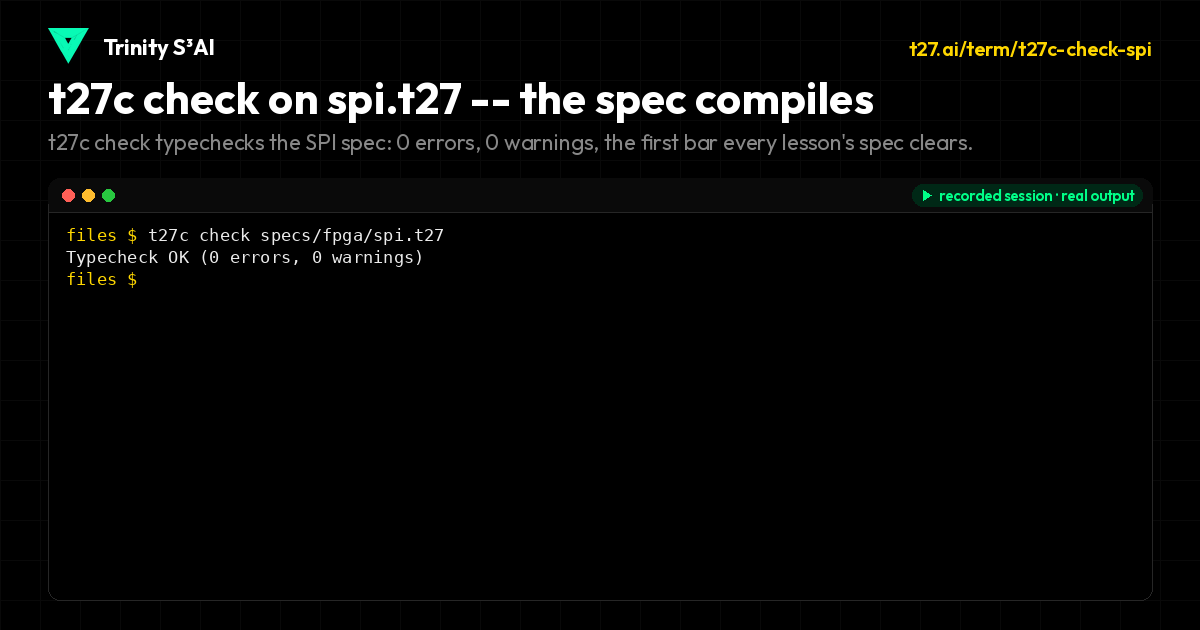
t27c check typechecks the SPI spec: 0 errors, 0 warnings, the first bar every lesson's spec clears.
specs/fpga/spi.t27
// SPDX-License-Identifier: Apache-2.0
// t27/specs/fpga/spi.t27
// SPI Master Specification for FPGA
// Mode 0: CPOL=0, CPHA=0 (SCK idle low, sample on rising edge)
// φ² + 1/φ² = 3 | TRINITY

module SPI_Master;
    // Import base types
    use base::types;

    // ═══════════════════════════════════════════════════════════════
    // 1. SPI Configuration
    // ═════════════════════════════════════════════════════════════════════════

    // System clock
    const CLK_FREQ : u32 = 50_000_000;    // 50 MHz

    // SPI Mode 0: CPOL=0, CPHA=0
    // CPOL (Clock Polarity): 0 = SCK idle low
    // CPHA (Clock Phase): 0 = Sample on first (rising) edge
    const SPI_CPOL : u8 = 0;
    const SPI_CPHA : u8 = 0;

    // SPI configuration
    const MAX_DATA_WIDTH : u8 = 32;       // Max bits per transfer
    const CS_ASSERT_DELAY : u32 = 100;     // CS to SCK delay (ns)
    const CS_DEASSERT_DELAY : u32 = 100;   // SCK to CS delay (ns)

    // SPI prescaler values (divides system clock)
    const PRESCALER_2 : u8 = 0;
    const PRESCALER_4 : u8 = 1;
    const PRESCALER_8 : u8 = 2;
    const PRESCALER_16 : u8 = 3;
    const PRESCALER_32 : u8 = 4;
    const PRESCALER_64 : u8 = 5;
    const PRESCALER_128 : u8 = 6;
    const PRESCALER_256 : u8 = 7;

    // ═══════════════════════════════════════════════════════════════
    // 2. SPI State Machine
    // ═════════════════════════════════════════════════════════════════════════

    // SPI states
    const SPI_IDLE : u8 = 0;
    const SPI_CS_ASSERT : u8 = 1;
    const SPI_TRANSFER : u8 = 2;
    const SPI_CS_DEASSERT : u8 = 3;

    // Transfer states
    const TX_BIT : u8 = 0;
    const RX_BIT : u8 = 1;
    const WAIT_EDGE : u8 = 2;

    // ═══════════════════════════════════════════════════════════════
    // 3. SPI Master Unit
    // ═════════════════════════════════════════════════════════════════════════

    // SPI master state
    struct SPI_Master_Unit {
        state : u8,                // Master state
        tx_state : u8,              // Transfer state
        cs_asserted : bool,          // Chip select state
        busy : bool,                // Transfer in progress

        // Transfer configuration
        prescaler : u8,            // Clock prescaler
        data_width : u8,            // Bits per transfer
        cs_mode : u8,              // CS mode (auto/manual)

        // Data registers
        tx_data : u32,              // Transmit data
        rx_data : u32,              // Receive data
        bit_count : u8,             // Bits transferred
        bit_counter : u32,          // Half-cycle counter

        // CS delay counters
        cs_assert_cnt : u32,        // CS assert delay
        cs_deassert_cnt : u32,      // CS deassert delay
    }

    // Default SPI unit
    var spi : SPI_Master_Unit = SPI_Master_Unit{
        .state = SPI_IDLE,
        .tx_state = TX_BIT,
        .cs_asserted = false,
        .busy = false,

        .prescaler = PRESCALER_16,  // Default: 16x prescaler
        .data_width = 8,           // Default: 8-bit transfers
        .cs_mode = 0,              // Auto CS

        .tx_data = 0,
        .rx_data = 0,
        .bit_count = 0,
        .bit_counter = 0,

        .cs_assert_cnt = 0,
        .cs_deassert_cnt = 0,
    };

    // spi_set_prescaler(psc: u8) → bool
    // Set SPI clock prescaler
    fn spi_set_prescaler(psc: u8) -> bool {
        if (psc > PRESCALER_256) {
            return false;
        }
        spi.prescaler = psc;
        return true;
    }

    // spi_get_prescaler_div() → u32
    // Get actual prescaler divider value
    fn spi_get_prescaler_div() -> u32 {
        // Was a `match` expression, which t27 has never parsed -- the whole
        // dispatch was silently DROPPED before the #1941 hardening (the fn
        // was an unimplemented stub). If-chain now.
        if (spi.prescaler == PRESCALER_2) { return 2; }
        if (spi.prescaler == PRESCALER_4) { return 4; }
        if (spi.prescaler == PRESCALER_8) { return 8; }
        if (spi.prescaler == PRESCALER_16) { return 16; }
        if (spi.prescaler == PRESCALER_32) { return 32; }
        if (spi.prescaler == PRESCALER_64) { return 64; }
        if (spi.prescaler == PRESCALER_128) { return 128; }
        if (spi.prescaler == PRESCALER_256) { return 256; }
        return 16;
    }

    // spi_get_sck_freq() → u32
    // Get SPI SCK frequency
    fn spi_get_sck_freq() -> u32 {
        return CLK_FREQ / spi_get_prescaler_div();
    }

    // spi_set_data_width(width: u8) → bool
    // Set data width (1-32 bits)
    fn spi_set_data_width(width: u8) -> bool {
        if (width == 0 || width > MAX_DATA_WIDTH) {
            return false;
        }
        spi.data_width = width;
        return true;
    }

    // spi_is_busy() → bool
    // Check if SPI is busy
    fn spi_is_busy() -> bool {
        return spi.busy;
    }

    // spi_transfer(data: u32) → bool
    // Start SPI transfer
    fn spi_transfer(data: u32) -> bool {
        if (spi.busy) {
            return false;
        }
        spi.tx_data = data;
        spi.rx_data = 0;
        spi.bit_count = 0;
        spi.bit_counter = 0;
        spi.state = SPI_CS_ASSERT;
        spi.busy = true;
        return true;
    }

    // spi_read_rx() → u32
    // Read received data (lower bits only)
    fn spi_read_rx() -> u32 {
        return spi.rx_data & ((1u32 << spi.data_width) - 1);
    }

    // spi_get_cs() → bool
    // Get CS line state
    fn spi_get_cs() -> bool {
        return spi.cs_asserted;
    }

    // spi_get_sck() → bool
    // Get SCK line state (Mode 0: idle low)
    fn spi_get_sck() -> bool {
        // In Mode 0: SCK is low in idle
        // Alternates during transfer
        // Was a `match` expression (never parsed; silently dropped pre-#1941).
        if (spi.tx_state == TX_BIT) { return false; }  // SCK low (setup)
        if (spi.tx_state == RX_BIT) { return true; }   // SCK high (sample)
        return SPI_CPOL == 0;
    }

    // spi_get_mosi() → bool
    // Get MOSI line state
    fn spi_get_mosi() -> bool {
        if (!spi.busy || spi.state != SPI_TRANSFER) {
            return false;  // Idle: MOSI low
        }
        return (spi.tx_data >> (spi.data_width - spi.bit_count - 1)) & 1 == 1;
    }

    // spi_tick() → void
    // Process one system clock cycle
    fn spi_tick() -> void {
        // Was a `match` statement (never parsed; the whole FSM tick was
        // silently dropped pre-#1941). If/else-if chain now.
        if (spi.state == SPI_CS_ASSERT) {
            spi.cs_assert_cnt = spi.cs_assert_cnt + 1;
            if (spi.cs_assert_cnt >= (CS_ASSERT_DELAY * CLK_FREQ / 1_000_000_000)) {
                spi.cs_assert_cnt = 0;
                spi.cs_asserted = true;
                spi.state = SPI_TRANSFER;
                spi.tx_state = TX_BIT;
            }
        } else if (spi.state == SPI_TRANSFER) {
            spi_transfer_bit();
        } else if (spi.state == SPI_CS_DEASSERT) {
            spi.cs_deassert_cnt = spi.cs_deassert_cnt + 1;
            if (spi.cs_deassert_cnt >= (CS_DEASSERT_DELAY * CLK_FREQ / 1_000_000_000)) {
                spi.cs_deassert_cnt = 0;
                spi.cs_asserted = false;
                spi.state = SPI_IDLE;
                spi.busy = false;
            }
        }
    }

    // spi_transfer_bit() → void
    // Transfer single bit
    fn spi_transfer_bit() -> void {
        const prescaler_div = spi_get_prescaler_div();
        spi.bit_counter = spi.bit_counter + 1;

        // Was a `match` statement (silently dropped pre-#1941).
        if (spi.tx_state == TX_BIT) {
            if (spi.bit_counter >= prescaler_div / 2) {
                spi.bit_counter = 0;
                spi.tx_state = RX_BIT;
            }
        } else if (spi.tx_state == RX_BIT) {
            if (spi.bit_counter >= prescaler_div / 2) {
                // Sample MISO 424 in spec-level simulation this is a placeholder;
                // Verilog emission reads the actual MISO input pin
                const miso_bit = false;
                spi.rx_data = (spi.rx_data << 1) | (if (miso_bit) { 1 } else { 0 });
                spi.bit_count = spi.bit_count + 1;
                spi.bit_counter = 0;

                if (spi.bit_count >= spi.data_width) {
                    spi.tx_state = WAIT_EDGE;
                } else {
                    spi.tx_state = TX_BIT;
                }
            }
        } else if (spi.tx_state == WAIT_EDGE) {
            if (spi.bit_counter >= prescaler_div / 2) {
                spi.bit_counter = 0;
                spi.state = SPI_CS_DEASSERT;
            }
        }
    }

    // ═══════════════════════════════════════════════════════════════════════════════════════════
    // TDD-Inside-Spec: Tests and Invariants for SPI_Master
    // ═══════════════════════════════════════════════════════════════════════════════════════════

    test spi_mode_0_configuration
        given cpol = SPI_CPOL
        and   cpha = SPI_CPHA
        then cpol == 0 and cpha == 0

    test spi_prescaler_16_default
        given psc = spi.prescaler
        then psc == PRESCALER_16

    test spi_set_prescaler_valid
        given result = spi_set_prescaler(PRESCALER_64)
        then result == true

    test spi_set_prescaler_invalid
        given result = spi_set_prescaler(99)
        then result == false

    test spi_prescaler_div_16
        given psc = PRESCALER_16
        and   div = spi_get_prescaler_div()
        then div == 16

    test spi_sck_freq_at_50MHz
        given freq = spi_get_sck_freq()
        and   div = spi_get_prescaler_div()
        then freq == CLK_FREQ / div

    test spi_set_data_width_8
        given result = spi_set_data_width(8)
        then result == true

    test spi_set_data_width_32
        given result = spi_set_data_width(32)
        then result == true

    test spi_set_data_width_invalid
        given result = spi_set_data_width(0)
        then result == false

    test spi_initially_not_busy
        given busy = spi_is_busy()
        then busy == false

    test spi_transfer_when_ready
        given result = spi_transfer(0xAA)
        then result == true

    test spi_transfer_when_busy
        given spi_transfer(0x55)
        and   result = spi_transfer(0xAA)
        then result == false

    test spi_cs_idle_high
        given cs = spi_get_cs()
        then cs == false

    test spi_sck_idle_low
        given sck = spi_get_sck()
        then sck == false  // Mode 0: idle low

    test spi_max_data_width_32
        given max = MAX_DATA_WIDTH
        then max == 32

    test spi_prescaler_range
        given min_psc = PRESCALER_2
        and   max_psc = PRESCALER_256
        then min_psc == 0 and max_psc == 7

    test spi_cs_delays_defined
        given assert_delay = CS_ASSERT_DELAY
        and   deassert_delay = CS_DEASSERT_DELAY
        then assert_delay == 100 and deassert_delay == 100

    invariant spi_mode_0_constant
        assert SPI_CPOL == 0 and SPI_CPHA == 0

    invariant spi_states_valid
        given state = spi.state
        assert state == SPI_IDLE or state == SPI_CS_ASSERT or state == SPI_TRANSFER or state == SPI_CS_DEASSERT

    invariant spi_tx_states_valid
        given tx_state = spi.tx_state
        assert tx_state == TX_BIT or tx_state == RX_BIT or tx_state == WAIT_EDGE

    invariant spi_prescaler_divides_clock
        given freq = spi_get_sck_freq()
        assert CLK_FREQ % freq == 0

    invariant spi_data_width_bounds
        assert spi.data_width > 0 and spi.data_width <= MAX_DATA_WIDTH

    invariant spi_busy_implies_cs_asserted
        assert spi.busy == false or spi.cs_asserted or spi.state == SPI_CS_ASSERT

    invariant spi_busy_only_in_transfer
        assert spi.busy == false or spi.state == SPI_CS_ASSERT or spi.state == SPI_TRANSFER or spi.state == SPI_CS_DEASSERT

    invariant spi_sck_alternates
        given old_sck = spi_get_sck()
        when spi.state == SPI_TRANSFER and spi.tx_state == TX_BIT
        and   spi.tx_state = RX_BIT
        and   new_sck = spi_get_sck()
        then old_sck != new_sck

    invariant spi_cs_deasserted_after_transfer
        given spi.data_width = 8
        and   spi_transfer(0xAA)
        then spi.state == SPI_CS_DEASSERT or spi.state == SPI_IDLE

    invariant spi_rx_data_masked
        given spi.data_width = 8
        and   spi.tx_data = 0xAA55AA55
        and   rx = spi_read_rx()
        then rx == rx & 0xFF

    invariant spi_bit_count_reset_after_transfer
        given spi.data_width = 8
        and   spi.bit_count = 8
        when spi.state == SPI_CS_DEASSERT and spi.state == SPI_IDLE
        and   spi.busy == false
        then spi.bit_count == 0

    invariant spi_cs_delay_counters_reset
        given spi.state == SPI_IDLE
        then spi.cs_assert_cnt == 0 and spi.cs_deassert_cnt == 0

    bench spi_transfer_latency
        measure: nanoseconds to complete 8-bit transfer
        target: < 2000ns  // 8 bits * 2 * prescaler / 50MHz

    bench spi_sck_max_frequency
        given spi_set_prescaler(PRESCALER_2)
        and   freq = spi_get_sck_freq()
        then freq == 25_000_000  // 50MHz / 2

    // CS_ASSERT_DELAY (100ns) plus margin
    bench spi_cs_assertion_time
        measure: nanoseconds for CS assertion
        target: < 150ns

    bench spi_prescaler_change_latency
        measure: nanoseconds to spi_set_prescaler(PRESCALER_32)
        target: < 100ns
All lessons
Module 1 · What a bus is
Why a bus exists at all: a conversation on wires, framed and addressed, and who is allowed to talk.
Module 2 · UART
The two-wire bus with no clock: the frame, the divisor that sets the rate, and the status a driver polls.
Module 3 · SPI
The clocked conversation: four modes, a prescaler ladder, and a chip select per servant.
Module 4 · APB
The register bus: PSEL and PENABLE, strobes and wait states, and how many address bits a peripheral count costs.
Module 5 · AXI4
The five channels: address, data and response in both directions, lite or full, bursts and IDs.
Module 6 · Memory
What sits on the far side of every bus: memory maps, port kinds, and latency that a wait state must cover.
Module 7 · Bridges
Why designs grow more than one bus, and the packet bridge that moves work between them.
Module 8 · Ethernet
Frames, the frame check sequence, RGMII timing, and the pre-registered steps of a real bring-up.
Module 9 · The bench
The discipline that guards real hardware: who holds the IO, taking and giving the lock, and what runs next.