Multiply and divide
You will learn
How the MMCM turns one clock into another by multiply and divide, and which windows the numbers must land in.
The MMCM turns one clock into another: the input is divided by D, multiplied by M into an internal VCO, and the VCO is divided by O for the output. mmcm.t27, written for this course, keeps M in eighths so fractional steps stay integer: M 2.000 to 64.000, D 1 to 106, O 1 to 128, and the VCO must land in its window -- 800 to 1600 MHz here, a teaching assumption the header labels, next to the ranges that come from UG472. From 200 MHz in, M 5, D 1: a 1000 MHz VCO, and O 10 gives 100 MHz out. The recording runs the native t27c: 16 tests pass, 4 invariants comptime.
Try it
In the recording, find the 500 MHz configuration the rejection test names; then in the spec frame find which ranges the header says come from UG472 and which are labelled assumptions.
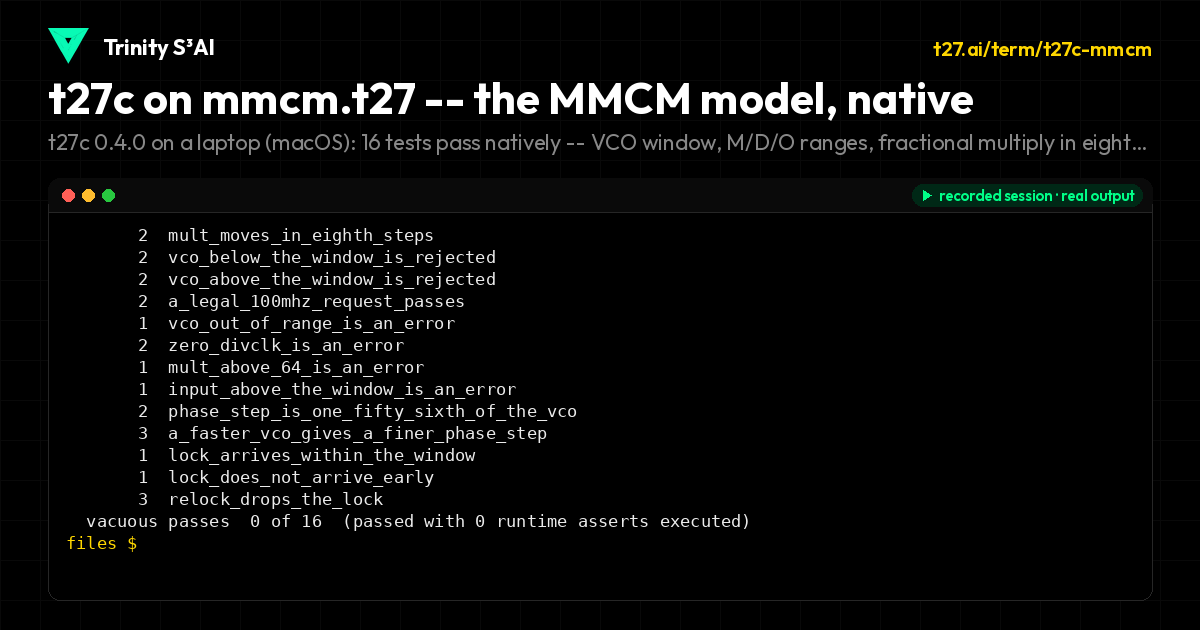
t27c 0.4.0 on a laptop (macOS): 16 tests pass natively -- VCO window, M/D/O ranges, fractional multiply in eighths, the 1/56 VCO-period phase step, and the lock window.
specs/fpga/mmcm.t27
// SPDX-License-Identifier: Apache-2.0
// t27/specs/fpga/mmcm.t27
// MMCM clock generator model for Trinity T27 FPGA HIR
// One clock in, one multiplied VCO, one divided clock out (MMCME2, Artix-7)
// All times integer; frequencies in kHz unless a name says MHz
// phi^2 + 1/phi^2 = 3 | TRINITY
//
// RANGES AND THEIR SOURCES. The divide/multiply ranges below (DIVCLK 1..106,
// CLKFBOUT_MULT 2.000..64.000 in 0.125 steps, CLKOUT_DIVIDE 1..128, phase step
// 1/56 of the VCO period) are the MMCME2 envelope as documented in AMD/Xilinx
// UG472, "7 Series FPGAs Clocking Resources". The VCO window 800..1600 MHz,
// the input window 70..800 MHz and the lock window 500 us are TEACHING
// ASSUMPTIONS: UG472 and DS181 list the exact VCO and Fin limits per speed
// grade and the exact lock time per device, and a real design reads its own
// numbers from its own timing report, not from this file. They are kept here,
// labelled, so the course can teach the shape of the rule (VCO must land in a
// window; the output divides it down) without pretending to a datasheet it
// does not have.

module Mmcm {

    // === Envelope constants (see header for sources) ===

    pub const DIVCLK_MIN : u32 = 1;
    pub const DIVCLK_MAX : u32 = 106;
    pub const MULT_MIN_EIGHTHS : u32 = 16;   // 2.000
    pub const MULT_MAX_EIGHTHS : u32 = 512;  // 64.000
    pub const CLKOUT_DIV_MIN : u32 = 1;
    pub const CLKOUT_DIV_MAX : u32 = 128;
    pub const FIN_MIN_MHZ : u32 = 70;        // assumption, see header
    pub const FIN_MAX_MHZ : u32 = 800;       // assumption, see header
    pub const VCO_MIN_KHZ : u32 = 800000;    // 800 MHz, assumption, see header
    pub const VCO_MAX_KHZ : u32 = 1600000;   // 1600 MHz, assumption, see header
    pub const PHASE_GRAN_DIVISOR : u32 = 56; // 1/56 of the VCO period, UG472
    pub const LOCK_WINDOW_US : u32 = 500;    // assumption, see header

    // === MMCM configuration ===

    pub struct MmcmConfig {
        name : &str,
        fin_mhz : u32,
        divclk_divide : u32,
        clkfbout_mult_eighths : u32,  // M * 8, so 0.125 steps stay integer
        clkout0_divide : u32,
    }

    fn mmcm(name: &str, fin_mhz: u32, divclk_divide: u32, mult_eighths: u32, clkout0_divide: u32) -> MmcmConfig {
        return MmcmConfig{
            .name = name,
            .fin_mhz = fin_mhz,
            .divclk_divide = divclk_divide,
            .clkfbout_mult_eighths = mult_eighths,
            .clkout0_divide = clkout0_divide,
        };
    }

    // === Frequency arithmetic ===

    // F_VCO = F_IN * M / D, in kHz; caller must keep divclk_divide >= 1
    fn vco_khz(cfg: MmcmConfig) -> u32 {
        if cfg.divclk_divide == 0 {
            return 0;
        }
        return cfg.fin_mhz * 1000 * cfg.clkfbout_mult_eighths / (8 * cfg.divclk_divide);
    }

    fn vco_mhz(cfg: MmcmConfig) -> u32 {
        return vco_khz(cfg) / 1000;
    }

    // F_OUT = F_VCO / O, in kHz; caller must keep clkout0_divide >= 1
    fn clkout_khz(cfg: MmcmConfig) -> u32 {
        if cfg.clkout0_divide == 0 {
            return 0;
        }
        return vco_khz(cfg) / cfg.clkout0_divide;
    }

    fn clkout_mhz(cfg: MmcmConfig) -> u32 {
        return clkout_khz(cfg) / 1000;
    }

    fn is_vco_in_range(cfg: MmcmConfig) -> bool {
        var v : u32 = vco_khz(cfg);
        return v >= VCO_MIN_KHZ and v <= VCO_MAX_KHZ;
    }

    // VCO period in femtoseconds, so a 1600 MHz VCO keeps 625000 fs of it
    fn vco_period_fs(cfg: MmcmConfig) -> i64 {
        var v : u32 = vco_khz(cfg);
        if v == 0 {
            return 0;
        }
        return 1000000000000 / (v as i64);
    }

    // Fine phase step: 1/56 of the VCO period (UG472). More VCO MHz means a
    // finer phase knob, which is why a high VCO is wanted for phase work.
    fn phase_step_fs(cfg: MmcmConfig) -> i64 {
        return vco_period_fs(cfg) / (PHASE_GRAN_DIVISOR as i64);
    }

    // === Lock model ===

    pub struct LockState {
        lock_counter_us : u32,
        locked : bool,
    }

    fn unlocked_state() -> LockState {
        return LockState{ .lock_counter_us = 0, .locked = false };
    }

    // One microsecond of settling with a legal, unchanging configuration
    fn lock_step(s: LockState) -> LockState {
        if s.locked {
            return s;
        }
        if s.lock_counter_us + 1 >= LOCK_WINDOW_US {
            return LockState{ .lock_counter_us = LOCK_WINDOW_US, .locked = true };
        }
        return LockState{ .lock_counter_us = s.lock_counter_us + 1, .locked = false };
    }

    // A reconfiguration drops lock immediately and restarts the window
    fn relock(s: LockState) -> LockState {
        return unlocked_state();
    }

    // Settle the model for a given number of microseconds without stepping
    // one microsecond at a time: lock arrives exactly at the window edge
    fn lock_after(us: u32) -> LockState {
        if us >= LOCK_WINDOW_US {
            return LockState{ .lock_counter_us = LOCK_WINDOW_US, .locked = true };
        }
        return LockState{ .lock_counter_us = us, .locked = false };
    }

    // === Validation ===

    fn validate_mmcm(cfg: MmcmConfig) -> u32 {
        var errors : u32 = 0;

        if cfg.name == "" {
            errors = errors + 1;
        }
        if cfg.divclk_divide < DIVCLK_MIN or cfg.divclk_divide > DIVCLK_MAX {
            errors = errors + 1;
        }
        if cfg.clkfbout_mult_eighths < MULT_MIN_EIGHTHS or cfg.clkfbout_mult_eighths > MULT_MAX_EIGHTHS {
            errors = errors + 1;
        }
        if cfg.clkout0_divide < CLKOUT_DIV_MIN or cfg.clkout0_divide > CLKOUT_DIV_MAX {
            errors = errors + 1;
        }
        if cfg.fin_mhz < FIN_MIN_MHZ or cfg.fin_mhz > FIN_MAX_MHZ {
            errors = errors + 1;
        }
        // Only judge the VCO once the dividers can form a frequency at all
        if cfg.divclk_divide >= DIVCLK_MIN and is_vco_in_range(cfg) == false {
            errors = errors + 1;
        }

        return errors;
    }

    // === Tests ===

    test vco_multiplies_the_input
        given cfg = mmcm("sys_mmcm", 200, 1, 40, 10)
        then vco_khz(cfg) == 1000000
        and vco_mhz(cfg) == 1000

    test clkout_divides_the_vco
        given cfg = mmcm("sys_mmcm", 200, 1, 40, 10)
        then clkout_khz(cfg) == 100000
        and clkout_mhz(cfg) == 100

    test divclk_divides_first
        given cfg = mmcm("half_in", 200, 2, 40, 10)
        then vco_khz(cfg) == 500000
        and vco_mhz(cfg) == 500

    test mult_moves_in_eighth_steps
        given cfg = mmcm("fractional", 100, 1, 65, 1)
        then vco_khz(cfg) == 812500
        and vco_mhz(cfg) == 812

    test vco_below_the_window_is_rejected
        given cfg = mmcm("too_low", 100, 1, 40, 5)
        then vco_mhz(cfg) == 500
        and is_vco_in_range(cfg) == false

    test vco_above_the_window_is_rejected
        given cfg = mmcm("too_high", 200, 1, 512, 8)
        then vco_mhz(cfg) == 12800
        and is_vco_in_range(cfg) == false

    test a_legal_100mhz_request_passes
        given cfg = mmcm("sys_mmcm", 200, 1, 40, 10)
        then validate_mmcm(cfg) == 0
        and is_vco_in_range(cfg) == true

    test vco_out_of_range_is_an_error
        given cfg = mmcm("bad_vco", 100, 1, 40, 5)
        then validate_mmcm(cfg) > 0

    test zero_divclk_is_an_error
        given cfg = mmcm("zero_d", 200, 0, 40, 10)
        then validate_mmcm(cfg) > 0
        and vco_khz(cfg) == 0

    test mult_above_64_is_an_error
        given cfg = mmcm("big_m", 200, 1, 520, 10)
        then validate_mmcm(cfg) > 0

    test input_above_the_window_is_an_error
        given cfg = mmcm("fast_in", 900, 1, 40, 10)
        then validate_mmcm(cfg) > 0

    test phase_step_is_one_fifty_sixth_of_the_vco
        given cfg = mmcm("sys_mmcm", 200, 1, 40, 10)
        then vco_period_fs(cfg) == 1000000
        and phase_step_fs(cfg) == 17857

    test a_faster_vco_gives_a_finer_phase_step
        given slow = mmcm("slow", 200, 1, 24, 3)
        and fast = mmcm("fast", 200, 1, 48, 6)
        then vco_mhz(slow) == 600
        and vco_mhz(fast) == 1200
        and phase_step_fs(fast) < phase_step_fs(slow)

    test lock_arrives_within_the_window
        then lock_after(LOCK_WINDOW_US).locked == true

    test lock_does_not_arrive_early
        then lock_after(499).locked == false

    test relock_drops_the_lock
        given s = lock_after(LOCK_WINDOW_US)
        and r = relock(s)
        then s.locked == true
        and r.locked == false
        and r.lock_counter_us == 0

    // === Invariants ===

    invariant a_legal_vco_is_positive
        given cfg = mmcm("inv", 200, 1, 40, 10)
        assert vco_khz(cfg) > 0

    invariant the_output_is_below_the_vco
        given cfg = mmcm("inv", 200, 1, 40, 10)
        assert clkout_khz(cfg) <= vco_khz(cfg)

    invariant the_phase_step_is_never_negative
        given cfg = mmcm("inv", 200, 1, 40, 10)
        assert phase_step_fs(cfg) > 0

    invariant lock_needs_the_whole_window
        given s = lock_after(499)
        assert s.locked == false

    // === Benchmarks ===

    bench vco_arithmetic
        measure: nanoseconds for vco_khz(mmcm("b", 200, 1, 40, 10))
        target: < 50ns
}

// phi^2 + 1/phi^2 = 3 | TRINITY
All lessons
Module 1 · What a clock is
One edge, one world: what shares a clock edge shares a world, the period and the jitter of a real edge, and where the clock enters a board.
Module 2 · Clock trees
Skew and insertion delay, the global buffer network, and the trap of gating a clock with logic.
Module 3 · PLL and MMCM
Multiply and divide one clock into another, move its phase in steps of the VCO, and which clocks the analyzer treats as related.
Module 4 · Resets
Assert asynchronously, release synchronously: the three reset kinds, the release pipe, and the tree a reset grows.
Module 5 · Metastability
The setup-hold window, the mean time between failures in integer arithmetic, and the two flops that fix it.
Module 6 · Crossing many bits
Why a binary bus tears, why Gray code does not, and the handshake that moves a pulse between worlds.
Module 7 · The asynchronous FIFO
Pointers, flags and depth: the buffer that moves a stream between two clocks.
Module 8 · Constraints
The lines that tell the analyzer what a clock is, which paths not to check, and what the pins must meet.
Module 9 · On the board
A CDC report, one crossing captured at the flip-flops, and the bitstream diff that closes the course.