Умножить и поделить
Вы узнаете
Как MMCM превращает один тактовый сигнал в другой умножением и делением и в какие окна должны попасть числа.
MMCM превращает один тактовый сигнал в другой: вход делится на D, умножается на M во внутренний VCO, а VCO делится на O для выхода. mmcm.t27, написанная для этого курса, хранит M в восьмых долях, чтобы дробные шаги остались целыми: M от 2,000 до 64,000, D от 1 до 106, O от 1 до 128, и VCO обязан попасть в своё окно — здесь от 800 до 1600 МГц, учебное допущение, которое шапка помечает рядом с диапазонами из UG472. Со входа 200 МГц, M 5, D 1: VCO 1000 МГц, и O 10 даёт на выходе 100 МГц. Запись запускает нативный t27c: проходят 16 тестов, 4 инварианта comptime.
Попробуйте
В записи найдите конфигурацию на 500 МГц, которую называет тест-отказник; затем в окне спеки найдите, какие диапазоны шапка берёт из UG472, а какие помечены как допущения.
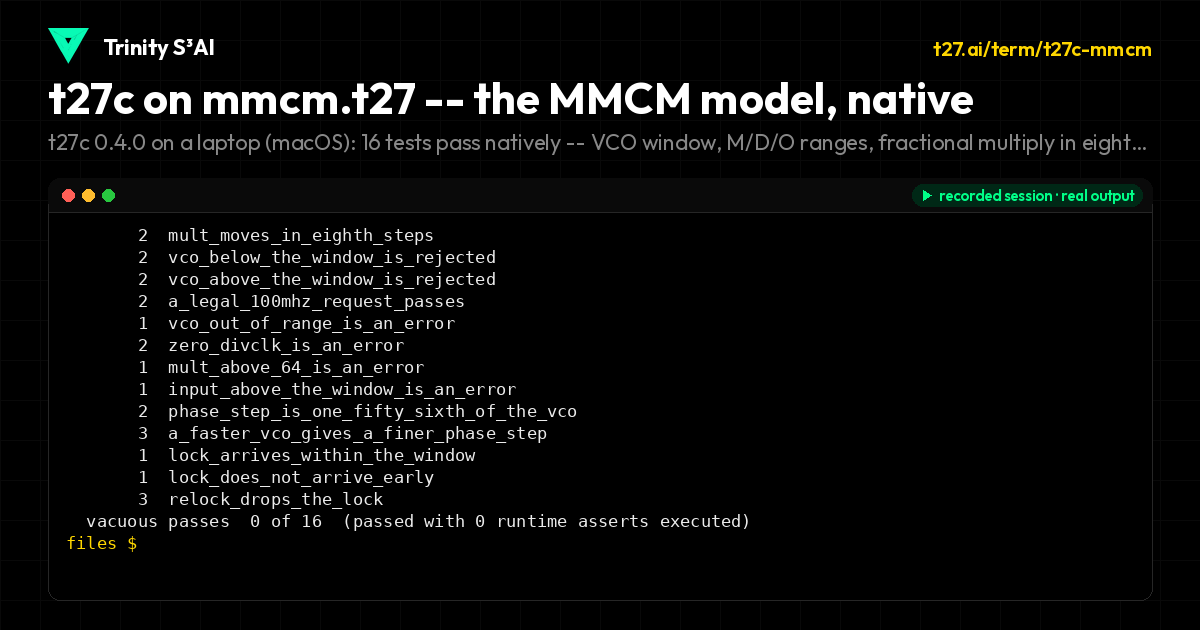
t27c 0.4.0 on a laptop (macOS): 16 tests pass natively -- VCO window, M/D/O ranges, fractional multiply in eighths, the 1/56 VCO-period phase step, and the lock window.
specs/fpga/mmcm.t27
// SPDX-License-Identifier: Apache-2.0
// t27/specs/fpga/mmcm.t27
// MMCM clock generator model for Trinity T27 FPGA HIR
// One clock in, one multiplied VCO, one divided clock out (MMCME2, Artix-7)
// All times integer; frequencies in kHz unless a name says MHz
// phi^2 + 1/phi^2 = 3 | TRINITY
//
// RANGES AND THEIR SOURCES. The divide/multiply ranges below (DIVCLK 1..106,
// CLKFBOUT_MULT 2.000..64.000 in 0.125 steps, CLKOUT_DIVIDE 1..128, phase step
// 1/56 of the VCO period) are the MMCME2 envelope as documented in AMD/Xilinx
// UG472, "7 Series FPGAs Clocking Resources". The VCO window 800..1600 MHz,
// the input window 70..800 MHz and the lock window 500 us are TEACHING
// ASSUMPTIONS: UG472 and DS181 list the exact VCO and Fin limits per speed
// grade and the exact lock time per device, and a real design reads its own
// numbers from its own timing report, not from this file. They are kept here,
// labelled, so the course can teach the shape of the rule (VCO must land in a
// window; the output divides it down) without pretending to a datasheet it
// does not have.

module Mmcm {

    // === Envelope constants (see header for sources) ===

    pub const DIVCLK_MIN : u32 = 1;
    pub const DIVCLK_MAX : u32 = 106;
    pub const MULT_MIN_EIGHTHS : u32 = 16;   // 2.000
    pub const MULT_MAX_EIGHTHS : u32 = 512;  // 64.000
    pub const CLKOUT_DIV_MIN : u32 = 1;
    pub const CLKOUT_DIV_MAX : u32 = 128;
    pub const FIN_MIN_MHZ : u32 = 70;        // assumption, see header
    pub const FIN_MAX_MHZ : u32 = 800;       // assumption, see header
    pub const VCO_MIN_KHZ : u32 = 800000;    // 800 MHz, assumption, see header
    pub const VCO_MAX_KHZ : u32 = 1600000;   // 1600 MHz, assumption, see header
    pub const PHASE_GRAN_DIVISOR : u32 = 56; // 1/56 of the VCO period, UG472
    pub const LOCK_WINDOW_US : u32 = 500;    // assumption, see header

    // === MMCM configuration ===

    pub struct MmcmConfig {
        name : &str,
        fin_mhz : u32,
        divclk_divide : u32,
        clkfbout_mult_eighths : u32,  // M * 8, so 0.125 steps stay integer
        clkout0_divide : u32,
    }

    fn mmcm(name: &str, fin_mhz: u32, divclk_divide: u32, mult_eighths: u32, clkout0_divide: u32) -> MmcmConfig {
        return MmcmConfig{
            .name = name,
            .fin_mhz = fin_mhz,
            .divclk_divide = divclk_divide,
            .clkfbout_mult_eighths = mult_eighths,
            .clkout0_divide = clkout0_divide,
        };
    }

    // === Frequency arithmetic ===

    // F_VCO = F_IN * M / D, in kHz; caller must keep divclk_divide >= 1
    fn vco_khz(cfg: MmcmConfig) -> u32 {
        if cfg.divclk_divide == 0 {
            return 0;
        }
        return cfg.fin_mhz * 1000 * cfg.clkfbout_mult_eighths / (8 * cfg.divclk_divide);
    }

    fn vco_mhz(cfg: MmcmConfig) -> u32 {
        return vco_khz(cfg) / 1000;
    }

    // F_OUT = F_VCO / O, in kHz; caller must keep clkout0_divide >= 1
    fn clkout_khz(cfg: MmcmConfig) -> u32 {
        if cfg.clkout0_divide == 0 {
            return 0;
        }
        return vco_khz(cfg) / cfg.clkout0_divide;
    }

    fn clkout_mhz(cfg: MmcmConfig) -> u32 {
        return clkout_khz(cfg) / 1000;
    }

    fn is_vco_in_range(cfg: MmcmConfig) -> bool {
        var v : u32 = vco_khz(cfg);
        return v >= VCO_MIN_KHZ and v <= VCO_MAX_KHZ;
    }

    // VCO period in femtoseconds, so a 1600 MHz VCO keeps 625000 fs of it
    fn vco_period_fs(cfg: MmcmConfig) -> i64 {
        var v : u32 = vco_khz(cfg);
        if v == 0 {
            return 0;
        }
        return 1000000000000 / (v as i64);
    }

    // Fine phase step: 1/56 of the VCO period (UG472). More VCO MHz means a
    // finer phase knob, which is why a high VCO is wanted for phase work.
    fn phase_step_fs(cfg: MmcmConfig) -> i64 {
        return vco_period_fs(cfg) / (PHASE_GRAN_DIVISOR as i64);
    }

    // === Lock model ===

    pub struct LockState {
        lock_counter_us : u32,
        locked : bool,
    }

    fn unlocked_state() -> LockState {
        return LockState{ .lock_counter_us = 0, .locked = false };
    }

    // One microsecond of settling with a legal, unchanging configuration
    fn lock_step(s: LockState) -> LockState {
        if s.locked {
            return s;
        }
        if s.lock_counter_us + 1 >= LOCK_WINDOW_US {
            return LockState{ .lock_counter_us = LOCK_WINDOW_US, .locked = true };
        }
        return LockState{ .lock_counter_us = s.lock_counter_us + 1, .locked = false };
    }

    // A reconfiguration drops lock immediately and restarts the window
    fn relock(s: LockState) -> LockState {
        return unlocked_state();
    }

    // Settle the model for a given number of microseconds without stepping
    // one microsecond at a time: lock arrives exactly at the window edge
    fn lock_after(us: u32) -> LockState {
        if us >= LOCK_WINDOW_US {
            return LockState{ .lock_counter_us = LOCK_WINDOW_US, .locked = true };
        }
        return LockState{ .lock_counter_us = us, .locked = false };
    }

    // === Validation ===

    fn validate_mmcm(cfg: MmcmConfig) -> u32 {
        var errors : u32 = 0;

        if cfg.name == "" {
            errors = errors + 1;
        }
        if cfg.divclk_divide < DIVCLK_MIN or cfg.divclk_divide > DIVCLK_MAX {
            errors = errors + 1;
        }
        if cfg.clkfbout_mult_eighths < MULT_MIN_EIGHTHS or cfg.clkfbout_mult_eighths > MULT_MAX_EIGHTHS {
            errors = errors + 1;
        }
        if cfg.clkout0_divide < CLKOUT_DIV_MIN or cfg.clkout0_divide > CLKOUT_DIV_MAX {
            errors = errors + 1;
        }
        if cfg.fin_mhz < FIN_MIN_MHZ or cfg.fin_mhz > FIN_MAX_MHZ {
            errors = errors + 1;
        }
        // Only judge the VCO once the dividers can form a frequency at all
        if cfg.divclk_divide >= DIVCLK_MIN and is_vco_in_range(cfg) == false {
            errors = errors + 1;
        }

        return errors;
    }

    // === Tests ===

    test vco_multiplies_the_input
        given cfg = mmcm("sys_mmcm", 200, 1, 40, 10)
        then vco_khz(cfg) == 1000000
        and vco_mhz(cfg) == 1000

    test clkout_divides_the_vco
        given cfg = mmcm("sys_mmcm", 200, 1, 40, 10)
        then clkout_khz(cfg) == 100000
        and clkout_mhz(cfg) == 100

    test divclk_divides_first
        given cfg = mmcm("half_in", 200, 2, 40, 10)
        then vco_khz(cfg) == 500000
        and vco_mhz(cfg) == 500

    test mult_moves_in_eighth_steps
        given cfg = mmcm("fractional", 100, 1, 65, 1)
        then vco_khz(cfg) == 812500
        and vco_mhz(cfg) == 812

    test vco_below_the_window_is_rejected
        given cfg = mmcm("too_low", 100, 1, 40, 5)
        then vco_mhz(cfg) == 500
        and is_vco_in_range(cfg) == false

    test vco_above_the_window_is_rejected
        given cfg = mmcm("too_high", 200, 1, 512, 8)
        then vco_mhz(cfg) == 12800
        and is_vco_in_range(cfg) == false

    test a_legal_100mhz_request_passes
        given cfg = mmcm("sys_mmcm", 200, 1, 40, 10)
        then validate_mmcm(cfg) == 0
        and is_vco_in_range(cfg) == true

    test vco_out_of_range_is_an_error
        given cfg = mmcm("bad_vco", 100, 1, 40, 5)
        then validate_mmcm(cfg) > 0

    test zero_divclk_is_an_error
        given cfg = mmcm("zero_d", 200, 0, 40, 10)
        then validate_mmcm(cfg) > 0
        and vco_khz(cfg) == 0

    test mult_above_64_is_an_error
        given cfg = mmcm("big_m", 200, 1, 520, 10)
        then validate_mmcm(cfg) > 0

    test input_above_the_window_is_an_error
        given cfg = mmcm("fast_in", 900, 1, 40, 10)
        then validate_mmcm(cfg) > 0

    test phase_step_is_one_fifty_sixth_of_the_vco
        given cfg = mmcm("sys_mmcm", 200, 1, 40, 10)
        then vco_period_fs(cfg) == 1000000
        and phase_step_fs(cfg) == 17857

    test a_faster_vco_gives_a_finer_phase_step
        given slow = mmcm("slow", 200, 1, 24, 3)
        and fast = mmcm("fast", 200, 1, 48, 6)
        then vco_mhz(slow) == 600
        and vco_mhz(fast) == 1200
        and phase_step_fs(fast) < phase_step_fs(slow)

    test lock_arrives_within_the_window
        then lock_after(LOCK_WINDOW_US).locked == true

    test lock_does_not_arrive_early
        then lock_after(499).locked == false

    test relock_drops_the_lock
        given s = lock_after(LOCK_WINDOW_US)
        and r = relock(s)
        then s.locked == true
        and r.locked == false
        and r.lock_counter_us == 0

    // === Invariants ===

    invariant a_legal_vco_is_positive
        given cfg = mmcm("inv", 200, 1, 40, 10)
        assert vco_khz(cfg) > 0

    invariant the_output_is_below_the_vco
        given cfg = mmcm("inv", 200, 1, 40, 10)
        assert clkout_khz(cfg) <= vco_khz(cfg)

    invariant the_phase_step_is_never_negative
        given cfg = mmcm("inv", 200, 1, 40, 10)
        assert phase_step_fs(cfg) > 0

    invariant lock_needs_the_whole_window
        given s = lock_after(499)
        assert s.locked == false

    // === Benchmarks ===

    bench vco_arithmetic
        measure: nanoseconds for vco_khz(mmcm("b", 200, 1, 40, 10))
        target: < 50ns
}

// phi^2 + 1/phi^2 = 3 | TRINITY
Все уроки
Модуль 1 · Что такое тактовый сигнал
Один фронт, один мир: всё, что делит фронт тактового сигнала, делит и мир; период и джиттер настоящего фронта и место, где тактовый сигнал входит в плату.
Модуль 2 · Деревья тактового сигнала
Перекос и задержка прохождения, глобальная сеть буферов и ловушка стробирования клока логикой.
Модуль 3 · PLL и MMCM
Умножить и поделить один тактовый сигнал в другой, сдвинуть его фазу шагами VCO и какие тактовые сигналы анализатор считает родственными.
Модуль 4 · Сбросы
Ассертировать асинхронно, снимать синхронно: три вида сброса, конвейер снятия и дерево, которое растит сброс.
Модуль 5 · Метастабильность
Окно setup-hold, среднее время между отказами в целочисленной арифметике и два триггера, которые это чинят.
Модуль 6 · Пересечение многих бит
Почему двоичная шина рвётся, почему код Грея нет, и рукопожатие, переносящее импульс между мирами.
Модуль 7 · Асинхронный FIFO
Указатели, флаги и глубина: буфер, переносящий поток между двумя тактовыми сигналами.
Модуль 8 · Ограничения
Строки, сообщающие анализатору, что такое тактовый сигнал, какие пути не проверять и чему должны соответствовать выводы.
Модуль 9 · На плате
Отчёт CDC, одно пересечение, захваченное на триггерах, и дифф битстрима, замыкающий курс.