Sync or async
You will learn
The three reset kinds, which one races the clock, and the shape the course recommends.
A board asserts reset when it wants to, not when your clock says so: the assert may be asynchronous. The release may not be. reset_sync.t27, written for this course, names the three kinds: sync (0), where assert and release both go through the clock; async assert, sync release (1), the usual choice; and async assert, async release (2), which races recovery and removal at every flop it feeds. is_recommended() accepts kinds 0 and 1 with at least 2 stages. The recording runs the native t27c: 16 tests pass, 3 invariants comptime.
Try it
In the recording, find the test that calls async release racy; then in the spec frame read is_recommended() and check what it requires of kind and stages.
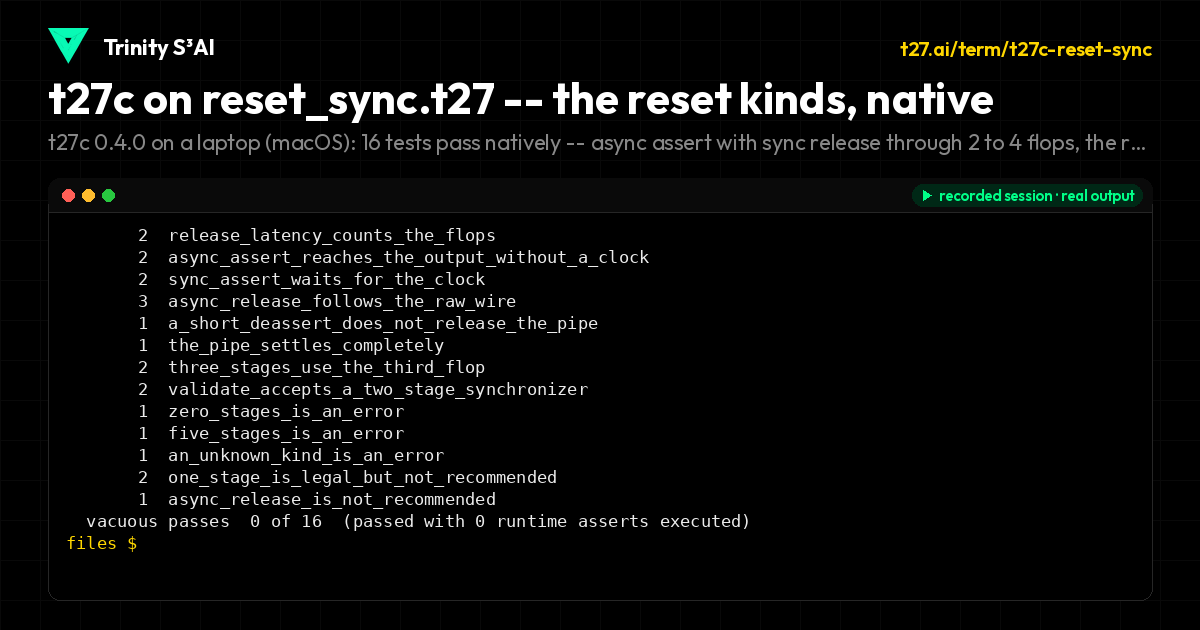
t27c 0.4.0 on a laptop (macOS): 16 tests pass natively -- async assert with sync release through 2 to 4 flops, the racy async release, and what validate accepts.
specs/fpga/reset_sync.t27
// SPDX-License-Identifier: Apache-2.0
// t27/specs/fpga/reset_sync.t27
// Reset synchronizer model for Trinity T27 FPGA HIR
// Three reset kinds, a shift-register model of the release path
// phi^2 + 1/phi^2 = 3 | TRINITY
//
// THE RULE THIS FILE TEACHES. A reset may assert asynchronously (the board
// does not wait for your clock) but must release synchronously: the release
// edge is captured by the destination clock and walked through a small shift
// register of 2 or more flops. A reset that releases asynchronously races the
// clock at every flip-flop it feeds and violates recovery/removal timing, so
// kind 2 below (async assert, async release) is legal hardware but not a
// recommended reset. The flop count is capped at 4 because the shift register
// is drawn one flop per field (d0..d3), and 2 to 4 stages covers the range a
// real design chooses from.

module ResetSync {

    // === Reset kinds ===

    pub const ResetKind = enum(i8) {
        sync = 0,                    // assert and release both through the clock
        async_assert_sync_release = 1, // assert immediate, release through the pipe
        async_assert_async_release = 2, // assert and release both immediate: races
    }

    // === Reset synchronizer configuration ===

    pub struct ResetSyncConfig {
        name : &str,
        kind : i8,
        stages : u32,
    }

    fn reset_sync(name: &str, kind: i8, stages: u32) -> ResetSyncConfig {
        return ResetSyncConfig{
            .name = name,
            .kind = kind,
            .stages = stages,
        };
    }

    // === Shift-register state (one bool per flop, d0 nearest the input) ===

    pub struct SyncState {
        d0 : bool,
        d1 : bool,
        d2 : bool,
        d3 : bool,
    }

    fn asserted_state() -> SyncState {
        return SyncState{ .d0 = true, .d1 = true, .d2 = true, .d3 = true };
    }

    fn released_state() -> SyncState {
        return SyncState{ .d0 = false, .d1 = false, .d2 = false, .d3 = false };
    }

    // One destination clock: every flop takes its neighbour's value
    fn step(s: SyncState, din: bool) -> SyncState {
        return SyncState{
            .d0 = din,
            .d1 = s.d0,
            .d2 = s.d1,
            .d3 = s.d2,
        };
    }

    // Run the pipe with the input released, as a clean reset release does
    fn after_clocks(s: SyncState, clocks: u32) -> SyncState {
        var r : SyncState = s;
        var i : u32 = 0;
        while i < clocks {
            r = step(r, false);
            i = i + 1;
        }
        return r;
    }

    fn settled(s: SyncState) -> bool {
        return (s.d0 or s.d1 or s.d2 or s.d3) == false;
    }

    // === Kind and timing queries ===

    fn asserts_async(cfg: ResetSyncConfig) -> bool {
        return (cfg.kind == 1) or (cfg.kind == 2);
    }

    fn releases_async(cfg: ResetSyncConfig) -> bool {
        return cfg.kind == 2;
    }

    // The flop the sync path reads: stage 1 is d0, stage 2 is d1, and so on
    fn pipe_output(s: SyncState, cfg: ResetSyncConfig) -> bool {
        if cfg.stages == 1 {
            return s.d0;
        }
        if cfg.stages == 2 {
            return s.d1;
        }
        if cfg.stages == 3 {
            return s.d2;
        }
        return s.d3;
    }

    // The reset seen by the logic, given the pipe state and the raw input
    fn reset_out(cfg: ResetSyncConfig, s: SyncState, raw_in: bool) -> bool {
        if cfg.kind == 2 {
            // Async release: the raw wire is the reset, glitches and all
            return raw_in;
        }
        if cfg.kind == 1 {
            // Async assert: the raw wire asserts at once; the pipe releases
            return raw_in or pipe_output(s, cfg);
        }
        // Sync reset: the pipe alone decides, assert and release both clocked
        return pipe_output(s, cfg);
    }

    // Cycles from a released input to a released output
    fn release_latency_cycles(cfg: ResetSyncConfig) -> u32 {
        return cfg.stages;
    }

    // === Validation ===

    fn validate_rst(cfg: ResetSyncConfig) -> u32 {
        var errors : u32 = 0;

        if cfg.name == "" {
            errors = errors + 1;
        }
        if cfg.kind < 0 or cfg.kind > 2 {
            errors = errors + 1;
        }
        if cfg.stages < 1 or cfg.stages > 4 {
            errors = errors + 1;
        }

        return errors;
    }

    // The shape the course recommends: release through at least two flops
    fn is_recommended(cfg: ResetSyncConfig) -> bool {
        return (cfg.kind == 0 or cfg.kind == 1) and cfg.stages >= 2;
    }

    // === Tests ===

    test the_pipe_shifts_one_flop_per_clock
        given s1 = step(released_state(), true)
        then s1.d0 == true
        and s1.d1 == false
        and s1.d2 == false

    test the_pipe_carries_the_release_downstream
        given s1 = step(asserted_state(), false)
        and s2 = step(s1, false)
        then s1.d0 == false
        and s1.d1 == true
        and s2.d0 == false
        and s2.d1 == false

    test a_two_stage_release_takes_two_clocks
        given cfg = reset_sync("sys_rst", 1, 2)
        and one = after_clocks(asserted_state(), 1)
        and two = after_clocks(asserted_state(), 2)
        then reset_out(cfg, one, false) == true
        and reset_out(cfg, two, false) == false

    test release_latency_counts_the_flops
        given cfg2 = reset_sync("two", 1, 2)
        and cfg3 = reset_sync("three", 1, 3)
        then release_latency_cycles(cfg2) == 2
        and release_latency_cycles(cfg3) == 3

    test async_assert_reaches_the_output_without_a_clock
        given cfg = reset_sync("sys_rst", 1, 2)
        then reset_out(cfg, released_state(), true) == true
        and asserts_async(cfg) == true

    test sync_assert_waits_for_the_clock
        given cfg = reset_sync("sys_rst", 0, 2)
        then reset_out(cfg, released_state(), true) == false
        and asserts_async(cfg) == false

    test async_release_follows_the_raw_wire
        given cfg = reset_sync("racy", 2, 2)
        then reset_out(cfg, asserted_state(), false) == false
        and reset_out(cfg, released_state(), true) == true
        and releases_async(cfg) == true

    test a_short_deassert_does_not_release_the_pipe
        given cfg = reset_sync("sys_rst", 1, 2)
        and glitch = step(asserted_state(), false)
        then reset_out(cfg, glitch, false) == true

    test the_pipe_settles_completely
        given s = after_clocks(asserted_state(), 4)
        then settled(s) == true

    test three_stages_use_the_third_flop
        given cfg = reset_sync("three", 0, 3)
        and s1 = step(step(step(released_state(), true), false), false)
        then pipe_output(s1, cfg) == true
        and reset_out(cfg, s1, false) == true

    test validate_accepts_a_two_stage_synchronizer
        given cfg = reset_sync("sys_rst", 1, 2)
        then validate_rst(cfg) == 0
        and is_recommended(cfg) == true

    test zero_stages_is_an_error
        given cfg = reset_sync("zero", 1, 0)
        then validate_rst(cfg) > 0

    test five_stages_is_an_error
        given cfg = reset_sync("five", 1, 5)
        then validate_rst(cfg) > 0

    test an_unknown_kind_is_an_error
        given cfg = reset_sync("weird", 3, 2)
        then validate_rst(cfg) > 0

    test one_stage_is_legal_but_not_recommended
        given cfg = reset_sync("thin", 1, 1)
        then validate_rst(cfg) == 0
        and is_recommended(cfg) == false

    test async_release_is_not_recommended
        given cfg = reset_sync("racy", 2, 2)
        then is_recommended(cfg) == false

    // === Invariants ===

    invariant the_release_always_settles
        given s = after_clocks(asserted_state(), 4)
        assert settled(s) == true

    invariant the_pipe_holds_the_reset_while_it_shifts
        given cfg = reset_sync("inv", 1, 2)
        and s = after_clocks(asserted_state(), 1)
        assert reset_out(cfg, s, false) == true

    invariant sync_reset_cannot_jump_the_pipe
        given cfg = reset_sync("inv", 0, 2)
        assert reset_out(cfg, released_state(), true) == false

    // === Benchmarks ===

    bench step_latency
        measure: nanoseconds to step(asserted_state(), true)
        target: < 10ns
}

// phi^2 + 1/phi^2 = 3 | TRINITY
All lessons
Module 1 · What a clock is
One edge, one world: what shares a clock edge shares a world, the period and the jitter of a real edge, and where the clock enters a board.
Module 2 · Clock trees
Skew and insertion delay, the global buffer network, and the trap of gating a clock with logic.
Module 3 · PLL and MMCM
Multiply and divide one clock into another, move its phase in steps of the VCO, and which clocks the analyzer treats as related.
Module 4 · Resets
Assert asynchronously, release synchronously: the three reset kinds, the release pipe, and the tree a reset grows.
Module 5 · Metastability
The setup-hold window, the mean time between failures in integer arithmetic, and the two flops that fix it.
Module 6 · Crossing many bits
Why a binary bus tears, why Gray code does not, and the handshake that moves a pulse between worlds.
Module 7 · The asynchronous FIFO
Pointers, flags and depth: the buffer that moves a stream between two clocks.
Module 8 · Constraints
The lines that tell the analyzer what a clock is, which paths not to check, and what the pins must meet.
Module 9 · On the board
A CDC report, one crossing captured at the flip-flops, and the bitstream diff that closes the course.