Skew and insertion delay
You will learn
Why the clock does not reach every flop at once, and what the tree delays of a 7-series chip cost.
The clock does not reach every flop at once: it arrives through a tree, and the spread of arrival times is skew. cts.t27 models that tree with the teaching delays of an Artix-7 in its header: a BUFH at 0.05 ns, a BUFG at 0.1 ns, PLL jitter of 50 ps, and a maximum skew target of 100 ps. The recording runs the native t27c on it: 15 tests pass, 2 invariants are proved comptime. Skew is not noise to remove but a budget to spend: a well-balanced tree spends it evenly, which is what makes one shared edge possible at all.
Try it
In the recording, find the two buffer delays in the header; then in the spec frame find the maximum skew target and the test that compares buffer fanout.
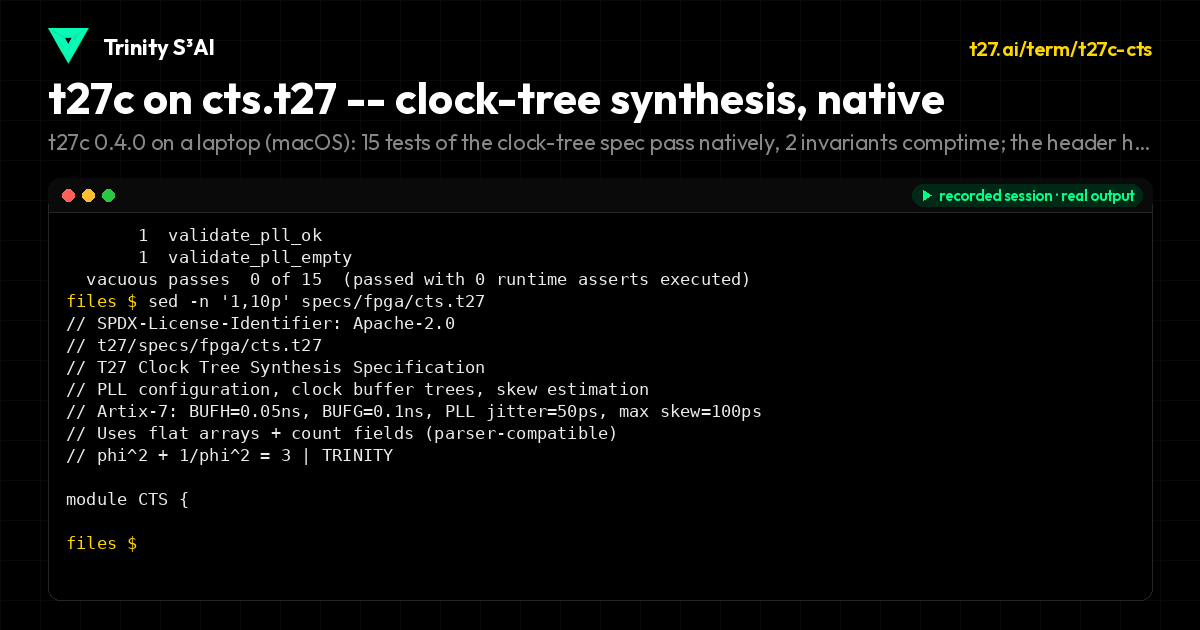
t27c 0.4.0 on a laptop (macOS): 15 tests of the clock-tree spec pass natively, 2 invariants comptime; the header holds the Artix-7 teaching delays (BUFG 0.1 ns, BUFH 0.05 ns, PLL jitter 50 ps).
specs/fpga/cts.t27
// SPDX-License-Identifier: Apache-2.0
// t27/specs/fpga/cts.t27
// T27 Clock Tree Synthesis Specification
// PLL configuration, clock buffer trees, skew estimation
// Artix-7: BUFH=0.05ns, BUFG=0.1ns, PLL jitter=50ps, max skew=100ps
// Uses flat arrays + count fields (parser-compatible)
// phi^2 + 1/phi^2 = 3 | TRINITY

module CTS {

    pub struct PllConfig {
        name : &str,
        input_mhz : u32,
        output_mhz : u32,
        multiply : u32,
        divide : u32,
        jitter_ps : u32,
    }

    fn pll_config(name: &str, input_mhz: u32, output_mhz: u32) -> PllConfig {
        var m : u32 = 1;
        var d : u32 = 1;
        if input_mhz > 0 {
            d = input_mhz;
            m = output_mhz;
        }
        return PllConfig{
            .name = name,
            .input_mhz = input_mhz,
            .output_mhz = output_mhz,
            .multiply = m,
            .divide = d,
            .jitter_ps = 50,
        };
    }

    fn pll_period_ps(pll: PllConfig) -> u32 {
        if pll.output_mhz == 0 {
            return 0;
        }
        return 1000000000 / pll.output_mhz;
    }

    pub struct ClockBuffer {
        name : &str,
        delay_ps : u32,
        fanout : u32,
    }

    fn bufg(name: &str) -> ClockBuffer {
        return ClockBuffer{ .name = name, .delay_ps = 100, .fanout = 32 };
    }

    fn bufh(name: &str) -> ClockBuffer {
        return ClockBuffer{ .name = name, .delay_ps = 50, .fanout = 16 };
    }

    fn bufg_has_higher_fanout(b: ClockBuffer) -> bool {
        return b.fanout >= 32;
    }

    pub struct ClockTree {
        root : &str,
        num_levels : u32,
        total_buffers : u32,
        max_skew_ps : u32,
    }

    fn clock_tree(root: &str, levels: u32, bufs: u32) -> ClockTree {
        return ClockTree{
            .root = root,
            .num_levels = levels,
            .total_buffers = bufs,
            .max_skew_ps = 100,
        };
    }

    fn tree_delay_ps(tree: ClockTree, buf_delay: u32) -> u32 {
        return tree.num_levels * buf_delay;
    }

    fn skew_ok(tree: ClockTree, max_allowed_ps: u32) -> bool {
        return tree.max_skew_ps <= max_allowed_ps;
    }

    pub struct CtsReport {
        num_clocks : u32,
        num_plls : u32,
        total_buffers : u32,
        worst_skew_ps : u32,
        worst_latency_ps : u32,
        has_violations : bool,
    }

    fn cts_ok(clocks: u32, plls: u32, bufs: u32, skew: u32, latency: u32) -> CtsReport {
        return CtsReport{
            .num_clocks = clocks,
            .num_plls = plls,
            .total_buffers = bufs,
            .worst_skew_ps = skew,
            .worst_latency_ps = latency,
            .has_violations = false,
        };
    }

    fn passed(r: CtsReport) -> bool {
        return r.has_violations == false;
    }

    // === Auto tree estimation ===

    fn est_buffers_needed(num_sinks: u32) -> u32 {
        if num_sinks <= 16 {
            return 1;
        }
        return num_sinks / 16 + 1;
    }

    fn est_tree_levels(num_sinks: u32) -> u32 {
        if num_sinks <= 16 {
            return 1;
        }
        if num_sinks <= 256 {
            return 2;
        }
        return 3;
    }

    // === Validation ===

    fn validate_pll(pll: PllConfig) -> u32 {
        var errors : u32 = 0;
        if pll.name == "" { errors = errors + 1; }
        if pll.output_mhz == 0 { errors = errors + 1; }
        return errors;
    }

    // === Tests ===

    test pll_config_creation
        given p = pll_config("sys_pll", 100, 200)
        then p.input_mhz == 100
        and p.output_mhz == 200
        and pll_period_ps(p) == 5000000

    test bufg_creation
        given b = bufg("clk_buf")
        then b.delay_ps == 100
        and b.fanout == 32
        and bufg_has_higher_fanout(b) == true

    test bufh_creation
        given b = bufh("clk_h")
        then b.delay_ps == 50
        and b.fanout == 16
        and bufg_has_higher_fanout(b) == false

    test clock_tree_creation
        given t = clock_tree("clk", 2, 5)
        then t.root == "clk"
        and t.num_levels == 2
        and t.total_buffers == 5
        and t.max_skew_ps == 100

    test tree_delay
        given t = clock_tree("clk", 3, 8)
        then tree_delay_ps(t, 100) == 300

    test skew_ok_yes
        given t = clock_tree("clk", 2, 5)
        then skew_ok(t, 200) == true

    test skew_ok_no
        given t = clock_tree("clk", 2, 5)
        then skew_ok(t, 50) == false

    test cts_report_ok
        given r = cts_ok(2, 1, 10, 80, 300)
        then passed(r) == true
        and r.has_violations == false

    test est_buffers_one
        then est_buffers_needed(10) == 1

    test est_buffers_many
        then est_buffers_needed(100) == 7

    test est_tree_levels_one
        then est_tree_levels(10) == 1

    test est_tree_levels_two
        then est_tree_levels(100) == 2

    test est_tree_levels_three
        then est_tree_levels(500) == 3

    test validate_pll_ok
        given p = pll_config("ok", 100, 200)
        then validate_pll(p) == 0

    test validate_pll_empty
        given p = PllConfig{.name = "", .input_mhz = 100, .output_mhz = 0, .multiply = 1, .divide = 1, .jitter_ps = 50}
        then validate_pll(p) > 0

    // === Invariants ===

    invariant bufg_delay_positive
        given b = bufg("inv")
        assert b.delay_ps > 0

    invariant skew_non_negative
        given t = clock_tree("inv", 2, 5)
        assert t.max_skew_ps >= 0

    bench buffer_estimation_latency
        measure: nanoseconds to est_buffers_needed(50)
        target: < 50ns

    bench tree_level_estimation_latency
        measure: nanoseconds to est_tree_levels(200)
        target: < 50ns
}

// phi^2 + 1/phi^2 = 3 | TRINITY
All lessons
Module 1 · What a clock is
One edge, one world: what shares a clock edge shares a world, the period and the jitter of a real edge, and where the clock enters a board.
Module 2 · Clock trees
Skew and insertion delay, the global buffer network, and the trap of gating a clock with logic.
Module 3 · PLL and MMCM
Multiply and divide one clock into another, move its phase in steps of the VCO, and which clocks the analyzer treats as related.
Module 4 · Resets
Assert asynchronously, release synchronously: the three reset kinds, the release pipe, and the tree a reset grows.
Module 5 · Metastability
The setup-hold window, the mean time between failures in integer arithmetic, and the two flops that fix it.
Module 6 · Crossing many bits
Why a binary bus tears, why Gray code does not, and the handshake that moves a pulse between worlds.
Module 7 · The asynchronous FIFO
Pointers, flags and depth: the buffer that moves a stream between two clocks.
Module 8 · Constraints
The lines that tell the analyzer what a clock is, which paths not to check, and what the pins must meet.
Module 9 · On the board
A CDC report, one crossing captured at the flip-flops, and the bitstream diff that closes the course.