Mean time between failures
You will learn
How MTBF prices a crossing in integer log2 arithmetic, and which constants are assumptions.
MTBF prices a crossing: e^(T/tau) divided by F_clk, F_data and the window W -- the form Xilinx WP323 teaches. mtbf.t27, written for this course, computes it in integer log2 with 10 fractional bits, because the honest answer overflows every integer seconds count. tau 50 ps and W 10 ps are labelled assumptions: the vendors publish flop parameters only partially. At 100 MHz receiving a 10 MHz stream, 1 stage leaves -200 ps of slack and a Q10 log2-MTBF of -19513 -- under two microseconds; 2 stages leave 9800 ps and 275887 -- beyond any clock the universe will run. The recording runs the native t27c: 15 tests pass, 4 invariants comptime.
Try it
In the recording, find the grep that lists the assumptions; then in the spec frame compute what stage_gain_q10() says one more flop buys at 100 MHz.
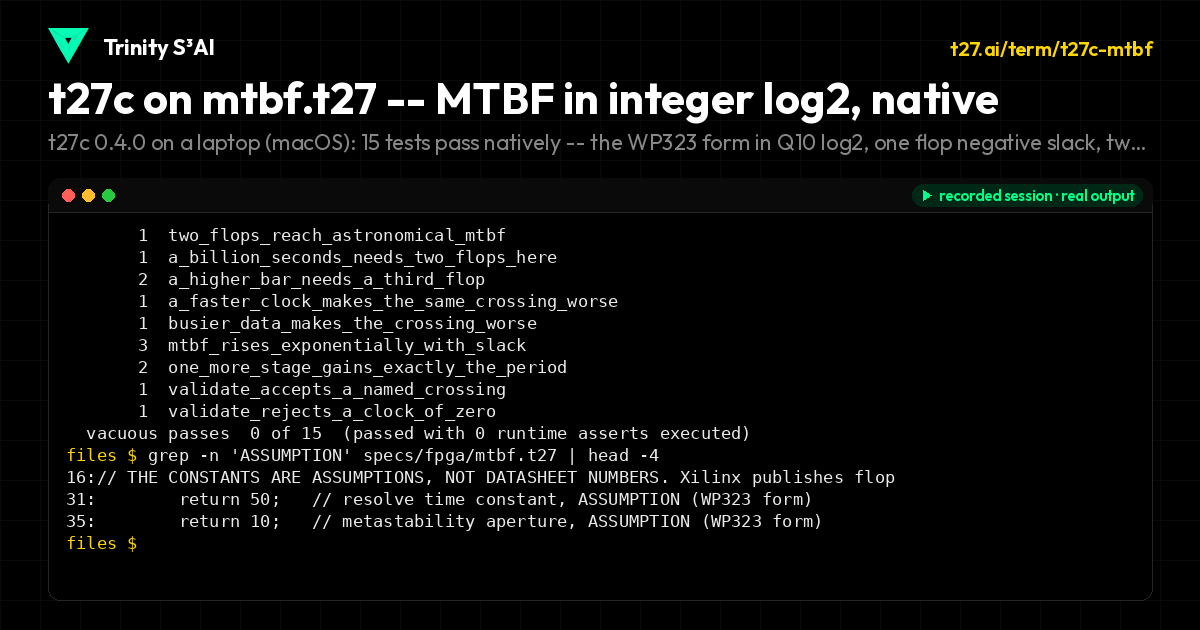
t27c 0.4.0 on a laptop (macOS): 15 tests pass natively -- the WP323 form in Q10 log2, one flop negative slack, two flops astronomical, and the grep that shows the assumptions.
specs/fpga/mtbf.t27
// SPDX-License-Identifier: Apache-2.0
// t27/specs/fpga/mtbf.t27
// Metastability MTBF model for Trinity T27 FPGA HIR
// Integer-only log2 arithmetic, no floats anywhere
// phi^2 + 1/phi^2 = 3 | TRINITY
//
// THE MODEL. MTBF = e^(T_slack / tau) / (F_clk * F_data * W), the form taught
// by Xilinx WP323, "Understanding Metastability in FPGAs": T_slack is the time
// a synchronizer's first flop is given to resolve, tau is its resolve time
// constant, W is the metastability aperture (window) of that flop, F_clk is
// the receiving clock and F_data the transition rate of the asynchronous
// input. Because e^(T/tau) overflows any integer seconds count long before a
// real synchronizer becomes safe, this file works in log2 of seconds with 10
// fractional bits (Q10): every MTBF below is log2(MTBF) * 1024.
//
// THE CONSTANTS ARE ASSUMPTIONS, NOT DATASHEET NUMBERS. Xilinx publishes flop
// metastability parameters only partially (WP323 gives the method and some
// measured taus for older families; DS181 does not list W or tau per device),
// so tau = 50 ps and W = 10 ps here are labelled teaching assumptions in the
// WP323 form. A design that needs a real number measures its own, or reads it
// from the vendor's CDC report. The lesson these numbers teach -- each extra
// synchronizer stage multiplies MTBF by 2^(T_clk * log2 e / tau) -- does not
// depend on the exact constants, and the tests below only use differences and
// the model's own arithmetic.

module Mtbf {

    // === Model constants (assumptions; see header) ===

    fn tau_ps() -> u32 {
        return 50;   // resolve time constant, ASSUMPTION (WP323 form)
    }

    fn window_ps() -> u32 {
        return 10;   // metastability aperture, ASSUMPTION (WP323 form)
    }

    fn setup_ps() -> u32 {
        return 200;  // flop setup, same teaching value as timing.t27
    }

    pub const LOG2_E_Q10 : i64 = 1477;  // 1024 * log2(e) = 1477.33
    pub const LOG2_1E6_Q10 : i64 = 20410;  // 1024 * log2(1e6) = 20409.97
    pub const LOG2_1E12_Q10 : i64 = 40820; // 1024 * log2(1e12) = 40819.85
    pub const MAX_STAGES : u32 = 8;

    // === Crossing model ===

    pub struct MtbfModel {
        name : &str,
        clk_mhz : u32,    // the receiving (destination) clock
        data_mhz : u32,   // transitions per second of the async input, in MHz
    }

    fn mtbf_model(name: &str, clk_mhz: u32, data_mhz: u32) -> MtbfModel {
        return MtbfModel{
            .name = name,
            .clk_mhz = clk_mhz,
            .data_mhz = data_mhz,
        };
    }

    fn period_ps(clk_mhz: u32) -> u32 {
        if clk_mhz == 0 {
            return 0;
        }
        return 1000000 / clk_mhz;
    }

    // Time the first flop is given to resolve: an N-stage synchronizer leaves
    // (N - 1) full periods minus one setup before its output is sampled again
    fn resolve_slack_ps(m: MtbfModel, stages: u32) -> i64 {
        var p : i64 = period_ps(m.clk_mhz) as i64;
        return (stages as i64 - 1) * p - setup_ps() as i64;
    }

    // Integer log2 in Q10: bit-normalize to [2^20, 2^21), then one fractional
    // bit per squaring. Exact for powers of two, +-1 unit otherwise.
    fn log2_q10(n: u32) -> i64 {
        if n < 2 {
            return 0;
        }
        var x : i64 = n as i64;
        var e : i64 = 0;
        while x < 1048576 {
            x = x * 2;
            e = e - 1;
        }
        while x >= 2097152 {
            x = x / 2;
            e = e + 1;
        }
        var frac : i64 = 0;
        var w : i64 = 512;
        var i : u32 = 0;
        while i < 10 {
            x = (x * x) >> 20;
            if x >= 2097152 {
                x = x / 2;
                frac = frac + w;
            }
            w = w / 2;
            i = i + 1;
        }
        return (e + 20) * 1024 + frac;
    }

    // log2(MTBF in seconds) * 1024 for a given resolve slack, per the header
    fn mtbf_log2_q10(m: MtbfModel, slack_ps: i64) -> i64 {
        var acc : i64 = slack_ps * LOG2_E_Q10 / (tau_ps() as i64);
        acc = acc - (log2_q10(m.clk_mhz) + LOG2_1E6_Q10);
        acc = acc - (log2_q10(m.data_mhz) + LOG2_1E6_Q10);
        acc = acc + (LOG2_1E12_Q10 - log2_q10(window_ps()));
        return acc;
    }

    // One more stage buys T_clk * log2(e) / tau of log2-MTBF, exactly
    fn stage_gain_q10(m: MtbfModel) -> i64 {
        return period_ps(m.clk_mhz) as i64 * LOG2_E_Q10 / (tau_ps() as i64);
    }

    // MTBF of an N-stage synchronizer on this crossing
    fn synchronizer_mtbf_q10(m: MtbfModel, stages: u32) -> i64 {
        return mtbf_log2_q10(m, resolve_slack_ps(m, stages));
    }

    // Smallest stage count (1..MAX_STAGES) whose MTBF reaches the Q10 target;
    // returns MAX_STAGES when even that does not reach it
    fn stages_for_mtbf(m: MtbfModel, target_q10: i64) -> u32 {
        var stages : u32 = 1;
        while stages < MAX_STAGES {
            if synchronizer_mtbf_q10(m, stages) >= target_q10 {
                return stages;
            }
            stages = stages + 1;
        }
        return stages;
    }

    // === Validation ===

    fn validate_model(m: MtbfModel) -> u32 {
        var errors : u32 = 0;

        if m.name == "" {
            errors = errors + 1;
        }
        if m.clk_mhz == 0 {
            errors = errors + 1;
        }
        if m.data_mhz == 0 {
            errors = errors + 1;
        }

        return errors;
    }

    // === Tests ===

    test log2_q10_is_exact_for_powers_of_two
        then log2_q10(1) == 0
        and log2_q10(2) == 1024
        and log2_q10(1024) == 10240
        and log2_q10(4096) == 12288

    test log2_q10_tracks_the_true_value
        then log2_q10(10) == 3401
        and log2_q10(100) == 6803
        and log2_q10(1000000) == 20409

    test a_100mhz_clock_has_a_10000ps_period
        then period_ps(100) == 10000
        and period_ps(200) == 5000

    test one_flop_gets_negative_slack
        given m = mtbf_model("cross", 100, 10)
        then resolve_slack_ps(m, 1) == -200

    test two_flops_get_a_period_minus_setup
        given m = mtbf_model("cross", 100, 10)
        then resolve_slack_ps(m, 2) == 9800

    test one_flop_is_not_enough
        given m = mtbf_model("cross", 100, 10)
        then synchronizer_mtbf_q10(m, 1) == -19513

    test two_flops_reach_astronomical_mtbf
        given m = mtbf_model("cross", 100, 10)
        then synchronizer_mtbf_q10(m, 2) == 275887

    test a_billion_seconds_needs_two_flops_here
        given m = mtbf_model("cross", 100, 10)
        and target = 30 * 1024
        then stages_for_mtbf(m, target) == 2

    test a_higher_bar_needs_a_third_flop
        given m = mtbf_model("cross", 100, 10)
        and target = 280000
        then synchronizer_mtbf_q10(m, 2) < target
        and stages_for_mtbf(m, target) == 3

    test a_faster_clock_makes_the_same_crossing_worse
        given slow = mtbf_model("slow", 50, 10)
        and fast = mtbf_model("fast", 200, 10)
        then synchronizer_mtbf_q10(slow, 2) > synchronizer_mtbf_q10(fast, 2)

    test busier_data_makes_the_crossing_worse
        given quiet = mtbf_model("quiet", 100, 1)
        and busy = mtbf_model("busy", 100, 50)
        then synchronizer_mtbf_q10(quiet, 2) > synchronizer_mtbf_q10(busy, 2)

    test mtbf_rises_exponentially_with_slack
        given m = mtbf_model("cross", 100, 10)
        then mtbf_log2_q10(m, 500) == 1165
        and mtbf_log2_q10(m, 1000) == 15935
        and mtbf_log2_q10(m, 1000) - mtbf_log2_q10(m, 500) > 10000

    test one_more_stage_gains_exactly_the_period
        given m = mtbf_model("cross", 100, 10)
        then stage_gain_q10(m) == 295400
        and synchronizer_mtbf_q10(m, 3) - synchronizer_mtbf_q10(m, 2) == stage_gain_q10(m)

    test validate_accepts_a_named_crossing
        given m = mtbf_model("cross", 100, 10)
        then validate_model(m) == 0

    test validate_rejects_a_clock_of_zero
        given m = mtbf_model("bad", 0, 10)
        then validate_model(m) > 0

    // === Invariants ===

    invariant mtbf_never_falls_as_slack_grows
        given m = mtbf_model("inv", 100, 10)
        assert mtbf_log2_q10(m, 1000) > mtbf_log2_q10(m, 500)

    invariant the_stage_gain_is_positive
        given m = mtbf_model("inv", 100, 10)
        assert stage_gain_q10(m) > 0

    invariant two_flops_beat_one
        given m = mtbf_model("inv", 100, 10)
        assert synchronizer_mtbf_q10(m, 2) > synchronizer_mtbf_q10(m, 1)

    invariant the_window_and_tau_are_stated_assumptions
        assert tau_ps() == 50
        and window_ps() == 10

    // === Benchmarks ===

    bench log2_cost
        measure: nanoseconds for log2_q10(1000000)
        target: < 100ns

    bench mtbf_cost
        measure: nanoseconds for synchronizer_mtbf_q10(mtbf_model("b", 100, 10), 2)
        target: < 200ns
}

// phi^2 + 1/phi^2 = 3 | TRINITY
All lessons
Module 1 · What a clock is
One edge, one world: what shares a clock edge shares a world, the period and the jitter of a real edge, and where the clock enters a board.
Module 2 · Clock trees
Skew and insertion delay, the global buffer network, and the trap of gating a clock with logic.
Module 3 · PLL and MMCM
Multiply and divide one clock into another, move its phase in steps of the VCO, and which clocks the analyzer treats as related.
Module 4 · Resets
Assert asynchronously, release synchronously: the three reset kinds, the release pipe, and the tree a reset grows.
Module 5 · Metastability
The setup-hold window, the mean time between failures in integer arithmetic, and the two flops that fix it.
Module 6 · Crossing many bits
Why a binary bus tears, why Gray code does not, and the handshake that moves a pulse between worlds.
Module 7 · The asynchronous FIFO
Pointers, flags and depth: the buffer that moves a stream between two clocks.
Module 8 · Constraints
The lines that tell the analyzer what a clock is, which paths not to check, and what the pins must meet.
Module 9 · On the board
A CDC report, one crossing captured at the flip-flops, and the bitstream diff that closes the course.