Learning XOR
You will learn
Why one neuron cannot learn XOR, and how a hidden layer trained by backpropagation does.
XOR is 1 when exactly one of two inputs is 1. No straight line separates the cases that give 1 from those that give 0, so a single neuron cannot learn it. A hidden layer bends the space: the spec trains a 2-8-1 network of ReLUs by backpropagation, lr 0.05, from fixed initial weights. Its loss falls from 0.8896 in epoch 1 to 1.8e-13 after 2000 epochs, and its four answers come out within 4e-7 of 0, 1, 1 and 0. The widget runs that training in your browser, from scratch for every point of the curve. The spec mlp.t27 holds the network and the test that it learns.
Try it
Drag the epochs back to 100 and read the four answers; then find the epoch where the curve stops falling.
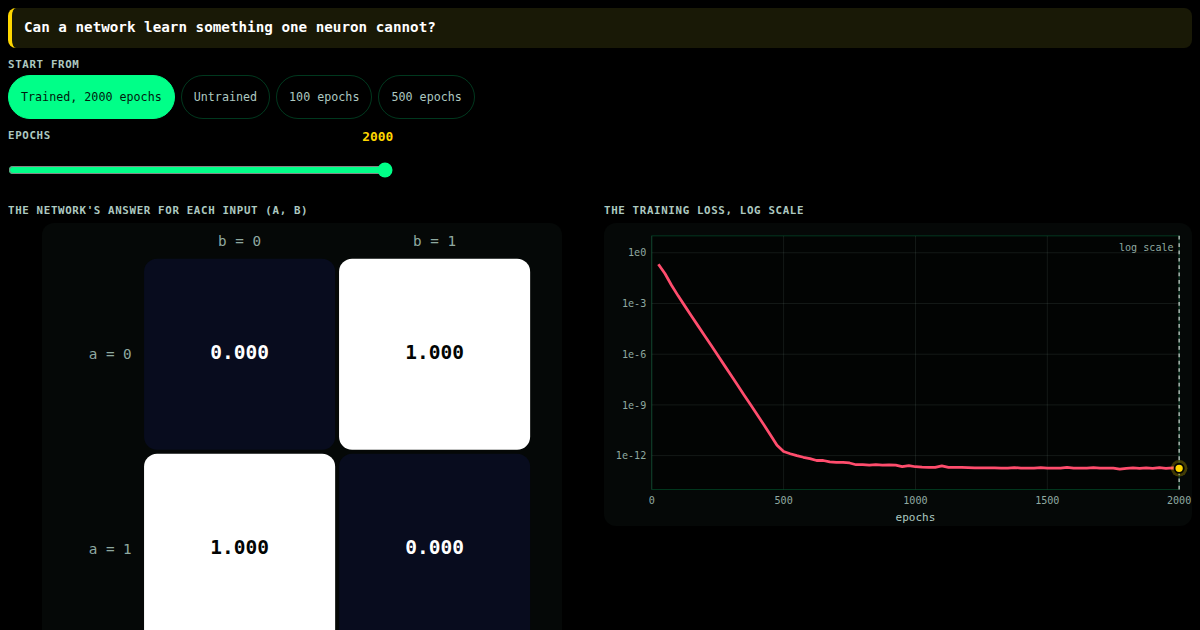
A 2-8-1 network trained by backpropagation in your browser: drag the epochs from 0 to 2000 and watch its four answers move to 0, 1, 1, 0 while the loss falls from 0.89 by twelve orders.
specs/ml/pathway/mlp.t27
// SPDX-License-Identifier: Apache-2.0
// t27/specs/
// ReLU activation for hidden layers | φ² + 1/φ² = 3 | TRINITY

// #8980: forward computed the hidden layer and wrote it into `output` (the
// second layer never ran); init called an undeclared `alloc_f32`; the tests
// called undeclared `create_test_*` helpers; and the invariants asserted `true`.
// The MLP is now two layers, h = relu(W1 x + b1) and y = W2 h + b2, over buffers
// the caller owns. train_step adds backpropagation with an SGD update, and the
// tests train the network on XOR, which no single linear layer can fit.

module Mlp;
    use base::types;
    use math::constants;

    // ═══════════════════════════════════════════════════════════
    // 1. Constants
    // ═══════════════════════════════════════════════════════════

    const MNIST_INPUT_SIZE : u32 = 784;
    const MNIST_OUTPUT_SIZE : u32 = 10;
    const DEFAULT_HIDDEN_SIZE : u32 = 128;

    // ═══════════════════════════════════════════════════════════
    // 2. Types
    // ═══════════════════════════════════════════════════════════

    pub const MLPConfig = struct {
        input_size : u32,
        hidden_size : u32,
        output_size : u32,
    };

    pub const MLPState = struct {
        w1 : []f32,
        b1 : []f32,
        w2 : []f32,
        b2 : []f32,
    };

    // ═══════════════════════════════════════════════════════════
    // 3. Core Functions
    // ═══════════════════════════════════════════════════════════

    // One dense layer: out[o] = sum_i w[o * n_in + i] in[i] + b[o], relu when asked
    fn layer(input: []const f32, w: []const f32, b: []const f32, n_in: u32, n_out: u32, relu: bool, out: []f32) -> void {
        var o : usize = 0;
        while (o < n_out) {
            var sum : f32 = b[o];
            var i : usize = 0;
            while (i < n_in) {
                sum = sum + w[o * n_in + i] * input[i];
                i = i + 1;
            }
            if (relu and sum < 0.0) {
                sum = 0.0;
            }
            out[o] = sum;
            o = o + 1;
        }
    }

    // h = relu(W1 x + b1) into `hidden`, y = W2 h + b2 into `output`
    fn forward(input: []const f32, state: MLPState, hidden: []f32, output: []f32, config: MLPConfig) -> void {
        layer(input, state.w1, state.b1, config.input_size, config.hidden_size, true, hidden);
        layer(hidden, state.w2, state.b2, config.hidden_size, config.output_size, false, output);
    }

    // He-scaled deterministic init: w in [-1, 1) sqrt(2 / fan_in) from a fixed hash of the
    // index (salt tells the layers apart); every bias 0
    fn init_weights(w: []f32, fan_in: u32, salt: usize) -> void {
        const scale : f32 = sqrt(2.0 / @as(f32, @floatFromInt(fan_in)));
        var k : usize = 0;
        while (k < w.len) {
            const h : u32 = @as(u32, @intCast(((k + salt) * 2654435761) % 1000));
            w[k] = (@as(f32, @floatFromInt(h)) / 500.0 - 1.0) * scale;
            k = k + 1;
        }
    }

    fn zero(v: []f32) -> void {
        var k : usize = 0;
        while (k < v.len) {
            v[k] = 0.0;
            k = k + 1;
        }
    }

    fn init(state: MLPState, config: MLPConfig) -> void {
        init_weights(state.w1, config.input_size, 1);
        zero(state.b1);
        init_weights(state.w2, config.hidden_size, 7);
        zero(state.b2);
    }

    // One SGD step on the loss 0.5 * sum_o (y_o - t_o)^2; returns the loss before the step.
    //   d2_o = y_o - t_o                                   (output error)
    //   d1_i = [z_i > 0] sum_o W2[o][i] d2_o                (backpropagated through relu)
    //   W2 -= lr d2 h^T, b2 -= lr d2;  W1 -= lr d1 x^T, b1 -= lr d1
    fn train_step(input: []const f32, target: []const f32, state: MLPState, hidden: []f32, delta: []f32, output: []f32, lr: f32, config: MLPConfig) -> f32 {
        forward(input, state, hidden, output, config);
        var loss : f32 = 0.0;
        var o : usize = 0;
        while (o < config.output_size) {
            const e = output[o] - target[o];
            loss = loss + 0.5 * e * e;
            o = o + 1;
        }
        var i : usize = 0;
        while (i < config.hidden_size) {
            var back : f32 = 0.0;
            if (hidden[i] > 0.0) {
                o = 0;
                while (o < config.output_size) {
                    back = back + state.w2[o * config.hidden_size + i] * (output[o] - target[o]);
                    o = o + 1;
                }
            }
            delta[i] = back;
            i = i + 1;
        }
        o = 0;
        while (o < config.output_size) {
            const d2 = output[o] - target[o];
            i = 0;
            while (i < config.hidden_size) {
                state.w2[o * config.hidden_size + i] = state.w2[o * config.hidden_size + i] - lr * d2 * hidden[i];
                i = i + 1;
            }
            state.b2[o] = state.b2[o] - lr * d2;
            o = o + 1;
        }
        i = 0;
        while (i < config.hidden_size) {
            var j : usize = 0;
            while (j < config.input_size) {
                state.w1[i * config.input_size + j] = state.w1[i * config.input_size + j] - lr * delta[i] * input[j];
                j = j + 1;
            }
            state.b1[i] = state.b1[i] - lr * delta[i];
            i = i + 1;
        }
        return loss;
    }

    fn mnist() -> MLPConfig {
        return MLPConfig{ .input_size = MNIST_INPUT_SIZE, .hidden_size = DEFAULT_HIDDEN_SIZE, .output_size = MNIST_OUTPUT_SIZE };
    }

    // which: 0 = output[index], 1 = min over every output, 2 = number of outputs written,
    // on the MNIST shape with input pixel k = (k % 7) / 7
    fn mnist_forward(which: u8, index: usize) -> f32 {
        var w1 : [784 * 128]f32 = undefined;
        var b1 : [128]f32 = undefined;
        var w2 : [128 * 10]f32 = undefined;
        var b2 : [10]f32 = undefined;
        const state = MLPState{ .w1 = &w1, .b1 = &b1, .w2 = &w2, .b2 = &b2 };
        init(state, mnist());
        var input : [784]f32 = undefined;
        var k : usize = 0;
        while (k < 784) {
            input[k] = @as(f32, @floatFromInt(k % 7)) / 7.0;
            k = k + 1;
        }
        var hidden : [128]f32 = undefined;
        var output : [11]f32 = [-99.0] ** 11;
        forward(&input, state, &hidden, &output, mnist());
        if (which == 0) {
            return output[index];
        }
        var min_h : f32 = hidden[0];
        var written : f32 = 0.0;
        k = 0;
        while (k < 128) {
            min_h = @min(min_h, hidden[k]);
            k = k + 1;
        }
        k = 0;
        while (k < 11) {
            if (output[k] != -99.0) {
                written = written + 1.0;
            }
            k = k + 1;
        }
        if (which == 1) {
            return min_h;
        }
        return written;
    }

    // which: 0 = w1.len written by init, 1 = b1[0], 2 = b2[0], 3 = largest |w1|
    fn mnist_init(which: u8) -> f32 {
        var w1 : [784 * 128]f32 = [9.0] ** (784 * 128);
        var b1 : [128]f32 = [9.0] ** 128;
        var w2 : [128 * 10]f32 = [9.0] ** (128 * 10);
        var b2 : [10]f32 = [9.0] ** 10;
        init(MLPState{ .w1 = &w1, .b1 = &b1, .w2 = &w2, .b2 = &b2 }, mnist());
        var written : f32 = 0.0;
        var largest : f32 = 0.0;
        var k : usize = 0;
        while (k < w1.len) {
            if (w1[k] != 9.0) {
                written = written + 1.0;
            }
            largest = @max(largest, @abs(w1[k]));
            k = k + 1;
        }
        if (which == 0) {
            return written;
        }
        if (which == 1) {
            return b1[0];
        }
        if (which == 2) {
            return b2[0];
        }
        return largest;
    }

    // Train a 2-8-1 network on XOR for `epochs` passes over the four cases.
    // which: 0 = total loss of the first epoch, 1 = total loss of the last epoch,
    // 2 + c = the trained network's output for case c
    fn xor(epochs: u32, which: usize) -> f32 {
        const cfg = MLPConfig{ .input_size = 2, .hidden_size = 8, .output_size = 1 };
        var w1 : [16]f32 = undefined;
        var b1 : [8]f32 = undefined;
        var w2 : [8]f32 = undefined;
        var b2 : [1]f32 = undefined;
        const state = MLPState{ .w1 = &w1, .b1 = &b1, .w2 = &w2, .b2 = &b2 };
        init(state, cfg);
        const xs : [8]f32 = [0.0, 0.0, 0.0, 1.0, 1.0, 0.0, 1.0, 1.0];
        const ts : [4]f32 = [0.0, 1.0, 1.0, 0.0];
        var hidden : [8]f32 = undefined;
        var delta : [8]f32 = undefined;
        var output : [1]f32 = undefined;
        var first : f32 = 0.0;
        var last : f32 = 0.0;
        var e : u32 = 0;
        while (e < epochs) {
            var total : f32 = 0.0;
            var c : usize = 0;
            while (c < 4) {
                total = total + train_step(xs[c * 2 .. c * 2 + 2], ts[c .. c + 1], state, &hidden, &delta, &output, 0.05, cfg);
                c = c + 1;
            }
            if (e == 0) {
                first = total;
            }
            last = total;
            e = e + 1;
        }
        if (which == 0) {
            return first;
        }
        if (which == 1) {
            return last;
        }
        forward(xs[(which - 2) * 2 .. (which - 2) * 2 + 2], state, &hidden, &output, cfg);
        return output[0];
    }

    // ═══════════════════════════════════════════════════════════
    // TDD: Tests (from .tri behaviors)
    // ═══════════════════════════════════════════════════════════

    // 784 -> 128 -> 10: exactly the 10 outputs are written, the 11th slot is untouched
    test forward_output_size
        given written = mnist_forward(2, 0)
        when spare = mnist_forward(0, 10)
        then written == 10.0 and spare == -99.0

    // The hidden layer is relu, so no hidden unit is negative
    test forward_relu_activation
        given min_hidden = mnist_forward(1, 0)
        then min_hidden >= 0.0

    // init writes every one of the 784 * 128 first-layer weights, each within sqrt(2 / 784) = 0.05051
    test init_allocation_sizes
        given written = mnist_init(0)
        when largest = mnist_init(3)
        then written == 100352.0 and largest <= 0.0506 and largest > 0.0

    test init_bias_initialization
        given b1 = mnist_init(1)
        when b2 = mnist_init(2)
        then b1 == 0.0 and b2 == 0.0

    // Backpropagation learns XOR: the loss falls by more than 100x, and each output is within 0.1
    test train_step_learns_xor
        given first = xor(2000, 0)
        when last = xor(2000, 1)
        then last < first / 100.0 and @abs(xor(2000, 2)) < 0.1 and @abs(xor(2000, 3) - 1.0) < 0.1 and @abs(xor(2000, 4) - 1.0) < 0.1 and @abs(xor(2000, 5)) < 0.1

    // ═══════════════════════════════════════════════════════════
    // TDD: Invariants (from .tri constraints)
    // ═══════════════════════════════════════════════════════════

    // input_size == MNIST_INPUT_SIZE (784)
    invariant mlp_constraint_0
        assert mnist().input_size == 784

    // output_size == MNIST_OUTPUT_SIZE (10)
    invariant mlp_constraint_1
        assert mnist().output_size == 10

    // hidden_size > 0
    invariant mlp_constraint_2
        assert mnist().hidden_size > 0

    // w1.size() == input_size * hidden_size
    invariant mlp_constraint_3
        assert mnist().input_size * mnist().hidden_size == 100352

    // w2.size() == hidden_size * output_size
    invariant mlp_constraint_4
        assert mnist().hidden_size * mnist().output_size == 1280

    // b1.size() == hidden_size
    invariant mlp_constraint_5
        assert DEFAULT_HIDDEN_SIZE == 128

    // b2.size() == output_size
    invariant mlp_constraint_6
        assert MNIST_OUTPUT_SIZE == 10
All lessons
Module 1 · One neuron
A neuron sums its inputs and bends the sum: ReLU, the sigmoid and tanh, and where each one stops passing a gradient back.
Module 2 · New bends
The smooth curves of current models: GELU with its dip, Swish with its knob, and ELU with a floor instead of a cliff.
Module 3 · A layer
What sits around the neurons: softmax turns scores into a choice, an embedding turns a word into numbers, dropout switches units off.
Module 4 · Pictures
Reading a picture in patches: a window averaged over its patch, max pooling, and batch normalisation of features on different scales.
Module 5 · The error
How wrong a guess is, as one number: mean squared error, cross-entropy for probabilities, and the Huber loss for outliers.
Module 6 · Downhill
Walking down the loss: gradient descent with momentum, RMSProp that ignores the gradient's size, and Adam that combines them.
Module 7 · Learning
Where the gradients come from and what they achieve: backpropagation through a layer, a network that learns XOR, and LAMB for large batches.
Module 8 · Memory and attention
Networks that read a sequence: a recurrent cell and its fading echo, the gates of an LSTM, and attention over every position at once.
Module 9 · The transformer and the reward
The parts of a transformer and of an agent: positions as clocks, one encoder block, and PPO, which learns from reward without lurching.