PPO and the reward
You will learn
How PPO turns a reward into a policy update, and how its clip keeps one update from going too far.
An agent learns from reward by making good actions more likely. PPO measures a change of policy by the ratio r of the new probability of an action to the old one and multiplies it by the advantage A, how much better the action did than expected. Then it clips: once r has moved more than eps the way A rewards, the objective goes flat. At r = 1.5, A = 1 and eps 0.2 the raw r A is 1.5, but PPO counts 1.2, so one batch cannot push the policy far. On the spec's batch, ratios 1, 1.1 and 0.9 with advantages 2, 1.5 and 3, the policy loss is -2.1167. The spec ppo_clip_loss.t27 computes it.
Try it
Make the advantage negative and find where the curve goes flat now; then widen eps to 0.5.
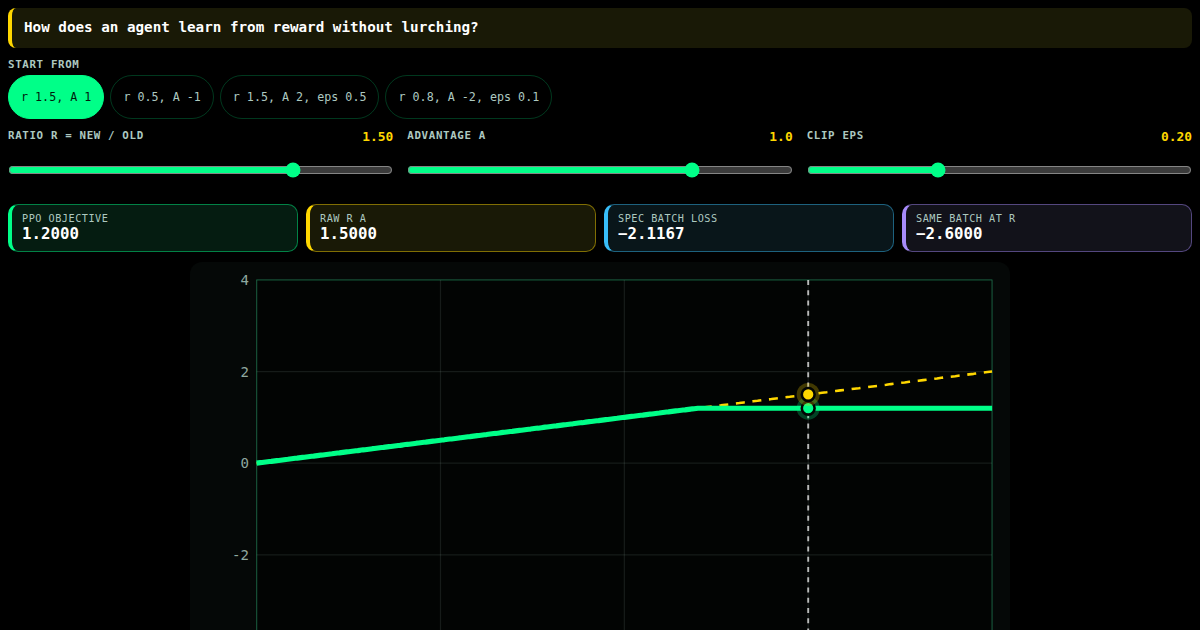
Drag the probability ratio of a new policy over the old: PPO's objective follows r times the advantage until r moves more than eps the rewarded way, then it goes flat and stops pulling.
specs/ml/rl/ppo_clip_loss.t27
// SPDX-License-Identifier: Apache-2.0
// t27/specs/
// Probability ratio between policies | φ² + 1/φ² = 3 | TRINITY

// #8980: written with `let x = if ... {}` and `for i in 0..n`, so it never compiled.
// Three formulas were wrong, and their tests pinned the wrong values:
// - compute_ratio returned log pi_new - log pi_old; the ratio is exp of that.
// - clipped_surrogate returned clip(r) A; PPO's term is min(r A, clip(r) A), so
//   r = 1.1 inside the clip range gives 2.2, not 2.4.
// - policy_loss returned the surrogate itself, a quantity to MAXIMISE; as a loss
//   added to the value and entropy losses it is minus the mean surrogate.
// Each test now states the value PPO defines (Schulman et al., 2017).

module PpoClipLoss;
    use base::types;
    use math::constants;

    // ═══════════════════════════════════════════════════════════
    // 1. Constants
    // ═══════════════════════════════════════════════════════════

    const DEFAULT_CLIP_EPSILON : f32 = 0.2;
    const DEFAULT_ENTROPY_COEF : f32 = 0.01;

    // ═══════════════════════════════════════════════════════════
    // 2. Types
    // ═══════════════════════════════════════════════════════════

    pub const PPOClipConfig = struct {
        clip_epsilon : f32,
        entropy_coef : f32,
        value_clip_coef : f32,
    };

    pub const PPOBatch = struct {
        states : [][]f32,
        actions : [][]f32,
        old_log_probs : []f32,
        advantages : []f32,
        returns : []f32,
        values : []f32,
    };

    // ═══════════════════════════════════════════════════════════
    // 3. Core Functions
    // ═══════════════════════════════════════════════════════════

    // r = pi_new / pi_old = exp(log pi_new - log pi_old)
    fn compute_ratio(new_log_prob: f32, old_log_prob: f32) -> f32 {
        return exp(new_log_prob - old_log_prob);
    }

    // min(r A, clip(r, 1 - eps, 1 + eps) A)
    fn clipped_surrogate(ratio: f32, advantage: f32, clip_epsilon: f32) -> f32 {
        const clipped_ratio = @min(@max(ratio, 1.0 - clip_epsilon), 1.0 + clip_epsilon);
        return @min(ratio * advantage, clipped_ratio * advantage);
    }

    // -mean_t min(r_t A_t, clip(r_t) A_t): the loss gradient descent minimises
    fn policy_loss(ratios: []const f32, advantages: []const f32, clip_epsilon: f32) -> f32 {
        var total : f32 = 0.0;
        var i : usize = 0;
        while (i < ratios.len) {
            total = total + clipped_surrogate(ratios[i], advantages[i], clip_epsilon);
            i = i + 1;
        }
        return -total / @as(f32, @floatFromInt(ratios.len));
    }

    // -coef * mean entropy: lower loss for a more exploratory policy
    fn entropy_loss(entropies: []const f32, entropy_coef: f32) -> f32 {
        var total : f32 = 0.0;
        var i : usize = 0;
        while (i < entropies.len) {
            total = total + entropies[i];
            i = i + 1;
        }
        return -entropy_coef * (total / @as(f32, @floatFromInt(entropies.len)));
    }

    // mean 0.5 (target - (old + clip(pred - old, -c, c)))^2
    fn value_loss(predicted_values: []const f32, target_values: []const f32, old_values: []const f32, clip_coef: f32) -> f32 {
        var total : f32 = 0.0;
        var i : usize = 0;
        while (i < predicted_values.len) {
            const diff = @min(@max(predicted_values[i] - old_values[i], -clip_coef), clip_coef);
            const err = target_values[i] - (old_values[i] + diff);
            total = total + 0.5 * err * err;
            i = i + 1;
        }
        return total / @as(f32, @floatFromInt(predicted_values.len));
    }

    fn policy_loss_of(r0: f32, r1: f32, r2: f32) -> f32 {
        const ratios : [3]f32 = [r0, r1, r2];
        const advantages : [3]f32 = [2.0, 1.5, 3.0];
        return policy_loss(&ratios, &advantages, DEFAULT_CLIP_EPSILON);
    }

    fn entropy_loss_of() -> f32 {
        const entropies : [3]f32 = [0.5, 0.6, 0.4];
        return entropy_loss(&entropies, DEFAULT_ENTROPY_COEF);
    }

    fn value_loss_of(p0: f32) -> f32 {
        const predicted : [3]f32 = [p0, 2.0, 1.5];
        const target : [3]f32 = [1.1, 2.1, 1.6];
        const old : [3]f32 = [0.9, 1.9, 1.4];
        return value_loss(&predicted, &target, &old, 0.2);
    }

    fn valid_input() -> f32 {
        return DEFAULT_CLIP_EPSILON;
    }

    // total_loss(policy_loss_value: f32, value_loss_value: f32, entropy_loss_value: f32, value_loss_coef: f32) → f32
    fn total_loss(policy_loss_value: f32, value_loss_value: f32, entropy_loss_value: f32, value_loss_coef: f32) -> f32 {
        // Combine all loss components
        return policy_loss_value + value_loss_coef * value_loss_value + entropy_loss_value;
    }

    // ═══════════════════════════════════════════════════════════
    // TDD: Tests (from .tri behaviors)
    // ═══════════════════════════════════════════════════════════

    test compute_ratio_basic_case
        given
            new_log_prob = 0.5
            old_log_prob = 0.3
        when result = compute_ratio(new_log_prob, old_log_prob)
        then @abs(result - 1.2214028) < 0.000001  // exp(0.2); the old `== 0.2` was the log ratio

    test clipped_surrogate_basic_case
        given
            ratio = 1.1
            advantage = 2.0
            clip_epsilon = 0.2
        when result = clipped_surrogate(ratio, advantage, clip_epsilon)
        then @abs(result - 1.1 * 2.0) < 0.000001  // inside [0.8, 1.2] the clip does nothing

    test clipped_surrogate_clipping_case
        given
            ratio = 1.5  // Above clip threshold of 1.2
            advantage = 2.0
            clip_epsilon = 0.2
        when result = clipped_surrogate(ratio, advantage, clip_epsilon)
        then @abs(result - 1.2 * 2.0) < 0.000001 and clipped_surrogate(0.5, -1.0, 0.2) == -0.8

    // min(r A, clip(r) A) = (2.0, 1.65, 2.7): the loss is -mean = -2.1166667. The old `> 0` was
    // the surrogate's sign; a ratio pushed past the clip earns nothing more.
    test policy_loss_basic_case
        given result = policy_loss_of(1.0, 1.1, 0.9)
        when pushed = policy_loss_of(1.0, 1.1, 3.0)
        then result < 0.0 and @abs(result + 2.1166667) < 0.000001 and @abs(pushed - policy_loss_of(1.0, 1.1, 1.2)) < 0.000001

    test entropy_loss_basic_case
        given result = entropy_loss_of()
        then result < 0.0 and @abs(result + 0.005) < 0.0000001

    test value_loss_basic_case
        given result = value_loss_of(1.0)
        when clipped = value_loss_of(5.0)
        then result > 0.0 and @abs(result - 0.005) < 0.0000001 and @abs(clipped - value_loss_of(1.1)) < 0.0000001

    test total_loss_basic_case
        given
            policy_loss_value = 1.0
            value_loss_value = 0.5
            entropy_loss_value = -0.01
            value_loss_coef = 0.5
        when result = total_loss(policy_loss_value, value_loss_value, entropy_loss_value, value_loss_coef)
        then @abs(result - (1.0 + 0.5 * 0.5 + (-0.01))) < 0.0000001

    // ═══════════════════════════════════════════════════════════
    // TDD: Invariants (from .tri constraints)
    // ═══════════════════════════════════════════════════════════

    // 0 < clip_epsilon <= 1 (typically 0.1-0.3)
    invariant ppo_clip_loss_constraint_0
        assert valid_input() > 0.0 and valid_input() <= 1.0

    // entropy_coef >= 0
    invariant ppo_clip_loss_constraint_1
        assert DEFAULT_ENTROPY_COEF >= 0.0

    // name: ppo_objective -- for A > 0 the surrogate stops growing at r = 1 + eps
    invariant ppo_clip_loss_constraint_2
        assert clipped_surrogate(5.0, 1.0, 0.2) == 1.2

    // name: probability_ratio -- equal log-probabilities give r = 1
    invariant ppo_clip_loss_constraint_3
        assert compute_ratio(0.3, 0.3) == 1.0

    // "Schulman et al. (2017) - Proximal Policy Optimization Algorithms, arXiv:1707.06347":
    // for A < 0 the surrogate stops falling at r = 1 - eps
    invariant ppo_clip_loss_constraint_4
        assert clipped_surrogate(0.1, -1.0, 0.2) == -0.8
All lessons
Module 1 · One neuron
A neuron sums its inputs and bends the sum: ReLU, the sigmoid and tanh, and where each one stops passing a gradient back.
Module 2 · New bends
The smooth curves of current models: GELU with its dip, Swish with its knob, and ELU with a floor instead of a cliff.
Module 3 · A layer
What sits around the neurons: softmax turns scores into a choice, an embedding turns a word into numbers, dropout switches units off.
Module 4 · Pictures
Reading a picture in patches: a window averaged over its patch, max pooling, and batch normalisation of features on different scales.
Module 5 · The error
How wrong a guess is, as one number: mean squared error, cross-entropy for probabilities, and the Huber loss for outliers.
Module 6 · Downhill
Walking down the loss: gradient descent with momentum, RMSProp that ignores the gradient's size, and Adam that combines them.
Module 7 · Learning
Where the gradients come from and what they achieve: backpropagation through a layer, a network that learns XOR, and LAMB for large batches.
Module 8 · Memory and attention
Networks that read a sequence: a recurrent cell and its fading echo, the gates of an LSTM, and attention over every position at once.
Module 9 · The transformer and the reward
The parts of a transformer and of an agent: positions as clocks, one encoder block, and PPO, which learns from reward without lurching.