Softmax and temperature
You will learn
How softmax turns scores into probabilities that sum to one, and what the temperature does to them.
A classifier ends with one score per class, and softmax turns the scores into probabilities: exp of each score over the sum of all of them. Scores 1, 2 and 3 become 0.090, 0.245 and 0.665. Dividing the scores by a temperature first changes how sure it is: at 0.5 the top score takes 0.867, at 5 the three are 0.27, 0.33 and 0.40. A language model picks its next token from exactly this, and the temperature setting of a chat model is this T. The spec softmax.t27 subtracts the largest score first, so exp never overflows.
Try it
Cool the temperature to 0.1 and read the three probabilities; then make a tie and heat it.
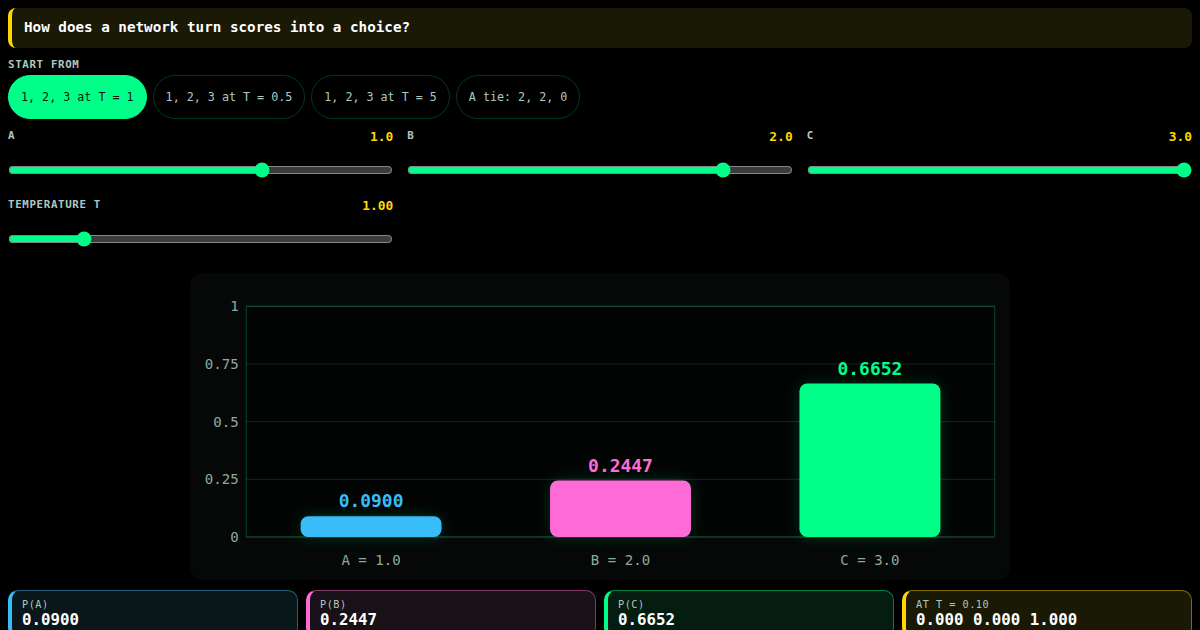
Move three scores and the temperature: softmax turns them into probabilities that sum to one. Cool it and the top score takes almost everything; heat it and the choice evens out.
specs/ml/activation/softmax.t27
// SPDX-License-Identifier: Apache-2.0
// t27/specs/
// Control sharpness of distribution | φ² + 1/φ² = 3 | TRINITY

// #8980: written with `range` and `math::exp`, which no spec declares, so no test
// ever ran. backward was also wrong: it used only the Jacobian's diagonal,
// p_i (1 - p_i), and dropped the -p_i p_j terms. It is now the full product
// grad_input_i = p_i (g_i - sum_j g_j p_j) / temperature.

module Softmax;
    use base::types;
    use math::constants;

    // ═══════════════════════════════════════════════════════════
    // 1. Constants
    // ═══════════════════════════════════════════════════════════

    const ZERO : f32 = 0.0;
    const ONE : f32 = 1.0;
    const MIN_TEMP : f32 = 0.001;

    // ═══════════════════════════════════════════════════════════
    // 2. Types
    // ═══════════════════════════════════════════════════════════

    pub const SoftmaxConfig = struct {
        temperature : f32,
        axis : u32,
        stable : bool,
    };

    // ═══════════════════════════════════════════════════════════
    // 3. Core Functions
    // ═══════════════════════════════════════════════════════════

    // output_i = exp((x_i - max) / T) / sum_j exp((x_j - max) / T); subtracting the max keeps exp finite
    fn forward(logits: []const f32, output: []f32, config: SoftmaxConfig) -> void {
        var max_val : f32 = logits[0];
        var i : usize = 0;
        while (i < logits.len) {
            if (logits[i] > max_val) {
                max_val = logits[i];
            }
            i = i + 1;
        }
        var sum : f32 = ZERO;
        i = 0;
        while (i < logits.len) {
            output[i] = exp((logits[i] - max_val) / config.temperature);
            sum = sum + output[i];
            i = i + 1;
        }
        i = 0;
        while (i < logits.len) {
            output[i] = output[i] / sum;
            i = i + 1;
        }
    }

    // Vector-Jacobian product: grad_input_i = p_i (g_i - sum_j g_j p_j) / T
    fn backward(grad_output: []const f32, probabilities: []const f32, grad_input: []f32, config: SoftmaxConfig) -> void {
        var dot : f32 = ZERO;
        var i : usize = 0;
        while (i < grad_output.len) {
            dot = dot + grad_output[i] * probabilities[i];
            i = i + 1;
        }
        i = 0;
        while (i < grad_output.len) {
            grad_input[i] = probabilities[i] * (grad_output[i] - dot) / config.temperature;
            i = i + 1;
        }
    }

    fn cfg(temperature: f32) -> SoftmaxConfig {
        return SoftmaxConfig{ .temperature = temperature, .axis = 0, .stable = true };
    }

    // output[index] of softmax over (a, b, c)
    fn softmax_at(a: f32, b: f32, c: f32, temperature: f32, index: usize) -> f32 {
        const logits : [3]f32 = [a, b, c];
        var output : [3]f32 = [0.0] ** 3;
        forward(&logits, &output, cfg(temperature));
        return output[index];
    }

    // grad_input[index] for grad_output (0.1, 0.2, 0.3) at probabilities (0.2, 0.3, 0.5)
    fn backward_at(index: usize) -> f32 {
        const grad_output : [3]f32 = [0.1, 0.2, 0.3];
        const probabilities : [3]f32 = [0.2, 0.3, 0.5];
        var grad_input : [3]f32 = [0.0] ** 3;
        backward(&grad_output, &probabilities, &grad_input, cfg(1.0));
        return grad_input[index];
    }

    // L = sum_i w_i softmax(x)_i with w = (0.1, 0.2, 0.3): the loss whose gradient backward computes
    fn weighted(a: f32, b: f32, c: f32) -> f32 {
        return 0.1 * softmax_at(a, b, c, 1.0, 0) + 0.2 * softmax_at(a, b, c, 1.0, 1) + 0.3 * softmax_at(a, b, c, 1.0, 2);
    }

    fn grad_at(a: f32, b: f32, c: f32, index: usize) -> f32 {
        const grad_output : [3]f32 = [0.1, 0.2, 0.3];
        var probabilities : [3]f32 = [0.0] ** 3;
        const logits : [3]f32 = [a, b, c];
        forward(&logits, &probabilities, cfg(1.0));
        var grad_input : [3]f32 = [0.0] ** 3;
        backward(&grad_output, &probabilities, &grad_input, cfg(1.0));
        return grad_input[index];
    }

    fn valid_input() -> f32 {
        return 3.0;
    }

    // ═══════════════════════════════════════════════════════════
    // TDD: Tests (from .tri behaviors)
    // ═══════════════════════════════════════════════════════════

    // softmax(1, 2, 3) = (0.0900306, 0.2447285, 0.6652410)
    test "forward_basic_case"
        given p0 = softmax_at(1.0, 2.0, 3.0, 1.0, 0)
        when p2 = softmax_at(1.0, 2.0, 3.0, 1.0, 2)
        then p0 > 0.0 and softmax_at(1.0, 2.0, 3.0, 1.0, 1) > 0.0 and p2 > 0.0 and @abs(p0 + softmax_at(1.0, 2.0, 3.0, 1.0, 1) + p2 - 1.0) < 0.0001 and @abs(p0 - 0.0900306) < 0.000001 and @abs(p2 - 0.6652410) < 0.000001

    // Subtracting the max: logits of 1000 do not overflow exp
    test "forward_large_logits_stay_finite"
        given p = softmax_at(1000.0, 1000.0, 1000.0, 1.0, 1)
        then @abs(p - 1.0 / 3.0) < 0.000001

    // A higher temperature flattens the distribution toward uniform
    test "forward_temperature_flattens"
        given sharp = softmax_at(1.0, 2.0, 3.0, 1.0, 2)
        when flat = softmax_at(1.0, 2.0, 3.0, 10.0, 2)
        then flat < sharp and flat > 1.0 / 3.0

    // dot = 0.23: grad = (0.2 (0.1 - 0.23), 0.3 (0.2 - 0.23), 0.5 (0.3 - 0.23)) = (-0.026, -0.009, 0.035)
    test "backward_basic_case"
        given g0 = backward_at(0)
        when g2 = backward_at(2)
        then g0 != 0.0 and backward_at(1) != 0.0 and g2 != 0.0 and @abs(g0 - (-0.026)) < 0.000001 and @abs(backward_at(1) - (-0.009)) < 0.000001 and @abs(g2 - 0.035) < 0.000001

    // The gradient of a function of probabilities that sum to 1 sums to 0
    test "backward_sums_to_zero"
        given total = backward_at(0) + backward_at(1) + backward_at(2)
        then @abs(total) < 0.0000001

    test "backward_matches_finite_difference"
        given slope = (weighted(1.0, 2.0 + 0.001, 3.0) - weighted(1.0, 2.0 - 0.001, 3.0)) / 0.002
        when result = grad_at(1.0, 2.0, 3.0, 1)
        then @abs(result - slope) < 0.0005

    // ═══════════════════════════════════════════════════════════
    // TDD: Invariants (from .tri constraints)
    // ═══════════════════════════════════════════════════════════

    // logits.size() == output.size(): the first and last element are both probabilities
    invariant softmax_constraint_0
        assert softmax_at(1.0, 2.0, valid_input(), 1.0, 0) >= 0.0 and softmax_at(1.0, 2.0, valid_input(), 1.0, 2) >= 0.0

    // config.temperature >= MIN_TEMP
    invariant softmax_constraint_1
        assert cfg(1.0).temperature >= MIN_TEMP

    // sum(output) = 1.0 within floating precision
    invariant softmax_constraint_2
        assert @abs(softmax_at(1.0, 2.0, valid_input(), 1.0, 0) + softmax_at(1.0, 2.0, valid_input(), 1.0, 1) + softmax_at(1.0, 2.0, valid_input(), 1.0, 2) - 1.0) < 0.0001
All lessons
Module 1 · One neuron
A neuron sums its inputs and bends the sum: ReLU, the sigmoid and tanh, and where each one stops passing a gradient back.
Module 2 · New bends
The smooth curves of current models: GELU with its dip, Swish with its knob, and ELU with a floor instead of a cliff.
Module 3 · A layer
What sits around the neurons: softmax turns scores into a choice, an embedding turns a word into numbers, dropout switches units off.
Module 4 · Pictures
Reading a picture in patches: a window averaged over its patch, max pooling, and batch normalisation of features on different scales.
Module 5 · The error
How wrong a guess is, as one number: mean squared error, cross-entropy for probabilities, and the Huber loss for outliers.
Module 6 · Downhill
Walking down the loss: gradient descent with momentum, RMSProp that ignores the gradient's size, and Adam that combines them.
Module 7 · Learning
Where the gradients come from and what they achieve: backpropagation through a layer, a network that learns XOR, and LAMB for large batches.
Module 8 · Memory and attention
Networks that read a sequence: a recurrent cell and its fading echo, the gates of an LSTM, and attention over every position at once.
Module 9 · The transformer and the reward
The parts of a transformer and of an agent: positions as clocks, one encoder block, and PPO, which learns from reward without lurching.