A float cut by phi
You will learn
How one rule, E = round((N - 1) / phi^2), splits every GoldenFloat width into sign, exponent and mantissa.
A float spends its bits on three fields: one sign bit, an exponent for range and a mantissa for precision. IEEE 754 picks the split by committee for each width. GoldenFloat uses one rule for all of them: of the N - 1 bits after the sign, round((N - 1) / phi^2) go to the exponent and the rest to the mantissa, so the ratio E / M stays near 1 / phi, about 0.618. The family spec lists 17 widths from GF4 to GF1024, and GF16 is the one it marks primary.
Try it
Run the tests of goldenfloat_family.t27 and find the one that counts the family. Then find which format the spec marks primary and the test that says only one is.
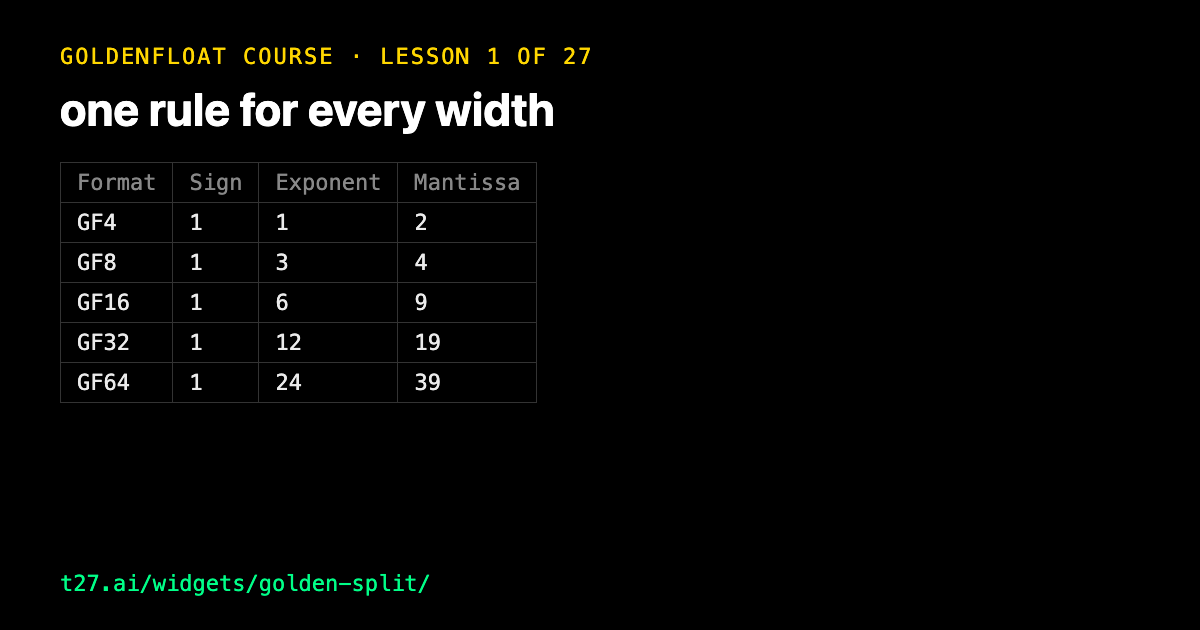
Five of the 17 GoldenFloat widths, read from goldenfloat_family.t27. Lesson 1 of the GoldenFloat course.
specs/numeric/goldenfloat_family.t27
// SPDX-License-Identifier: Apache-2.0
// t27/specs/numeric/goldenfloat_family.t27
// GoldenFloat Family -- phi-structured floating point formats
// NUMERIC-STANDARD-001 -- Agent 1 (P0)

module GoldenFloatFamily {
    // Import constants for phi-structured design
    use math::constants;
    use math::sacred_physics;

    // ----------------------------------------------------------------
    // 1. GoldenFloatFormat -- canonical format descriptor
    // ----------------------------------------------------------------

    struct GoldenFloatFormat {
        name            : string,       // "GF4", "GF8", ..., "GF256"
        bits            : u8,           // Total bits: 4, 8, 12, 16, 20, 24, 32, 64, 256
        sign_bits       : u8,           // Always 1
        exp_bits        : u8,           // Exponent bits = round((bits-1)/phi^2)
        mant_bits       : u8,           // Mantissa bits = bits - 1 - exp_bits
        exp_mant_ratio  : f64,          // exp / mantissa ratio
        phi_distance    : f64,          // |exp/mant - 1/phi| (lower = closer to 1/phi)
        is_primary      : bool,         // true only for GF16
    }

    // ----------------------------------------------------------------
    // 2. GOLDEN_FLOAT_FAMILY -- the canonical format registry
    // ----------------------------------------------------------------

    // phi-ratio target: 1/phi ~ 0.618.
    // ONE closed rule (normative, FORMAT-SPEC-001 v1.2):
    //     e = round((N - 1) / phi^2)
    //     m = N - 1 - e
    //     bias = 2^(e - 1) - 1
    //     exp_max = 2^e - 1
    // derives the exp:mant split for every rung of the 4-to-1024-bit
    // ladder. GFTernary (2-bit code) is the special-case base of the
    // ladder and lives outside this struct (no E/M split). TF3 (1+3+4)
    // is a ternary-weight CONTAINER, not a binary rung, and also lives
    // separately. This array holds the 17 binary-ladder rungs only.
    //
    // Status (v1.2):
    //   - Verified arithmetic (rule produces exact widths): 17/17.
    //   - Frozen tape-out anchor: GF16 = 1+6+9, bias = 31
    //     (tt-trinity-gamma/src/gf16_v2_mul.v).
    //   - Whether the ladder is BETTER than an equally-tuned non-phi
    //     family (posit / OCP-MX / takum / LNS) stays [Open conjecture].
    //   - Per-format PHI_BIAS empirical values are OPEN (do not invent
    //     via Fibonacci/Lucas coincidence for new rungs).
    const PHI_RATIO_TARGET : f64 = sacred_physics::PHI_INV;

    // Format array: ordered by bits (4 .. 1024), one rule across the ladder.
    const GOLDEN_FLOAT_FAMILY : [17]GoldenFloatFormat = [
        // name,  bits, S,  E,   M,   ratio, phi_dist, primary
        GoldenFloatFormat{
            name = "GF4",
            bits = 4,
            sign_bits = 1,
            exp_bits = 1,
            mant_bits = 2,
            exp_mant_ratio = 0.5,
            phi_distance = abs(0.5 - PHI_RATIO_TARGET),
            is_primary = false,
        },
        GoldenFloatFormat{
            name = "GF6",
            bits = 6,
            sign_bits = 1,
            exp_bits = 2,
            mant_bits = 3,
            exp_mant_ratio = 0.6666666666666667,
            phi_distance = abs(0.6666666666666667 - PHI_RATIO_TARGET),
            is_primary = false,
        },
        GoldenFloatFormat{
            name = "GF8",
            bits = 8,
            sign_bits = 1,
            exp_bits = 3,
            mant_bits = 4,
            exp_mant_ratio = 0.75,
            phi_distance = abs(0.75 - PHI_RATIO_TARGET),
            is_primary = false,
        },
        GoldenFloatFormat{
            name = "GF10",
            bits = 10,
            sign_bits = 1,
            exp_bits = 3,
            mant_bits = 6,
            exp_mant_ratio = 0.5,
            phi_distance = abs(0.5 - PHI_RATIO_TARGET),
            is_primary = false,
        },
        GoldenFloatFormat{
            name = "GF12",
            bits = 12,
            sign_bits = 1,
            exp_bits = 4,
            mant_bits = 7,
            exp_mant_ratio = 0.5714285714285714,
            phi_distance = abs(0.5714285714285714 - PHI_RATIO_TARGET),
            is_primary = false,
        },
        GoldenFloatFormat{
            name = "GF14",
            bits = 14,
            sign_bits = 1,
            exp_bits = 5,
            mant_bits = 8,
            exp_mant_ratio = 0.625,
            phi_distance = abs(0.625 - PHI_RATIO_TARGET),
            is_primary = false,
        },
        GoldenFloatFormat{
            name = "GF16",
            bits = 16,
            sign_bits = 1,
            exp_bits = 6,
            mant_bits = 9,
            exp_mant_ratio = 0.6666666666666667,
            phi_distance = abs(0.6666666666666667 - PHI_RATIO_TARGET),
            is_primary = true,  // PRIMARY FORMAT
        },
        GoldenFloatFormat{
            name = "GF20",
            bits = 20,
            sign_bits = 1,
            exp_bits = 7,
            mant_bits = 12,
            exp_mant_ratio = 0.5833333333333333,
            phi_distance = abs(0.5833333333333333 - PHI_RATIO_TARGET),
            is_primary = false,
        },
        GoldenFloatFormat{
            name = "GF24",
            bits = 24,
            sign_bits = 1,
            exp_bits = 9,
            mant_bits = 14,
            exp_mant_ratio = 0.6428571428571429,
            phi_distance = abs(0.6428571428571429 - PHI_RATIO_TARGET),
            is_primary = false,
        },
        GoldenFloatFormat{
            name = "GF32",
            bits = 32,
            sign_bits = 1,
            exp_bits = 12,
            mant_bits = 19,
            exp_mant_ratio = 0.631578947368421,
            phi_distance = abs(0.631578947368421 - PHI_RATIO_TARGET),
            is_primary = false,
        },
        GoldenFloatFormat{
            name = "GF48",
            bits = 48,
            sign_bits = 1,
            exp_bits = 18,
            mant_bits = 29,
            exp_mant_ratio = 0.6206896551724138,
            phi_distance = abs(0.6206896551724138 - PHI_RATIO_TARGET),
            is_primary = false,
        },
        GoldenFloatFormat{
            name = "GF64",
            bits = 64,
            sign_bits = 1,
            exp_bits = 24,
            mant_bits = 39,
            exp_mant_ratio = 0.6153846153846154,
            phi_distance = abs(0.6153846153846154 - PHI_RATIO_TARGET),
            is_primary = false,
        },
        GoldenFloatFormat{
            name = "GF96",
            bits = 96,
            sign_bits = 1,
            exp_bits = 36,
            mant_bits = 59,
            exp_mant_ratio = 0.6101694915254238,
            phi_distance = abs(0.6101694915254238 - PHI_RATIO_TARGET),
            is_primary = false,
        },
        GoldenFloatFormat{
            name = "GF128",
            bits = 128,
            sign_bits = 1,
            exp_bits = 49,
            mant_bits = 78,
            exp_mant_ratio = 0.6282051282051282,
            phi_distance = abs(0.6282051282051282 - PHI_RATIO_TARGET),
            is_primary = false,
        },
        GoldenFloatFormat{
            name = "GF256",
            bits = 256,
            sign_bits = 1,
            exp_bits = 97,
            mant_bits = 158,
            exp_mant_ratio = 0.6139240506329114,
            phi_distance = abs(0.6139240506329114 - PHI_RATIO_TARGET),
            is_primary = false,
        },
        GoldenFloatFormat{
            name = "GF512",
            bits = 512,
            sign_bits = 1,
            exp_bits = 195,
            mant_bits = 316,
            exp_mant_ratio = 0.6170886075949367,
            phi_distance = abs(0.6170886075949367 - PHI_RATIO_TARGET),
            is_primary = false,
        },
        GoldenFloatFormat{
            name = "GF1024",
            bits = 1024,
            sign_bits = 1,
            exp_bits = 391,
            mant_bits = 632,
            exp_mant_ratio = 0.6186708860759494,
            phi_distance = abs(0.6186708860759494 - PHI_RATIO_TARGET),
            is_primary = false,
        },
    ];

    // ----------------------------------------------------------------
    // 3. Query functions
    // ----------------------------------------------------------------

    // (Loops below were `for (const XS) |x|`; the `const` qualifier inside
    // the iterable parentheses is not t27 and is dropped -- same iteration.
    // Rust `Option<T>` return types are written as the optional `?T`.)
    fn get_format_by_name(name: string) -> ?GoldenFloatFormat {
        for (GOLDEN_FLOAT_FAMILY) |fmt| {
            if (fmt.name == name) {
                return fmt;
            }
        }
        return null;
    }

    fn get_format_by_bits(bits: u8) -> ?GoldenFloatFormat {
        for (GOLDEN_FLOAT_FAMILY) |fmt| {
            if (fmt.bits == bits) {
                return fmt;
            }
        }
        return null;
    }

    fn get_primary_format() -> GoldenFloatFormat {
        return GOLDEN_FLOAT_FAMILY[6];  // GF16 at index 6 (after GF4, GF6, GF8, GF10, GF12, GF14)
    }

    // ----------------------------------------------------------------
    // 4. Verification functions
    // ----------------------------------------------------------------

    struct VerificationReport {
        all_valid            : bool,
        primary_is_gf16      : bool,
        phi_distances_ok     : bool,
        best_phi_format      : string,
        best_phi_distance    : f64,
        avg_phi_distance     : f64,
    }

    fn verify_golden_family() -> VerificationReport {
        var primary_count : u8 = 0;
        var best_dist : f64 = 1.0;
        var best_name : string = "";
        var total_dist : f64 = 0.0;
        var format_count : u8 = 0;
        var all_names_unique : bool = true;
        var all_bit_sums_valid : bool = true;
        var all_phi_distances_non_negative : bool = true;

        // Check for duplicate names
        var names_seen : [17]string = ["", "", "", "", "", "", "", "", "", "", "", "", "", "", "", "", ""];

        for (GOLDEN_FLOAT_FAMILY) |fmt| {
            format_count = format_count + 1;

            // Count primary formats (should be exactly 1)
            if (fmt.is_primary) {
                primary_count = primary_count + 1;
            }

            // Track best phi distance
            if (fmt.phi_distance < best_dist) {
                best_dist = fmt.phi_distance;
                best_name = fmt.name;
            }

            total_dist = total_dist + fmt.phi_distance;

            // Check for duplicate names
            for (names_seen) |name| {
                if (name != "" && name == fmt.name) {
                    all_names_unique = false;
                }
            }
            names_seen[format_count - 1] = fmt.name;

            // Check that exp_bits + mant_bits + 1 = bits (sign bit)
            if (fmt.exp_bits + fmt.mant_bits + 1 != fmt.bits) {
                all_bit_sums_valid = false;
            }

            // Check phi_distance is non-negative
            if (fmt.phi_distance < 0.0) {
                all_phi_distances_non_negative = false;
            }
        }

        const avg_dist = total_dist / 17.0;

        // All checks must pass
        const all_checks_valid =
            format_count == 17 &&
            all_names_unique &&
            all_bit_sums_valid &&
            all_phi_distances_non_negative &&
            primary_count == 1;

        return VerificationReport{
            all_valid = all_checks_valid,
            primary_is_gf16 = (primary_count == 1) && (GOLDEN_FLOAT_FAMILY[6].is_primary),
            phi_distances_ok = best_dist < 0.1,  // All within 0.1 of 1/phi
            best_phi_format = best_name,
            best_phi_distance = best_dist,
            avg_phi_distance = avg_dist,
        };
    }

    // ----------------------------------------------------------------
    // 5. Utility functions
    // ----------------------------------------------------------------

    fn max_value(format: GoldenFloatFormat) -> f64 {
        // Max value = (2 - 2^(-M)) * 2^(2^E - 1)
        const mant_max = 2.0 - pow(2.0, -(format.mant_bits as f64));
        const exp_max = pow(2.0, format.exp_bits as f64) - 1.0;
        return mant_max * pow(2.0, exp_max);
    }

    fn min_positive(format: GoldenFloatFormat) -> f64 {
        // Min positive = 2^(-M) * 2^(1 - bias)
        const mant_min = pow(2.0, -(format.mant_bits as f64));
        const bias = pow(2.0, format.exp_bits as f64 - 1.0) - 1.0;
        return mant_min * pow(2.0, 1.0 - bias);
    }

    fn memory_efficiency(format: GoldenFloatFormat) -> f64 {
        // Memory efficiency vs FP32 (1.0 = same, 0.5 = half size)
        return format.bits as f64 / 32.0;
    }

    // ----------------------------------------------------------------
    // TDD-Inside-Spec: Tests and Invariants for GoldenFloatFamily
    // ----------------------------------------------------------------

    test gffamily_get_format_by_name_gf16
        given fmt = get_format_by_name("GF16")
        then fmt != null and fmt.?.name == "GF16" and fmt.?.bits == 16

    test gffamily_get_format_by_bits_8
        given fmt = get_format_by_bits(8)
        then fmt != null and fmt.?.name == "GF8" and fmt.?.bits == 8

    test gffamily_get_primary_format_is_gf16
        given primary = get_primary_format()
        then primary.name == "GF16" and primary.is_primary == true

    test gffamily_family_size_17
        given size = GOLDEN_FLOAT_FAMILY.len()
        then size == 17

    test gffamily_phi_ratio_target_is_phi_inverse
        given target = PHI_RATIO_TARGET
        and   phi_inv = sacred_physics::PHI_INV
        then abs(target - phi_inv) < 0.000001

    test gffamily_gf4_has_correct_bit_counts
        given fmt = get_format_by_name("GF4").?
        then fmt.sign_bits == 1 and fmt.exp_bits == 1 and fmt.mant_bits == 2

    test gffamily_gf32_has_correct_bit_counts
        given fmt = get_format_by_name("GF32").?
        then fmt.sign_bits == 1 and fmt.exp_bits == 12 and fmt.mant_bits == 19

    test gffamily_gf64_has_correct_bit_counts
        given fmt = get_format_by_name("GF64").?
        then fmt.sign_bits == 1 and fmt.exp_bits == 24 and fmt.mant_bits == 39

    test gffamily_gf256_has_correct_bit_counts
        given fmt = get_format_by_name("GF256").?
        then fmt.sign_bits == 1 and fmt.exp_bits == 97 and fmt.mant_bits == 158

    test gffamily_only_gf16_is_primary
        var count = 0
        for (GOLDEN_FLOAT_FAMILY) |fmt| {
            if (fmt.is_primary) { count = count + 1; }
        }
        then count == 1

    test gffamily_verify_primary_is_gf16
        given report = verify_golden_family()
        then report.primary_is_gf16 == true

    test gffamily_phi_distances_within_tolerance
        given report = verify_golden_family()
        then report.phi_distances_ok == true

    test gffamily_best_phi_format_is_gf1024
        // GF1024 has the smallest phi-distance (0.0006) of the ladder
        // (GF64 was best in the 9-rung family pre-v1.2 at 0.003).
        given report = verify_golden_family()
        then report.best_phi_format == "GF1024"

    test gffamily_memory_efficiency_gf8
        given fmt = get_format_by_name("GF8").?
        and   eff = memory_efficiency(fmt)
        then abs(eff - 0.25) < 0.01

    test gffamily_memory_efficiency_gf16
        given fmt = get_format_by_name("GF16").?
        and   eff = memory_efficiency(fmt)
        then abs(eff - 0.5) < 0.01

    test gffamily_max_value_positive
        given fmt = get_format_by_name("GF8").?
        and   max_val = max_value(fmt)
        then max_val > 0.0

    test gffamily_min_positive_greater_than_zero
        given fmt = get_format_by_name("GF8").?
        and   min_pos = min_positive(fmt)
        then min_pos > 0.0

    test gffamily_get_format_by_unknown_name
        given fmt = get_format_by_name("GF999")
        then fmt == null

    test gffamily_get_format_by_unknown_bits
        given fmt = get_format_by_bits(100)
        then fmt == null

    test gffamily_verify_all_valid
        given report = verify_golden_family()
        then report.all_valid == true

    test gffamily_verify_format_count_is_9
        given report = verify_golden_family()
        then report.all_valid == true  // implies format_count == 9

    test gffamily_verify_names_unique
        given report = verify_golden_family()
        then report.all_valid == true  // implies names are unique

    test gffamily_verify_bit_sums_valid
        given report = verify_golden_family()
        then report.all_valid == true  // implies bit sums are valid

    test gffamily_verify_phi_distances_non_negative
        given report = verify_golden_family()
        then report.all_valid == true  // implies phi_distances are non-negative

    test gffamily_verify_exactly_one_primary
        given report = verify_golden_family()
        then report.all_valid == true  // implies exactly 1 primary format

    test gffamily_best_phi_distance_is_small
        given report = verify_golden_family()
        then report.best_phi_distance < 0.05

    test gffamily_avg_phi_distance_reasonable
        given report = verify_golden_family()
        and avg = report.avg_phi_distance
        then avg > 0.0 and avg < 0.2

    invariant gffamily_phi_ratio_target_positive
        assert PHI_RATIO_TARGET > 0.0

    invariant gffamily_phi_ratio_target_less_than_one
        assert PHI_RATIO_TARGET < 1.0

    invariant gffamily_family_size_constant
        assert GOLDEN_FLOAT_FAMILY.len() == 9

    invariant gffamily_gf4_at_index_0
        assert GOLDEN_FLOAT_FAMILY[0].name == "GF4"

    invariant gffamily_gf256_at_index_8
        assert GOLDEN_FLOAT_FAMILY[8].name == "GF256"

    // (The three loop invariants below are in brace form: a `for` loop
    // cannot open a keyword-style block, which the parser dropped.)
    invariant gffamily_all_formats_have_sign_bits_1 {
        for (GOLDEN_FLOAT_FAMILY) |fmt| {
            assert fmt.sign_bits == 1;
        }
    }

    invariant gffamily_all_formats_bits_sum_correct {
        for (GOLDEN_FLOAT_FAMILY) |fmt| {
            assert fmt.sign_bits + fmt.exp_bits + fmt.mant_bits == fmt.bits;
        }
    }

    invariant gffamily_primary_is_gf16
        assert GOLDEN_FLOAT_FAMILY[3].is_primary == true

    invariant gffamily_phi_distances_non_negative {
        for (GOLDEN_FLOAT_FAMILY) |fmt| {
            assert fmt.phi_distance >= 0.0;
        }
    }

    invariant gffamily_memory_efficiency_gf4
        assert abs(memory_efficiency(GOLDEN_FLOAT_FAMILY[0]) - 0.125) < 0.01

    invariant gffamily_memory_efficiency_gf64
        assert abs(memory_efficiency(GOLDEN_FLOAT_FAMILY[7]) - 2.0) < 0.01

    // (Benches were keyword-style `measure:` / `target:` lines, which no
    // backend lowers; now brace form: both lines kept as comments and the
    // measured call written as the bench statement.)
    bench gffamily_get_format_by_name_latency {
        // measure: nanoseconds to get_format_by_name("GF16")
        // target: < 100ns
        _ = get_format_by_name("GF16");
    }

    bench gffamily_get_format_by_bits_latency {
        // measure: nanoseconds to get_format_by_bits(16)
        // target: < 100ns
        _ = get_format_by_bits(16);
    }

    bench gffamily_get_primary_format_latency {
        // measure: nanoseconds to get_primary_format()
        // target: < 50ns
        _ = get_primary_format();
    }

    bench gffamily_verify_golden_family_latency {
        // measure: nanoseconds to verify_golden_family()
        // target: < 500ns
        _ = verify_golden_family();
    }

    bench gffamily_memory_efficiency_latency {
        // measure: nanoseconds to memory_efficiency(GOLDEN_FLOAT_FAMILY[3])
        // target: < 100ns
        _ = memory_efficiency(GOLDEN_FLOAT_FAMILY[3]);
    }
}
All lessons
Module 1 · The rule and its numbers
One rule splits every width, the ratio it aims at, and the Lucas numbers behind the 3.
Module 2 · Why phi, why three
Why the split is phi, why base three, and how a spec checks GF16 keeps phi.
Module 3 · The small rungs: GF4 to GF8
GF4, GF6 and GF8, the fewest bits, where rounding to whole bits costs the most.
Module 4 · Ten to fourteen bits
GF10, GF12 and GF14, and how the distance from 1 / phi moves as the word grows.
Module 5 · GF16 at work
The primary 16-bit format, a two-term dot product in GF-T16, then GF20 and GF24.
Module 6 · GF32 to GF64
GF32 beside IEEE single, GF48 with no IEEE twin, GF64 beside IEEE double.
Module 7 · GF96 to GF256
GF96, GF128 and GF256, where the specs hold the layout with invariants.
Module 8 · The widest rungs, then trits
GF512 and GF1024, the two widest rungs, then GF-T8, where the exponent moves to trits.
Module 9 · More trits, then the decode
GF-T16 and GF-T32, then why fixed fields decode in parallel and a posit does not.