GF10: ten bits
You will learn
How 10 bits split into 1 + 3 + 6, and why its ratio sits 0.118 from 1 / phi.
GF10 has 10 bits: 1 sign, 3 exponent, 6 mantissa, bias 3. The rule gives E = round(9 / phi^2) = 3, and E / M is 0.5, the same distance of 0.118 from 1 / phi as GF4. Rounding to whole bits is what costs it: at small widths there are few splits to choose from.
Try it
Find EM_RATIO and PHI_DIST in gf10.t27. Then compute round(9 / phi^2) yourself and check it against EXP_BITS.
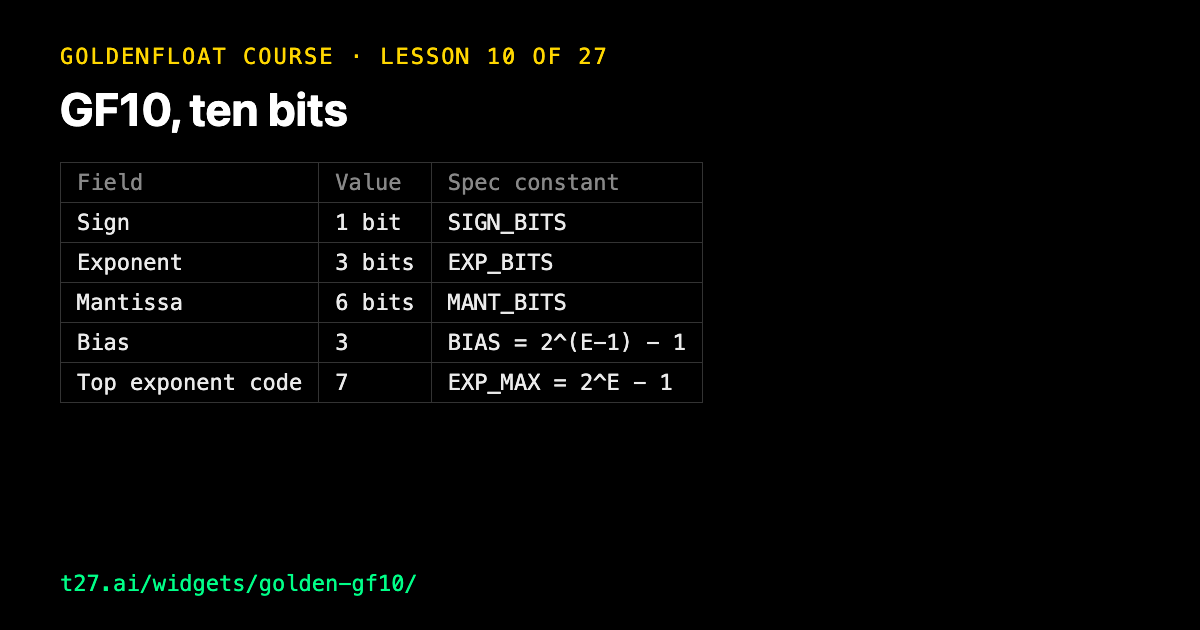
GF10: 10 bits as the spec lays them out, read from gf10.t27. Lesson 10 of the GoldenFloat course.
specs/numeric/gf10.t27
// SPDX-License-Identifier: Apache-2.0
; gf10.t27 -- GoldenFloat10 Encode/Decode
; GF10: 10-bit floating point with 1 sign + 3 exponent + 6 mantissa
; Bit layout: [S(1) E(3) M(6)] = [9:9][8:6][5:0]
; phi^2 + 1/phi^2 = 3 | TRINITY
; Generated by the closed-form rule e = round((N-1)/phi^2), m = N-1-e.
; STATUS: Conj (closed-form rule, no RTL yet on this repo).

module triformat-gf10;

// ============================================================================
// Constants -- derived from the closed-form rule
// ============================================================================

pub const TOTAL_BITS : u16 = 10;
pub const SIGN_BITS  : u8 = 1;
pub const EXP_BITS   : u8 = 3;
pub const MANT_BITS  : u16 = 6;

pub const SIGN_SHIFT : u16 = 9;
pub const EXP_SHIFT  : u16 = 6;
pub const MANT_SHIFT : u16 = 0;

pub const BIAS    : u64 = 3;        // 2^(E-1) - 1
pub const EXP_MAX : u64 = 7;     // 2^E - 1

// E/M ratio (target: 1/phi ~ 0.6180339887)
pub const EM_RATIO   : f64 = 0.500000000000;
pub const PHI_DIST   : f64 = 0.118033988750;

pub const PHI_BIAS_STATUS : str = "OPEN -- not derivable from closed form; empirical per format";

// PHI_BIAS for this rung is NOT defined. The published formula
// PHI_BIAS = EXP_MAX - BIAS reproduces GF64 only and is RETRACTED as a general law.
// Do NOT invent a value via Fibonacci/Lucas/square coincidence; those are
// descriptive, not prescriptive.

// ============================================================================
// Invariants -- the Fpath below, made executable (W601)
//
// This file declared its own falsification path in a comment and nothing
// checked it. W600's per-test measurement found 38 specs that compile while
// asserting nothing; this is one, and the rule it is derived from is stated
// precisely enough to be a test.
// ============================================================================

invariant gf10_field_widths_partition_the_word {
    @compileAssert(SIGN_BITS + EXP_BITS + MANT_BITS == TOTAL_BITS);
}

invariant gf10_closed_form_mantissa {
    // m = N - 1 - e, the second half of the generating rule
    @compileAssert(MANT_BITS == TOTAL_BITS - 1 - EXP_BITS);
}

invariant gf10_closed_form_exponent {
    // e = round((N-1)/phi^2)  <=>  (e - 1/2)*phi^2 <= N-1 <= (e + 1/2)*phi^2
    // Stated as bounds because the rule rounds; phi^2 = 2.618033988749895.
    @compileAssert((EXP_BITS as f64 - 0.5) * 2.618033988749895 <= TOTAL_BITS as f64 - 1.0);
    @compileAssert(TOTAL_BITS as f64 - 1.0 <= (EXP_BITS as f64 + 0.5) * 2.618033988749895);
}

invariant gf10_shifts_follow_the_layout {
    @compileAssert(SIGN_SHIFT == TOTAL_BITS - 1);
    @compileAssert(EXP_SHIFT == MANT_BITS);
    @compileAssert(MANT_SHIFT == 0);
}

invariant gf10_bias_identity {
    // BIAS = 2^(E-1) - 1, as the declaration's own comment states
    @compileAssert(BIAS == (1 << (EXP_BITS - 1)) - 1);
}

invariant gf10_exp_max_identity {
    // EXP_MAX = 2^E - 1
    @compileAssert(EXP_MAX == (1 << EXP_BITS) - 1);
}

; ============================================================================
; Claim-status: Conj
; Fpath: closed-form rule mis-applied (verify e = round((10-1)/phi^2) = 3, m = 6)
;        or RTL emission diverges from this constant set.
;        As of W601 the Fpath above is CHECKED by the invariants in this file.
; ============================================================================
All lessons
Module 1 · The rule and its numbers
One rule splits every width, the ratio it aims at, and the Lucas numbers behind the 3.
Module 2 · Why phi, why three
Why the split is phi, why base three, and how a spec checks GF16 keeps phi.
Module 3 · The small rungs: GF4 to GF8
GF4, GF6 and GF8, the fewest bits, where rounding to whole bits costs the most.
Module 4 · Ten to fourteen bits
GF10, GF12 and GF14, and how the distance from 1 / phi moves as the word grows.
Module 5 · GF16 at work
The primary 16-bit format, a two-term dot product in GF-T16, then GF20 and GF24.
Module 6 · GF32 to GF64
GF32 beside IEEE single, GF48 with no IEEE twin, GF64 beside IEEE double.
Module 7 · GF96 to GF256
GF96, GF128 and GF256, where the specs hold the layout with invariants.
Module 8 · The widest rungs, then trits
GF512 and GF1024, the two widest rungs, then GF-T8, where the exponent moves to trits.
Module 9 · More trits, then the decode
GF-T16 and GF-T32, then why fixed fields decode in parallel and a posit does not.