Конвейер снятия
Вы узнаете
Как снятие сброса проходит по сдвиговому регистру и что компилятор для него генерирует.
Снятие идёт по сдвиговому регистру: на такте приёмника триггер за триггером берёт значение соседа, и сброс держится, пока конвейер не опустеет. Задержка равна числу ступеней — 2 ступени снимаются за 2 такта, 3 за 3. Запись показывает, что компилятор генерирует для модели: t27c gen печатает Zig, и функция step — это копирование структуры, по одному полю на триггер, и ничего больше. wc -l в конце записи — размер всей сгенерированной модели.
Попробуйте
В записи найдите число из wc -l; затем в окне спеки найдите after_clocks() и проверьте, что задержка снятия равна числу ступеней.
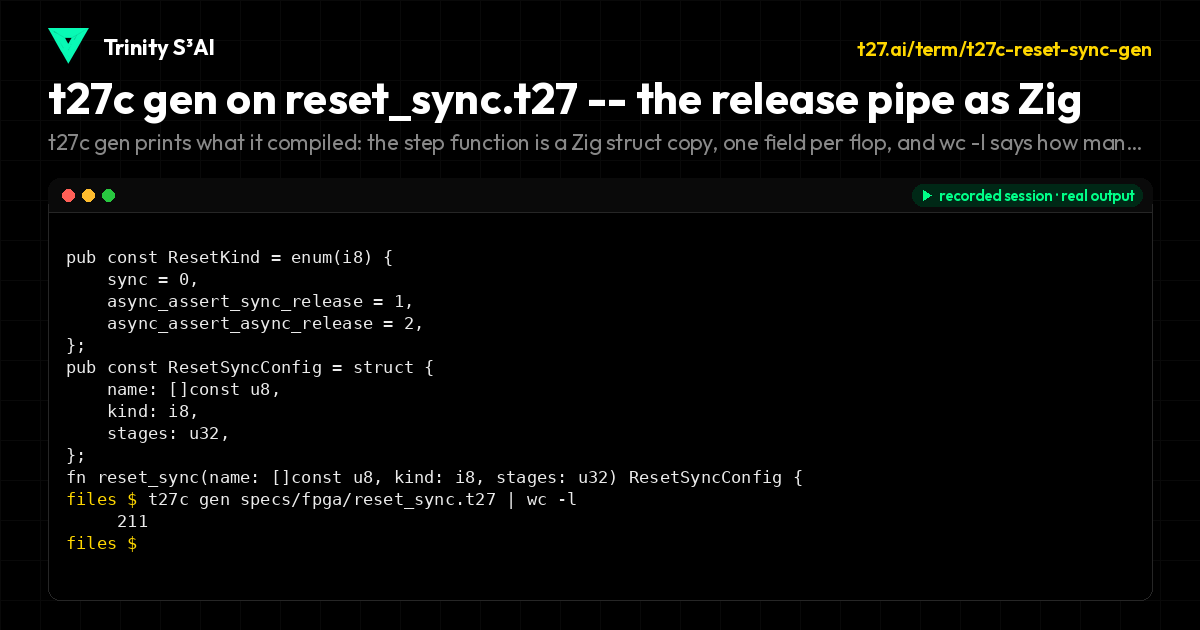
t27c gen prints what it compiled: the step function is a Zig struct copy, one field per flop, and wc -l says how many lines the whole model took.
specs/fpga/reset_sync.t27
// SPDX-License-Identifier: Apache-2.0
// t27/specs/fpga/reset_sync.t27
// Reset synchronizer model for Trinity T27 FPGA HIR
// Three reset kinds, a shift-register model of the release path
// phi^2 + 1/phi^2 = 3 | TRINITY
//
// THE RULE THIS FILE TEACHES. A reset may assert asynchronously (the board
// does not wait for your clock) but must release synchronously: the release
// edge is captured by the destination clock and walked through a small shift
// register of 2 or more flops. A reset that releases asynchronously races the
// clock at every flip-flop it feeds and violates recovery/removal timing, so
// kind 2 below (async assert, async release) is legal hardware but not a
// recommended reset. The flop count is capped at 4 because the shift register
// is drawn one flop per field (d0..d3), and 2 to 4 stages covers the range a
// real design chooses from.

module ResetSync {

    // === Reset kinds ===

    pub const ResetKind = enum(i8) {
        sync = 0,                    // assert and release both through the clock
        async_assert_sync_release = 1, // assert immediate, release through the pipe
        async_assert_async_release = 2, // assert and release both immediate: races
    }

    // === Reset synchronizer configuration ===

    pub struct ResetSyncConfig {
        name : &str,
        kind : i8,
        stages : u32,
    }

    fn reset_sync(name: &str, kind: i8, stages: u32) -> ResetSyncConfig {
        return ResetSyncConfig{
            .name = name,
            .kind = kind,
            .stages = stages,
        };
    }

    // === Shift-register state (one bool per flop, d0 nearest the input) ===

    pub struct SyncState {
        d0 : bool,
        d1 : bool,
        d2 : bool,
        d3 : bool,
    }

    fn asserted_state() -> SyncState {
        return SyncState{ .d0 = true, .d1 = true, .d2 = true, .d3 = true };
    }

    fn released_state() -> SyncState {
        return SyncState{ .d0 = false, .d1 = false, .d2 = false, .d3 = false };
    }

    // One destination clock: every flop takes its neighbour's value
    fn step(s: SyncState, din: bool) -> SyncState {
        return SyncState{
            .d0 = din,
            .d1 = s.d0,
            .d2 = s.d1,
            .d3 = s.d2,
        };
    }

    // Run the pipe with the input released, as a clean reset release does
    fn after_clocks(s: SyncState, clocks: u32) -> SyncState {
        var r : SyncState = s;
        var i : u32 = 0;
        while i < clocks {
            r = step(r, false);
            i = i + 1;
        }
        return r;
    }

    fn settled(s: SyncState) -> bool {
        return (s.d0 or s.d1 or s.d2 or s.d3) == false;
    }

    // === Kind and timing queries ===

    fn asserts_async(cfg: ResetSyncConfig) -> bool {
        return (cfg.kind == 1) or (cfg.kind == 2);
    }

    fn releases_async(cfg: ResetSyncConfig) -> bool {
        return cfg.kind == 2;
    }

    // The flop the sync path reads: stage 1 is d0, stage 2 is d1, and so on
    fn pipe_output(s: SyncState, cfg: ResetSyncConfig) -> bool {
        if cfg.stages == 1 {
            return s.d0;
        }
        if cfg.stages == 2 {
            return s.d1;
        }
        if cfg.stages == 3 {
            return s.d2;
        }
        return s.d3;
    }

    // The reset seen by the logic, given the pipe state and the raw input
    fn reset_out(cfg: ResetSyncConfig, s: SyncState, raw_in: bool) -> bool {
        if cfg.kind == 2 {
            // Async release: the raw wire is the reset, glitches and all
            return raw_in;
        }
        if cfg.kind == 1 {
            // Async assert: the raw wire asserts at once; the pipe releases
            return raw_in or pipe_output(s, cfg);
        }
        // Sync reset: the pipe alone decides, assert and release both clocked
        return pipe_output(s, cfg);
    }

    // Cycles from a released input to a released output
    fn release_latency_cycles(cfg: ResetSyncConfig) -> u32 {
        return cfg.stages;
    }

    // === Validation ===

    fn validate_rst(cfg: ResetSyncConfig) -> u32 {
        var errors : u32 = 0;

        if cfg.name == "" {
            errors = errors + 1;
        }
        if cfg.kind < 0 or cfg.kind > 2 {
            errors = errors + 1;
        }
        if cfg.stages < 1 or cfg.stages > 4 {
            errors = errors + 1;
        }

        return errors;
    }

    // The shape the course recommends: release through at least two flops
    fn is_recommended(cfg: ResetSyncConfig) -> bool {
        return (cfg.kind == 0 or cfg.kind == 1) and cfg.stages >= 2;
    }

    // === Tests ===

    test the_pipe_shifts_one_flop_per_clock
        given s1 = step(released_state(), true)
        then s1.d0 == true
        and s1.d1 == false
        and s1.d2 == false

    test the_pipe_carries_the_release_downstream
        given s1 = step(asserted_state(), false)
        and s2 = step(s1, false)
        then s1.d0 == false
        and s1.d1 == true
        and s2.d0 == false
        and s2.d1 == false

    test a_two_stage_release_takes_two_clocks
        given cfg = reset_sync("sys_rst", 1, 2)
        and one = after_clocks(asserted_state(), 1)
        and two = after_clocks(asserted_state(), 2)
        then reset_out(cfg, one, false) == true
        and reset_out(cfg, two, false) == false

    test release_latency_counts_the_flops
        given cfg2 = reset_sync("two", 1, 2)
        and cfg3 = reset_sync("three", 1, 3)
        then release_latency_cycles(cfg2) == 2
        and release_latency_cycles(cfg3) == 3

    test async_assert_reaches_the_output_without_a_clock
        given cfg = reset_sync("sys_rst", 1, 2)
        then reset_out(cfg, released_state(), true) == true
        and asserts_async(cfg) == true

    test sync_assert_waits_for_the_clock
        given cfg = reset_sync("sys_rst", 0, 2)
        then reset_out(cfg, released_state(), true) == false
        and asserts_async(cfg) == false

    test async_release_follows_the_raw_wire
        given cfg = reset_sync("racy", 2, 2)
        then reset_out(cfg, asserted_state(), false) == false
        and reset_out(cfg, released_state(), true) == true
        and releases_async(cfg) == true

    test a_short_deassert_does_not_release_the_pipe
        given cfg = reset_sync("sys_rst", 1, 2)
        and glitch = step(asserted_state(), false)
        then reset_out(cfg, glitch, false) == true

    test the_pipe_settles_completely
        given s = after_clocks(asserted_state(), 4)
        then settled(s) == true

    test three_stages_use_the_third_flop
        given cfg = reset_sync("three", 0, 3)
        and s1 = step(step(step(released_state(), true), false), false)
        then pipe_output(s1, cfg) == true
        and reset_out(cfg, s1, false) == true

    test validate_accepts_a_two_stage_synchronizer
        given cfg = reset_sync("sys_rst", 1, 2)
        then validate_rst(cfg) == 0
        and is_recommended(cfg) == true

    test zero_stages_is_an_error
        given cfg = reset_sync("zero", 1, 0)
        then validate_rst(cfg) > 0

    test five_stages_is_an_error
        given cfg = reset_sync("five", 1, 5)
        then validate_rst(cfg) > 0

    test an_unknown_kind_is_an_error
        given cfg = reset_sync("weird", 3, 2)
        then validate_rst(cfg) > 0

    test one_stage_is_legal_but_not_recommended
        given cfg = reset_sync("thin", 1, 1)
        then validate_rst(cfg) == 0
        and is_recommended(cfg) == false

    test async_release_is_not_recommended
        given cfg = reset_sync("racy", 2, 2)
        then is_recommended(cfg) == false

    // === Invariants ===

    invariant the_release_always_settles
        given s = after_clocks(asserted_state(), 4)
        assert settled(s) == true

    invariant the_pipe_holds_the_reset_while_it_shifts
        given cfg = reset_sync("inv", 1, 2)
        and s = after_clocks(asserted_state(), 1)
        assert reset_out(cfg, s, false) == true

    invariant sync_reset_cannot_jump_the_pipe
        given cfg = reset_sync("inv", 0, 2)
        assert reset_out(cfg, released_state(), true) == false

    // === Benchmarks ===

    bench step_latency
        measure: nanoseconds to step(asserted_state(), true)
        target: < 10ns
}

// phi^2 + 1/phi^2 = 3 | TRINITY
Все уроки
Модуль 1 · Что такое тактовый сигнал
Один фронт, один мир: всё, что делит фронт тактового сигнала, делит и мир; период и джиттер настоящего фронта и место, где тактовый сигнал входит в плату.
Модуль 2 · Деревья тактового сигнала
Перекос и задержка прохождения, глобальная сеть буферов и ловушка стробирования клока логикой.
Модуль 3 · PLL и MMCM
Умножить и поделить один тактовый сигнал в другой, сдвинуть его фазу шагами VCO и какие тактовые сигналы анализатор считает родственными.
Модуль 4 · Сбросы
Ассертировать асинхронно, снимать синхронно: три вида сброса, конвейер снятия и дерево, которое растит сброс.
Модуль 5 · Метастабильность
Окно setup-hold, среднее время между отказами в целочисленной арифметике и два триггера, которые это чинят.
Модуль 6 · Пересечение многих бит
Почему двоичная шина рвётся, почему код Грея нет, и рукопожатие, переносящее импульс между мирами.
Модуль 7 · Асинхронный FIFO
Указатели, флаги и глубина: буфер, переносящий поток между двумя тактовыми сигналами.
Модуль 8 · Ограничения
Строки, сообщающие анализатору, что такое тактовый сигнал, какие пути не проверять и чему должны соответствовать выводы.
Модуль 9 · На плате
Отчёт CDC, одно пересечение, захваченное на триггерах, и дифф битстрима, замыкающий курс.