Внутри симулятора
Вы научитесь
Что симулятор хранит (состояние) и чего не хранит (время между событиями).
Симулятор — это состояние плюс очередь событий, и знание этого делает его вывод заслуживающим доверия. Spec урока, simulator, моделирует сам движок: состояния, точки наблюдения, записи трассы и цикл, разбирающий события по порядку. Виджет читает настоящий стенд так, как симулятор держит состояние: кабели, платы, блокировки и последние прогоны на плате — три прогона x7-board PASS 51840/51840 — одна команда, один снимок, без пересказов между делом.
Попробуйте
Найдите в simulator.t27 цикл, разбирающий события, и скажите, что он сделает, если два события поделят одну метку времени; затем сравните с одним снимком статуса в виджете.
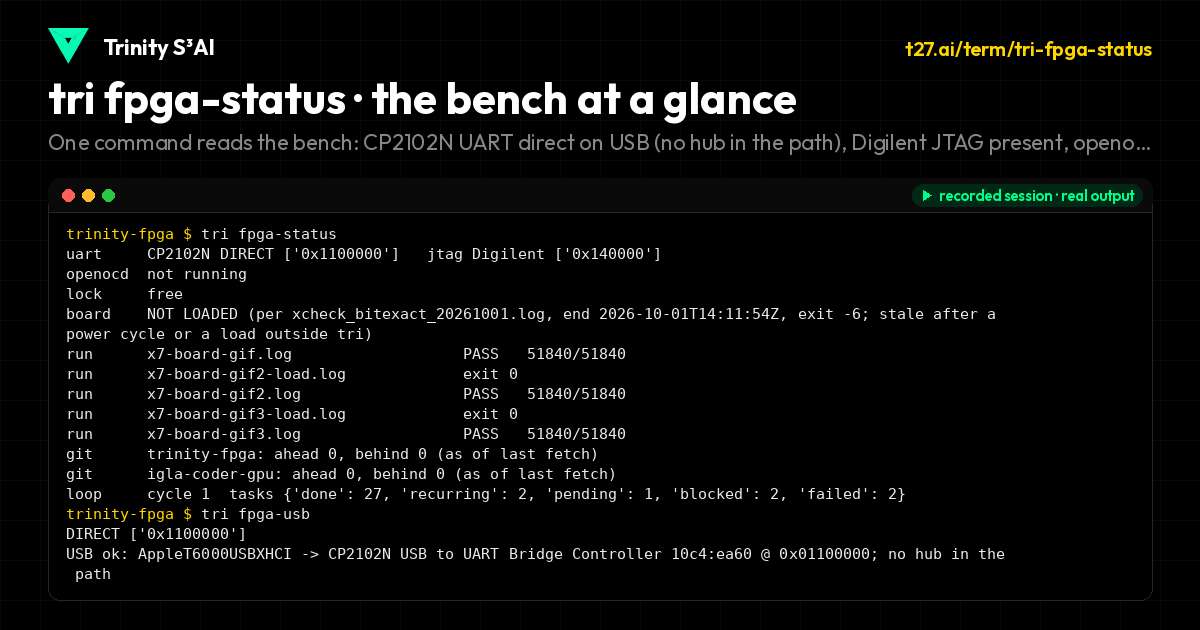
One command reads the bench: CP2102N UART direct on USB (no hub in the path), Digilent JTAG present, openocd not running, lock free, and the last board runs: three x7-board runs PASS 51840/51840.
specs/fpga/simulator.t27
// SPDX-License-Identifier: Apache-2.0
// t27/specs/fpga/simulator.t27
// HIR Cycle-Accurate Simulation Engine Specification
// Provides simulation primitives for verifying HIR modules pre-synthesis
// Uses flat arrays + count fields (parser-compatible)
// phi^2 + 1/phi^2 = 3 | TRINITY

module Simulator {

    // === Simulator state ===

    pub const SimState = enum(i8) {
        idle = 0,
        running = 1,
        paused = 2,
        done = 3,
        error = 4,
    }

    // === Simulator configuration ===

    pub struct SimConfig {
        name : &str,
        max_cycles : u32,
        clock_freq_hz : u32,
        trace_enabled : bool,
        vcd_output : bool,
        break_on_error : bool,
        vcd_path : &str,
    }

    // === Simulation result ===

    pub struct SimResult {
        cycles : u32,
        state : i8,
        errors : u32,
        assertions_fired : u32,
        coverage_points : u32,
    }

    // === Signal probe point ===

    pub struct ProbePoint {
        name : &str,
        signal : &str,
        width : u32,
        is_signed : bool,
    }

    // === Trace entry ===

    pub struct TraceEntry {
        cycle : u32,
        signal : &str,
        value : u32,
    }

    // === Constructor helpers ===

    fn sim_config(name: &str, max_cycles: u32) -> SimConfig {
        return SimConfig{
            .name = name,
            .max_cycles = max_cycles,
            .clock_freq_hz = 100000000,
            .trace_enabled = false,
            .vcd_output = false,
            .break_on_error = true,
            .vcd_path = "",
        };
    }

    fn sim_config_with_trace(name: &str, max_cycles: u32, vcd_path: &str) -> SimConfig {
        return SimConfig{
            .name = name,
            .max_cycles = max_cycles,
            .clock_freq_hz = 100000000,
            .trace_enabled = true,
            .vcd_output = true,
            .break_on_error = true,
            .vcd_path = vcd_path,
        };
    }

    fn sim_ok(cycles: u32, coverage: u32) -> SimResult {
        return SimResult{
            .cycles = cycles,
            .state = 3,
            .errors = 0,
            .assertions_fired = 0,
            .coverage_points = coverage,
        };
    }

    fn sim_error(cycles: u32, errors: u32) -> SimResult {
        return SimResult{
            .cycles = cycles,
            .state = 4,
            .errors = errors,
            .assertions_fired = 0,
            .coverage_points = 0,
        };
    }

    fn probe(name: &str, signal: &str, width: u32) -> ProbePoint {
        return ProbePoint{
            .name = name,
            .signal = signal,
            .width = width,
            .is_signed = false,
        };
    }

    fn trace_entry(cycle: u32, signal: &str, value: u32) -> TraceEntry {
        return TraceEntry{
            .cycle = cycle,
            .signal = signal,
            .value = value,
        };
    }

    // === Query functions ===

    fn is_idle(r: SimResult) -> bool {
        return r.state == 0;
    }

    fn is_done(r: SimResult) -> bool {
        return r.state == 3;
    }

    fn is_error(r: SimResult) -> bool {
        return r.state == 4;
    }

    fn sim_time_ns(cfg: SimConfig, cycles: u32) -> u32 {
        if (cfg.clock_freq_hz == 0) {
            return 0;
        }
        // `cycles * 1000000000` overflows u32 for cycles >= 5: at cycles=100
        // the product is 100_000_000_000 against a u32 max of 4_294_967_295.
        // Widen the intermediate to u64 -- and then SATURATE, because the
        // result is not always small: at 2_000_000_000 cycles on a 100 MHz
        // clock it is 20_000_000_000, and a bare `as u32` wraps it to
        // 2_820_130_816. The hand-written model in rings/ring-090-rust, which
        // this spec is supposed to define, has always had that guard; the spec
        // did not, and the two disagreed on 126 of 1190 differential cases.
        var ns : u64 = (cycles as u64) * 1000000000 / (cfg.clock_freq_hz as u64);
        if (ns > 4294967295) {
            return 4294967295;
        }
        return ns as u32;
    }

    // The case that made the spec and rings/ring-090-rust disagree: at
    // 2_000_000_000 cycles on the default 100 MHz clock the nanosecond count is
    // 20_000_000_000, and a bare `as u32` wraps it to 2_820_130_816.
    test "sim_time_ns_saturates_instead_of_wrapping"
        const cfg = sim_config("sat", 0);
        assert(sim_time_ns(cfg, 2000000000) == 4294967295);

    test "sim_time_ns_is_exact_below_the_ceiling"
        const cfg2 = sim_config("exact", 0);
        assert(sim_time_ns(cfg2, 100) == 1000);

    fn sim_time_us(cfg: SimConfig, cycles: u32) -> u32 {
        return sim_time_ns(cfg, cycles) / 1000;
    }

    fn sim_time_ms(cfg: SimConfig, cycles: u32) -> u32 {
        return sim_time_ns(cfg, cycles) / 1000000;
    }

    fn cycles_for_time_ns(cfg: SimConfig, ns: u32) -> u32 {
        if (cfg.clock_freq_hz == 0) {
            return 0;
        }
        // Same overflow as sim_time_ns, inverted: at ns=1000 and a 100 MHz
        // clock the product is 100_000_000_000, far past the u32 max.
        return ((ns as u64) * (cfg.clock_freq_hz as u64) / 1000000000) as u32;
    }

    fn has_errors(r: SimResult) -> bool {
        return r.errors > 0;
    }

    fn passed(r: SimResult) -> bool {
        return r.state == 3 and r.errors == 0;
    }

    // === Validation ===

    fn validate_sim_config(cfg: SimConfig) -> u32 {
        var errors : u32 = 0;
        if (cfg.name == "") {
            errors = errors + 1;
        }
        if (cfg.max_cycles == 0) {
            errors = errors + 1;
        }
        if (cfg.clock_freq_hz == 0) {
            errors = errors + 1;
        }
        return errors;
    }

    // === Tests ===

    test sim_config_creation
        given cfg = sim_config("uart_sim", 10000)
        then cfg.max_cycles == 10000
        and cfg.trace_enabled == false

    test sim_config_with_trace
        given cfg = sim_config_with_trace("uart_sim", 10000, "uart.vcd")
        then cfg.trace_enabled == true
        and cfg.vcd_output == true
        and cfg.vcd_path == "uart.vcd"

    test sim_ok_result
        given r = sim_ok(5000, 10)
        then is_done(r) == true
        and is_error(r) == false
        and passed(r) == true
        and has_errors(r) == false
        and r.cycles == 5000
        and r.coverage_points == 10

    test sim_error_result
        given r = sim_error(3000, 2)
        then is_done(r) == false
        and is_error(r) == true
        and passed(r) == false
        and has_errors(r) == true
        and r.errors == 2

    test is_idle_true
        given r = SimResult{.cycles = 0, .state = 0, .errors = 0, .assertions_fired = 0, .coverage_points = 0}
        then is_idle(r) == true

    test is_idle_false_when_done
        given r = sim_ok(100, 5)
        then is_idle(r) == false

    test is_idle_false_when_error
        given r = sim_error(50, 1)
        then is_idle(r) == false

    test probe_creation
        given p = probe("clk_probe", "clk", 1)
        then p.name == "clk_probe"
        and p.signal == "clk"
        and p.width == 1

    test trace_entry_creation
        given t = trace_entry(42, "counter", 27)
        then t.cycle == 42
        and t.signal == "counter"
        and t.value == 27

    test sim_time_ns
        given cfg = sim_config("sim", 10000)
        then sim_time_ns(cfg, 100) == 1000

    test sim_time_us
        given cfg = sim_config("sim", 10000)
        then sim_time_us(cfg, 100000) == 1000

    test sim_time_ms
        given cfg = sim_config("sim", 10000)
        then sim_time_ms(cfg, 100000000) == 1000

    test cycles_for_time_ns
        given cfg = sim_config("sim", 10000)
        then cycles_for_time_ns(cfg, 1000) == 100

    test validate_config_ok
        given cfg = sim_config("sim", 10000)
        then validate_sim_config(cfg) == 0

    test validate_config_empty_name
        given cfg = sim_config("", 10000)
        then validate_sim_config(cfg) > 0

    test validate_config_zero_cycles
        given cfg = sim_config("sim", 0)
        then validate_sim_config(cfg) > 0

    // === Invariants ===

    invariant max_cycles_positive
        given cfg = sim_config("inv", 100)
        assert cfg.max_cycles > 0

    invariant sim_time_positive
        given cfg = sim_config("inv", 100)
        assert sim_time_ns(cfg, 1) > 0

    invariant cycles_for_time_positive
        given cfg = sim_config("inv", 100)
        assert cycles_for_time_ns(cfg, 10) > 0

    invariant validate_non_negative
        given cfg = sim_config("inv", 100)
        assert validate_sim_config(cfg) >= 0

    // === Benchmarks ===

    bench sim_time_calc_latency
        measure: nanoseconds for sim_time_ns(sim_config("b", 1000), 1000)
        target: < 100ns
}

// phi^2 + 1/phi^2 = 3 | TRINITY
Все уроки
Модуль 1 · Зачем проверять
Дизайны, которые компилируются и ошибаются; модель, которая выносит вердикт; план, записанный до кода.
Модуль 2 · Тестбенчи
Стимулы, проверки и вердикт, записанные как один spec рядом с дизайном, который они судят.
Модуль 3 · Временные диаграммы
Трасса каждого сигнала, прочитанная так, как её читает инженер по железу, и два прогона, сравнённые между собой.
Модуль 4 · Векторы соответствия
Случаи с ответом, записанным рядом, там, откуда их достанет компилятор.
Модуль 5 · Косимуляция
Spec, симулятор и плата сходятся в одном ответе на стенде Artix-7 XC7A200T, и что делать, когда не сходятся.
Модуль 6 · Покрытие
Чего коснулись тесты: строки, переключения, состояния — и что прячет это число.
Модуль 7 · Формальные методы
Ассерты, верные каждый такт; ограниченный поиск контрпримера; и почему доказательству нужна индукция.
Модуль 8 · Мутации
Ломайте дизайн нарочно и считайте, что заметили тесты.
Модуль 9 · Приёмка
Одна команда, все квитанции, чистый вердикт, который можно показать.