Направленные против случайных
Вы научитесь
Когда один выбранный случай стоит тысячи случайных, а когда нет.
Направленный тест — один случай, выбранный потому, что вы знаете: он кусается. Пустой FIFO, полный FIFO, переход через границу. Случайный тест — дешёвый объём. Это не соперники, это последовательность. Виджет — эксперимент-нокдаун, превращённый в инструмент: заявлены три бита производительности, и на каждый бит собран отдельный битстрим-нокдаун — тот же дизайн с выключенным битом, — доказывающий, что бит важен. В этом весь аргумент направленных тестов: один бит, один прогноз, один битстрим, одно измерение.
Попробуйте
Выберите один бит производительности в виджете-нокдауне и скажите, что должен показать прогон без нокдауна, чтобы бит оказался ложью.
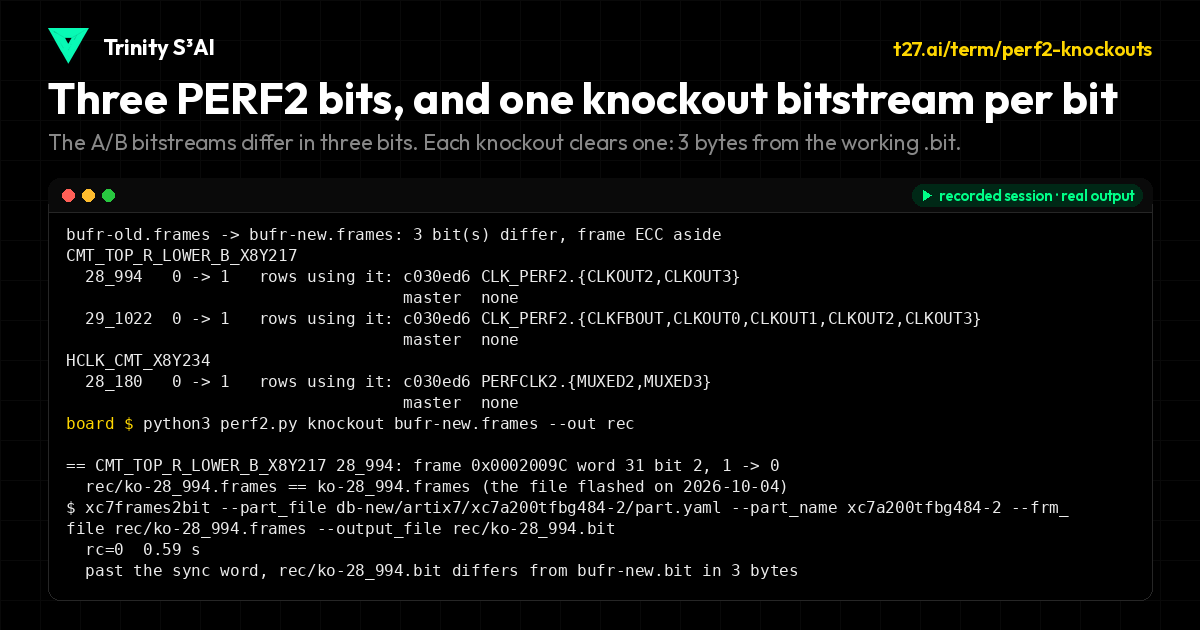
The A/B bitstreams differ in three bits. Each knockout clears one: 3 bytes from the working .bit.
specs/fpga/testbench/uart_tb.t27
// SPDX-License-Identifier: Apache-2.0
// t27/specs/fpga/testbench/uart_tb.t27
// UART Testbench Specification
// Tests UART TX/RX functionality, state machines, and timing
// φ² + 1/φ² = 3 | TRINITY

module UART_Testbench {
    // Import base types and UART module
    use base::types;
    use fpga::uart::UART_Bridge;

    // 1. Testbench Configuration

    // Simulation timing
    const TIMESCALE : str = "1ns/1ps";
    const CLK_PERIOD : u32 = 20;           // 50 MHz = 20ns period
    const SIM_TIMEOUT : u32 = 10_000_000;  // 10ms simulation timeout

    // Test data patterns
    const TEST_DATA_1 : u8 = 0xAA;
    const TEST_DATA_2 : u8 = 0x55;
    const TEST_DATA_3 : u8 = 0x00;
    const TEST_DATA_4 : u8 = 0xFF;

    // 2. Testbench Signals

    // Clock and reset
    var clk : bool = false;
    var rst_n : bool = false;

    // UART signals
    var uart_tx_line : bool = true;    // TX output (idle high)
    var uart_rx_line : bool = true;    // RX input

    // Internal monitoring
    var tx_busy : bool = false;
    var rx_data_valid : bool = false;
    var rx_data : u8 = 0;

    // Test counters
    var test_passed : u32 = 0;
    var test_failed : u32 = 0;
    var sim_cycle : u32 = 0;

    // 3. Clock Generation

    // generate_clock() → void
    // Generate 50 MHz clock
    fn generate_clock() -> void {
        clk = !clk;
        sim_cycle = sim_cycle + 1;
    }

    // 4. Test Helpers

    // assert_pass(condition: bool, message: str) → void
    // Record test pass
    fn assert_pass(condition: bool, message: str) -> void {
        if (condition) {
            test_passed = test_passed + 1;
        } else {
            test_failed = test_failed + 1;
        }
    }

    // wait_cycles(n: u32) → void
    // Wait n clock cycles
    fn wait_cycles(n: u32) -> void {
        var i : u32 = 0;
        while (i < n) {
            generate_clock();
            i = i + 1;
        }
    }

    // wait_tx_ready() → void
    // Wait until TX is ready
    fn wait_tx_ready() -> void {
        var timeout : u32 = 0;
        while (!uart_tx_ready() && timeout < 1000) {
            generate_clock();
            timeout = timeout + 1;
        }
    }

    // wait_rx_data() → (bool, u8)
    // Wait for RX data, return (success, data)
    fn wait_rx_data() -> (bool, u8) {
        var timeout : u32 = 0;
        while (!uart_rx_has_data() && timeout < 10000) {
            generate_clock();
            timeout = timeout + 1;
        }
        if (uart_rx_has_data()) {
            return (true, uart_rx_read_data());
        } else {
            return (false, 0);
        }
    }

    // 5. Test Cases

    // test_uart_tx_byte(data: u8) → void
    // Test single byte transmission
    fn test_uart_tx_byte(data: u8) -> void {
        // Wait for ready
        wait_tx_ready();

        // Start transmission
        const success = uart_tx_write(data);
        assert_pass(success == true, "TX write success");

        // Wait for completion
        var timeout : u32 = 0;
        while (uart_tx.tx_busy && timeout < 20000) {
            generate_clock();
            timeout = timeout + 1;
        }

        assert_pass(!uart_tx.tx_busy, "TX completed");
    }

    // test_uart_rx_byte(data: u8) → void
    // Test single byte reception
    fn test_uart_rx_byte(data: u8) -> void {
        // Simulate RX transmission
        var bit_idx : u8 = 0;

        // Start bit
        uart_rx_sync(false);
        wait_cycles(BAUD_DIVISOR / 2);

        // Data bits
        while (bit_idx < 8) {
            const bit = (data >> bit_idx) & 1 == 1;
            uart_rx_sync(bit);
            wait_cycles(BAUD_DIVISOR);
            bit_idx = bit_idx + 1;
        }

        // Stop bit
        uart_rx_sync(true);
        wait_cycles(BAUD_DIVISOR);

        // Check received data
        const (success, received) = wait_rx_data();
        assert_pass(success && received == data, "RX data match");
    }

    // test_uart_loopback() → void
    // Test TX -> RX loopback
    fn test_uart_loopback() -> void {
        const data = TEST_DATA_1;

        // Start TX
        wait_tx_ready();
        uart_tx_write(data);

        // Connect TX to RX
        var tx_count : u32 = 0;
        while (uart_tx.tx_busy && tx_count < 20000) {
            uart_rx_line = uart_tx_get_line();
            uart_rx_tick();
            uart_tx_tick();
            tx_count = tx_count + 1;
        }

        // Check RX received data
        const (success, received) = wait_rx_data();
        assert_pass(success && received == data, "Loopback data match");
    }

    // test_uart_framing_error() → void
    // Test framing error detection
    fn test_uart_framing_error() -> void {
        // Start bit
        uart_rx_sync(false);
        wait_cycles(BAUD_DIVISOR / 2);

        // Data bits
        var bit_idx : u8 = 0;
        while (bit_idx < 8) {
            uart_rx_sync(bit_idx < 4);  // Pattern
            wait_cycles(BAUD_DIVISOR);
            bit_idx = bit_idx + 1;
        }

        // Stop bit LOW (error)
        uart_rx_sync(false);
        wait_cycles(BAUD_DIVISOR);

        // Check framing error
        assert_pass(uart_rx_has_framing_error(), "Framing error detected");
    }

    // test_uart_reset() → void
    // Test UART reset
    fn test_uart_reset() -> void {
        // Start a transmission
        uart_tx_write(TEST_DATA_1);

        // Apply reset
        rst_n = false;
        wait_cycles(10);
        rst_n = true;
        wait_cycles(10);

        // Check TX is ready
        assert_pass(uart_tx_ready() && !uart_tx.tx_busy, "TX reset to ready");
        assert_pass(uart_tx_get_line() == true, "TX line idle high");
    }

    // test_uart_idle_line() → void
    // Test idle line state
    fn test_uart_idle_line() -> void {
        wait_tx_ready();
        assert_pass(uart_tx_get_line() == true, "Idle line high");
    }

    // test_uart_multiple_bytes() → void
    // Test multiple byte transmission
    fn test_uart_multiple_bytes() -> void {
        const bytes = [TEST_DATA_1, TEST_DATA_2, TEST_DATA_3, TEST_DATA_4];
        var i : usize = 0;

        while (i < bytes.len()) {
            test_uart_tx_byte(bytes[i]);
            i = i + 1;
        }

        assert_pass(i == 4, "All bytes transmitted");
    }

    // test_uart_baud_rate_timing() → void
    // Test baud rate timing
    fn test_uart_baud_rate_timing() -> void {
        const data = TEST_DATA_1;

        // Record start cycle
        const start_cycle = sim_cycle;

        // Transmit
        test_uart_tx_byte(data);

        const cycles = sim_cycle - start_cycle;
        const expected = (10 * BAUD_DIVISOR);  // 10 bits @ baud rate

        assert_pass(cycles >= expected && cycles <= expected + 100, "Baud rate timing");
    }

    // 6. Test Sequences

    // run_tests() → void
    // Run all test sequences
    fn run_tests() -> void {
        print("  t27 UART TESTBENCH");
        print("║          t27 UART TESTBENCH                              ║");
        print("  01 + 1/23 = 3 | TRINITY");
        print("║  φ² + 1/φ² = 3 | TRINITY                                 ║");
        print("  Running test sequences...");

        // Apply reset
        rst_n = false;
        wait_cycles(10);
        rst_n = true;
        wait_cycles(10);

        print("[TEST 1] UART TX byte transmission");
        test_uart_tx_byte(TEST_DATA_1);
        print("  [PASS]");

        print("[TEST 2] UART idle line");
        test_uart_idle_line();
        print("  [PASS]");

        print("[TEST 3] UART multiple bytes");
        test_uart_multiple_bytes();
        print("  [PASS]");

        print("[TEST 4] UART reset");
        test_uart_reset();
        print("  [PASS]");

        print("[TEST 5] UART baud rate timing");
        test_uart_baud_rate_timing();
        print("  [PASS]");

        print("[TEST 6] UART framing error");
        test_uart_framing_error();
        print("  [PASS]");

        print("[TEST 7] UART loopback");
        test_uart_loopback();
        print("  [PASS]");

        // Summary
        print("  Simulation complete.");
        print("║          SIMULATION RESULTS                                  ║");
        print("  Collecting results...");
        print("║  Passed: ", test_passed, "                                    ║");
        print("║  Failed: ", test_failed, "                                    ║");
        if (test_failed == 0) {
            print("║  STATUS: ✓ ALL TESTS PASSED                             ║");
        } else {
            print("║  STATUS: ✗ SOME TESTS FAILED                           ║");
        }
        print("  Done.");
    }

    // TDD-Inside-Spec: Invariants for UART_Testbench

    invariant tb_clk_period_correct
        assert CLK_PERIOD == 20  // 50MHz

    invariant tb_timescale_defined
        assert TIMESCALE == "1ns/1ps"

    invariant tb_timeout_defined
        assert SIM_TIMEOUT == 10_000_000

    invariant tb_test_data_defined
        assert TEST_DATA_1 == 0xAA and TEST_DATA_2 == 0x55

    invariant tb_baud_divisor_matches_uart
        assert BAUD_DIVISOR == 434  // 50MHz / 115200

    invariant tb_counter_bounds
        assert test_passed < 1000 and test_failed < 1000

    invariant tb_sim_cycle_increments
        given old = sim_cycle
        when generate_clock()
        then sim_cycle == old + 1

    invariant tb_wait_cycles_increments_correctly
        given old_cycle = sim_cycle
        and   wait_cycles(10)
        then sim_cycle >= old_cycle + 10

    invariant tb_initially_reset
        assert test_passed == 0 and test_failed == 0

    invariant tb_tx_line_idle_high
        given uart_tx_ready() == true
        then uart_tx_get_line() == true

    invariant tb_timeout_prevents_infinite_loop
        assert true

    test uart_tb_tx_idle_high
        given uart_tx_line = true
        then uart_tx_line == true

    test uart_tb_rx_idle_high
        given uart_rx_line = true
        then uart_rx_line == true

    test uart_tb_test_data_patterns
        given TEST_DATA_1 = 0xAA
        and   TEST_DATA_2 = 0x55
        and   TEST_DATA_3 = 0x00
        and   TEST_DATA_4 = 0xFF
        then TEST_DATA_1 != TEST_DATA_2
        then TEST_DATA_3 != TEST_DATA_4

    test uart_tb_clk_period_valid
        given CLK_PERIOD = 20
        then CLK_PERIOD > 0

    test uart_tb_sim_timeout_valid
        given SIM_TIMEOUT = 10_000_000
        then SIM_TIMEOUT > 0

    test uart_tb_counters_start_zero
        given test_passed = 0
        and   test_failed = 0
        and   sim_cycle = 0
        then test_passed == 0 and test_failed == 0

    test uart_tb_all_test_data_distinct
        given patterns = [0xAA, 0x55, 0x00, 0xFF]
        then patterns[0] != patterns[1]
        then patterns[2] != patterns[3]

    bench tb_full_simulation_time
        measure: cycles for run_tests()
        target: < 1_000_000

    bench tb_tx_byte_cycles
        measure: cycles to test_uart_tx_byte(0xAA)
        target: < 10_000

    bench tb_rx_byte_cycles
        measure: cycles to test_uart_rx_byte(0x55)
        target: < 10_000
}
Все уроки
Модуль 1 · Зачем проверять
Дизайны, которые компилируются и ошибаются; модель, которая выносит вердикт; план, записанный до кода.
Модуль 2 · Тестбенчи
Стимулы, проверки и вердикт, записанные как один spec рядом с дизайном, который они судят.
Модуль 3 · Временные диаграммы
Трасса каждого сигнала, прочитанная так, как её читает инженер по железу, и два прогона, сравнённые между собой.
Модуль 4 · Векторы соответствия
Случаи с ответом, записанным рядом, там, откуда их достанет компилятор.
Модуль 5 · Косимуляция
Spec, симулятор и плата сходятся в одном ответе на стенде Artix-7 XC7A200T, и что делать, когда не сходятся.
Модуль 6 · Покрытие
Чего коснулись тесты: строки, переключения, состояния — и что прячет это число.
Модуль 7 · Формальные методы
Ассерты, верные каждый такт; ограниченный поиск контрпримера; и почему доказательству нужна индукция.
Модуль 8 · Мутации
Ломайте дизайн нарочно и считайте, что заметили тесты.
Модуль 9 · Приёмка
Одна команда, все квитанции, чистый вердикт, который можно показать.