Поворот сдвигами
Вы узнаете
Как режим вращения CORDIC получает cos и sin одними сдвигами и сложениями.
На шаге i поворачивайте вектор на atan(2^-i) в ту или другую сторону: умножение на tan — это сдвиг на i, так что каждый шаг — два сдвига и два сложения. Выбор направления по знаку оставшегося угла сводит этот угол к нулю, а старт с K(n) вместо 1 компенсирует растяжение, которое добавляет каждый шаг; K(n) стремится к 0.6072529350. После 16 шагов 30 градусов дают cos 0.866018 и sin 0.500013. Спека cordic.t27 вычисляет каждый шаг, который рисует виджет.
Попробовать
Прогоните 30 градусов за 4 шага, а затем за 16, и прочитайте ошибки; затем найдите шаг, на котором направление впервые меняется на поворот по часовой стрелке.
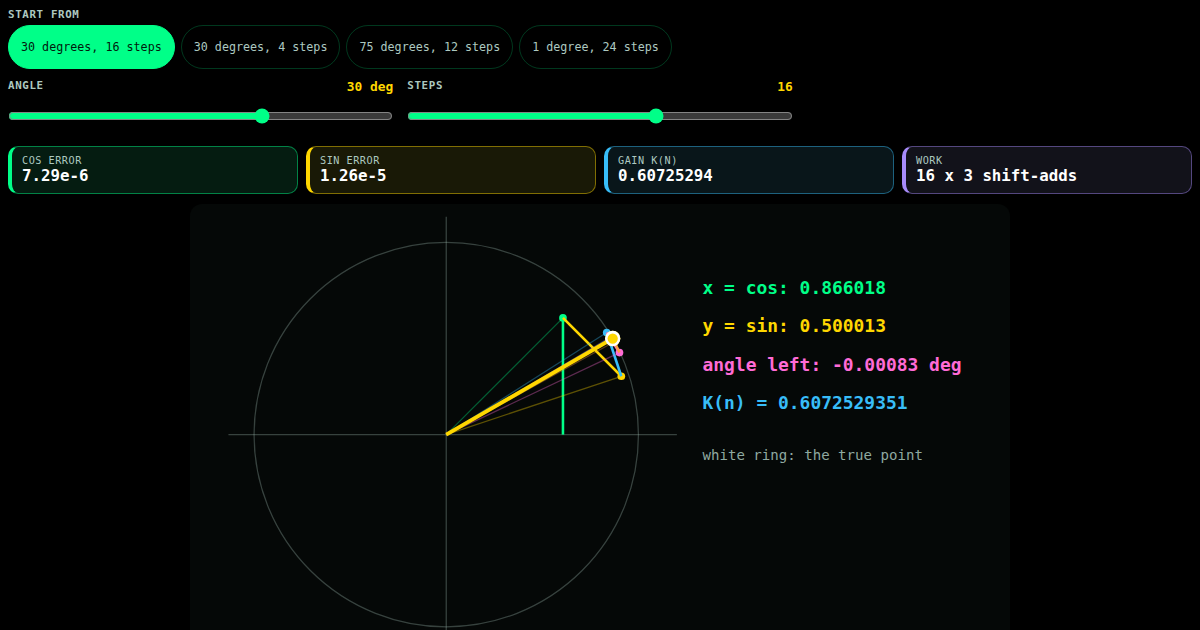
Set an angle and a number of steps and watch the vector turn by ever smaller angles, each one only a shift and an add, until it lands on cos and sin.
specs/fpga/dsp/cordic.t27
// SPDX-License-Identifier: Apache-2.0
// specs/fpga/dsp/cordic.t27 -- functions in hardware: CORDIC rotation and vectoring, and a sine table
// Host: gHashTag/trinity apps/website public/widgets/{cordic,cordic-vector,sine-table}/ (module 4
//       of the course arithmetic-and-dsp): each widget's logic.js is these fn bodies compiled to
//       wasm (scripts/t27-logic.mjs in gHashTag/999-multibots-telegraf, types stripped); the
//       pages write no formula of their own.
//
// CORDIC (J. E. Volder, "The CORDIC trigonometric computing technique", IRE Trans. Electronic
// Computers EC-8(3), 1959; J. S. Walther, "A unified algorithm for elementary functions",
// AFIPS 1971). Rotate a vector by a sequence of fixed angles atan(2^-i), each one either way,
// so every step is two shifts and two adds:
//     x(i+1) = x(i) - d(i) y(i) 2^-i,   y(i+1) = y(i) + d(i) x(i) 2^-i,   z(i+1) = z(i) - d(i) atan(2^-i)
// ROTATION mode picks d(i) = sign(z(i)) and drives the angle left z to 0: starting from
// (K(n), 0, theta) it ends at (cos theta, sin theta). Every step stretches the vector by
// sqrt(1 + 2^-2i); starting at K(n) = prod 1 / sqrt(1 + 2^-2i) cancels the stretch, and K(n)
// tends to 0.6072529350088812 (1/K = 1.6467602581210656). VECTORING mode picks d(i) = -sign(y(i))
// and drives y to 0: the angle collects in z (atan2) and x grows to |v| / K(n). A vector in the
// left half-plane is first turned by 90 degrees, so every angle in (-180, 180] converges.
// atan(2^-i) is computed here from its series; sqrt by Newton's method.
//
// A SINE TABLE. n entries per quarter wave of b-bit words, entry k = round(sin(k h) S) / S with
// h = (pi/2) / n and S = 2^(b-1) - 1. Taking the nearest entry costs up to about h / 2; linear
// interpolation between two entries cuts that to h^2 / 8 (max |sin''| = 1), until the b-bit
// rounding of the entries, 1 / (2 S), is what is left. The reference sine is this file's own
// CORDIC run for REF_STEPS steps (error below 1e-13), so no second sine is written here.
//
// WHAT IT DOES NOT CLAIM: the iterations run in f64, not in a fixed-point datapath; a b-bit
// CORDIC adds its own rounding per step. Throughput, pipelining and area are not modelled.
// Claim status: checked by the tests below -- K(16) = 0.6072529351, cos/sin 30 degrees after 16
// steps 0.866018 / 0.500013, atan2(4, 3) and |(3, 4)| = 5 by vectoring, the table errors
// 4.8958e-2 nearest and 1.2064e-3 interpolated for 16 entries of 16 bits.
// phi^2 + 1/phi^2 = 3 | TRINITY

module fpga::dsp::cordic {

    pub const KIND : str = "widget-logic";
    pub const ID : str = "cordic";
    pub const VERSION : u8 = 1;
    pub const PI : f64 = 3.141592653589793;
    pub const HALF_PI : f64 = 1.5707963267948966;
    pub const K_LIMIT : f64 = 0.6072529350088812;
    pub const REF_STEPS : u8 = 50;
    pub const MAX_STEPS : u8 = 60;
    pub const X_OUT : u8 = 0;
    pub const Y_OUT : u8 = 1;
    pub const Z_OUT : u8 = 2;

    // atan(2^-i): pi/4 for i = 0, otherwise the series x - x^3/3 + x^5/5 - ... with x <= 1/2.
    fn atan_pow2(i: u8) -> f64 {
        if (i == 0) {
            return PI / 4.0;
        }
        var x : f64 = 1.0;
        var k : u8 = 0;
        while (k < i) {
            x = x / 2.0;
            k = k + 1;
        }
        const x2 = x * x;
        var power : f64 = x;
        var sum : f64 = 0.0;
        var sign : f64 = 1.0;
        var odd : f64 = 1.0;
        while (power > 0.00000000000000001) {
            sum = sum + sign * power / odd;
            power = power * x2;
            sign = 0.0 - sign;
            odd = odd + 2.0;
        }
        return sum;
    }

    // sqrt(v) for v >= 0 by Newton's method, until the guess stops moving (at most 80 steps).
    fn sqrt_newton(v: f64) -> f64 {
        if (v <= 0.0) {
            return 0.0;
        }
        var g : f64 = 1.0;
        if (v > 1.0) {
            g = v;
        }
        var last : f64 = 0.0;
        var k : u8 = 0;
        while (k < 80 && g != last) {
            last = g;
            g = (g + v / g) / 2.0;
            k = k + 1;
        }
        return g;
    }

    // K(n) = prod over i < n of 1 / sqrt(1 + 2^-2i).
    fn gain(n: u8) -> f64 {
        var kk : f64 = 1.0;
        var p : f64 = 1.0;
        var i : u8 = 0;
        while (i < n) {
            kk = kk / sqrt_newton(1.0 + p * p);
            p = p / 2.0;
            i = i + 1;
        }
        return kk;
    }

    // Rotation mode: x, y or z (which = X_OUT, Y_OUT, Z_OUT) after `step` steps of a run
    // that starts at (K(total), 0, theta). |theta| <= 1.74 rad converges.
    fn rot_state(theta: f64, total: u8, step: u8, which: u8) -> f64 {
        var x : f64 = gain(total);
        var y : f64 = 0.0;
        var z : f64 = theta;
        var p : f64 = 1.0;
        var i : u8 = 0;
        while (i < step && i < MAX_STEPS) {
            var d : f64 = 1.0;
            if (z < 0.0) {
                d = -1.0;
            }
            const nx = x - d * y * p;
            y = y + d * x * p;
            x = nx;
            z = z - d * atan_pow2(i);
            p = p / 2.0;
            i = i + 1;
        }
        if (which == X_OUT) {
            return x;
        }
        if (which == Y_OUT) {
            return y;
        }
        return z;
    }

    // The direction step i takes in rotation mode: +1 or -1.
    fn rot_dir(theta: f64, total: u8, i: u8) -> i8 {
        if (rot_state(theta, total, i, Z_OUT) < 0.0) {
            return -1;
        }
        return 1;
    }

    // Vectoring mode: x, y or z after `step` steps from (x0, y0, 0); a left-half-plane
    // vector is turned by 90 degrees first and z starts at +-pi/2.
    fn vec_state(x0: f64, y0: f64, step: u8, which: u8) -> f64 {
        var x : f64 = x0;
        var y : f64 = y0;
        var z : f64 = 0.0;
        if (x0 < 0.0) {
            if (y0 >= 0.0) {
                x = y0;
                y = 0.0 - x0;
                z = HALF_PI;
            } else {
                x = 0.0 - y0;
                y = x0;
                z = 0.0 - HALF_PI;
            }
        }
        var p : f64 = 1.0;
        var i : u8 = 0;
        while (i < step && i < MAX_STEPS) {
            var d : f64 = 1.0;
            if (y >= 0.0) {
                d = -1.0;
            }
            const nx = x - d * y * p;
            y = y + d * x * p;
            x = nx;
            z = z - d * atan_pow2(i);
            p = p / 2.0;
            i = i + 1;
        }
        if (which == X_OUT) {
            return x;
        }
        if (which == Y_OUT) {
            return y;
        }
        return z;
    }

    // atan2(y0, x0) after n vectoring steps.
    fn vec_angle(x0: f64, y0: f64, n: u8) -> f64 {
        return vec_state(x0, y0, n, Z_OUT);
    }

    // |(x0, y0)| after n vectoring steps: x grown by 1/K(n), scaled back by K(n).
    fn vec_magnitude(x0: f64, y0: f64, n: u8) -> f64 {
        return vec_state(x0, y0, n, X_OUT) * gain(n);
    }

    // The exact magnitude, for the error.
    fn magnitude(x0: f64, y0: f64) -> f64 {
        return sqrt_newton(x0 * x0 + y0 * y0);
    }

    // The reference sine and cosine for |x| <= pi/2: this CORDIC, REF_STEPS steps.
    fn ref_sin(x: f64) -> f64 {
        return rot_state(x, REF_STEPS, REF_STEPS, Y_OUT);
    }

    fn ref_cos(x: f64) -> f64 {
        return rot_state(x, REF_STEPS, REF_STEPS, X_OUT);
    }

    // Entry k of an n-entry, b-bit quarter-wave table: round(sin(k h) S) / S.
    fn table_entry(k: u16, n: u16, bits: u8) -> f64 {
        const h = HALF_PI / (n as f64);
        const scale = ((1 as i32) << (bits - 1)) - 1;
        const s = (scale as f64);
        const v : f64 = ref_sin((k as f64) * h) * s + 0.5;
        var t : f64 = (v as i32) as f64;
        if (t > v) {
            t = t - 1.0;
        }
        return t / s;
    }

    // The table's sine of x in [0, pi/2]: the nearest entry, or the line between two.
    fn table_sin(x: f64, n: u16, bits: u8, interp: bool) -> f64 {
        const h = HALF_PI / (n as f64);
        const u : f64 = x / h;
        if (interp) {
            var i : u16 = u as u16;
            if (i >= n) {
                i = n - 1;
            }
            const frac = u - (i as f64);
            const a = table_entry(i, n, bits);
            return a + (table_entry(i + 1, n, bits) - a) * frac;
        }
        var j : u16 = (u + 0.5) as u16;
        if (j > n) {
            j = n;
        }
        return table_entry(j, n, bits);
    }

    // The largest |table - sine| over 8 points per entry across the quarter wave.
    fn table_max_err(n: u16, bits: u8, interp: bool) -> f64 {
        var e : [1025]f64 = [0.0; 1025];
        var k : u16 = 0;
        while (k <= n) {
            e[k] = table_entry(k, n, bits);
            k = k + 1;
        }
        const h = HALF_PI / (n as f64);
        var worst : f64 = 0.0;
        var j : u32 = 0;
        const top = (n as u32) * 8;
        while (j <= top) {
            const x = (j as f64) * h / 8.0;
            const u : f64 = x / h;
            var got : f64 = 0.0;
            if (interp) {
                var i : u16 = u as u16;
                if (i >= n) {
                    i = n - 1;
                }
                got = e[i] + (e[i + 1] - e[i]) * (u - (i as f64));
            } else {
                var m : u16 = (u + 0.5) as u16;
                if (m > n) {
                    m = n;
                }
                got = e[m];
            }
            const err = error_of(got, ref_sin(x));
            if (err > worst) {
                worst = err;
            }
            j = j + 1;
        }
        return worst;
    }

    // The interpolation bound h^2 / 8 and the word bound 1 / (2 S).
    fn interp_bound(n: u16) -> f64 {
        const h = HALF_PI / (n as f64);
        return h * h / 8.0;
    }

    fn word_bound(bits: u8) -> f64 {
        const scale = ((1 as i32) << (bits - 1)) - 1;
        return 0.5 / (scale as f64);
    }

    // Bits of memory the table takes: n + 1 entries of b bits.
    fn table_bits(n: u16, bits: u8) -> u32 {
        return ((n as u32) + 1) * (bits as u32);
    }

    // Degrees to radians and back, for the pages that speak in degrees.
    fn radians(deg: f64) -> f64 {
        return deg * PI / 180.0;
    }

    fn degrees(rad: f64) -> f64 {
        return rad * 180.0 / PI;
    }

    // |got - want|: the error the pages print.
    fn error_of(got: f64, want: f64) -> f64 {
        if (got > want) {
            return got - want;
        }
        return want - got;
    }

    // ---- Tests -----------------------------------------------------------------------------

    test "the angles and the gain" {
        assert(error_of(atan_pow2(0), 0.7853981634) < 0.0000000001);
        assert(error_of(atan_pow2(1), 0.4636476090) < 0.0000000001);
        assert(error_of(atan_pow2(3), 0.1243549945) < 0.0000000001);
        assert(error_of(gain(1), 0.7071067812) < 0.0000000001);
        assert(error_of(gain(16), 0.6072529351) < 0.0000000001);
        assert(error_of(gain(MAX_STEPS), K_LIMIT) < 0.000000000001);
        assert(error_of(1.0 / gain(MAX_STEPS), 1.6467602581) < 0.0000000001);
    }

    test "rotation mode gives cos and sin of 30 degrees" {
        const t = PI / 6.0;
        assert(error_of(rot_state(t, 16, 16, X_OUT), 0.8660181182) < 0.0000000001);
        assert(error_of(rot_state(t, 16, 16, Y_OUT), 0.5000126188) < 0.0000000001);
        assert(error_of(rot_state(t, 8, 8, Y_OUT), 0.5039980218) < 0.0000000001);
        assert(error_of(rot_state(PI / 4.0, 1, 1, X_OUT), 0.7071067812) < 0.0000000001);
        assert(error_of(rot_state(0.0 - PI / 3.0, 20, 20, Y_OUT), -0.8660247940) < 0.0000000001);
        assert(rot_dir(t, 16, 0) == 1);
        assert(rot_dir(t, 16, 1) == -1);
        assert(rot_dir(0.0, 16, 0) == 1);
        assert(error_of(rot_state(0.0, 1, 1, Y_OUT), 0.7071067812) < 0.0000000001);
    }

    test "vectoring mode gives the angle and the magnitude" {
        assert(error_of(vec_angle(3.0, 4.0, 24), 0.9272951469) < 0.0000000001);
        assert(error_of(vec_magnitude(3.0, 4.0, 16), 5.0) < 0.000000001);
        assert(error_of(vec_magnitude(3.0, 4.0, 8), 4.9998763800) < 0.0000000001);
        assert(error_of(vec_angle(0.0 - 1.0, 1.0, 20), 2.3561928526) < 0.0000000001);
        assert(error_of(vec_angle(0.0 - 1.0, 0.0 - 2.0, 20), -2.0344457950) < 0.0000000001);
        assert(error_of(magnitude(3.0, 4.0), 5.0) < 0.000000000001);
        assert(error_of(radians(30.0), PI / 6.0) < 0.000000000001);
        assert(error_of(degrees(vec_angle(1.0, 1.0, 40)), 45.0) < 0.000000001);
    }

    test "the reference sine is exact to the last digits" {
        assert(error_of(ref_sin(PI / 6.0), 0.5) < 0.0000000000001);
        assert(error_of(ref_cos(PI / 3.0), 0.5) < 0.0000000000001);
        assert(error_of(ref_sin(HALF_PI), 1.0) < 0.0000000000001);
    }

    test "a table: nearest entry against interpolation" {
        assert(error_of(table_max_err(16, 16, false), 0.04895778) < 0.0000001);
        assert(error_of(table_max_err(16, 16, true), 0.001206418) < 0.000000001);
        assert(error_of(table_max_err(64, 16, true), 0.0000816481) < 0.000000001);
        assert(error_of(table_max_err(256, 12, true), 0.0002441433) < 0.000000001);
        assert(table_max_err(1024, 16, true) < table_max_err(256, 16, true));
        assert(error_of(interp_bound(16), 0.001204786) < 0.000000001);
        assert(error_of(word_bound(16), 0.00001525925) < 0.0000000001);
        assert(table_bits(256, 16) == 4112);
        assert(table_entry(16, 16, 16) == 1.0);
    }

    test "VERSION says what the header says" {
        assert(VERSION == 1);
        assert(error_of(gain(REF_STEPS), K_LIMIT) < 0.000000000001);
    }
}
// phi^2 + 1/phi^2 = 3 | TRINITY
Все уроки
Модуль 1 · Сложение
Почему сложение медленное: перенос, который идёт вверх по слову, выделенная цепь в каждом слайсе, префиксные сети и деревья сохранения переноса.
Модуль 2 · Умножение
Произведение — сумма сдвинутых копий; перекодирование Бута вдвое сокращает их, а слайс DSP48E1 делает остальное одним блоком.
Модуль 3 · Фиксированная точка
Где стоит двоичная точка, что округление делает со значением и с его средним и что даёт каждый бит квантователя.
Модуль 4 · Функции в железе
Синус, косинус, угол и длина из сдвигов и сложений — и когда таблица оказывается выгоднее.
Модуль 5 · Сигналы и дискретизация
Что дискретизация делает с частотой, как генератор строится из сумматора и что измеряет бин ДПФ.
Модуль 6 · Фильтры FIR
Скользящее среднее, расчёт окном sinc с целыми коэффициентами и раскладка отводов по слайсам DSP.
Модуль 7 · Многоскоростная обработка
Понижение частоты дискретизации без заворота шума: децимация, фильтр CIC и полифазная форма.
Модуль 8 · БПФ
N log N вместо N^2: бабочки, бит-реверсный порядок входа и биты, которые добавляет каждый этап.
Модуль 9 · На стенде
От арифметики к плате: коррелятор из спеки модема, бюджет слайсов и тайминга и итоговый фильтр.