Три числа сразу
Вы узнаете
Как счётчики 3:2 складывают много чисел почти без распространения переноса и сколько слоёв нужно для k чисел.
Счётчик 3:2 — это ряд полных сумматоров без связей между ними: на входе три числа, на выходе слово суммы и слово переноса, и эти два в сумме дают те три. Слои таких счётчиков сжимают k чисел до двух, а затем их доскладывает один обычный сумматор. Высоты Дадды 2, 3, 4, 6, 9, 13, 19, 28, 42, 63 — наибольшее число слагаемых, которое сводит каждое количество слоёв, поэтому 9 числам нужно 4 слоя, а 64 — 10. Для 9 чисел по 16 бит это 20 задержек полного сумматора против 128 у цепочки сумматоров.
Попробовать
Задайте 28 чисел, а затем 29: сколько слоёв нужно каждому и почему одно лишнее число стоит слоя? Затем проверьте в счётчике ниже, что сумма + перенос равны a + b + c.
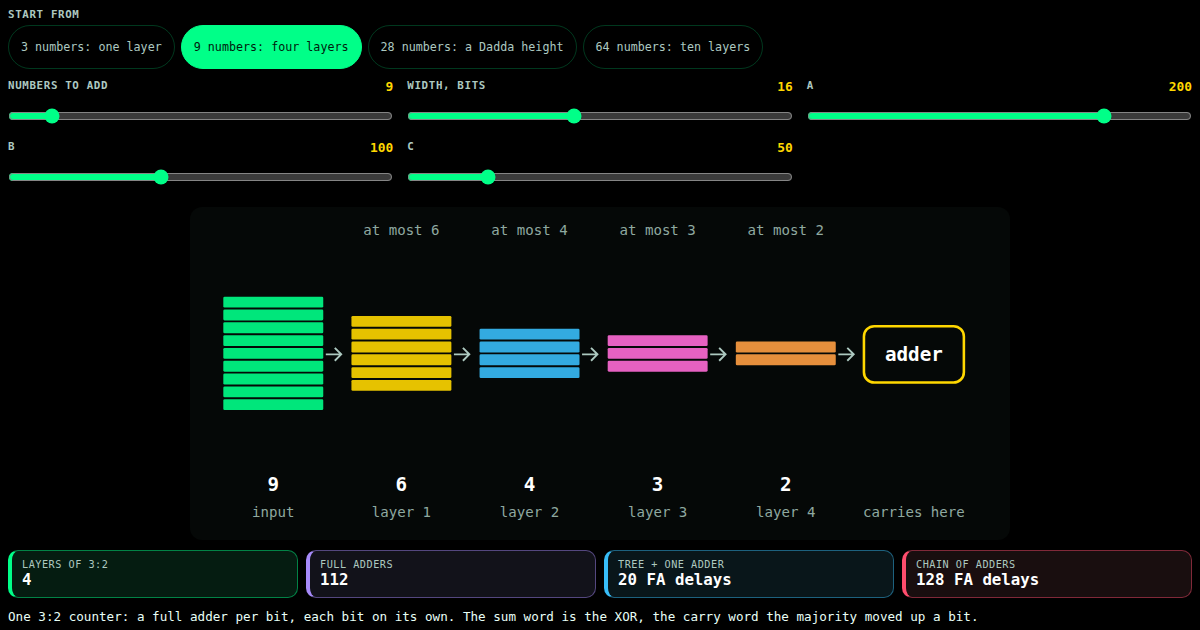
Set how many numbers to add and watch 3:2 counters squeeze them to two, layer by layer, before a single carry-propagate adder. Then try one counter on three numbers.
specs/fpga/dsp/adders.t27
// SPDX-License-Identifier: Apache-2.0
// specs/fpga/dsp/adders.t27 -- adding numbers in hardware: the carry chain, prefix networks, carry-save trees
// Host: gHashTag/trinity apps/website public/widgets/{carry-chain,prefix-adder,csa-tree}/ (module 1 of the
//       course arithmetic-and-dsp): each widget's logic.js is these fn bodies compiled to wasm
//       (scripts/t27-logic.mjs in gHashTag/999-multibots-telegraf, types stripped); the pages
//       write no formula of their own.
//
// THE CARRY CHAIN. Bit i of a + b is a_i XOR b_i XOR c_i, and the carry out of bit i is the
// majority of a_i, b_i and c_i (c_0 = 0). A carry generated at one bit travels up through every
// bit that propagates it (a_i XOR b_i = 1), so the wait for the top bit grows with the width.
// The FPGA answer is a dedicated chain: one LUT per bit forms propagate and generate, and the
// carry then hops through a multiplexer per bit with no general routing between bits. On a
// 7-series device the chain comes in CARRY4 blocks of 4 bits, one per slice (Xilinx UG474,
// "7 Series FPGAs CLB User Guide", carry logic). The delay model below is the teaching model:
// a carry recomputed by a LUT pays a LUT and a route per bit; the dedicated chain pays one LUT
// and one route, then one hop per bit. Every delay is an input the reader sets; no number here
// is a datasheet figure.
//
// PREFIX NETWORKS (D. Harris, "A taxonomy of parallel prefix networks", Asilomar 2003). The
// carries are prefixes of an associative operator, so they can be computed as a tree. src()
// says, for every column i and logic level, which column it combines with (-1: none):
//   serial (ripple)   level l joins column l+1 to column l        n - 1 levels, n - 1 cells
//   Sklansky          bit l of i set: i joins (i >> l << l) - 1    log2 n levels, (n/2) log2 n cells
//   Kogge-Stone       i >= 2^l: i joins i - 2^l                    log2 n levels, n log2 n - n + 1 cells
//   Brent-Kung        an up-sweep and a down-sweep                 2 log2 n - 1 levels, 2n - 2 - log2 n cells
// covers() replays the network on the spans [lo..i] and checks every column ends at [0..i]:
// the network computes every carry, not just the counts.
//
// CARRY-SAVE TREES. A 3:2 counter (a full adder per bit) turns three numbers into two -- a sum
// word a ^ b ^ c and a carry word majority(a, b, c) << 1 -- with no carry propagation at all.
// k operands need csa_levels(k) layers of them before one carry-propagate adder; the Dadda
// heights 2, 3, 4, 6, 9, 13, 19, 28, 42, 63 (d(j+1) = floor(3 d(j) / 2); L. Dadda, "Some
// schemes for parallel multipliers", Alta Frequenza 34, 1965) are the most operands j layers
// can reduce to two. wallace_next() is one layer of the Wallace reduction (C. S. Wallace, IEEE
// Trans. Electronic Computers EC-13, 1964); the tests hold the two counts equal.
//
// WHAT IT DOES NOT CLAIM: no device timing. Fanout and wire length cost real delay that the
// level count does not show; max_fanout() names the first of them.
// Claim status: checked by the tests below -- the sum of 100 + 27, the 7-bit run of 127 + 1,
// the four prefix networks verified to compute every carry for n = 2..32 and their cell
// counts equal to the closed forms, the Dadda sequence, and Wallace = Dadda levels for k <= 300.
// phi^2 + 1/phi^2 = 3 | TRINITY

module fpga::dsp::adders {

    pub const KIND : str = "widget-logic";
    pub const ID : str = "adders";
    pub const VERSION : u8 = 1;
    pub const CARRY4_BITS : u8 = 4;
    pub const MAX_BITS : u8 = 32;
    pub const NET_RIPPLE : u8 = 0;
    pub const NET_SKLANSKY : u8 = 1;
    pub const NET_KOGGE_STONE : u8 = 2;
    pub const NET_BRENT_KUNG : u8 = 3;
    pub const DADDA_FIRST : u16 = 2;

    // ---- The carry chain -------------------------------------------------------------------

    // The carry out of bit i of a + b (carry in 0): the majority, bit by bit from the bottom.
    fn carry_out(a: u32, b: u32, i: u8) -> u8 {
        var c : u32 = 0;
        var j : u8 = 0;
        while (j <= i && j < MAX_BITS) {
            const x = (a >> j) & 1;
            const y = (b >> j) & 1;
            c = (x & y) | (x & c) | (y & c);
            j = j + 1;
        }
        return c as u8;
    }

    // Bit i of a + b.
    fn sum_bit(a: u32, b: u32, i: u8) -> u8 {
        var cin : u32 = 0;
        if (i > 0) {
            cin = carry_out(a, b, i - 1) as u32;
        }
        return (((a >> i) ^ (b >> i) ^ cin) & 1) as u8;
    }

    // a + b over n bits, the carry out of the top bit included, as one number.
    fn sum_value(a: u32, b: u32, n: u8) -> f64 {
        var v : f64 = 0.0;
        var w : f64 = 1.0;
        var i : u8 = 0;
        while (i < n) {
            v = v + w * (sum_bit(a, b, i) as f64);
            w = w * 2.0;
            i = i + 1;
        }
        if (n > 0) {
            v = v + w * (carry_out(a, b, n - 1) as f64);
        }
        return v;
    }

    // 1 when bit i generates a carry, 2 when it propagates one, 0 when it kills it.
    fn bit_role(a: u32, b: u32, i: u8) -> u8 {
        const x = (a >> i) & 1;
        const y = (b >> i) & 1;
        if (x == 1 && y == 1) {
            return 1;
        }
        if ((x ^ y) == 1) {
            return 2;
        }
        return 0;
    }

    // The longest run of consecutive bits whose carry out is 1, over bits 0..n-1: how far the
    // slowest carry of this particular sum travels.
    fn carry_run(a: u32, b: u32, n: u8) -> u8 {
        var best : u8 = 0;
        var cur : u8 = 0;
        var i : u8 = 0;
        while (i < n) {
            if (carry_out(a, b, i) == 1) {
                cur = cur + 1;
                if (cur > best) {
                    best = cur;
                }
            } else {
                cur = 0;
            }
            i = i + 1;
        }
        return best;
    }

    // A carry recomputed by a LUT in every bit: a LUT and a route per bit.
    fn ripple_ps(n: u8, lut_ps: u16, route_ps: u16) -> u32 {
        return (n as u32) * ((lut_ps as u32) + (route_ps as u32));
    }

    // The dedicated chain: one LUT and one route into it, then one hop per bit.
    fn chain_ps(n: u8, lut_ps: u16, route_ps: u16, hop_ps: u16) -> u32 {
        return (lut_ps as u32) + (route_ps as u32) + (n as u32) * (hop_ps as u32);
    }

    // CARRY4 blocks (one per slice) an n-bit chain occupies.
    fn carry4_blocks(n: u8) -> u8 {
        return (n + CARRY4_BITS - 1) / CARRY4_BITS;
    }

    // ---- Prefix networks -------------------------------------------------------------------

    // log2 of a power of two n (2..32).
    fn depth_of(n: u8) -> u8 {
        var d : u8 = 0;
        var m : u8 = n;
        while (m > 1) {
            m = m / 2;
            d = d + 1;
        }
        return d;
    }

    // Logic levels of a network over n columns.
    fn levels(net: u8, n: u8) -> u8 {
        const d = depth_of(n);
        if (net == NET_RIPPLE) {
            return n - 1;
        }
        if (net == NET_BRENT_KUNG) {
            return 2 * d - 1;
        }
        return d;
    }

    // The column that column i combines with at one level, or -1.
    fn src(net: u8, n: u8, i: u8, level: u8) -> i16 {
        const d = depth_of(n);
        const ii = i as i16;
        if (net == NET_RIPPLE) {
            if (i >= 1 && level == i - 1) {
                return ii - 1;
            }
            return -1;
        }
        if (net == NET_SKLANSKY) {
            if (level < d && ((i >> level) & 1) == 1) {
                return (((i >> level) << level) as i16) - 1;
            }
            return -1;
        }
        if (net == NET_KOGGE_STONE) {
            if (level < d && (ii >= ((1 as i16) << level))) {
                return ii - ((1 as i16) << level);
            }
            return -1;
        }
        if (level < d) {
            const span = (1 as i16) << level;
            if (@rem(ii + 1, span * 2) == 0) {
                return ii - span;
            }
            return -1;
        }
        if (level - d + 2 > d) {
            return -1;
        }
        const k = d - 2 - (level - d);
        const half = (1 as i16) << k;
        if (@rem(ii + 1, half * 2) == half && ii >= 3 * half - 1) {
            return ii - half;
        }
        return -1;
    }

    // Prefix cells (black dots) the network uses: every (column, level) with a source.
    fn cells(net: u8, n: u8) -> u16 {
        var count : u16 = 0;
        var level : u8 = 0;
        const top = levels(net, n);
        while (level < top) {
            var i : u8 = 0;
            while (i < n) {
                if (src(net, n, i, level) >= 0) {
                    count = count + 1;
                }
                i = i + 1;
            }
            level = level + 1;
        }
        return count;
    }

    // The most cells one column feeds at a single level.
    fn max_fanout(net: u8, n: u8) -> u8 {
        var best : u8 = 0;
        var level : u8 = 0;
        const top = levels(net, n);
        while (level < top) {
            var j : u8 = 0;
            while (j < n) {
                var fan : u8 = 0;
                var i : u8 = 0;
                while (i < n) {
                    if (src(net, n, i, level) == (j as i16)) {
                        fan = fan + 1;
                    }
                    i = i + 1;
                }
                if (fan > best) {
                    best = fan;
                }
                j = j + 1;
            }
            level = level + 1;
        }
        return best;
    }

    // Replays the network on spans: column i starts as [i..i]; joining i with s is legal only
    // when s ends right below i's span, and leaves i spanning down to s's low end. True when
    // every join was legal and every column ends spanning [0..i].
    fn covers(net: u8, n: u8) -> bool {
        var lo : [32]i16 = [0; 32];
        var nxt : [32]i16 = [0; 32];
        var i : u8 = 0;
        while (i < n) {
            lo[i] = i as i16;
            i = i + 1;
        }
        var level : u8 = 0;
        const top = levels(net, n);
        while (level < top) {
            var j : u8 = 0;
            while (j < n) {
                nxt[j] = lo[j];
                const s = src(net, n, j, level);
                if (s >= 0) {
                    if (lo[j] != s + 1) {
                        return false;
                    }
                    nxt[j] = lo[s as u8];
                }
                j = j + 1;
            }
            var c : u8 = 0;
            while (c < n) {
                lo[c] = nxt[c];
                c = c + 1;
            }
            level = level + 1;
        }
        var k : u8 = 0;
        while (k < n) {
            if (lo[k] != 0) {
                return false;
            }
            k = k + 1;
        }
        return true;
    }

    // ---- Carry-save trees ------------------------------------------------------------------

    // The Dadda height d(j), j >= 1: d(1) = 2, d(j+1) = floor(3 d(j) / 2).
    fn dadda(j: u8) -> u16 {
        var d : u16 = DADDA_FIRST;
        var k : u8 = 1;
        while (k < j) {
            d = d * 3 / 2;
            k = k + 1;
        }
        return d;
    }

    // Layers of 3:2 counters that reduce k operands to two: the j with d(j) < k <= d(j+1).
    fn csa_levels(k: u16) -> u8 {
        if (k <= DADDA_FIRST) {
            return 0;
        }
        var j : u8 = 1;
        while (dadda(j + 1) < k) {
            j = j + 1;
        }
        return j;
    }

    // One Wallace layer: every group of three rows becomes two, the rest pass through.
    fn wallace_next(k: u16) -> u16 {
        return 2 * (k / 3) + k % 3;
    }

    // Wallace layers until two rows are left.
    fn wallace_levels(k: u16) -> u8 {
        var rows : u16 = k;
        var n : u8 = 0;
        while (rows > 2) {
            rows = wallace_next(rows);
            n = n + 1;
        }
        return n;
    }

    // The sum word of a 3:2 counter: one full adder per bit, no carry between bits.
    fn csa_sum(a: u16, b: u16, c: u16) -> u32 {
        return ((a as u32) ^ (b as u32)) ^ (c as u32);
    }

    // The carry word of a 3:2 counter, already shifted to the next bit.
    fn csa_carry(a: u16, b: u16, c: u16) -> u32 {
        const x = a as u32;
        const y = b as u32;
        const z = c as u32;
        return ((x & y) | (x & z) | (y & z)) << 1;
    }

    // What the two words of a 3:2 counter add up to: a + b + c.
    fn csa_total(a: u16, b: u16, c: u16) -> u32 {
        return csa_sum(a, b, c) + csa_carry(a, b, c);
    }

    // Full-adder delays to add k n-bit numbers: k - 1 carry-propagate adders in a row
    // (each n deep, no overlap) against a carry-save tree and one final adder.
    fn chain_fa_delays(k: u16, n: u8) -> u32 {
        return ((k as u32) - 1) * (n as u32);
    }

    fn tree_fa_delays(k: u16, n: u8) -> u32 {
        return (csa_levels(k) as u32) + (n as u32);
    }

    // Full adders the carry-save layers use: each removes one operand of n bits.
    fn csa_adders(k: u16, n: u8) -> u32 {
        if (k <= 2) {
            return 0;
        }
        return ((k as u32) - 2) * (n as u32);
    }

    // Every k from 3 to top: the Wallace count equals the Dadda count.
    fn wallace_is_dadda(top: u16) -> bool {
        var k : u16 = 2;
        while (k <= top) {
            if (wallace_levels(k) != csa_levels(k)) {
                return false;
            }
            k = k + 1;
        }
        return true;
    }

    // ---- Tests -----------------------------------------------------------------------------

    test "the sum bits are the sum" {
        assert(sum_bit(100, 27, 0) == 1);
        assert(sum_bit(100, 27, 6) == 1);
        assert(sum_bit(100, 27, 7) == 0);
        assert(sum_bit(255, 1, 0) == 0);
        assert(sum_bit(255, 1, 8) == 1);
        assert(carry_out(127, 1, 6) == 1);
        assert(carry_out(127, 1, 7) == 0);
        assert(sum_value(100, 27, 8) == 127.0);
        assert(sum_value(4294967295, 1, 32) == 4294967296.0);
    }

    test "a carry runs as far as the bits propagate it" {
        assert(carry_run(127, 1, 8) == 7);
        assert(carry_run(255, 1, 8) == 8);
        assert(carry_run(85, 170, 8) == 0);
        assert(carry_run(3855, 241, 12) == 12);
        assert(bit_role(5, 3, 0) == 1);
        assert(bit_role(5, 3, 1) == 2);
        assert(bit_role(5, 3, 3) == 0);
    }

    test "the chain beats the LUT ripple and fills CARRY4 blocks" {
        assert(ripple_ps(32, 120, 300) == 13440);
        assert(chain_ps(32, 120, 300, 30) == 1380);
        assert(carry4_blocks(32) == 8);
        assert(carry4_blocks(33) == 9);
        assert(carry4_blocks(1) == 1);
    }

    test "every prefix network computes every carry" {
        var n : u8 = 2;
        while (n <= 32) {
            assert(covers(NET_RIPPLE, n));
            assert(covers(NET_SKLANSKY, n));
            assert(covers(NET_KOGGE_STONE, n));
            assert(covers(NET_BRENT_KUNG, n));
            n = n * 2;
        }
    }

    test "cell counts are the closed forms" {
        assert(cells(NET_RIPPLE, 16) == 15);
        assert(cells(NET_SKLANSKY, 16) == 32);
        assert(cells(NET_KOGGE_STONE, 16) == 49);
        assert(cells(NET_BRENT_KUNG, 16) == 26);
        assert(cells(NET_KOGGE_STONE, 32) == 129);
        assert(cells(NET_BRENT_KUNG, 32) == 57);
        assert(cells(NET_SKLANSKY, 8) == 12);
        assert(cells(NET_BRENT_KUNG, 8) == 11);
    }

    test "levels trade against cells and fanout" {
        assert(levels(NET_RIPPLE, 32) == 31);
        assert(levels(NET_SKLANSKY, 32) == 5);
        assert(levels(NET_KOGGE_STONE, 32) == 5);
        assert(levels(NET_BRENT_KUNG, 32) == 9);
        assert(max_fanout(NET_SKLANSKY, 32) == 16);
        assert(max_fanout(NET_KOGGE_STONE, 32) == 1);
        assert(max_fanout(NET_BRENT_KUNG, 32) == 1);
        assert(src(NET_KOGGE_STONE, 8, 5, 2) == 1);
        assert(src(NET_SKLANSKY, 8, 6, 1) == 5);
        assert(src(NET_BRENT_KUNG, 8, 5, 3) == 3);
    }

    test "the Dadda heights and the carry-save levels" {
        assert(dadda(1) == 2);
        assert(dadda(5) == 9);
        assert(dadda(10) == 63);
        assert(csa_levels(2) == 0);
        assert(csa_levels(3) == 1);
        assert(csa_levels(4) == 2);
        assert(csa_levels(9) == 4);
        assert(csa_levels(10) == 5);
        assert(csa_levels(64) == 10);
        assert(wallace_next(28) == 19);
        assert(wallace_is_dadda(300));
    }

    test "a 3:2 counter keeps the sum" {
        assert(csa_sum(11, 6, 13) == 0);
        assert(csa_carry(11, 6, 13) == 30);
        assert(csa_total(200, 100, 50) == 350);
        assert(csa_sum(11, 6, 13) + csa_carry(11, 6, 13) == 30);
        assert(csa_sum(65535, 65535, 65535) + csa_carry(65535, 65535, 65535) == 196605);
        assert(tree_fa_delays(16, 16) == 22);
        assert(chain_fa_delays(16, 16) == 240);
        assert(csa_adders(16, 16) == 224);
    }

    test "VERSION says what the header says" {
        assert(VERSION == 1);
        assert(carry4_blocks(MAX_BITS) == 8);
        assert(depth_of(MAX_BITS) == 5);
    }
}
// phi^2 + 1/phi^2 = 3 | TRINITY
Все уроки
Модуль 1 · Сложение
Почему сложение медленное: перенос, который идёт вверх по слову, выделенная цепь в каждом слайсе, префиксные сети и деревья сохранения переноса.
Модуль 2 · Умножение
Произведение — сумма сдвинутых копий; перекодирование Бута вдвое сокращает их, а слайс DSP48E1 делает остальное одним блоком.
Модуль 3 · Фиксированная точка
Где стоит двоичная точка, что округление делает со значением и с его средним и что даёт каждый бит квантователя.
Модуль 4 · Функции в железе
Синус, косинус, угол и длина из сдвигов и сложений — и когда таблица оказывается выгоднее.
Модуль 5 · Сигналы и дискретизация
Что дискретизация делает с частотой, как генератор строится из сумматора и что измеряет бин ДПФ.
Модуль 6 · Фильтры FIR
Скользящее среднее, расчёт окном sinc с целыми коэффициентами и раскладка отводов по слайсам DSP.
Модуль 7 · Многоскоростная обработка
Понижение частоты дискретизации без заворота шума: децимация, фильтр CIC и полифазная форма.
Модуль 8 · БПФ
N log N вместо N^2: бабочки, бит-реверсный порядок входа и биты, которые добавляет каждый этап.
Модуль 9 · На стенде
От арифметики к плате: коррелятор из спеки модема, бюджет слайсов и тайминга и итоговый фильтр.