Rotating by shifts
You will learn
How CORDIC rotation mode reaches cos and sin with nothing but shifts and adds.
Turn a vector by atan(2^-i), one way or the other, at step i: the multiply by tan is a shift by i, so each step is two shifts and two adds. Steering by the sign of the angle left drives that angle to zero, and starting at K(n) instead of 1 cancels the stretch each step adds; K(n) tends to 0.6072529350. After 16 steps, 30 degrees comes out as cos 0.866018 and sin 0.500013. The spec cordic.t27 computes every step the widget draws.
Try it
Run 30 degrees with 4 steps and then with 16, and read the errors; then find the step at which the direction first turns clockwise.
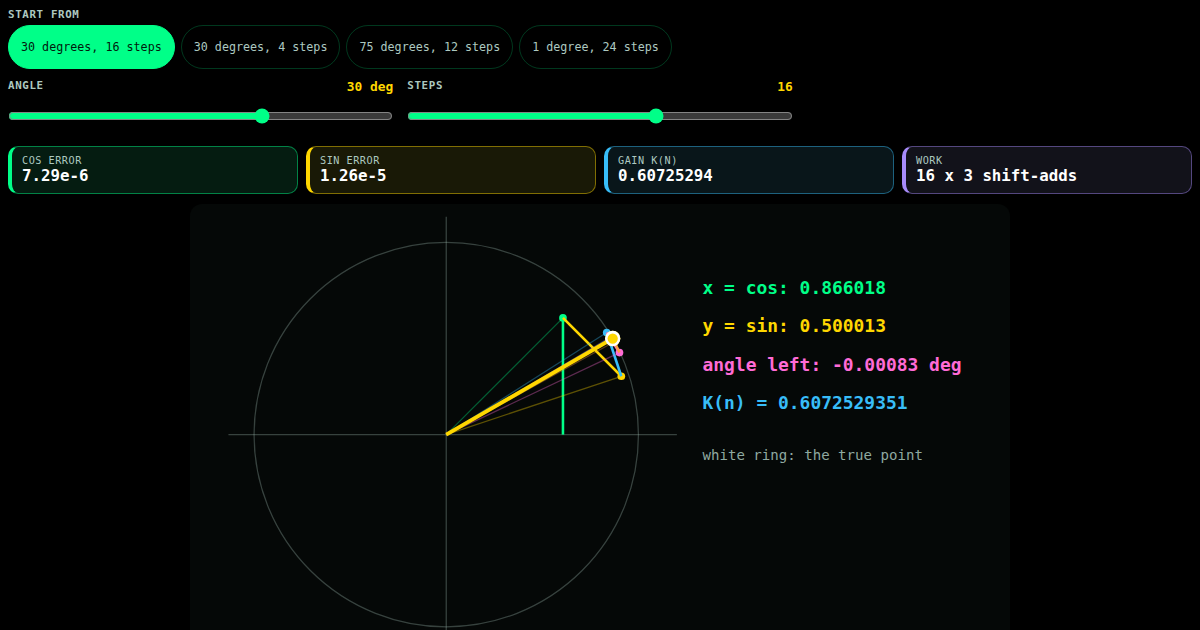
Set an angle and a number of steps and watch the vector turn by ever smaller angles, each one only a shift and an add, until it lands on cos and sin.
specs/fpga/dsp/cordic.t27
// SPDX-License-Identifier: Apache-2.0
// specs/fpga/dsp/cordic.t27 -- functions in hardware: CORDIC rotation and vectoring, and a sine table
// Host: gHashTag/trinity apps/website public/widgets/{cordic,cordic-vector,sine-table}/ (module 4
//       of the course arithmetic-and-dsp): each widget's logic.js is these fn bodies compiled to
//       wasm (scripts/t27-logic.mjs in gHashTag/999-multibots-telegraf, types stripped); the
//       pages write no formula of their own.
//
// CORDIC (J. E. Volder, "The CORDIC trigonometric computing technique", IRE Trans. Electronic
// Computers EC-8(3), 1959; J. S. Walther, "A unified algorithm for elementary functions",
// AFIPS 1971). Rotate a vector by a sequence of fixed angles atan(2^-i), each one either way,
// so every step is two shifts and two adds:
//     x(i+1) = x(i) - d(i) y(i) 2^-i,   y(i+1) = y(i) + d(i) x(i) 2^-i,   z(i+1) = z(i) - d(i) atan(2^-i)
// ROTATION mode picks d(i) = sign(z(i)) and drives the angle left z to 0: starting from
// (K(n), 0, theta) it ends at (cos theta, sin theta). Every step stretches the vector by
// sqrt(1 + 2^-2i); starting at K(n) = prod 1 / sqrt(1 + 2^-2i) cancels the stretch, and K(n)
// tends to 0.6072529350088812 (1/K = 1.6467602581210656). VECTORING mode picks d(i) = -sign(y(i))
// and drives y to 0: the angle collects in z (atan2) and x grows to |v| / K(n). A vector in the
// left half-plane is first turned by 90 degrees, so every angle in (-180, 180] converges.
// atan(2^-i) is computed here from its series; sqrt by Newton's method.
//
// A SINE TABLE. n entries per quarter wave of b-bit words, entry k = round(sin(k h) S) / S with
// h = (pi/2) / n and S = 2^(b-1) - 1. Taking the nearest entry costs up to about h / 2; linear
// interpolation between two entries cuts that to h^2 / 8 (max |sin''| = 1), until the b-bit
// rounding of the entries, 1 / (2 S), is what is left. The reference sine is this file's own
// CORDIC run for REF_STEPS steps (error below 1e-13), so no second sine is written here.
//
// WHAT IT DOES NOT CLAIM: the iterations run in f64, not in a fixed-point datapath; a b-bit
// CORDIC adds its own rounding per step. Throughput, pipelining and area are not modelled.
// Claim status: checked by the tests below -- K(16) = 0.6072529351, cos/sin 30 degrees after 16
// steps 0.866018 / 0.500013, atan2(4, 3) and |(3, 4)| = 5 by vectoring, the table errors
// 4.8958e-2 nearest and 1.2064e-3 interpolated for 16 entries of 16 bits.
// phi^2 + 1/phi^2 = 3 | TRINITY

module fpga::dsp::cordic {

    pub const KIND : str = "widget-logic";
    pub const ID : str = "cordic";
    pub const VERSION : u8 = 1;
    pub const PI : f64 = 3.141592653589793;
    pub const HALF_PI : f64 = 1.5707963267948966;
    pub const K_LIMIT : f64 = 0.6072529350088812;
    pub const REF_STEPS : u8 = 50;
    pub const MAX_STEPS : u8 = 60;
    pub const X_OUT : u8 = 0;
    pub const Y_OUT : u8 = 1;
    pub const Z_OUT : u8 = 2;

    // atan(2^-i): pi/4 for i = 0, otherwise the series x - x^3/3 + x^5/5 - ... with x <= 1/2.
    fn atan_pow2(i: u8) -> f64 {
        if (i == 0) {
            return PI / 4.0;
        }
        var x : f64 = 1.0;
        var k : u8 = 0;
        while (k < i) {
            x = x / 2.0;
            k = k + 1;
        }
        const x2 = x * x;
        var power : f64 = x;
        var sum : f64 = 0.0;
        var sign : f64 = 1.0;
        var odd : f64 = 1.0;
        while (power > 0.00000000000000001) {
            sum = sum + sign * power / odd;
            power = power * x2;
            sign = 0.0 - sign;
            odd = odd + 2.0;
        }
        return sum;
    }

    // sqrt(v) for v >= 0 by Newton's method, until the guess stops moving (at most 80 steps).
    fn sqrt_newton(v: f64) -> f64 {
        if (v <= 0.0) {
            return 0.0;
        }
        var g : f64 = 1.0;
        if (v > 1.0) {
            g = v;
        }
        var last : f64 = 0.0;
        var k : u8 = 0;
        while (k < 80 && g != last) {
            last = g;
            g = (g + v / g) / 2.0;
            k = k + 1;
        }
        return g;
    }

    // K(n) = prod over i < n of 1 / sqrt(1 + 2^-2i).
    fn gain(n: u8) -> f64 {
        var kk : f64 = 1.0;
        var p : f64 = 1.0;
        var i : u8 = 0;
        while (i < n) {
            kk = kk / sqrt_newton(1.0 + p * p);
            p = p / 2.0;
            i = i + 1;
        }
        return kk;
    }

    // Rotation mode: x, y or z (which = X_OUT, Y_OUT, Z_OUT) after `step` steps of a run
    // that starts at (K(total), 0, theta). |theta| <= 1.74 rad converges.
    fn rot_state(theta: f64, total: u8, step: u8, which: u8) -> f64 {
        var x : f64 = gain(total);
        var y : f64 = 0.0;
        var z : f64 = theta;
        var p : f64 = 1.0;
        var i : u8 = 0;
        while (i < step && i < MAX_STEPS) {
            var d : f64 = 1.0;
            if (z < 0.0) {
                d = -1.0;
            }
            const nx = x - d * y * p;
            y = y + d * x * p;
            x = nx;
            z = z - d * atan_pow2(i);
            p = p / 2.0;
            i = i + 1;
        }
        if (which == X_OUT) {
            return x;
        }
        if (which == Y_OUT) {
            return y;
        }
        return z;
    }

    // The direction step i takes in rotation mode: +1 or -1.
    fn rot_dir(theta: f64, total: u8, i: u8) -> i8 {
        if (rot_state(theta, total, i, Z_OUT) < 0.0) {
            return -1;
        }
        return 1;
    }

    // Vectoring mode: x, y or z after `step` steps from (x0, y0, 0); a left-half-plane
    // vector is turned by 90 degrees first and z starts at +-pi/2.
    fn vec_state(x0: f64, y0: f64, step: u8, which: u8) -> f64 {
        var x : f64 = x0;
        var y : f64 = y0;
        var z : f64 = 0.0;
        if (x0 < 0.0) {
            if (y0 >= 0.0) {
                x = y0;
                y = 0.0 - x0;
                z = HALF_PI;
            } else {
                x = 0.0 - y0;
                y = x0;
                z = 0.0 - HALF_PI;
            }
        }
        var p : f64 = 1.0;
        var i : u8 = 0;
        while (i < step && i < MAX_STEPS) {
            var d : f64 = 1.0;
            if (y >= 0.0) {
                d = -1.0;
            }
            const nx = x - d * y * p;
            y = y + d * x * p;
            x = nx;
            z = z - d * atan_pow2(i);
            p = p / 2.0;
            i = i + 1;
        }
        if (which == X_OUT) {
            return x;
        }
        if (which == Y_OUT) {
            return y;
        }
        return z;
    }

    // atan2(y0, x0) after n vectoring steps.
    fn vec_angle(x0: f64, y0: f64, n: u8) -> f64 {
        return vec_state(x0, y0, n, Z_OUT);
    }

    // |(x0, y0)| after n vectoring steps: x grown by 1/K(n), scaled back by K(n).
    fn vec_magnitude(x0: f64, y0: f64, n: u8) -> f64 {
        return vec_state(x0, y0, n, X_OUT) * gain(n);
    }

    // The exact magnitude, for the error.
    fn magnitude(x0: f64, y0: f64) -> f64 {
        return sqrt_newton(x0 * x0 + y0 * y0);
    }

    // The reference sine and cosine for |x| <= pi/2: this CORDIC, REF_STEPS steps.
    fn ref_sin(x: f64) -> f64 {
        return rot_state(x, REF_STEPS, REF_STEPS, Y_OUT);
    }

    fn ref_cos(x: f64) -> f64 {
        return rot_state(x, REF_STEPS, REF_STEPS, X_OUT);
    }

    // Entry k of an n-entry, b-bit quarter-wave table: round(sin(k h) S) / S.
    fn table_entry(k: u16, n: u16, bits: u8) -> f64 {
        const h = HALF_PI / (n as f64);
        const scale = ((1 as i32) << (bits - 1)) - 1;
        const s = (scale as f64);
        const v : f64 = ref_sin((k as f64) * h) * s + 0.5;
        var t : f64 = (v as i32) as f64;
        if (t > v) {
            t = t - 1.0;
        }
        return t / s;
    }

    // The table's sine of x in [0, pi/2]: the nearest entry, or the line between two.
    fn table_sin(x: f64, n: u16, bits: u8, interp: bool) -> f64 {
        const h = HALF_PI / (n as f64);
        const u : f64 = x / h;
        if (interp) {
            var i : u16 = u as u16;
            if (i >= n) {
                i = n - 1;
            }
            const frac = u - (i as f64);
            const a = table_entry(i, n, bits);
            return a + (table_entry(i + 1, n, bits) - a) * frac;
        }
        var j : u16 = (u + 0.5) as u16;
        if (j > n) {
            j = n;
        }
        return table_entry(j, n, bits);
    }

    // The largest |table - sine| over 8 points per entry across the quarter wave.
    fn table_max_err(n: u16, bits: u8, interp: bool) -> f64 {
        var e : [1025]f64 = [0.0; 1025];
        var k : u16 = 0;
        while (k <= n) {
            e[k] = table_entry(k, n, bits);
            k = k + 1;
        }
        const h = HALF_PI / (n as f64);
        var worst : f64 = 0.0;
        var j : u32 = 0;
        const top = (n as u32) * 8;
        while (j <= top) {
            const x = (j as f64) * h / 8.0;
            const u : f64 = x / h;
            var got : f64 = 0.0;
            if (interp) {
                var i : u16 = u as u16;
                if (i >= n) {
                    i = n - 1;
                }
                got = e[i] + (e[i + 1] - e[i]) * (u - (i as f64));
            } else {
                var m : u16 = (u + 0.5) as u16;
                if (m > n) {
                    m = n;
                }
                got = e[m];
            }
            const err = error_of(got, ref_sin(x));
            if (err > worst) {
                worst = err;
            }
            j = j + 1;
        }
        return worst;
    }

    // The interpolation bound h^2 / 8 and the word bound 1 / (2 S).
    fn interp_bound(n: u16) -> f64 {
        const h = HALF_PI / (n as f64);
        return h * h / 8.0;
    }

    fn word_bound(bits: u8) -> f64 {
        const scale = ((1 as i32) << (bits - 1)) - 1;
        return 0.5 / (scale as f64);
    }

    // Bits of memory the table takes: n + 1 entries of b bits.
    fn table_bits(n: u16, bits: u8) -> u32 {
        return ((n as u32) + 1) * (bits as u32);
    }

    // Degrees to radians and back, for the pages that speak in degrees.
    fn radians(deg: f64) -> f64 {
        return deg * PI / 180.0;
    }

    fn degrees(rad: f64) -> f64 {
        return rad * 180.0 / PI;
    }

    // |got - want|: the error the pages print.
    fn error_of(got: f64, want: f64) -> f64 {
        if (got > want) {
            return got - want;
        }
        return want - got;
    }

    // ---- Tests -----------------------------------------------------------------------------

    test "the angles and the gain" {
        assert(error_of(atan_pow2(0), 0.7853981634) < 0.0000000001);
        assert(error_of(atan_pow2(1), 0.4636476090) < 0.0000000001);
        assert(error_of(atan_pow2(3), 0.1243549945) < 0.0000000001);
        assert(error_of(gain(1), 0.7071067812) < 0.0000000001);
        assert(error_of(gain(16), 0.6072529351) < 0.0000000001);
        assert(error_of(gain(MAX_STEPS), K_LIMIT) < 0.000000000001);
        assert(error_of(1.0 / gain(MAX_STEPS), 1.6467602581) < 0.0000000001);
    }

    test "rotation mode gives cos and sin of 30 degrees" {
        const t = PI / 6.0;
        assert(error_of(rot_state(t, 16, 16, X_OUT), 0.8660181182) < 0.0000000001);
        assert(error_of(rot_state(t, 16, 16, Y_OUT), 0.5000126188) < 0.0000000001);
        assert(error_of(rot_state(t, 8, 8, Y_OUT), 0.5039980218) < 0.0000000001);
        assert(error_of(rot_state(PI / 4.0, 1, 1, X_OUT), 0.7071067812) < 0.0000000001);
        assert(error_of(rot_state(0.0 - PI / 3.0, 20, 20, Y_OUT), -0.8660247940) < 0.0000000001);
        assert(rot_dir(t, 16, 0) == 1);
        assert(rot_dir(t, 16, 1) == -1);
        assert(rot_dir(0.0, 16, 0) == 1);
        assert(error_of(rot_state(0.0, 1, 1, Y_OUT), 0.7071067812) < 0.0000000001);
    }

    test "vectoring mode gives the angle and the magnitude" {
        assert(error_of(vec_angle(3.0, 4.0, 24), 0.9272951469) < 0.0000000001);
        assert(error_of(vec_magnitude(3.0, 4.0, 16), 5.0) < 0.000000001);
        assert(error_of(vec_magnitude(3.0, 4.0, 8), 4.9998763800) < 0.0000000001);
        assert(error_of(vec_angle(0.0 - 1.0, 1.0, 20), 2.3561928526) < 0.0000000001);
        assert(error_of(vec_angle(0.0 - 1.0, 0.0 - 2.0, 20), -2.0344457950) < 0.0000000001);
        assert(error_of(magnitude(3.0, 4.0), 5.0) < 0.000000000001);
        assert(error_of(radians(30.0), PI / 6.0) < 0.000000000001);
        assert(error_of(degrees(vec_angle(1.0, 1.0, 40)), 45.0) < 0.000000001);
    }

    test "the reference sine is exact to the last digits" {
        assert(error_of(ref_sin(PI / 6.0), 0.5) < 0.0000000000001);
        assert(error_of(ref_cos(PI / 3.0), 0.5) < 0.0000000000001);
        assert(error_of(ref_sin(HALF_PI), 1.0) < 0.0000000000001);
    }

    test "a table: nearest entry against interpolation" {
        assert(error_of(table_max_err(16, 16, false), 0.04895778) < 0.0000001);
        assert(error_of(table_max_err(16, 16, true), 0.001206418) < 0.000000001);
        assert(error_of(table_max_err(64, 16, true), 0.0000816481) < 0.000000001);
        assert(error_of(table_max_err(256, 12, true), 0.0002441433) < 0.000000001);
        assert(table_max_err(1024, 16, true) < table_max_err(256, 16, true));
        assert(error_of(interp_bound(16), 0.001204786) < 0.000000001);
        assert(error_of(word_bound(16), 0.00001525925) < 0.0000000001);
        assert(table_bits(256, 16) == 4112);
        assert(table_entry(16, 16, 16) == 1.0);
    }

    test "VERSION says what the header says" {
        assert(VERSION == 1);
        assert(error_of(gain(REF_STEPS), K_LIMIT) < 0.000000000001);
    }
}
// phi^2 + 1/phi^2 = 3 | TRINITY
All lessons
Module 1 · Adding numbers
Why addition is slow: the carry that walks up the word, the dedicated chain in every slice, prefix networks and carry-save trees.
Module 2 · Multiplying
A product is a sum of shifted copies; Booth recoding halves them, and the DSP48E1 slice does the rest in one block.
Module 3 · Fixed point
Where the binary point sits, what rounding does to a value and to its average, and what each bit of a quantizer buys.
Module 4 · Functions in hardware
Sine, cosine, angle and length from shifts and adds, and when a table is the better answer.
Module 5 · Signals and sampling
What sampling does to a frequency, how an oscillator is built from an adder, and what a DFT bin measures.
Module 6 · FIR filters
The moving average, a windowed-sinc design with integer taps, and folding the taps onto DSP slices.
Module 7 · Multirate
Lowering the sample rate without folding noise in: decimation, the CIC filter and the polyphase form.
Module 8 · The FFT
N log N instead of N^2: butterflies, the bit-reversed input order and the bits each stage adds.
Module 9 · On the bench
From the arithmetic to the board: a correlator from the modem spec, a budget of slices and timing, and the capstone filter.