Review first
You will learn
Why the Queen closes the backlog while finished work waits for a review, and what still goes.
On 2026-10-18 the status page read 69 of 70 workers busy, and in one hour 102 dispatches, 56 finished and 11 reviewed. Bees started about nine for every verdict, and each new bee held files that the bees in review needed when they were sent back. review_first.t27 closes the backlog while the review queue is longer than REVIEW_QUEUE_MAX, 0. Work the review sent back and work the owner assigned still go: admission admits them at any queue length.
Try it
Drag the queue to 0 and back to 1; then find the candidates that are admitted at any length.
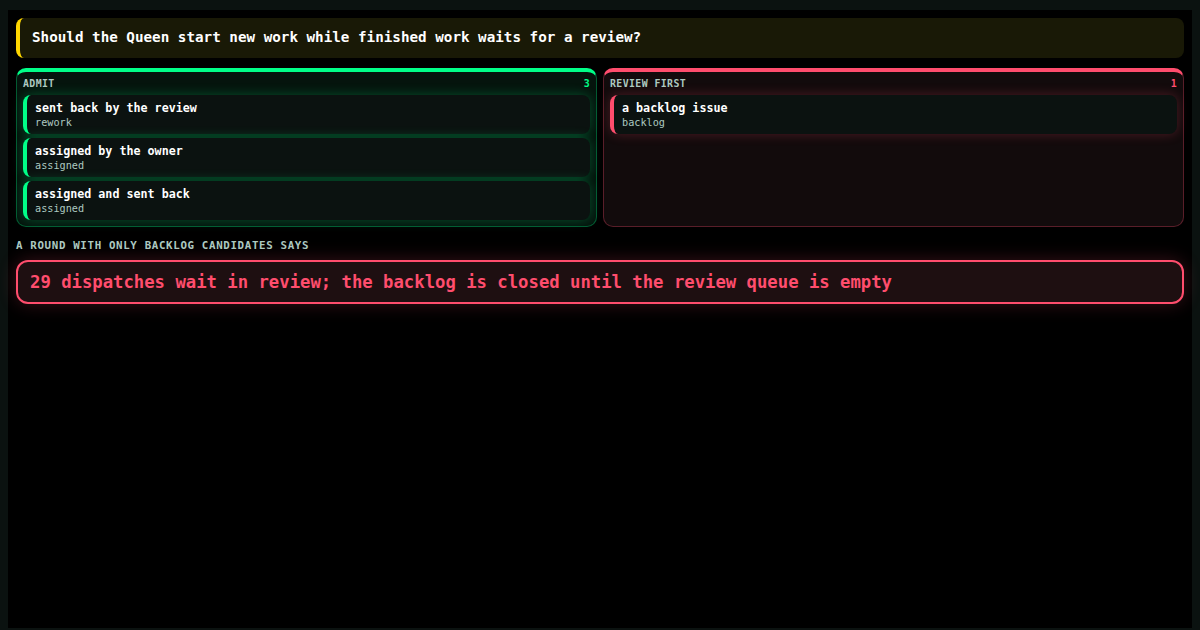
Drag the review queue. While anything waits in review, a backlog issue is refused; work the review sent back and work the owner assigned still go.
specs/queen/review_first.t27
// SPDX-License-Identifier: Apache-2.0
; specs/queen/review_first.t27 -- no new work from the backlog while finished work waits in review (gHashTag/t27#10555).
; The owner's rule, 2026-10-18: the Queen takes nothing from the backlog while there is a queue in review.
; Measured 2026-10-18 17:09Z on api.t27.ai/queen/status: 69 of 70 workers busy; in the last hour 102
; dispatched, 56 finished, 11 reviewed; reviewable (the review sweep's own queue) 29, unreviewed 362.
; The swarm starts about nine bees for every verdict, so the queue in review only grows, and each new bee
; holds files (claim.t27) that the bees already in review need when they are sent back.
; The rule:
;   1. the review queue is exactly the review sweep's own filter, the one the status page counts as
;      `reviewable`: the dispatch started, it finished, its review_state is NULL or 'wait', it was not
;      reaped, and its issue is still open (in_review_queue);
;   2. while that queue is longer than REVIEW_QUEUE_MAX (0: not while anything waits) a candidate from
;      the backlog is refused, and the round says why (admission, R_REVIEW_FIRST);
;   3. work the review itself asked for is never backlog: an issue the review sent back is dispatched
;      again at any queue length (KIND_REWORK), and so is an issue the owner assigned by hand
;      (KIND_ASSIGNED, the supervisor's pendingAssigns);
;   4. the queue empties on its own: every outcome of the review that is not an accept has a clock
;      (review_valve.t27), so a closed backlog always reopens without a person.
; The host counts the queue and names each candidate's kind; this file decides. Not here: the wiring into
; trios (queen-tick.ts candidate filter, vendored wasm and t27c gen-ts constants), how keys are shared
; between bees and the reviewer, the review verdicts themselves. ASCII only (L3).
; phi^2 + 1/phi^2 = 3 | TRINITY

module QueenReviewFirst;

; --- 1. What a candidate is ---------------------------------------------------------------------------

/// KIND_BACKLOG: an open issue with no dispatch the review is working on. KIND_REWORK: an issue whose
/// last dispatch the review sent back (review_state 'sendBack'). KIND_ASSIGNED: an issue the owner
/// assigned by hand. The codes are mirrored by number: a new kind takes the next code, none moves.
pub const KIND_BACKLOG : u8 = 0;
pub const KIND_REWORK : u8 = 1;
pub const KIND_ASSIGNED : u8 = 2;

/// The owner's hand wins over the review's send-back, and both win over the backlog.
pub fn kind_of(assigned: bool, sent_back: bool) -> u8 {
    if (assigned) { return KIND_ASSIGNED; }
    if (sent_back) { return KIND_REWORK; }
    return KIND_BACKLOG;
}

; --- 2. What the review queue is ----------------------------------------------------------------------

/// A dispatch row's review_state as the host reads it: RS_NONE is NULL (no verdict yet), RS_WAIT is
/// 'wait' (fewer verdicts than criteria, dispatch.t27 REVIEW_RULE), RS_OTHER is any written verdict.
pub const RS_NONE : u8 = 0;
pub const RS_WAIT : u8 = 1;
pub const RS_OTHER : u8 = 2;

/// Whether one dispatch row is in the review queue: the sweep's own filter (trios queen-tick.ts
/// reviewFinishedDispatches, counted as `reviewable` by queen-public-status.ts). A row whose issue was
/// closed is never reviewed, so it never holds the backlog shut.
pub fn in_review_queue(started: bool, finished: bool, state: u8, reaped: bool, issue_open: bool) -> bool {
    if (started == false) { return false; }
    if (finished == false) { return false; }
    if (reaped) { return false; }
    if (issue_open == false) { return false; }
    if (state == RS_NONE) { return true; }
    return state == RS_WAIT;
}

; --- 3. Admission -------------------------------------------------------------------------------------

/// How many dispatches may wait in review while the backlog stays open. Zero, the owner's words: not
/// while anything is in review.
pub const REVIEW_QUEUE_MAX : u32 = 0;

/// R_ADMIT: the candidate may be chosen. R_REVIEW_FIRST: refused, the backlog is closed while the review
/// queue is longer than REVIEW_QUEUE_MAX.
pub const R_ADMIT : u8 = 0;
pub const R_REVIEW_FIRST : u8 = 1;

/// The refusal as the round reports it, after the queue length: "29 dispatches wait in review; ...".
pub const REFUSAL_TAIL : str = " dispatches wait in review; the backlog is closed until the review queue is empty";

pub fn backlog_open(review_queue: u32) -> bool {
    return review_queue <= REVIEW_QUEUE_MAX;
}

pub fn admission(kind: u8, review_queue: u32) -> u8 {
    if (kind == KIND_REWORK) { return R_ADMIT; }
    if (kind == KIND_ASSIGNED) { return R_ADMIT; }
    if (backlog_open(review_queue)) { return R_ADMIT; }
    return R_REVIEW_FIRST;
}

pub fn admits(kind: u8, review_queue: u32) -> bool {
    return admission(kind, review_queue) == R_ADMIT;
}

/// Whether a round that admitted no candidate owes the review-first sentence: some candidate was
/// refused by this rule and none was admitted.
pub fn round_refused(admitted: u32, refused: u32) -> bool {
    if (admitted > 0) { return false; }
    return refused > 0;
}

; --- 4. Tests -----------------------------------------------------------------------------------------

test the_owner_hand_wins_then_the_review_then_the_backlog {
    assert kind_of(false, false) == 0;
    assert kind_of(false, true) == 1;
    assert kind_of(true, false) == 2;
    assert kind_of(true, true) == 2;
}

test the_queue_is_the_sweeps_own_filter {
    assert in_review_queue(true, true, RS_NONE, false, true) == true;
    assert in_review_queue(true, true, RS_WAIT, false, true) == true;
    assert in_review_queue(true, true, RS_OTHER, false, true) == false;
    assert in_review_queue(true, false, RS_NONE, false, true) == false;
    assert in_review_queue(false, true, RS_NONE, false, true) == false;
    assert in_review_queue(true, true, RS_NONE, true, true) == false;
    assert in_review_queue(true, true, RS_NONE, false, false) == false;
    assert in_review_queue(true, true, RS_WAIT, true, true) == false;
    assert in_review_queue(true, true, 7, false, true) == false;
}

test the_backlog_is_closed_while_anything_waits_in_review {
    assert admission(KIND_BACKLOG, 0) == 0;
    assert admission(KIND_BACKLOG, 1) == 1;
    assert admission(KIND_BACKLOG, 29) == 1;
    assert admission(KIND_BACKLOG, 4294967295) == 1;
    assert backlog_open(0) == true;
    assert backlog_open(1) == false;
    assert admits(KIND_BACKLOG, 0) == true;
    assert admits(KIND_BACKLOG, 1) == false;
}

test work_the_review_asked_for_is_never_backlog {
    assert admission(KIND_REWORK, 0) == 0;
    assert admission(KIND_REWORK, 1) == 0;
    assert admission(KIND_REWORK, 29) == 0;
    assert admission(KIND_REWORK, 4294967295) == 0;
    assert admits(KIND_REWORK, 362) == true;
}

test the_owners_assignment_is_never_held {
    assert admission(KIND_ASSIGNED, 0) == 0;
    assert admission(KIND_ASSIGNED, 29) == 0;
    assert admits(KIND_ASSIGNED, 4294967295) == true;
}

test an_unknown_kind_is_backlog_and_is_held {
    assert admission(3, 0) == 0;
    assert admission(3, 1) == 1;
    assert admission(255, 29) == 1;
}

test a_round_reports_the_rule_only_when_it_stopped_everything {
    assert round_refused(0, 0) == false;
    assert round_refused(0, 5) == true;
    assert round_refused(1, 5) == false;
    assert round_refused(3, 0) == false;
}

test the_measured_round_of_2026_10_18 {
    assert admits(kind_of(false, false), 29) == false;
    assert admits(kind_of(false, true), 29) == true;
    assert admits(kind_of(true, false), 29) == true;
    assert admits(kind_of(false, false), 0) == true;
}

; --- 5. Invariants ------------------------------------------------------------------------------------

invariant the_codes_never_move {
    assert KIND_BACKLOG == 0 and KIND_REWORK == 1 and KIND_ASSIGNED == 2;
    assert RS_NONE == 0 and RS_WAIT == 1 and RS_OTHER == 2;
    assert R_ADMIT == 0 and R_REVIEW_FIRST == 1;
}

/// The owner's bound: nothing may wait in review while the backlog is open.
invariant the_bound_is_the_owners {
    assert REVIEW_QUEUE_MAX == 0;
}
All lessons
Module 1 · The task
An issue becomes work only once it is shaped: the sections it lacks are written or asked for, its boundary names real files, and one filter reads every kind of task.
Module 2 · Who goes next
The order the Queen takes issues in: a label ages one step, at most 3 criticals run as critical, and nothing new starts while finished work waits for review.
Module 3 · A bee's life
From candidate to done: twelve states and sixteen events, a ship in the game that flies home, and a deploy that does not cut a bee short.
Module 4 · The reviewer bee
Finished work is judged on its own clock: enough reviews at once to keep up, a pause that doubles for a row that waits, and a merge gate that zero checks cannot open.
Module 5 · The review jam
A pull request that will not move is in exactly one of ten cases, each with the Queen's move, and a red check is inherited only when master says so.
Module 6 · Keys
A bee's model key can be refused: the code in the body sorts the refusal, a transient one rests the key for seconds, and the bee moves on to the next free key.
Module 7 · Credit and money
Lending a key earns no credit, an operation is sold at twice its cost in half-cent tokens, and tokens burn 30 days after they land.
Module 8 · Agents among themselves
One bot per agent in one group: who is called, a chain three bot messages deep, and the clocks that keep agents from flooding a chat.
Module 9 · Night and the board
What the hive shows: a night watch that opens, comments on and closes issues, the columns of the public board, and the comb that flashes for each event.