Aging a label
You will learn
How a labelled issue moves up with age, and why only by one level.
Without labels the Queen takes issues in GitHub's listing order. priority.t27 adds four levels, critical, high, normal and low; lower runs first, and an unlabelled issue counts as normal. A labelled issue gains one level after AGING_DAYS, 14 days, and at most MAX_AGING_STEPS, 1 level, so a low issue reaches normal on day 14 and stays there. High and critical do not age. effective_level computes the line the widget draws.
Try it
Find the day a labelled low issue moves up; then remove the label and drag to day 60.
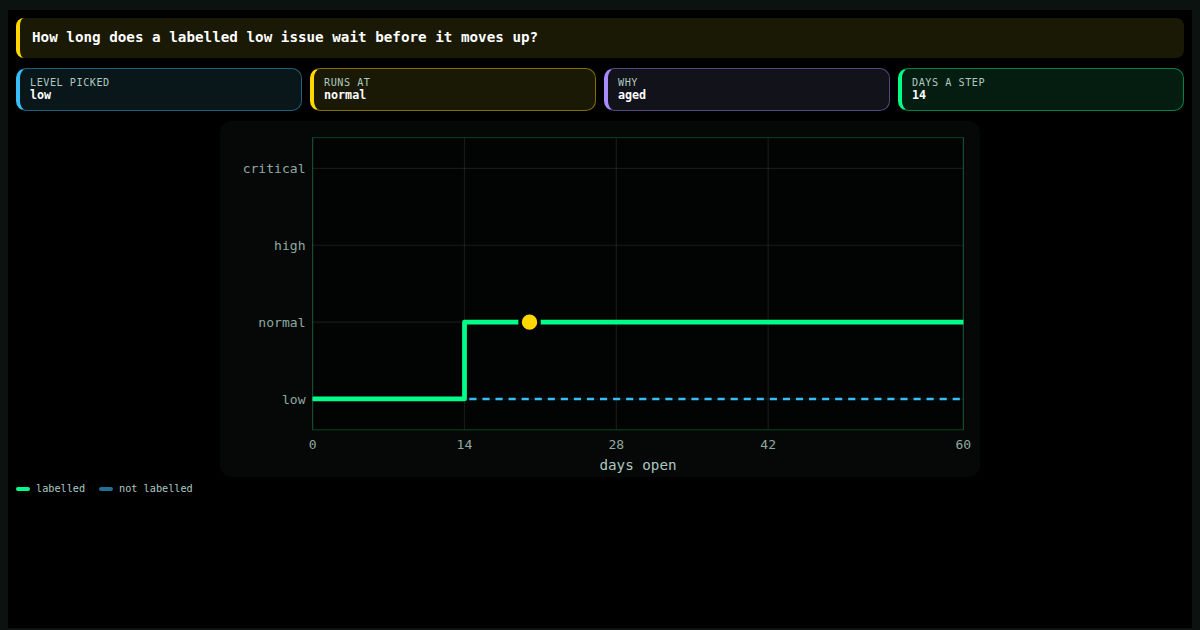
Pick a level, label it or not, and drag its age: a labelled issue gains one level after 14 days, at most one, and never reaches critical.
specs/queen/priority.t27
// SPDX-License-Identifier: Apache-2.0
; specs/queen/priority.t27 -- the order the Queen should take open issues in (gHashTag/t27#6366)
; Today the Queen takes the first eligible issue in GitHub's listing order, newest first, and reads no
; label (specs/queen/dispatch.t27, PRIORITY_RULE). This file is the one home of the rule that replaces it.
; Runtimes read it, nobody restates it: the supervisor imports the label vocabulary from `t27c gen-js`
; of this file, `tri priority` calls the functions below through `t27c gen-c` and ctypes.
; Design notes from the survey of agent schedulers (Copilot agent, Devin, OpenHands, Cursor, Jira rank,
; Kubernetes priority queue, Sidekiq weights, stokowski's Linear sort):
;   - "no priority" must never sort ahead of "urgent" (stokowski sorted Linear's 0 = none first);
;   - an issue with an open blocker is skipped, not waited on (head-of-line blocking);
;   - a cap on critical stops priority inflation; aging stops starvation of labelled low work;
;   - an issue nobody labelled keeps today's place, so a repository with no labels sees no change.
; Not here: the fair share of bees per level, cooldown after failed attempts, GitHub's typed Priority
; field (read it first once the org enables it; its four values map onto the same levels).
; phi^2 + 1/phi^2 = 3 | TRINITY

module QueenPriority;

/// Levels, lower runs first. An unlabelled issue is NORMAL and never ages.
pub const LEVEL_CRITICAL : u8 = 0;
pub const LEVEL_HIGH : u8 = 1;
pub const LEVEL_NORMAL : u8 = 2;
pub const LEVEL_LOW : u8 = 3;

/// The label vocabulary, comma separated, one string per level. A label in none of them means nothing.
/// When an issue carries labels of two levels, the more urgent one counts.
pub const CRITICAL_LABELS : str = "P0,priority/critical,critical";
pub const HIGH_LABELS : str = "P1,priority/high,high-priority";
pub const NORMAL_LABELS : str = "P2,priority/medium";
pub const LOW_LABELS : str = "P3,P4,priority/low";

/// A labelled issue gains one level after this many days open, and at most MAX_AGING_STEPS levels,
/// never CRITICAL. One step, not more: a LOW label that aged past unlabelled work would make "low"
/// the fastest way to the front of a long queue.
pub const AGING_DAYS : u32 = 14;
pub const MAX_AGING_STEPS : u32 = 1;

/// At most this many issues of one listing run as CRITICAL, taken in listing order; the rest run as HIGH.
pub const CRITICAL_CAP : u32 = 3;

/// Why an issue sits where it does: the code `tri priority` prints and a supervisor logs.
pub const WHY_LISTING : u8 = 0;
pub const WHY_LABEL : u8 = 1;
pub const WHY_AGED : u8 = 2;
pub const WHY_CAPPED : u8 = 3;
pub const WHY_BLOCKED : u8 = 4;

/// The level after the critical cap: criticals_before counts CRITICAL issues listed before this one.
pub fn capped_level(base: u8, criticals_before: u32) -> u8 {
    if (base == LEVEL_CRITICAL) {
        if (criticals_before >= CRITICAL_CAP) {
            return LEVEL_HIGH;
        }
    }
    return base;
}

/// The level an issue runs at: its capped level, raised one step per AGING_DAYS (at most MAX_AGING_STEPS)
/// when it is labelled.
pub fn effective_level(level: u8, labelled: bool, age_days: u32) -> u8 {
    if (labelled == false) {
        return level;
    }
    if (level <= LEVEL_HIGH) {
        return level;
    }
    var steps : u32 = age_days / AGING_DAYS;
    if (steps > MAX_AGING_STEPS) {
        steps = MAX_AGING_STEPS;
    }
    var gap : u32 = (level as u32) - (LEVEL_HIGH as u32);
    if (steps >= gap) {
        return LEVEL_HIGH;
    }
    return ((level as u32) - steps) as u8;
}

/// An issue with an open blocker is not a candidate; the Queen moves past it.
pub fn eligible(open_blockers: u32) -> bool {
    return open_blockers == 0;
}

/// Whether issue a is taken before issue b: lower effective level, then lower capped level (an aged
/// issue never beats a real one of the same level), then earlier in GitHub's listing.
pub fn outranks(eff_a: u8, level_a: u8, index_a: u32, eff_b: u8, level_b: u8, index_b: u32) -> bool {
    if (eff_a < eff_b) { return true; }
    if (eff_a > eff_b) { return false; }
    if (level_a < level_b) { return true; }
    if (level_a > level_b) { return false; }
    return index_a < index_b;
}

/// The reason printed for one issue.
pub fn why(base: u8, level: u8, eff: u8, labelled: bool, open_blockers: u32) -> u8 {
    if (open_blockers > 0) { return WHY_BLOCKED; }
    if (level != base) { return WHY_CAPPED; }
    if (eff != level) { return WHY_AGED; }
    if (labelled) { return WHY_LABEL; }
    return WHY_LISTING;
}

test no_label_keeps_the_listing_order {
    assert effective_level(LEVEL_NORMAL, false, 400) == LEVEL_NORMAL;
    assert outranks(LEVEL_NORMAL, LEVEL_NORMAL, 0, LEVEL_NORMAL, LEVEL_NORMAL, 1);
    assert outranks(LEVEL_NORMAL, LEVEL_NORMAL, 1, LEVEL_NORMAL, LEVEL_NORMAL, 0) == false;
    // #7077: a strict order, so a sort can use it: no issue outranks itself
    assert outranks(LEVEL_NORMAL, LEVEL_NORMAL, 4, LEVEL_NORMAL, LEVEL_NORMAL, 4) == false;
}

test critical_runs_before_a_newer_unlabelled_issue {
    assert outranks(LEVEL_CRITICAL, LEVEL_CRITICAL, 9, LEVEL_NORMAL, LEVEL_NORMAL, 0);
}

test unlabelled_never_beats_urgent {
    assert outranks(LEVEL_NORMAL, LEVEL_NORMAL, 0, LEVEL_CRITICAL, LEVEL_CRITICAL, 5) == false;
    assert outranks(LEVEL_NORMAL, LEVEL_NORMAL, 0, LEVEL_HIGH, LEVEL_HIGH, 5) == false;
}

test labelled_work_ages_one_level_and_never_to_critical {
    assert effective_level(LEVEL_LOW, true, 13) == LEVEL_LOW;
    assert effective_level(LEVEL_LOW, true, 14) == LEVEL_NORMAL;
    assert effective_level(LEVEL_LOW, true, 9000) == LEVEL_NORMAL;
    assert effective_level(LEVEL_NORMAL, true, 14) == LEVEL_HIGH;
    assert effective_level(LEVEL_HIGH, true, 9000) == LEVEL_HIGH;
}

test an_aged_issue_loses_the_tie_to_a_real_one {
    var aged : u8 = effective_level(LEVEL_LOW, true, 28);
    assert outranks(aged, LEVEL_LOW, 0, LEVEL_NORMAL, LEVEL_NORMAL, 7) == false;
    assert outranks(LEVEL_NORMAL, LEVEL_NORMAL, 7, aged, LEVEL_LOW, 0);
    // #7077: of two LOW labels the aged one goes first, whatever the listing says
    assert outranks(aged, LEVEL_LOW, 5, LEVEL_LOW, LEVEL_LOW, 0);
    assert outranks(LEVEL_LOW, LEVEL_LOW, 0, aged, LEVEL_LOW, 5) == false;
}

test the_fourth_critical_runs_as_high {
    assert capped_level(LEVEL_CRITICAL, 0) == LEVEL_CRITICAL;
    assert capped_level(LEVEL_CRITICAL, 2) == LEVEL_CRITICAL;
    assert capped_level(LEVEL_CRITICAL, 3) == LEVEL_HIGH;
    assert capped_level(LEVEL_LOW, 9) == LEVEL_LOW;
}

test a_blocked_issue_is_skipped {
    assert eligible(0);
    assert eligible(1) == false;
    assert why(LEVEL_CRITICAL, LEVEL_CRITICAL, LEVEL_CRITICAL, true, 2) == WHY_BLOCKED;
}

test every_reason_is_reachable {
    assert why(LEVEL_NORMAL, LEVEL_NORMAL, LEVEL_NORMAL, false, 0) == WHY_LISTING;
    assert why(LEVEL_HIGH, LEVEL_HIGH, LEVEL_HIGH, true, 0) == WHY_LABEL;
    assert why(LEVEL_LOW, LEVEL_LOW, LEVEL_NORMAL, true, 0) == WHY_AGED;
    assert why(LEVEL_CRITICAL, LEVEL_HIGH, LEVEL_HIGH, true, 0) == WHY_CAPPED;
}

invariant levels_are_ordered {
    assert LEVEL_CRITICAL < LEVEL_HIGH;
    assert LEVEL_HIGH < LEVEL_NORMAL;
    assert LEVEL_NORMAL < LEVEL_LOW;
    assert CRITICAL_CAP > 0;
    assert AGING_DAYS > 0;
    assert MAX_AGING_STEPS == 1;
}
All lessons
Module 1 · The task
An issue becomes work only once it is shaped: the sections it lacks are written or asked for, its boundary names real files, and one filter reads every kind of task.
Module 2 · Who goes next
The order the Queen takes issues in: a label ages one step, at most 3 criticals run as critical, and nothing new starts while finished work waits for review.
Module 3 · A bee's life
From candidate to done: twelve states and sixteen events, a ship in the game that flies home, and a deploy that does not cut a bee short.
Module 4 · The reviewer bee
Finished work is judged on its own clock: enough reviews at once to keep up, a pause that doubles for a row that waits, and a merge gate that zero checks cannot open.
Module 5 · The review jam
A pull request that will not move is in exactly one of ten cases, each with the Queen's move, and a red check is inherited only when master says so.
Module 6 · Keys
A bee's model key can be refused: the code in the body sorts the refusal, a transient one rests the key for seconds, and the bee moves on to the next free key.
Module 7 · Credit and money
Lending a key earns no credit, an operation is sold at twice its cost in half-cent tokens, and tokens burn 30 days after they land.
Module 8 · Agents among themselves
One bot per agent in one group: who is called, a chain three bot messages deep, and the clocks that keep agents from flooding a chat.
Module 9 · Night and the board
What the hive shows: a night watch that opens, comments on and closes issues, the columns of the public board, and the comb that flashes for each event.