A refused key
You will learn
How the Queen sorts a provider's refusal into transient, quota, auth or a bad request.
Bees call models with keys, and keys get refused. key_failover.t27 sorts each refusal with error_kind. The z.ai code in the body wins over the HTTP status, because z.ai sends a spent quota and a passing overload with the same 429: code 1305 is transient, 1113 is quota. No answer at all is transient. A quota or auth refusal closes the key, and only a bad request is charged to the issue.
Try it
Compare 429 with codes 1308 and 1312; then read what no answer at all is.
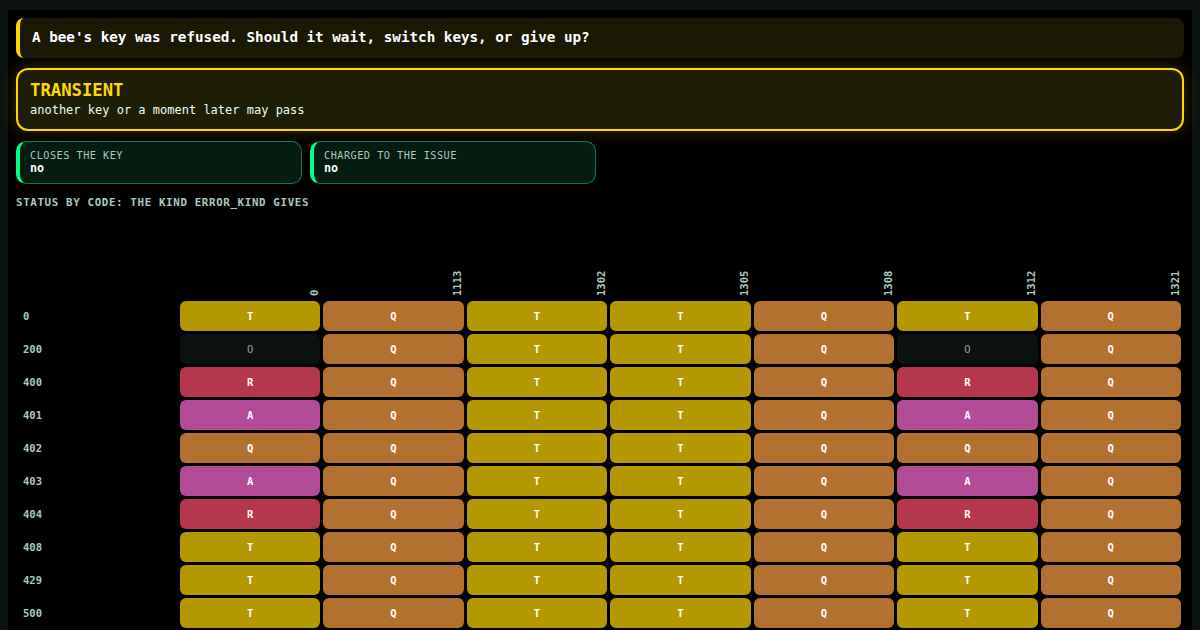
Pick the HTTP status and the z.ai code a bee got back. error_kind sorts the refusal, and the grid colours every status against every code the same way.
specs/queen/key_failover.t27
// SPDX-License-Identifier: Apache-2.0
; specs/queen/key_failover.t27 -- a bee whose key is refused moves to another key, then another pool (gHashTag/t27#9993).
; Measured 2026-10-17 13:00-15:18Z in the Railway logs of trios-bee-runner-2: 93 bee turns, 17 of them
; ended after 0 steps; at least 22 AI_RetryError on z.ai "429 code 1305" (temporary overload), in bursts
; at 13:53, 13:59, 14:08 (16 in one minute), 14:19, 14:47 and 14:50. trios-bee-runner-1: about 6 of 48
; turns ended after 0 steps. The bee for #9967 started at 14:50:47 on pool-2 key 9/10 and died at 14:50:54.
; The cause: a bee gets ONE key when it is dispatched (trios queen-dispatch.ts resolveWorkerProvider,
; round-robin) and keeps it. On 1305 the SDK retried the same key three times, the turn closed with no
; completion frame, and the dispatch ended "cause undetermined" while 33 other keys in two pools (24 and
; 10) stood by. The reviewer already does the right thing (trios queen-tick.ts, "a transient refusal
; tries the next lane too", after it lost 16 of 16 calls to 1302/1305 on 2026-09-23); bees did not.
; The rule here, after Envoy's retry_host_predicate previous_hosts plus outlier ejection, and the LiteLLM
; router's cooldown-then-fallback:
;   1. classify the refusal: transient, quota, auth or a bad request (error_kind);
;   2. a transient refusal rests the key for seconds (cooldown_seconds), a quota or auth refusal closes
;      it for the long break -- 1302 and 1305 never close a key and never retire work;
;   3. the next attempt goes to the next free key of the pool, never the key that just failed
;      (next_free); 1305 is an overload of the pool's MODEL, not of one key, so once POOL_OVERLOAD_KEYS
;      distinct keys of one pool answered 1305 inside OVERLOAD_WINDOW_SECONDS the bee moves to the next
;      pool instead of burning the rest (pool_overloaded);
;   4. at most MAX_ATTEMPTS_PER_TURN attempts, then the turn ends as provider_overloaded (trios#1708),
;      its claim is released (trios#1886), and the end is not charged to the issue (charges_issue).
; Masks: bit i of a u32 mask is key i of the pool (or pool i of the pool list); a pool holds at most
; POOL_MAX keys. NO_KEY means "none left". The host keeps the clock and the masks; this file decides.
; Not here: the wiring into trios. It lands as generated code, not hand-written TypeScript. ASCII only (L3).
; phi^2 + 1/phi^2 = 3 | TRINITY

module QueenKeyFailover;

; --- 1. What the provider said -----------------------------------------------------------------------

/// KE_OK: the request was answered. KE_TRANSIENT: refused for now, another key or a moment later may
/// pass. KE_QUOTA: the key's quota, plan or balance is spent. KE_AUTH: the key itself is refused.
/// KE_REQUEST: the request is wrong; every key would answer the same.
pub const KE_OK : u8 = 0;
pub const KE_TRANSIENT : u8 = 1;
pub const KE_QUOTA : u8 = 2;
pub const KE_AUTH : u8 = 3;
pub const KE_REQUEST : u8 = 4;

/// The z.ai rate limit and temporary overload codes. Both arrive as HTTP 429 and both clear on their own.
pub const ZAI_RATE_LIMIT : u32 = 1302;
pub const ZAI_OVERLOAD : u32 = 1305;

/// The z.ai codes whose documented meaning is a spent quota, plan or balance: 1113 and 1308-1321
/// except 1312, the closed list ZAI_QUOTA_EXHAUSTED_CODES in trios queen-dispatch.ts (#1301).
pub fn is_quota_code(code: u32) -> bool {
    if (code == 1113) { return true; }
    if (code == 1312) { return false; }
    if (code < 1308) { return false; }
    return code <= 1321;
}

/// `status` is the HTTP status, 0 when no response came at all (timeout, reset, abort). `zai_code` is
/// the business code in the body, 0 when there is none. The code wins over the status, because z.ai
/// sends a spent quota and a passing overload with the same 429.
pub fn error_kind(status: u32, zai_code: u32) -> u8 {
    if (is_quota_code(zai_code)) { return KE_QUOTA; }
    if (zai_code == ZAI_RATE_LIMIT) { return KE_TRANSIENT; }
    if (zai_code == ZAI_OVERLOAD) { return KE_TRANSIENT; }
    if (status == 0) { return KE_TRANSIENT; }
    if (status == 402) { return KE_QUOTA; }
    if (status == 401) { return KE_AUTH; }
    if (status == 403) { return KE_AUTH; }
    if (status == 408) { return KE_TRANSIENT; }
    if (status == 429) { return KE_TRANSIENT; }
    if (status >= 600) { return KE_REQUEST; }
    if (status >= 500) { return KE_TRANSIENT; }
    if (status >= 400) { return KE_REQUEST; }
    return KE_OK;
}

; --- 2. How long a refused key rests ------------------------------------------------------------------

/// A transient refusal rests the key COOL_BASE_SECONDS, doubled per strike in a row, never more than
/// COOL_CAP_SECONDS: long enough that the next bee does not hit the same overloaded key at once, short
/// enough that 34 keys are never all resting through a one-minute burst like 14:08.
pub const COOL_BASE_SECONDS : u32 = 15;
pub const COOL_CAP_SECONDS : u32 = 240;
/// A spent quota or a refused key closes for the long break the runtime already uses (30 minutes).
pub const KEY_BREAK_SECONDS : u32 = 1800;

/// `strikes` is the key's transient refusals in a row before this one. The cap is the base doubled
/// exactly four times (an invariant pins it), so the doubling meets the cap and never steps past it.
pub fn cooldown_seconds(kind: u8, strikes: u32) -> u32 {
    if (kind == KE_QUOTA) { return KEY_BREAK_SECONDS; }
    if (kind == KE_AUTH) { return KEY_BREAK_SECONDS; }
    if (kind != KE_TRANSIENT) { return 0; }
    var wait : u32 = COOL_BASE_SECONDS;
    var n : u32 = 0;
    while (n < strikes) {
        if (wait >= COOL_CAP_SECONDS) { return COOL_CAP_SECONDS; }
        wait = wait * 2;
        n = n + 1;
    }
    return wait;
}

/// Whether the refusal closes the key for the long break. A transient refusal never does.
pub fn key_closes(kind: u8) -> bool {
    if (kind == KE_QUOTA) { return true; }
    return kind == KE_AUTH;
}

; --- 3. The next key, the next pool ------------------------------------------------------------------

pub const POOL_MAX : u32 = 32;
pub const NO_KEY : u32 = 255;

pub fn bit(i: u32) -> u32 {
    if (i >= POOL_MAX) { return 0; }
    return 1 << i;
}

pub fn is_set(mask: u32, i: u32) -> bool {
    return (mask & bit(i)) != 0;
}

/// The next index after `last`, wrapping, that is neither tried in this turn nor blocked (resting or
/// closed), and is never `last` itself: the scan visits the size - 1 other indices only. `last` out of
/// range (NO_KEY) visits all of them from index 0. NO_KEY when none is free. A list longer than
/// POOL_MAX does not fit a mask and is refused (NO_KEY), never read as its first 32. The same rule
/// picks a key inside a pool and a pool inside the pool list.
pub fn next_free(tried: u32, blocked: u32, size: u32, last: u32) -> u32 {
    if (size > POOL_MAX) { return NO_KEY; }
    var start : u32 = 0;
    var count : u32 = size;
    if (last < size) {
        start = last + 1;
        count = size - 1;
    }
    var k : u32 = 0;
    while (k < count) {
        var i : u32 = (start + k) % size;
        if (is_set(tried | blocked, i) == false) { return i; }
        k = k + 1;
    }
    return NO_KEY;
}

/// 1305 from POOL_OVERLOAD_KEYS distinct keys of one pool inside OVERLOAD_WINDOW_SECONDS is the
/// pool's model overloaded. A pool smaller than that is overloaded when every key said it.
pub const POOL_OVERLOAD_KEYS : u32 = 3;
pub const OVERLOAD_WINDOW_SECONDS : u32 = 60;

pub fn pool_overloaded(distinct_keys_1305: u32, pool_size: u32) -> bool {
    if (distinct_keys_1305 >= POOL_OVERLOAD_KEYS) { return true; }
    if (pool_size == 0) { return false; }
    return distinct_keys_1305 >= pool_size;
}

; --- 4. The step after a refusal ---------------------------------------------------------------------

/// FA_DONE: answered, go on. FA_NEXT_KEY: retry on next_free's key. FA_NEXT_POOL: retry on the next
/// pool. FA_GIVE_UP: no key left; the turn ends as provider_overloaded. FA_FAIL: the request is wrong.
pub const FA_DONE : u8 = 0;
pub const FA_NEXT_KEY : u8 = 1;
pub const FA_NEXT_POOL : u8 = 2;
pub const FA_GIVE_UP : u8 = 3;
pub const FA_FAIL : u8 = 4;

/// The bound on attempts in one turn, the failed one included: three keys of the first pool to see an
/// overload, three of the second, and two to spare. It keeps a turn from spinning through 34 keys.
pub const MAX_ATTEMPTS_PER_TURN : u32 = 8;

/// `attempts` counts the attempts of this turn so far, this one included. `next_key` and `next_pool`
/// are next_free's answers for the current pool and for the pool list (NO_KEY when none).
pub fn step(kind: u8, attempts: u32, next_key: u32, distinct_keys_1305: u32, pool_size: u32, next_pool: u32) -> u8 {
    if (kind == KE_OK) { return FA_DONE; }
    if (kind >= KE_REQUEST) { return FA_FAIL; }
    if (attempts >= MAX_ATTEMPTS_PER_TURN) { return FA_GIVE_UP; }
    var pool_out : bool = false;
    if (kind == KE_TRANSIENT) { pool_out = pool_overloaded(distinct_keys_1305, pool_size); }
    if (pool_out == false) {
        if (next_key != NO_KEY) { return FA_NEXT_KEY; }
    }
    if (next_pool != NO_KEY) { return FA_NEXT_POOL; }
    return FA_GIVE_UP;
}

/// Whether a turn that ended on this kind counts against the issue. A provider that is overloaded,
/// spent or refusing a key says nothing about the work, so it never retires the issue; a wrong request
/// does. Only KE_REQUEST charges. This narrows dispatch_exit.t27 counts_against_issue, which charges
/// every DX_PROVIDER_ERROR.
pub fn charges_issue(kind: u8) -> bool {
    return kind == KE_REQUEST;
}

; --- 5. Tests ----------------------------------------------------------------------------------------

test the_quota_list_is_the_closed_list_of_the_runtime {
    assert is_quota_code(1113) == true;
    assert is_quota_code(1308) == true;
    assert is_quota_code(1311) == true;
    assert is_quota_code(1312) == false;
    assert is_quota_code(1313) == true;
    assert is_quota_code(1321) == true;
    assert is_quota_code(1322) == false;
    assert is_quota_code(1307) == false;
    assert is_quota_code(1112) == false;
    assert is_quota_code(1114) == false;
    assert is_quota_code(ZAI_RATE_LIMIT) == false;
    assert is_quota_code(ZAI_OVERLOAD) == false;
    assert is_quota_code(0) == false;
}

test the_code_wins_over_the_status {
    assert error_kind(429, 1305) == KE_TRANSIENT;
    assert error_kind(429, 1302) == KE_TRANSIENT;
    assert error_kind(429, 1113) == KE_QUOTA;
    assert error_kind(429, 1316) == KE_QUOTA;
    assert error_kind(200, 1308) == KE_QUOTA;
    assert error_kind(400, 1305) == KE_TRANSIENT;
    assert error_kind(400, 1302) == KE_TRANSIENT;
    assert error_kind(429, 1312) == KE_TRANSIENT;
}

test a_status_without_a_code_falls_in_its_kind {
    assert error_kind(0, 0) == KE_TRANSIENT;
    assert error_kind(200, 0) == KE_OK;
    assert error_kind(399, 0) == KE_OK;
    assert error_kind(400, 0) == KE_REQUEST;
    assert error_kind(401, 0) == KE_AUTH;
    assert error_kind(402, 0) == KE_QUOTA;
    assert error_kind(403, 0) == KE_AUTH;
    assert error_kind(404, 0) == KE_REQUEST;
    assert error_kind(407, 0) == KE_REQUEST;
    assert error_kind(408, 0) == KE_TRANSIENT;
    assert error_kind(409, 0) == KE_REQUEST;
    assert error_kind(428, 0) == KE_REQUEST;
    assert error_kind(429, 0) == KE_TRANSIENT;
    assert error_kind(430, 0) == KE_REQUEST;
    assert error_kind(499, 0) == KE_REQUEST;
    assert error_kind(500, 0) == KE_TRANSIENT;
    assert error_kind(503, 0) == KE_TRANSIENT;
    assert error_kind(529, 0) == KE_TRANSIENT;
    assert error_kind(599, 0) == KE_TRANSIENT;
    assert error_kind(600, 0) == KE_REQUEST;
}

test a_transient_refusal_rests_seconds_and_a_spent_key_closes {
    assert cooldown_seconds(KE_TRANSIENT, 0) == 15;
    assert cooldown_seconds(KE_TRANSIENT, 1) == 30;
    assert cooldown_seconds(KE_TRANSIENT, 2) == 60;
    assert cooldown_seconds(KE_TRANSIENT, 3) == 120;
    assert cooldown_seconds(KE_TRANSIENT, 4) == COOL_CAP_SECONDS;
    assert cooldown_seconds(KE_TRANSIENT, 5) == COOL_CAP_SECONDS;
    assert cooldown_seconds(KE_TRANSIENT, 4000000000) == COOL_CAP_SECONDS;
    assert cooldown_seconds(KE_QUOTA, 0) == KEY_BREAK_SECONDS;
    assert cooldown_seconds(KE_AUTH, 7) == KEY_BREAK_SECONDS;
    assert cooldown_seconds(KE_OK, 3) == 0;
    assert cooldown_seconds(KE_REQUEST, 3) == 0;
    assert key_closes(KE_QUOTA) == true;
    assert key_closes(KE_AUTH) == true;
    assert key_closes(KE_TRANSIENT) == false;
    assert key_closes(KE_OK) == false;
    assert key_closes(KE_REQUEST) == false;
}

test bits_name_keys {
    assert bit(0) == 1;
    assert bit(3) == 8;
    assert bit(31) == 2147483648;
    assert bit(32) == 0;
    assert is_set(8, 3) == true;
    assert is_set(8, 2) == false;
    assert is_set(4294967295, 31) == true;
    assert is_set(4294967295, 32) == false;
}

test the_next_key_is_never_the_one_that_failed {
    // the #9967 case: pool 2 has 10 keys, key 9 answered 1305; the next try wraps to key 0
    assert next_free(bit(9), 0, 10, 9) == 0;
    // even when the failed key is not marked tried, it is skipped
    assert next_free(0, 0, 10, 9) == 0;
    assert next_free(0, 0, 10, 4) == 5;
    // a pool of one key has no other key
    assert next_free(0, 0, 1, 0) == NO_KEY;
    // tried and resting keys are both skipped
    assert next_free(bit(5), bit(6), 10, 4) == 7;
    assert next_free(bit(0) | bit(1), 0, 3, 2) == NO_KEY;
    // a fresh turn starts at key 0
    assert next_free(0, 0, 24, NO_KEY) == 0;
    assert next_free(bit(0), 0, 24, NO_KEY) == 1;
    // every key but the failed one is taken
    assert next_free(4294967295 - bit(9), 0, 10, 9) == NO_KEY;
    // an empty pool has nothing
    assert next_free(0, 0, 0, NO_KEY) == NO_KEY;
    // `last` just past the end is out of range: the scan starts at 0
    assert next_free(0, 0, 10, 10) == 0;
    // a full mask of POOL_MAX keys wraps from the top index
    assert next_free(0, 0, 32, 31) == 0;
    assert next_free(0, 0, 32, NO_KEY) == 0;
    assert next_free(0, 4294967295 - bit(31), 32, 30) == 31;
    // a list longer than POOL_MAX does not fit a mask and is refused
    assert next_free(0, 0, 33, NO_KEY) == NO_KEY;
    assert next_free(0, 0, 40, 31) == NO_KEY;
}

test an_overload_seen_on_three_keys_is_the_pools_model {
    assert pool_overloaded(0, 24) == false;
    assert pool_overloaded(2, 24) == false;
    assert pool_overloaded(3, 24) == true;
    assert pool_overloaded(16, 24) == true;
    assert pool_overloaded(2, 2) == true;
    assert pool_overloaded(1, 2) == false;
    assert pool_overloaded(1, 1) == true;
    assert pool_overloaded(0, 0) == false;
}

/// The conformance table: one assert per row. Columns: kind, attempts, next key, distinct keys that
/// answered 1305 in the window, pool size, next pool.
test conformance_rows {
    // r01 answered: go on
    assert step(KE_OK, 1, 5, 0, 24, 1) == FA_DONE;
    // r02 a wrong request fails, whatever keys are left
    assert step(KE_REQUEST, 1, 5, 0, 24, 1) == FA_FAIL;
    // r03 an unknown kind is read as a wrong request
    assert step(9, 1, 5, 0, 24, 1) == FA_FAIL;
    // r04 the #9967 case: first 1305 on pool 2, keys left: next key, not the same key
    assert step(KE_TRANSIENT, 1, 0, 1, 10, 0) == FA_NEXT_KEY;
    // r05 a rate limit (1302) on a fresh pool: next key
    assert step(KE_TRANSIENT, 1, 3, 0, 24, 1) == FA_NEXT_KEY;
    // r06 the third distinct key said 1305: the model is overloaded, next pool
    assert step(KE_TRANSIENT, 3, 4, 3, 24, 1) == FA_NEXT_POOL;
    // r07 the 14:08 burst: overloaded and no other pool: give up, do not burn the rest
    assert step(KE_TRANSIENT, 3, 4, 3, 24, NO_KEY) == FA_GIVE_UP;
    // r08 a spent quota on one key does not mean an overloaded pool: next key
    assert step(KE_QUOTA, 1, 2, 5, 24, 1) == FA_NEXT_KEY;
    // r09 a refused key: next key
    assert step(KE_AUTH, 1, 2, 0, 24, 1) == FA_NEXT_KEY;
    // r10 no key left in the pool: next pool
    assert step(KE_TRANSIENT, 2, NO_KEY, 1, 24, 1) == FA_NEXT_POOL;
    // r11 no key and no pool left: give up
    assert step(KE_QUOTA, 2, NO_KEY, 0, 24, NO_KEY) == FA_GIVE_UP;
    // r12 the attempt bound stops a turn with keys still left
    assert step(KE_TRANSIENT, MAX_ATTEMPTS_PER_TURN, 4, 0, 24, 1) == FA_GIVE_UP;
    // r13 one attempt below the bound still moves on
    assert step(KE_TRANSIENT, MAX_ATTEMPTS_PER_TURN - 1, 4, 0, 24, 1) == FA_NEXT_KEY;
    // r14 a two-key pool where both said 1305 is overloaded
    assert step(KE_TRANSIENT, 2, NO_KEY, 2, 2, 0) == FA_NEXT_POOL;
    // r15 a 503 with no 1305 seen keeps to the pool
    assert step(KE_TRANSIENT, 2, 7, 0, 24, 1) == FA_NEXT_KEY;
    // r16 the bound beats a wrong request? no: a wrong request fails first
    assert step(KE_REQUEST, MAX_ATTEMPTS_PER_TURN, 4, 0, 24, 1) == FA_FAIL;
    // r17 an answer after many attempts is still an answer
    assert step(KE_OK, MAX_ATTEMPTS_PER_TURN, NO_KEY, 9, 24, NO_KEY) == FA_DONE;
}

test an_overloaded_provider_never_retires_the_issue {
    assert charges_issue(KE_TRANSIENT) == false;
    assert charges_issue(KE_QUOTA) == false;
    assert charges_issue(KE_AUTH) == false;
    assert charges_issue(KE_REQUEST) == true;
    assert charges_issue(KE_OK) == false;
    assert charges_issue(9) == false;
}

; --- 6. Invariants -----------------------------------------------------------------------------------

invariant the_kinds_and_steps_are_distinct {
    assert KE_OK == 0 and KE_TRANSIENT == 1 and KE_QUOTA == 2 and KE_AUTH == 3 and KE_REQUEST == 4;
    assert FA_DONE == 0 and FA_NEXT_KEY == 1 and FA_NEXT_POOL == 2 and FA_GIVE_UP == 3 and FA_FAIL == 4;
}

/// A transient rest is always shorter than the long break, so a 1305 can never close a key.
invariant a_rest_is_shorter_than_a_break {
    assert COOL_BASE_SECONDS > 0 and COOL_CAP_SECONDS == COOL_BASE_SECONDS * 16;
    assert COOL_CAP_SECONDS < KEY_BREAK_SECONDS and KEY_BREAK_SECONDS == 1800;
}

/// The bound leaves room to see an overload in one pool and still try the next: the overload is
/// detected before the bound stops the turn.
invariant the_bound_leaves_room_for_a_second_pool {
    assert MAX_ATTEMPTS_PER_TURN > POOL_OVERLOAD_KEYS * 2;
    assert POOL_OVERLOAD_KEYS >= 2 and OVERLOAD_WINDOW_SECONDS > 0;
}

/// NO_KEY is no index a mask can hold.
invariant no_key_is_out_of_range {
    assert POOL_MAX == 32 and NO_KEY >= POOL_MAX;
    assert ZAI_RATE_LIMIT == 1302 and ZAI_OVERLOAD == 1305;
}
All lessons
Module 1 · The task
An issue becomes work only once it is shaped: the sections it lacks are written or asked for, its boundary names real files, and one filter reads every kind of task.
Module 2 · Who goes next
The order the Queen takes issues in: a label ages one step, at most 3 criticals run as critical, and nothing new starts while finished work waits for review.
Module 3 · A bee's life
From candidate to done: twelve states and sixteen events, a ship in the game that flies home, and a deploy that does not cut a bee short.
Module 4 · The reviewer bee
Finished work is judged on its own clock: enough reviews at once to keep up, a pause that doubles for a row that waits, and a merge gate that zero checks cannot open.
Module 5 · The review jam
A pull request that will not move is in exactly one of ten cases, each with the Queen's move, and a red check is inherited only when master says so.
Module 6 · Keys
A bee's model key can be refused: the code in the body sorts the refusal, a transient one rests the key for seconds, and the bee moves on to the next free key.
Module 7 · Credit and money
Lending a key earns no credit, an operation is sold at twice its cost in half-cent tokens, and tokens burn 30 days after they land.
Module 8 · Agents among themselves
One bot per agent in one group: who is called, a chain three bot messages deep, and the clocks that keep agents from flooding a chat.
Module 9 · Night and the board
What the hive shows: a night watch that opens, comments on and closes issues, the columns of the public board, and the comb that flashes for each event.