Капстоун: что запускается дальше
Вы узнаете
Как куски курса сходятся в один дизайн и что запускается на стенде дальше.
Закройте курс там, где он начался, — у целого дизайна: top_level.t27 несёт CLK_FREQ_HZ 100,000,000, SYSTICK_HZ 1000, NUM_MAC_UNITS 8, DATA_WIDTH 32 и коды операций CMD_NOP, CMD_MAC_MULT, CMD_MAC_DOT и CMD_UART_SEND — девятнадцать тестов дизайна, который держит все шины, разобранные этим курсом. Запись читает, что стенд запускает дальше; боковые кнопки опускают весь дизайн в Verilog — и его верхний стенд вместе с ним.
Попробовать
В записи прочитайте, что запускается дальше; затем в спеке найдите четыре кода операций и посчитайте тесты дизайна.
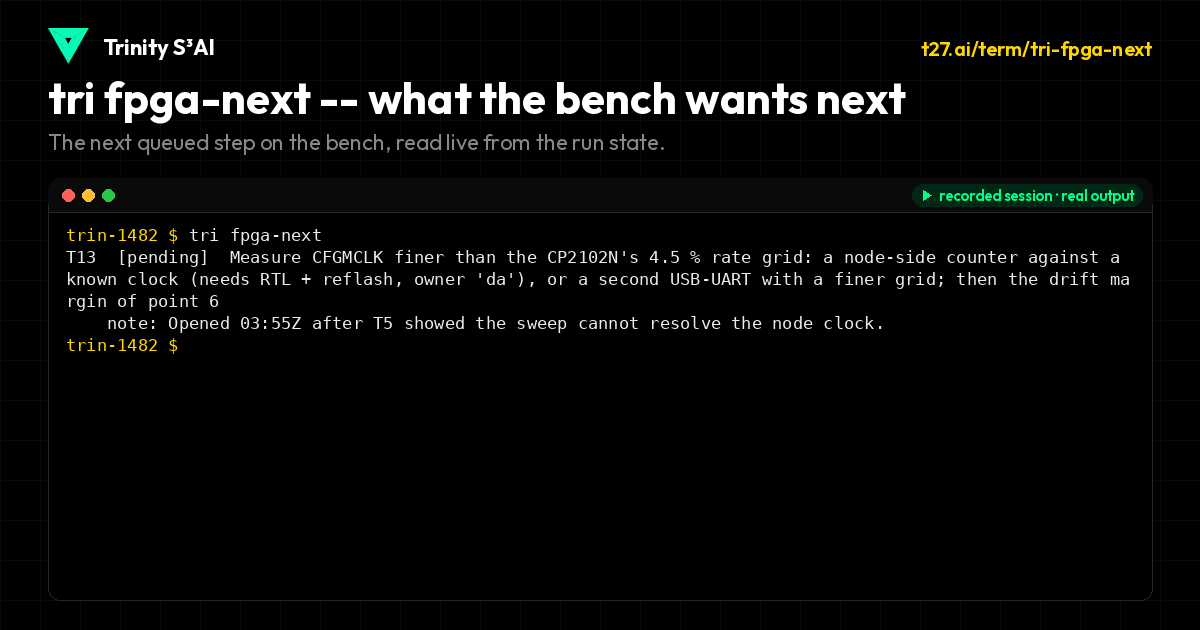
The next queued step on the bench, read live from the run state.
specs/fpga/top_level.t27
// SPDX-License-Identifier: Apache-2.0
// t27/specs/fpga/top_level.t27
// ZeroDSP FPGA Top Level Module
// Integrates MAC and UART for FPGA deployment
// φ² + 1/φ² = 3 | TRINITY

module ZeroDSP_TopLevel {
    use base::types;
    use base::ops;
    use isa::registers;

    const CLK_FREQ_HZ : u32 = 100_000_000;
    const SYSTICK_HZ : u32 = 1000;

    const NUM_MAC_UNITS : usize = 8;
    const DATA_WIDTH : usize = 32;

    const CMD_NOP : u8 = 0;
    const CMD_MAC_MULT : u8 = 1;
    const CMD_MAC_DOT : u8 = 2;
    const CMD_UART_SEND : u8 = 3;
    const CMD_RESET : u8 = 0xFF;

    struct SystemState {
        mac_ready : bool,
        uart_ready : bool,
        processing : bool,
        error : bool,
    }

    var system_state : SystemState = SystemState{
        .mac_ready = true,
        .uart_ready = true,
        .processing = false,
        .error = false,
    };

    var mac_result : i32 = 0;
    var uart_tx_data : u8 = 0;

    fn system_init() -> void {
        system_state.mac_ready = true;
        system_state.uart_ready = true;
        system_state.processing = false;
        system_state.error = false;
    }

    fn system_ready() -> bool {
        return system_state.mac_ready and system_state.uart_ready;
    }

    fn system_busy() -> bool {
        return system_state.processing;
    }

    fn system_error() -> bool {
        return system_state.error;
    }

    fn system_reset() -> void {
        system_init();
        mac_result = 0;
        uart_tx_data = 0;
    }

    fn set_mac_result(value: i32) -> void {
        mac_result = value;
        system_state.processing = false;
    }

    fn get_mac_result() -> i32 {
        return mac_result;
    }

    fn set_uart_data(data: u8) -> void {
        uart_tx_data = data;
    }

    fn get_uart_data() -> u8 {
        return uart_tx_data;
    }

    fn start_processing() -> void {
        if (system_ready()) {
            system_state.processing = true;
        }
    }

    fn stop_processing() -> void {
        system_state.processing = false;
    }

    fn set_error() -> void {
        system_state.error = true;
        system_state.processing = false;
    }

    fn clear_error() -> void {
        system_state.error = false;
    }

    test system_initially_ready
        given ready = system_ready()
        then ready == true

    test system_initially_not_busy
        given busy = system_busy()
        then busy == false

    test system_initially_no_error
        given error = system_error()
        then error == false

    test system_reset_clears_state
        given set_error()
        and   system_reset()
        and   ready = system_ready()
        and   error = system_error()
        then ready == true and error == false

    test start_processing_sets_busy
        given start_processing()
        and   busy = system_busy()
        then busy == true

    test stop_processing_clears_busy
        given start_processing()
        and   stop_processing()
        and   busy = system_busy()
        then busy == false

    test set_error_clears_busy
        given start_processing()
        and   set_error()
        and   busy = system_busy()
        and   error = system_error()
        then busy == false and error == true

    test get_mac_result_after_set
        given set_mac_result(42)
        and   result = get_mac_result()
        then result == 42

    test get_uart_data_after_set
        given set_uart_data(0xAA)
        and   data = get_uart_data()
        then data == 0xAA

    test mac_result_clears_processing
        given start_processing()
        and   set_mac_result(100)
        and   busy = system_busy()
        then busy == false

    test constants_clk_freq
        then CLK_FREQ_HZ == 100_000_000
        and SYSTICK_HZ == 1000
        and NUM_MAC_UNITS == 8
        and DATA_WIDTH == 32

    test command_constants
        then CMD_NOP == 0
        and CMD_MAC_MULT == 1
        and CMD_MAC_DOT == 2
        and CMD_UART_SEND == 3
        and CMD_RESET == 0xFF

    test system_reset_clears_mac_result
        given set_mac_result(999)
        and system_reset()
        then get_mac_result() == 0

    test system_reset_clears_uart_data
        given set_uart_data(0xFF)
        and system_reset()
        then get_uart_data() == 0

    test clear_error_does_not_affect_ready
        given set_error()
        and clear_error()
        then system_error() == false
        and system_ready() == true

    test start_processing_requires_ready
        given system_state.mac_ready = false
        then system_ready() == false

    test set_mac_result_negative
        given set_mac_result(-42)
        then get_mac_result() == -42

    test set_uart_data_boundary
        given set_uart_data(0)
        then get_uart_data() == 0
        given set_uart_data(255)
        then get_uart_data() == 255

    test system_init_resets_state
        given system_init()
        and   ready = system_ready()
        and   busy = system_busy()
        and   error = system_error()
        then ready == true
        and busy == false
        and error == false

    invariant system_ready_when_not_processing
        given busy = system_busy()
        and   ready = system_ready()
        assert busy == true or ready == true

    invariant system_error_implies_not_busy
        given error = system_error()
        and   busy = system_busy()
        assert error == false or busy == false

    invariant system_ready_implies_mac_uart_ready
        given ready = system_ready()
        assert ready == false or system_state.mac_ready == true

    // Implementation: call the function to measure its latency
    bench system_ready_latency
        measure: nanoseconds to system_ready()
        target: < 20ns

    // Implementation: call the function to measure its latency
    bench system_reset_latency
        measure: nanoseconds to system_reset()
        target: < 100ns
}
Все уроки
Модуль 1 · Что такое шина
Зачем вообще существует шина: разговор по проводам, с кадрами и адресами, и кому позволено говорить.
Модуль 2 · Разговор по UART
Двухпроводная шина без такта: кадр, делитель, задающий скорость, и статус, который опрашивает драйвер.
Модуль 3 · SPI под тактом
Разговор под тактом: четыре режима, лестница предделителей и выбор кристалла на каждого подчинённого.
Модуль 4 · Регистровая шина APB
Шина регистров: PSEL и PENABLE, строобы и ожидания, и сколько адресных бит стоит количество периферии.
Модуль 5 · Пять каналов AXI4
Пять каналов: адрес, данные и отклик в обе стороны, lite или full, пакеты и идентификаторы.
Модуль 6 · Память
Что находится на дальнем конце каждой шины: карты памяти, типы портов и задержка, которую должно покрывать ожидание.
Модуль 7 · Мосты
Почему в дизайне появляется больше одной шины и пакетный мост, переносящий работу между ними.
Модуль 8 · Ethernet: кадры и тайминг
Кадры, контрольная сумма кадра, тайминг RGMII и заранее зарегистрированные шаги настоящего запуска.
Модуль 9 · Стенд
Дисциплина, оберегающая настоящее железо: кто держит IO, как взять и вернуть захват, и что запускается дальше.