Очередь
Вы узнаете
Как потолок, старение и блокеры упорядочивают очередь открытых задач.
Метки раздуваются: если каждая задача критична, критичных нет. capped_level позволяет идти как critical не больше чем CRITICAL_CAP, 3, задачам списка, в порядке списка, а 4-я идёт как high. Задача с открытым блокером пропускается, её не ждут, и она не может задержать очередь. outranks сравнивает уровень с учётом старения, затем настоящий уровень, затем место в списке, так что постаревшая задача никогда не обгонит настоящую своего уровня. why называет причину каждого места.
Попробовать
Сделайте критичной пятую задачу и посмотрите, куда она встанет; затем поставьте задаче без метки метку low.
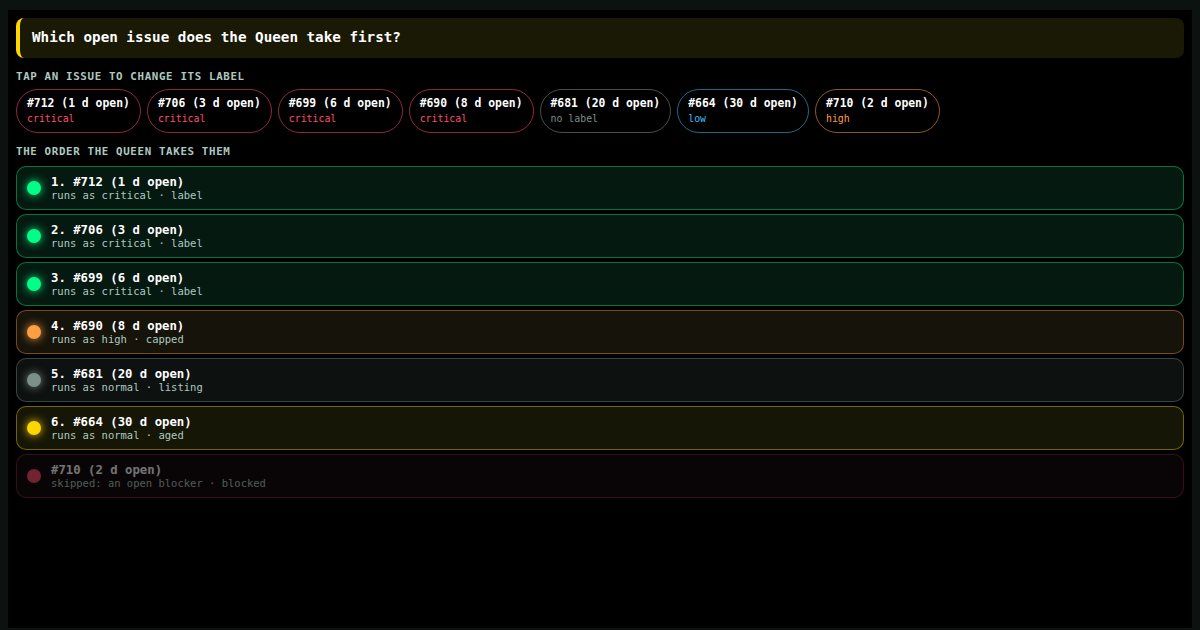
Seven open issues in GitHub order. Tap one to change its label: the cap, aging, blockers and outranks reorder the queue, and each issue says why it sits there.
specs/queen/priority.t27
// SPDX-License-Identifier: Apache-2.0
; specs/queen/priority.t27 -- the order the Queen should take open issues in (gHashTag/t27#6366)
; Today the Queen takes the first eligible issue in GitHub's listing order, newest first, and reads no
; label (specs/queen/dispatch.t27, PRIORITY_RULE). This file is the one home of the rule that replaces it.
; Runtimes read it, nobody restates it: the supervisor imports the label vocabulary from `t27c gen-js`
; of this file, `tri priority` calls the functions below through `t27c gen-c` and ctypes.
; Design notes from the survey of agent schedulers (Copilot agent, Devin, OpenHands, Cursor, Jira rank,
; Kubernetes priority queue, Sidekiq weights, stokowski's Linear sort):
;   - "no priority" must never sort ahead of "urgent" (stokowski sorted Linear's 0 = none first);
;   - an issue with an open blocker is skipped, not waited on (head-of-line blocking);
;   - a cap on critical stops priority inflation; aging stops starvation of labelled low work;
;   - an issue nobody labelled keeps today's place, so a repository with no labels sees no change.
; Not here: the fair share of bees per level, cooldown after failed attempts, GitHub's typed Priority
; field (read it first once the org enables it; its four values map onto the same levels).
; phi^2 + 1/phi^2 = 3 | TRINITY

module QueenPriority;

/// Levels, lower runs first. An unlabelled issue is NORMAL and never ages.
pub const LEVEL_CRITICAL : u8 = 0;
pub const LEVEL_HIGH : u8 = 1;
pub const LEVEL_NORMAL : u8 = 2;
pub const LEVEL_LOW : u8 = 3;

/// The label vocabulary, comma separated, one string per level. A label in none of them means nothing.
/// When an issue carries labels of two levels, the more urgent one counts.
pub const CRITICAL_LABELS : str = "P0,priority/critical,critical";
pub const HIGH_LABELS : str = "P1,priority/high,high-priority";
pub const NORMAL_LABELS : str = "P2,priority/medium";
pub const LOW_LABELS : str = "P3,P4,priority/low";

/// A labelled issue gains one level after this many days open, and at most MAX_AGING_STEPS levels,
/// never CRITICAL. One step, not more: a LOW label that aged past unlabelled work would make "low"
/// the fastest way to the front of a long queue.
pub const AGING_DAYS : u32 = 14;
pub const MAX_AGING_STEPS : u32 = 1;

/// At most this many issues of one listing run as CRITICAL, taken in listing order; the rest run as HIGH.
pub const CRITICAL_CAP : u32 = 3;

/// Why an issue sits where it does: the code `tri priority` prints and a supervisor logs.
pub const WHY_LISTING : u8 = 0;
pub const WHY_LABEL : u8 = 1;
pub const WHY_AGED : u8 = 2;
pub const WHY_CAPPED : u8 = 3;
pub const WHY_BLOCKED : u8 = 4;

/// The level after the critical cap: criticals_before counts CRITICAL issues listed before this one.
pub fn capped_level(base: u8, criticals_before: u32) -> u8 {
    if (base == LEVEL_CRITICAL) {
        if (criticals_before >= CRITICAL_CAP) {
            return LEVEL_HIGH;
        }
    }
    return base;
}

/// The level an issue runs at: its capped level, raised one step per AGING_DAYS (at most MAX_AGING_STEPS)
/// when it is labelled.
pub fn effective_level(level: u8, labelled: bool, age_days: u32) -> u8 {
    if (labelled == false) {
        return level;
    }
    if (level <= LEVEL_HIGH) {
        return level;
    }
    var steps : u32 = age_days / AGING_DAYS;
    if (steps > MAX_AGING_STEPS) {
        steps = MAX_AGING_STEPS;
    }
    var gap : u32 = (level as u32) - (LEVEL_HIGH as u32);
    if (steps >= gap) {
        return LEVEL_HIGH;
    }
    return ((level as u32) - steps) as u8;
}

/// An issue with an open blocker is not a candidate; the Queen moves past it.
pub fn eligible(open_blockers: u32) -> bool {
    return open_blockers == 0;
}

/// Whether issue a is taken before issue b: lower effective level, then lower capped level (an aged
/// issue never beats a real one of the same level), then earlier in GitHub's listing.
pub fn outranks(eff_a: u8, level_a: u8, index_a: u32, eff_b: u8, level_b: u8, index_b: u32) -> bool {
    if (eff_a < eff_b) { return true; }
    if (eff_a > eff_b) { return false; }
    if (level_a < level_b) { return true; }
    if (level_a > level_b) { return false; }
    return index_a < index_b;
}

/// The reason printed for one issue.
pub fn why(base: u8, level: u8, eff: u8, labelled: bool, open_blockers: u32) -> u8 {
    if (open_blockers > 0) { return WHY_BLOCKED; }
    if (level != base) { return WHY_CAPPED; }
    if (eff != level) { return WHY_AGED; }
    if (labelled) { return WHY_LABEL; }
    return WHY_LISTING;
}

test no_label_keeps_the_listing_order {
    assert effective_level(LEVEL_NORMAL, false, 400) == LEVEL_NORMAL;
    assert outranks(LEVEL_NORMAL, LEVEL_NORMAL, 0, LEVEL_NORMAL, LEVEL_NORMAL, 1);
    assert outranks(LEVEL_NORMAL, LEVEL_NORMAL, 1, LEVEL_NORMAL, LEVEL_NORMAL, 0) == false;
    // #7077: a strict order, so a sort can use it: no issue outranks itself
    assert outranks(LEVEL_NORMAL, LEVEL_NORMAL, 4, LEVEL_NORMAL, LEVEL_NORMAL, 4) == false;
}

test critical_runs_before_a_newer_unlabelled_issue {
    assert outranks(LEVEL_CRITICAL, LEVEL_CRITICAL, 9, LEVEL_NORMAL, LEVEL_NORMAL, 0);
}

test unlabelled_never_beats_urgent {
    assert outranks(LEVEL_NORMAL, LEVEL_NORMAL, 0, LEVEL_CRITICAL, LEVEL_CRITICAL, 5) == false;
    assert outranks(LEVEL_NORMAL, LEVEL_NORMAL, 0, LEVEL_HIGH, LEVEL_HIGH, 5) == false;
}

test labelled_work_ages_one_level_and_never_to_critical {
    assert effective_level(LEVEL_LOW, true, 13) == LEVEL_LOW;
    assert effective_level(LEVEL_LOW, true, 14) == LEVEL_NORMAL;
    assert effective_level(LEVEL_LOW, true, 9000) == LEVEL_NORMAL;
    assert effective_level(LEVEL_NORMAL, true, 14) == LEVEL_HIGH;
    assert effective_level(LEVEL_HIGH, true, 9000) == LEVEL_HIGH;
}

test an_aged_issue_loses_the_tie_to_a_real_one {
    var aged : u8 = effective_level(LEVEL_LOW, true, 28);
    assert outranks(aged, LEVEL_LOW, 0, LEVEL_NORMAL, LEVEL_NORMAL, 7) == false;
    assert outranks(LEVEL_NORMAL, LEVEL_NORMAL, 7, aged, LEVEL_LOW, 0);
    // #7077: of two LOW labels the aged one goes first, whatever the listing says
    assert outranks(aged, LEVEL_LOW, 5, LEVEL_LOW, LEVEL_LOW, 0);
    assert outranks(LEVEL_LOW, LEVEL_LOW, 0, aged, LEVEL_LOW, 5) == false;
}

test the_fourth_critical_runs_as_high {
    assert capped_level(LEVEL_CRITICAL, 0) == LEVEL_CRITICAL;
    assert capped_level(LEVEL_CRITICAL, 2) == LEVEL_CRITICAL;
    assert capped_level(LEVEL_CRITICAL, 3) == LEVEL_HIGH;
    assert capped_level(LEVEL_LOW, 9) == LEVEL_LOW;
}

test a_blocked_issue_is_skipped {
    assert eligible(0);
    assert eligible(1) == false;
    assert why(LEVEL_CRITICAL, LEVEL_CRITICAL, LEVEL_CRITICAL, true, 2) == WHY_BLOCKED;
}

test every_reason_is_reachable {
    assert why(LEVEL_NORMAL, LEVEL_NORMAL, LEVEL_NORMAL, false, 0) == WHY_LISTING;
    assert why(LEVEL_HIGH, LEVEL_HIGH, LEVEL_HIGH, true, 0) == WHY_LABEL;
    assert why(LEVEL_LOW, LEVEL_LOW, LEVEL_NORMAL, true, 0) == WHY_AGED;
    assert why(LEVEL_CRITICAL, LEVEL_HIGH, LEVEL_HIGH, true, 0) == WHY_CAPPED;
}

invariant levels_are_ordered {
    assert LEVEL_CRITICAL < LEVEL_HIGH;
    assert LEVEL_HIGH < LEVEL_NORMAL;
    assert LEVEL_NORMAL < LEVEL_LOW;
    assert CRITICAL_CAP > 0;
    assert AGING_DAYS > 0;
    assert MAX_AGING_STEPS == 1;
}
Все уроки
Модуль 1 · Задача
Задача становится работой, только когда её оформили: недостающие разделы дописаны или запрошены, граница называет настоящие файлы, а один фильтр читает задачи всех видов.
Модуль 2 · Кто следующий
Порядок, в котором Королева берёт задачи: метка стареет на одну ступень, критичными идут не больше 3, и ничего нового не начинается, пока готовая работа ждёт ревью.
Модуль 3 · Жизнь пчелы
От кандидата до готовой работы: двенадцать состояний и шестнадцать событий, корабль в игре, который улетает домой, и деплой, который не обрывает пчелу.
Модуль 4 · Пчела-ревьюер
Готовую работу судят по своим часам: столько ревью сразу, чтобы успевать, пауза, которая удваивается для строки в ожидании, и ворота слияния, которые не открыть без проверок.
Модуль 5 · Затор ревью
Застрявший пулл-реквест всегда в одном из десяти случаев, у каждого свой ход Королевы, а красная проверка считается унаследованной, только если так говорит master.
Модуль 6 · Ключи
Ключ модели у пчелы могут отклонить: код в теле ответа сортирует отказ, временный отказ даёт ключу отдохнуть секунды, и пчела переходит к следующему свободному ключу.
Модуль 7 · Заслуги и деньги
Одолженный ключ не приносит заслуг, операция продаётся вдвое дороже своей цены в токенах по полцента, а токены сгорают через 30 дней после зачисления.
Модуль 8 · Агенты между собой
У каждого агента свой бот в одной группе: кого зовут, цепочка глубиной в три сообщения ботов и часы, которые не дают агентам завалить чат.
Модуль 9 · Ночь и доска
Что показывает улей: ночной дозор, который открывает, комментирует и закрывает задачи, колонки публичной доски и соты, которые вспыхивают на каждое событие.