Отступить
Вы узнаете
Почему строку, которая отвечает wait, проверяют всё реже и как часто хотя бы.
За 44 минуты на 2026-10-09 ревьюер сделал 941 визит к строкам, из них 888 с ответом wait, от 22 строк, чью ветку он не мог прочитать; одну строку проверили 54 раза. Теперь revisit_after_seconds ждёт 30 с после одного wait и удваивает паузу на каждый следующий, не больше 900 с: 30, 60, 120, 240, 480, 900. due_again даёт взять строку, только когда это время прошло, а любой другой ответ сбрасывает счёт.
Попробовать
Найдите число ожиданий, после которого пауза перестаёт расти; затем поставьте 4 ожидания и найдите секунду, когда строка снова к сроку.
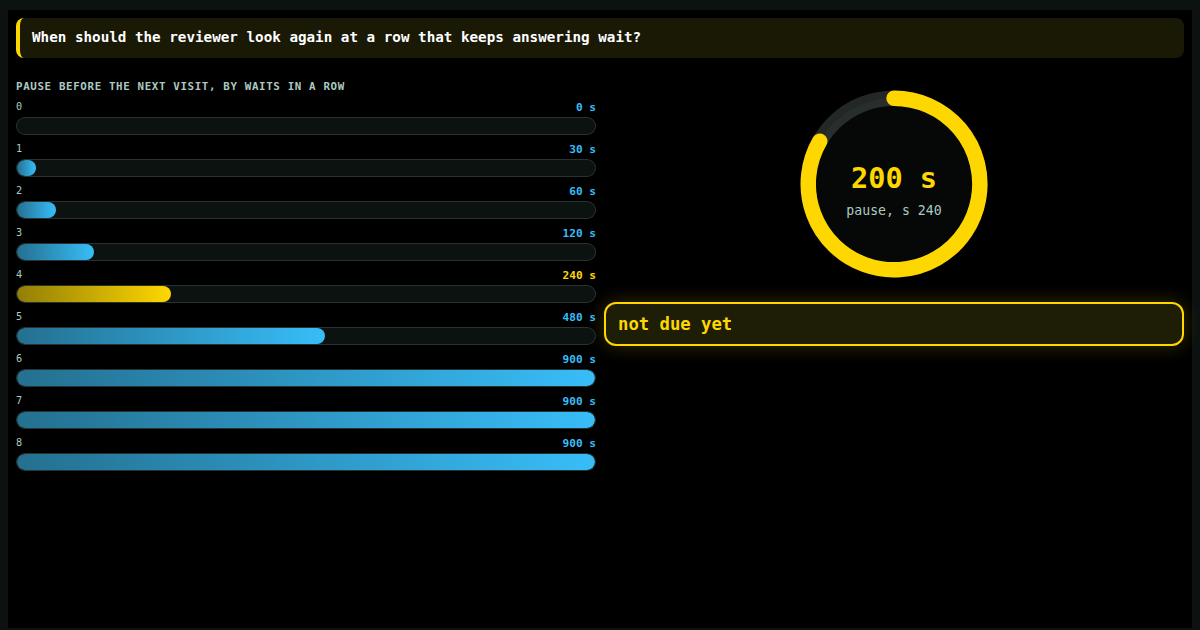
A row that answered wait is not visited again at once: 30 s, doubled per wait, never more than 900 s. Drag the waits and the clock and see when it is due.
specs/queen/reviewer.t27
// SPDX-License-Identifier: Apache-2.0
; specs/queen/reviewer.t27 -- the Queen's reviewer runs on its own clock, several reviews at a time
; Owner, 2026-10-08 (translated): "do point 3 -- a separate reviewer". Measured that afternoon on the
; live Queen (gHashTag/BrowserOS trios/agent-server):
; - bees finished 47 tasks in an hour and the Queen reviewed 23, so finished work queued up (91);
; - the review sweep ran INSIDE the round, before it handed out work: at most 3 reviews, one after
;   another, and at most 45 s of wall clock (0.75 of a 60 s tick), each review a model call of up to
;   2 minutes -- in practice about one review a round;
; - every finished task waiting for its verdict held its files (holds.t27 now lets go after 30 min).
; The reviewer moves out of the round: its own clock, up to REVIEWER_CONCURRENCY rows at once, each
; on its own lane, one row never twice at once, and every waiting row visited in turn. The round
; then reviews nothing: two sweeps over one row would race on its verdict.
; ASCII only (L3).
; phi^2 + 1/phi^2 = 3 | TRINITY

module QueenReviewer;

/// How often the reviewer looks for rows to take: often, because a pass that finds every slot busy
/// costs one query.
pub const REVIEWER_EVERY_SECONDS : u32 = 10;

/// Rows reviewed at once by a host that has not measured its lanes and memory: the fixed bound the
/// reviewer started with. Each row takes its own lane (a key no bee and no other review holds).
/// A host that knows its keys, lanes and free memory uses `reviewer_concurrency` instead; this stays
/// as the bound behind `review_slots` so callers that pass no measurement keep their behaviour.
pub const REVIEWER_CONCURRENCY : u32 = 4;

/// The most rows reviewed at once, whatever the lanes and memory allow: four times the fixed 4, and
/// three times the 5 the measured load of 2026-10-09 needs (see `slots_needed`).
pub const REVIEWER_CEILING : u32 = 16;

/// Seconds in an hour; finish rates are measured per hour.
pub const SECONDS_PER_HOUR : u32 = 3600;

/// One row's wall clock: the witness, the criteria measurement and the model call. It no longer
/// shares a 45 s budget with the round, because it no longer holds the round up.
pub const REVIEW_ROW_SECONDS : u32 = 300;

/// Measured 2026-10-09 on the live Queen (`/queen/status`, `/queen/public-activity`): about 58
/// dispatches finished an hour against about 11 reviewed, with 111 rows waiting. At REVIEW_ROW_SECONDS
/// a slot reviews at most 3600 / 300 = 12 rows an hour, so the fixed 4 tops out at 48 an hour: below
/// the finish rate even if every review used its whole budget, and the backlog only grows.
/// How many rows the reviewer may take at once, from what the host measures:
/// - `keys` model keys, each with `lanes_per_key` lanes free for review;
/// - `free_mb` megabytes free, each review costing `mb_per_review` (0 = not measured: one review);
/// - never above REVIEWER_CEILING, never above the rows `waiting`;
/// - 0 only when nothing waits, and at least 1 while anything waits, so the backlog always drains.
pub fn reviewer_concurrency(keys: u32, lanes_per_key: u32, free_mb: u32, mb_per_review: u32, waiting: u32) -> u32 {
    if (waiting == 0) { return 0; }
    var k : u32 = keys;
    if (k > REVIEWER_CEILING) { k = REVIEWER_CEILING; }
    var l : u32 = lanes_per_key;
    if (l > REVIEWER_CEILING) { l = REVIEWER_CEILING; }
    var bound : u32 = k * l;
    if (bound > REVIEWER_CEILING) { bound = REVIEWER_CEILING; }
    var by_memory : u32 = 1;
    if (mb_per_review > 0) { by_memory = free_mb / mb_per_review; }
    if (by_memory < bound) { bound = by_memory; }
    if (waiting < bound) { bound = waiting; }
    if (bound < 1) { return 1; }
    return bound;
}

/// Rows at once needed so the reviewer finishes at least `finished_per_hour` rows an hour when every
/// row uses its whole REVIEW_ROW_SECONDS: ceil(finished_per_hour * REVIEW_ROW_SECONDS / 3600).
/// Split by the hour so no u32 product overflows.
pub fn slots_needed(finished_per_hour: u32) -> u32 {
    let whole : u32 = finished_per_hour / SECONDS_PER_HOUR;
    let part : u32 = finished_per_hour % SECONDS_PER_HOUR;
    let part_seconds : u32 = part * REVIEW_ROW_SECONDS;
    var extra : u32 = part_seconds / SECONDS_PER_HOUR;
    if (part_seconds % SECONDS_PER_HOUR > 0) { extra = extra + 1; }
    return whole * REVIEW_ROW_SECONDS + extra;
}

/// Whether `slots` reviews at once keep up with `finished_per_hour` finished rows.
pub fn keeps_up(slots: u32, finished_per_hour: u32) -> bool {
    return slots >= slots_needed(finished_per_hour);
}

/// How many rows a pass starts against a bound (normally `reviewer_concurrency`): the free slots, but
/// no more than the rows waiting.
pub fn review_slots_within(bound: u32, in_flight: u32, waiting: u32) -> u32 {
    if (in_flight >= bound) { return 0; }
    let room : u32 = bound - in_flight;
    if (waiting < room) { return waiting; }
    return room;
}

/// How many rows a pass starts on a host that measured nothing: the same rule against the fixed
/// REVIEWER_CONCURRENCY, unchanged for its existing callers.
pub fn review_slots(in_flight: u32, waiting: u32) -> u32 {
    return review_slots_within(REVIEWER_CONCURRENCY, in_flight, waiting);
}

/// The order rows are taken in: the one this reviewer visited longest ago first, a row it never
/// visited before any it has. Without it, a row that is re-read and waits again (no review spent)
/// keeps its place at the head and the reviewer circles the same few rows.
pub fn visit_first(never_a: bool, seconds_since_a: u32, never_b: bool, seconds_since_b: u32) -> bool {
    if (never_a and never_b == false) { return true; }
    if (never_b and never_a == false) { return false; }
    return seconds_since_a > seconds_since_b;
}

/// While the reviewer runs, the round reviews nothing.
pub fn round_reviews(reviewer_running: bool) -> bool {
    return reviewer_running == false;
}

/// A row that answered `wait` is not visited again at once. Measured 2026-10-09 on the live Queen,
/// over 44 minutes: 941 row visits, 888 of them `wait`, from just 22 rows whose branch the Queen could
/// not read. One row was visited 54 times. Only 53 visits decided anything. Nothing about such a row
/// changes in 50 s, and the frozen-wait valve releases it only after six hours, so each one burned
/// about 430 visits of the reviewer's slots.
/// After n waits in a row, the next visit waits WAIT_REVISIT_BASE_SECONDS doubled n - 1 times, never
/// more than WAIT_REVISIT_CAP_SECONDS. Any answer other than `wait` resets the count, so a row that
/// has started to read is visited at the normal pace again.
pub const WAIT_REVISIT_BASE_SECONDS : u32 = 30;
pub const WAIT_REVISIT_CAP_SECONDS : u32 = 900;

pub fn revisit_after_seconds(waits: u32) -> u32 {
    if (waits == 0) { return 0; }
    var wait : u32 = WAIT_REVISIT_BASE_SECONDS;
    var n : u32 = 1;
    while (n < waits) {
        if (wait >= WAIT_REVISIT_CAP_SECONDS) { return WAIT_REVISIT_CAP_SECONDS; }
        wait = wait * 2;
        n = n + 1;
    }
    if (wait > WAIT_REVISIT_CAP_SECONDS) { return WAIT_REVISIT_CAP_SECONDS; }
    return wait;
}

/// Whether a row may be taken now: one that never waited always may, and one that waited only after
/// its revisit time has passed since the last visit.
pub fn due_again(waits: u32, seconds_since_visit: u32) -> bool {
    return seconds_since_visit >= revisit_after_seconds(waits);
}

/// A RUNNER BEE THAT COMMITTED NOTHING LEAVES NOTHING TO READ (gHashTag/t27#9069). Measured on the
/// live Queen, 07:10-09:43Z on 2026-10-11: 425 of the reviewer's 480 row visits answered `wait`
/// because the diff of queen-N could not be read. A runner stores its bee's branch as a bundle only
/// when the bee committed something, so a bee that committed nothing leaves no branch here, the
/// diff fails, and the row waits for the six-hour frozen-wait valve while its issue stays claimed.
/// A container bee that commits nothing is judged an empty attempt at once, and its issue is free
/// again after the retry floor.
/// A runner stores the bundle after the turn has ended, so a row may be visited before its bundle
/// is there. Over 07:10-10:31Z, 15 runner rows whose diff failed got their bundle on a later visit,
/// the latest 58 s after the first. So a finished runner row with no stored bundle is an empty
/// attempt only once NO_BUNDLE_GRACE_MINUTES have passed since it finished; before that it waits,
/// and a bundle that arrives meanwhile is judged on its branch. A container row (`on_runner`
/// false) and a row whose bundle is stored are never decided here: their diff failed for some
/// other reason, and that still decides nothing.
pub const NO_BUNDLE_GRACE_MINUTES : u32 = 10;

pub fn no_bundle_is_empty(on_runner: bool, bundle_stored: bool, minutes_since_finished: u32) -> bool {
    if (on_runner == false) { return false; }
    if (bundle_stored) { return false; }
    return minutes_since_finished >= NO_BUNDLE_GRACE_MINUTES;
}

test a_pass_fills_the_free_slots_with_waiting_rows {
    assert review_slots(0, 0) == 0;
    assert review_slots(0, 2) == 2;
    assert review_slots(0, 100) == REVIEWER_CONCURRENCY;
    assert review_slots(1, 100) == REVIEWER_CONCURRENCY - 1;
    assert review_slots(REVIEWER_CONCURRENCY - 1, 1) == 1;
    assert review_slots(REVIEWER_CONCURRENCY, 100) == 0;
    assert review_slots(REVIEWER_CONCURRENCY + 1, 100) == 0;
}

test the_bound_follows_lanes_memory_and_backlog {
    // nothing waits: no slot, whatever the host has
    assert reviewer_concurrency(10, 10, 100000, 100, 0) == 0;
    // lanes bound: 2 keys x 3 lanes
    assert reviewer_concurrency(2, 3, 100000, 100, 111) == 6;
    // memory bound: 1000 MB at 300 MB a review
    assert reviewer_concurrency(10, 10, 1000, 300, 111) == 3;
    // the hard ceiling: 16, though 10 x 10 lanes and 1000 reviews' worth of memory are free
    assert reviewer_concurrency(10, 10, 100000, 100, 111) == 16;
    assert reviewer_concurrency(4294967295, 4294967295, 4294967295, 1, 4294967295) == REVIEWER_CEILING;
    // never above the backlog
    assert reviewer_concurrency(10, 10, 100000, 100, 2) == 2;
    // at least one while anything waits, even with no lane or memory measured
    assert reviewer_concurrency(0, 0, 0, 0, 1) == 1;
    assert reviewer_concurrency(10, 10, 100, 300, 111) == 1;
    assert reviewer_concurrency(10, 10, 100000, 0, 111) == 1;
    assert reviewer_concurrency(10, 0, 100000, 100, 111) == 1;
}

test the_measured_load_needs_five_and_the_bound_admits_them {
    // 58 finished an hour at 300 s a row: ceil(58 * 300 / 3600) = ceil(4.83) = 5
    assert slots_needed(58) == 5;
    assert slots_needed(0) == 0;
    assert slots_needed(12) == 1;
    assert slots_needed(13) == 2;
    assert slots_needed(3600) == REVIEW_ROW_SECONDS;
    assert slots_needed(3601) == REVIEW_ROW_SECONDS + 1;
    assert slots_needed(4294967295) == 357913942;
    // the fixed 4 cannot keep up; 70 lanes (measured 2026-10-09) and 8 GB at 512 MB a review can
    assert keeps_up(REVIEWER_CONCURRENCY, 58) == false;
    assert keeps_up(reviewer_concurrency(7, 10, 8192, 512, 111), 58) == true;
    assert reviewer_concurrency(7, 10, 8192, 512, 111) == 16;
    assert keeps_up(4, 48) == true;
    assert keeps_up(4, 49) == false;
}

test a_pass_fills_the_free_slots_against_the_computed_bound {
    let bound : u32 = reviewer_concurrency(7, 10, 8192, 512, 111);
    assert review_slots_within(bound, 0, 111) == 16;
    assert review_slots_within(bound, 11, 111) == 5;
    assert review_slots_within(bound, 15, 3) == 1;
    assert review_slots_within(bound, 16, 111) == 0;
    assert review_slots_within(bound, 17, 111) == 0;
    assert review_slots_within(bound, 0, 3) == 3;
    assert review_slots_within(0, 0, 111) == 0;
}

test every_row_is_visited_in_turn {
    // never visited goes first
    assert visit_first(true, 0, false, 9999) == true;
    assert visit_first(false, 9999, true, 0) == false;
    // otherwise the one visited longest ago
    assert visit_first(false, 300, false, 20) == true;
    assert visit_first(false, 20, false, 300) == false;
    assert visit_first(false, 20, false, 20) == false;
    assert visit_first(true, 0, true, 0) == false;
}

test the_round_stands_aside_for_the_reviewer {
    assert round_reviews(true) == false;
    assert round_reviews(false) == true;
}

test a_row_that_keeps_waiting_is_visited_less_and_less {
    assert revisit_after_seconds(0) == 0;
    assert revisit_after_seconds(1) == 30;
    assert revisit_after_seconds(2) == 60;
    assert revisit_after_seconds(3) == 120;
    assert revisit_after_seconds(5) == 480;
    assert revisit_after_seconds(6) == WAIT_REVISIT_CAP_SECONDS;
    assert revisit_after_seconds(50) == WAIT_REVISIT_CAP_SECONDS;
    assert revisit_after_seconds(4294967295) == WAIT_REVISIT_CAP_SECONDS;
    // a row that never waited is always due; one that waited is due only once its time has passed
    assert due_again(0, 0) == true;
    assert due_again(1, 29) == false;
    assert due_again(1, 30) == true;
    assert due_again(6, 899) == false;
    assert due_again(6, 900) == true;
}

test no_bundle_is_empty_for_a_runner_row_past_the_grace {
    // a runner row with no stored bundle, the grace spent: an empty attempt, not a wait
    assert no_bundle_is_empty(true, false, NO_BUNDLE_GRACE_MINUTES) == true;
    assert no_bundle_is_empty(true, false, NO_BUNDLE_GRACE_MINUTES + 1) == true;
    // the six hours the frozen-wait valve would otherwise have held it
    assert no_bundle_is_empty(true, false, 360) == true;
    assert no_bundle_is_empty(true, false, 4294967295) == true;
}

test no_bundle_is_empty_waits_inside_the_grace {
    // just finished: the runner may not have stored its bundle yet
    assert no_bundle_is_empty(true, false, 0) == false;
    // a bundle 40 s late is still awaited, and judged on its branch when it arrives
    assert no_bundle_is_empty(true, false, 1) == false;
    assert no_bundle_is_empty(true, false, NO_BUNDLE_GRACE_MINUTES - 1) == false;
}

test no_bundle_is_empty_leaves_a_container_row_alone {
    // a bee that ran here has no bundle by design; its diff failing decides nothing
    assert no_bundle_is_empty(false, false, 0) == false;
    assert no_bundle_is_empty(false, false, NO_BUNDLE_GRACE_MINUTES) == false;
    assert no_bundle_is_empty(false, false, 4294967295) == false;
    assert no_bundle_is_empty(false, true, 4294967295) == false;
}

test no_bundle_is_empty_leaves_a_stored_bundle_alone {
    // the bundle is there, so the diff failed for another reason: still a wait
    assert no_bundle_is_empty(true, true, 0) == false;
    assert no_bundle_is_empty(true, true, NO_BUNDLE_GRACE_MINUTES) == false;
    assert no_bundle_is_empty(true, true, 4294967295) == false;
}

invariant a_runner_row_with_no_bundle_is_judged_inside_the_hour {
    // the latest late bundle measured on 2026-10-11 came 58 s after the row's first visit
    assert NO_BUNDLE_GRACE_MINUTES > 1;
    assert no_bundle_is_empty(true, false, 1) == false;
    // a row that keeps waiting is visited at least every WAIT_REVISIT_CAP_SECONDS, so the visit
    // that judges it comes within the hour of its finish, not after the six-hour valve
    assert NO_BUNDLE_GRACE_MINUTES * 60 + WAIT_REVISIT_CAP_SECONDS <= SECONDS_PER_HOUR;
}

invariant the_reviewer_is_quicker_than_the_round {
    assert REVIEWER_EVERY_SECONDS < 60;
    assert REVIEWER_CONCURRENCY > 1;
    assert REVIEW_ROW_SECONDS >= 120;
    // a stuck row is still seen several times an hour, so one that starts to read is not lost for long
    assert WAIT_REVISIT_CAP_SECONDS <= 3600;
    assert WAIT_REVISIT_BASE_SECONDS >= REVIEWER_EVERY_SECONDS;
}

invariant the_reviewer_can_outrun_the_measured_finish_rate {
    // FR-002: at 58 finished an hour and REVIEW_ROW_SECONDS, a host with the lanes and memory gets
    // at least the slots that load needs, and the ceiling is not what stops it
    assert keeps_up(reviewer_concurrency(REVIEWER_CEILING, REVIEWER_CEILING, 4294967295, 1, 111), 58);
    assert REVIEWER_CEILING >= slots_needed(58);
    assert REVIEWER_CEILING >= REVIEWER_CONCURRENCY;
    // the fixed bound alone could not, which is why it is only the fallback
    assert keeps_up(REVIEWER_CONCURRENCY, 58) == false;
    // one hour holds a whole number of review budgets, so slots_needed is exact at whole hours
    assert SECONDS_PER_HOUR % REVIEW_ROW_SECONDS == 0;
    // FR-001: 0 only when nothing waits
    assert reviewer_concurrency(0, 0, 0, 0, 0) == 0;
    assert reviewer_concurrency(0, 0, 0, 0, 1) >= 1;
}
Все уроки
Модуль 1 · Задача
Задача становится работой, только когда её оформили: недостающие разделы дописаны или запрошены, граница называет настоящие файлы, а один фильтр читает задачи всех видов.
Модуль 2 · Кто следующий
Порядок, в котором Королева берёт задачи: метка стареет на одну ступень, критичными идут не больше 3, и ничего нового не начинается, пока готовая работа ждёт ревью.
Модуль 3 · Жизнь пчелы
От кандидата до готовой работы: двенадцать состояний и шестнадцать событий, корабль в игре, который улетает домой, и деплой, который не обрывает пчелу.
Модуль 4 · Пчела-ревьюер
Готовую работу судят по своим часам: столько ревью сразу, чтобы успевать, пауза, которая удваивается для строки в ожидании, и ворота слияния, которые не открыть без проверок.
Модуль 5 · Затор ревью
Застрявший пулл-реквест всегда в одном из десяти случаев, у каждого свой ход Королевы, а красная проверка считается унаследованной, только если так говорит master.
Модуль 6 · Ключи
Ключ модели у пчелы могут отклонить: код в теле ответа сортирует отказ, временный отказ даёт ключу отдохнуть секунды, и пчела переходит к следующему свободному ключу.
Модуль 7 · Заслуги и деньги
Одолженный ключ не приносит заслуг, операция продаётся вдвое дороже своей цены в токенах по полцента, а токены сгорают через 30 дней после зачисления.
Модуль 8 · Агенты между собой
У каждого агента свой бот в одной группе: кого зовут, цепочка глубиной в три сообщения ботов и часы, которые не дают агентам завалить чат.
Модуль 9 · Ночь и доска
Что показывает улей: ночной дозор, который открывает, комментирует и закрывает задачи, колонки публичной доски и соты, которые вспыхивают на каждое событие.