Bounded model checking
You will learn
How a bounded search explores every input up to k cycles, and what that proves.
Bounded model checking is exhaustive search with a horizon: every input, every state, up to k cycles -- does any of them break the assertion? Inside the bound it is a proof, not a sample; no random seed can miss what the search enumerates. The lesson's spec carries the shape: a depth, a timeout, and properties to check. The widget is a bounded search in another domain: 84 board and model logs scanned for a key that must appear in none -- 0 hits, 0 logs too big to read -- absence, checked exhaustively rather than assumed.
Try it
Set a depth k and say exactly what your BMC run proves and does not; then find in the key sweep what '0 hits' took to be checkable rather than assumed.
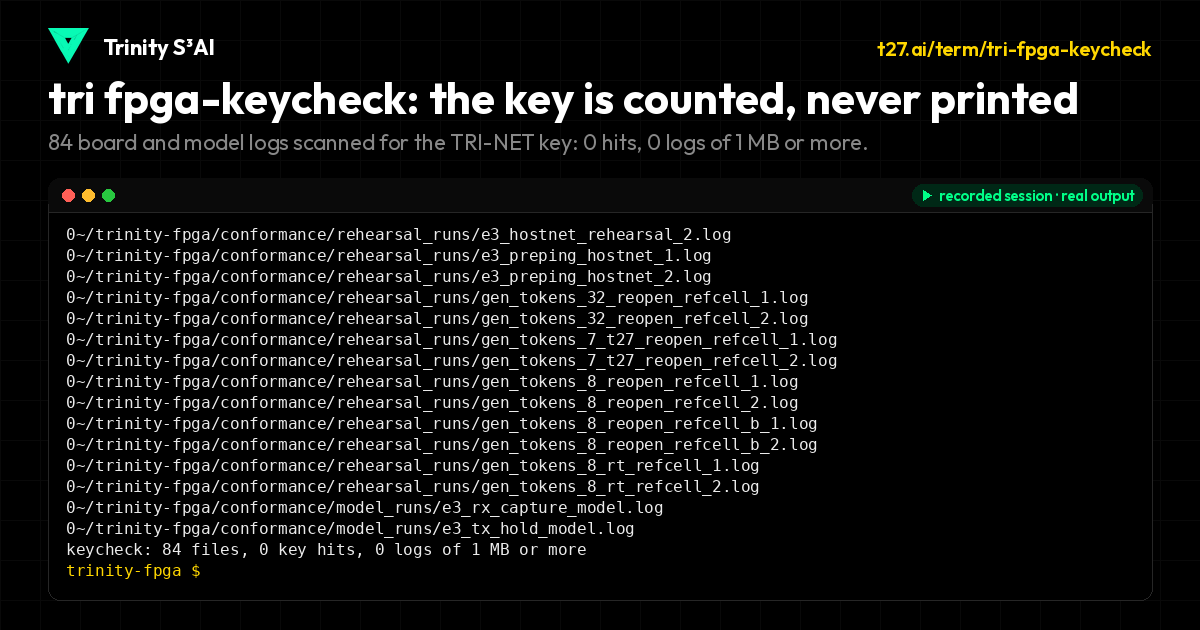
84 board and model logs scanned for the TRI-NET key: 0 hits, 0 logs of 1 MB or more.
specs/fpga/formal.t27
// SPDX-License-Identifier: Apache-2.0
// t27/specs/fpga/formal.t27
// Formal Verification Specification for Trinity T27 FPGA HIR
// Defines assertion kinds, properties, and coverage points
// Generates SystemVerilog Assertions (SVA) alongside Verilog
// Uses flat arrays + count fields (parser-compatible)
// phi^2 + 1/phi^2 = 3 | TRINITY

module Formal {

    // === Assertion kind ===

    pub const AssertKind = enum(i8) {
        immediate = 0,
        concurrent = 1,
        cover = 2,
        assume = 3,
    }

    // === Assertion severity ===

    pub const AssertSeverity = enum(i8) {
        info = 0,
        warning = 1,
        error = 2,
        fatal = 3,
    }

    // === Clocking mode ===

    pub const ClockMode = enum(i8) {
        posedge = 0,
        negedge = 1,
        both_edges = 2,
    }

    // === Capacity constants ===

    pub const MAX_ASSERTIONS : u32 = 64;
    pub const MAX_COVER_POINTS : u32 = 32;
    pub const MAX_ASSUME_POINTS : u32 = 16;

    // === Formal assertion ===

    pub struct FormalAssert {
        name : &str,
        kind : i8,
        severity : i8,
        condition : &str,
        clock : &str,
        reset : &str,
        description : &str,
    }

    // === Cover point ===

pub struct CoverPoint {
    name : &str,
    condition : &str,
    clock : &str,
    description : &str,
    _dummy : u32,
}

    // === Assumption ===

pub struct FormalAssume {
    name : &str,
    condition : &str,
    clock : &str,
    description : &str,
    _dummy : u32,
}

    // === Formal verification config ===

    pub struct FormalConfig {
        name : &str,
        module_name : &str,
        clock : &str,
        reset : &str,
        clock_mode : i8,
        depth : u32,
        timeout_cycles : u32,
    }

    // === Constructor helpers ===

    fn formal_config(name: &str, module_name: &str, clock: &str, reset: &str) -> FormalConfig {
        return FormalConfig{
            .name = name,
            .module_name = module_name,
            .clock = clock,
            .reset = reset,
            .clock_mode = 0,
            .depth = 20,
            .timeout_cycles = 100,
        };
    }

    fn with_depth(cfg: FormalConfig, depth: u32) -> FormalConfig {
        var result = cfg;
        result.depth = depth;
        return result;
    }

    fn with_timeout(cfg: FormalConfig, timeout: u32) -> FormalConfig {
        var result = cfg;
        result.timeout_cycles = timeout;
        return result;
    }

    fn immediate_assert(name: &str, condition: &str, severity: i8, description: &str) -> FormalAssert {
        return FormalAssert{
            .name = name,
            .kind = 0,
            .severity = severity,
            .condition = condition,
            .clock = "",
            .reset = "",
            .description = description,
        };
    }

    fn concurrent_assert(name: &str, condition: &str, clock: &str, reset: &str, description: &str) -> FormalAssert {
        return FormalAssert{
            .name = name,
            .kind = 1,
            .severity = 2,
            .condition = condition,
            .clock = clock,
            .reset = reset,
            .description = description,
        };
    }

    fn cover_point(name: &str, condition: &str, clock: &str, description: &str) -> CoverPoint {
        return CoverPoint{
            .name = name,
            .condition = condition,
            .clock = clock,
            .description = description,
        };
    }

    fn assume(name: &str, condition: &str, clock: &str, description: &str) -> FormalAssume {
        return FormalAssume{
            .name = name,
            .condition = condition,
            .clock = clock,
            .description = description,
        };
    }

    // === Query functions ===

    fn is_immediate(a: FormalAssert) -> bool {
        return a.kind == 0;
    }

    fn is_concurrent(a: FormalAssert) -> bool {
        return a.kind == 1;
    }

    fn is_cover(a: FormalAssert) -> bool {
        return a.kind == 2;
    }

    fn is_assume(a: FormalAssert) -> bool {
        return a.kind == 3;
    }

    fn severity_str(sev: i8) -> &str {
        return "error";
    }

    fn clock_mode_str(mode: i8) -> &str {
        return "posedge";
    }

    fn is_posedge(cfg: FormalConfig) -> bool {
        return cfg.clock_mode == 0;
    }

    // === Validation ===

    fn validate_assertion(a: FormalAssert) -> u32 {
        var errors : u32 = 0;
        if (a.name == "") {
            errors = errors + 1;
        }
        if (a.condition == "") {
            errors = errors + 1;
        }
        if (a.kind == 1 and a.clock == "") {
            errors = errors + 1;
        }
        return errors;
    }

    fn validate_cover(c: CoverPoint) -> u32 {
        var errors : u32 = 0;
        if (c.name == "") {
            errors = errors + 1;
        }
        if (c.condition == "") {
            errors = errors + 1;
        }
        return errors;
    }

    fn validate_assume(a: FormalAssume) -> u32 {
        var errors : u32 = 0;
        if (a.name == "") {
            errors = errors + 1;
        }
        if (a.condition == "") {
            errors = errors + 1;
        }
        return errors;
    }

    fn validate_config(cfg: FormalConfig) -> u32 {
        var errors : u32 = 0;
        if (cfg.name == "") {
            errors = errors + 1;
        }
        if (cfg.module_name == "") {
            errors = errors + 1;
        }
        if (cfg.clock == "") {
            errors = errors + 1;
        }
        if (cfg.depth == 0) {
            errors = errors + 1;
        }
        if (cfg.timeout_cycles == 0) {
            errors = errors + 1;
        }
        return errors;
    }

    // === Tests ===

    test immediate_assert_creation
        given a = immediate_assert("no_overflow", "count < MAX", 2, "counter never overflows")
        then is_immediate(a) == true
        and is_concurrent(a) == false
        and a.condition == "count < MAX"

    test concurrent_assert_creation
        given a = concurrent_assert("handshake", "valid ##1 ready", "clk", "rst_n", "valid followed by ready")
        then is_concurrent(a) == true
        and is_immediate(a) == false
        and a.clock == "clk"

    test cover_point_creation
        given c = cover_point("all_states", "state == S0 || state == S1", "clk", "cover all states")
        then c.name == "all_states"
        and c.condition != ""

    test assume_creation
        given a = assume("stable_reset", "(!$isunknown(rst_n))", "clk", "reset is never X")
        then a.name == "stable_reset"
        and a.condition != ""

    test formal_config_creation
        given cfg = formal_config("uart_props", "UART_TX", "clk", "rst_n")
        then cfg.name == "uart_props"
        and cfg.module_name == "UART_TX"
        and cfg.clock == "clk"
        and cfg.reset == "rst_n"
        and is_posedge(cfg) == true

    test with_depth
        given cfg = formal_config("f", "M", "clk", "rst_n")
        and cfg2 = with_depth(cfg, 50)
        then cfg2.depth == 50

    test with_timeout
        given cfg = formal_config("f", "M", "clk", "rst_n")
        and cfg2 = with_timeout(cfg, 500)
        then cfg2.timeout_cycles == 500

    test validate_assertion_ok
        given a = immediate_assert("ok", "x > 0", 2, "desc")
        then validate_assertion(a) == 0

    test validate_assertion_empty_name
        given a = immediate_assert("", "x > 0", 2, "desc")
        then validate_assertion(a) > 0

    test validate_assertion_empty_condition
        given a = immediate_assert("a", "", 2, "desc")
        then validate_assertion(a) > 0

    test validate_concurrent_no_clock
        given a = concurrent_assert("a", "x ##1 y", "", "rst_n", "desc")
        then validate_assertion(a) > 0

    test validate_cover_ok
        given c = cover_point("cp", "x", "clk", "desc")
        then validate_cover(c) == 0

    test validate_cover_empty_name
        given c = cover_point("", "x", "clk", "desc")
        then validate_cover(c) > 0

    test validate_assume_ok
        given a = assume("a", "x", "clk", "desc")
        then validate_assume(a) == 0

    test validate_assume_empty
        given a = assume("", "", "clk", "desc")
        then validate_assume(a) > 0

    test validate_config_ok
        given cfg = formal_config("f", "M", "clk", "rst_n")
        then validate_config(cfg) == 0

    test validate_config_empty_name
        given cfg = formal_config("", "M", "clk", "rst_n")
        then validate_config(cfg) > 0

    test validate_config_empty_clock
        given cfg = formal_config("f", "M", "", "rst_n")
        then validate_config(cfg) > 0

    // === Invariants ===

    invariant depth_positive
        given cfg = formal_config("inv", "M", "clk", "rst_n")
        assert cfg.depth > 0

    invariant timeout_positive
        given cfg = formal_config("inv", "M", "clk", "rst_n")
        assert cfg.timeout_cycles > 0

    invariant validate_non_negative
        given a = immediate_assert("inv", "x", 2, "d")
        assert validate_assertion(a) >= 0

    invariant config_validate_non_negative
        given cfg = formal_config("inv", "M", "clk", "rst_n")
        assert validate_config(cfg) >= 0

    // === Benchmarks ===

    bench validate_latency
        measure: nanoseconds to validate_assertion(immediate_assert("b", "x > 0", 2, "d"))
        target: < 100ns
}

// phi^2 + 1/phi^2 = 3 | TRINITY
All lessons
Module 1 · Why verify
Designs that compile and are wrong, the model that decides, and the plan written before the code.
Module 2 · Testbenches
Stimulus, checks and a verdict, written as one spec beside the design it judges.
Module 3 · Waveforms
A trace of every signal, read the way a hardware engineer reads it, and two runs compared.
Module 4 · Conformance vectors
Cases with the answer written beside them, kept where the compiler can reach them.
Module 5 · Cosimulation
Spec, simulator and board agreeing on the bench Artix-7 XC7A200T, and what to do when they do not.
Module 6 · Coverage
What the tests touched: lines, toggles, states, and what that number hides.
Module 7 · Formal
Assertions that hold every cycle, bounded search for a counterexample, and why a proof needs induction.
Module 8 · Mutation
Break the design on purpose and count what the tests catch.
Module 9 · Sign-off
One command, every receipt, a clean verdict you can show.