Sum and carry
You will learn
How the addition of two trits splits into a sum table and a carry table.
Two trits add to something from -2 to +2. Written in balanced ternary that is a sum trit plus three times a carry trit: +1 + +1 = 2 = 3 - 1, carry +1, sum -1. The widget shows both as gates. Counting tables, a two-input ternary gate has 3^9 = 19683 possibilities against 16 in binary. The lesson spec builds XOR from ternary neurons, the hardware side of the same idea.
Try it
Find the two input pairs whose carry is not 0, and check a + b = sum + 3 x carry on each.
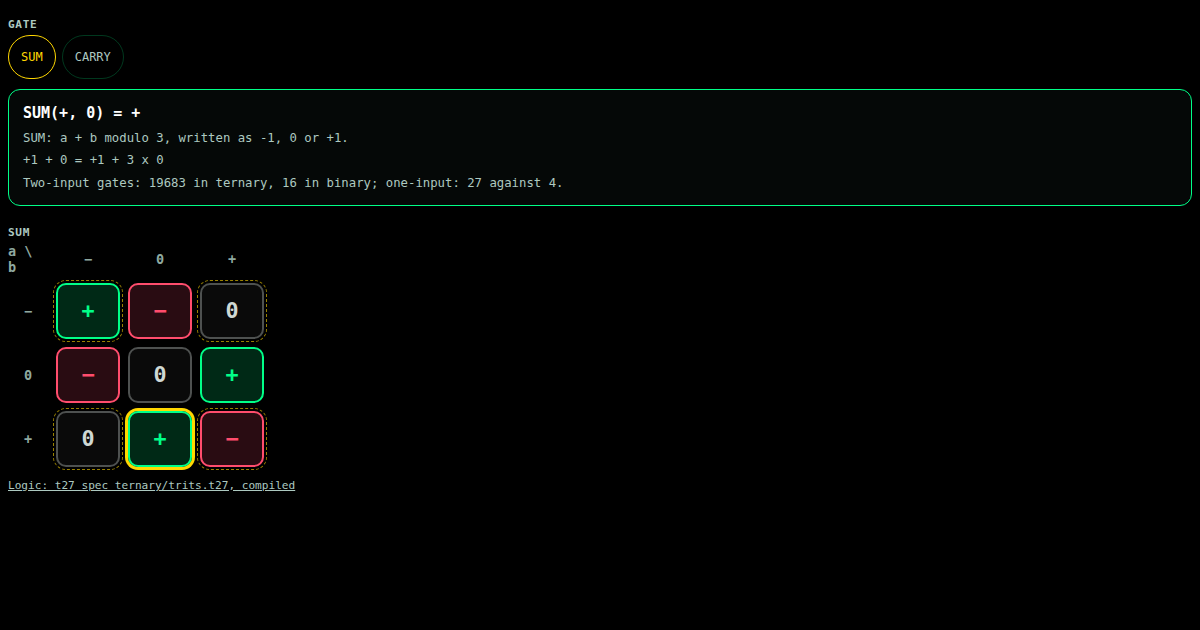
The sum trit and the carry trit of a + b are two 3 x 3 tables. There are 19,683 such two-input gates in ternary and 16 in binary.
specs/ternary/ternary_xor.t27
module TernaryXor;
fn tmul(ta: u8, tb: u8) -> i8 {
    if (ta == 1) { return 0; }
    if (tb == 1) { return 0; }
    if (ta == tb) { return 1; }
    return -1;
}
fn dot27(a: u64, b: u64) -> i16 {
    var acc : i16 = 0;
    var i : u32 = 0;
    while (i < 27) {
        var ta : u8 = ((a >> (i << 1)) & 3) as u8;
        var tb : u8 = ((b >> (i << 1)) & 3) as u8;
        acc = acc + tmul(ta, tb) as i16;
        i = i + 1;
    }
    return acc;
}
// Sign at zero: v > 0 -> P, v < 0 -> N, else Z.
fn sign0(v: i16) -> u8 {
    if (v > 0) { return 2; }
    if (v < 0) { return 0; }
    return 1;
}
// Trit negate: P<->N, Z fixed.
fn negate(t: u8) -> u8 {
    if (t == 2) { return 0; }
    if (t == 0) { return 2; }
    return 1;
}
// Pack 2 trits into lanes 0,1 of a chunk; the rest are Z.
fn pack2(t0: u8, t1: u8) -> u64 {
    var z : u64 = 6004799503160661;
    var cleared : u64 = z & 18446744073709551600;
    return cleared | (t0 as u64) | ((t1 as u64) << 2);
}
// Biased ternary neuron: sign(dot(x, w) + bias). The bias is the neuron's
// threshold offset -- what a trained network learns alongside the weights.
fn bneuron(x: u64, w: u64, bias: i16) -> u8 {
    return sign0(dot27(x, w) + bias);
}
// Ternary XOR over binary-embedded inputs {N=-1, P=+1}: P if the inputs differ,
// N if they match. XOR is NOT linearly separable -- a single neuron cannot
// compute it -- so this is a genuine 2-LAYER network:
//   h1 = sign(a + b - 1)   (AND-like)
//   h2 = sign(a + b + 1)   (OR-like)
//   out = sign(h2 + (-h1) - 1)   (h2 AND NOT h1)
pub fn ternary_xor(a: u8, b: u8) -> u8 {
    var x : u64 = pack2(a, b);
    var w_pp : u64 = pack2(2, 2);
    var h1 : u8 = bneuron(x, w_pp, -1);
    var h2 : u8 = bneuron(x, w_pp, 1);
    var hidden : u64 = pack2(h2, negate(h1));
    return bneuron(hidden, w_pp, -1);
}
test xor_p_p { assert_eq(ternary_xor(2, 2), 0); }
test xor_p_n { assert_eq(ternary_xor(2, 0), 2); }
test xor_n_p { assert_eq(ternary_xor(0, 2), 2); }
test xor_n_n { assert_eq(ternary_xor(0, 0), 0); }
// W697: the hardware boundary, derived from the CALL GRAPH.
//
// This spec has several functions that take a parameter and return a value,
// so W696's count rule left it AMBIGUOUS. But exactly ONE of them is called
// by no other function -- it is the root, and every other candidate is a
// helper it reaches. With one root the choice is forced by structure rather
// than by count, and forwarding to it still invents nothing.
//
// The call graph is built from FUNCTION BODIES ONLY. Counting `test` blocks
// as callers makes the rule vacuous -- every function is called by its own
// test, so nothing is ever a root.
//
// Measured: the rule resolved 14 of 136 ambiguous specs, 6 of them with
// types that can cross a module boundary. It is narrow because most of the
// rest are libraries of INDEPENDENT functions, which have several roots and
// correctly stay ambiguous.
fn on_comb(a: u8, b: u8) -> u8 { return ternary_xor(a, b); }

endmodule
All lessons
Module 1 · Three values
Why three, how balanced ternary writes every number without a sign, and what flipping and cutting trits do.
Module 2 · Logic with unknown
Kleene's three-valued gates, two gates binary has no twin for, and addition as a pair of tables.
Module 3 · Adding trits
The half adder, the full adder and a carry that ripples left, one place at a time.
Module 4 · Multiplying without a multiplier
Copy, drop or flip: a product by one trit, long multiplication, and a MAC that only adds.
Module 5 · Trits in binary memory
Two bits per trit, five trits per byte, and the bits a 27-trit word needs.
Module 6 · The TRI-27 instruction word
The 32-bit word the Trinity emulator decodes: its fields, its 47 opcodes and its 15-bit immediate.
Module 7 · A ternary machine
An ALU built from this course's adders, a three-way jump, and a program you can step.
Module 8 · Three answers
Compare at the highest differing trit, find a number in thirds, sort with three-way compares.
Module 9 · Ternary neurons
Weights of -1, 0, +1: one neuron, a detector and a small layer, with no multiplier anywhere.