Using other modules
You will learn
How a use line is written, and what the browser can and cannot do with it.
use base::types; names a module by its path, with :: between the parts. The parser reads it as a use declaration. The compiler in your browser has no checkout of the other files, so it does not open base::types and does not check names that come from it. The native t27c resolves imports from a repository; this lesson could not run that check here.
Try it
Find the use declaration in the parser tree of the lesson spec in the player.
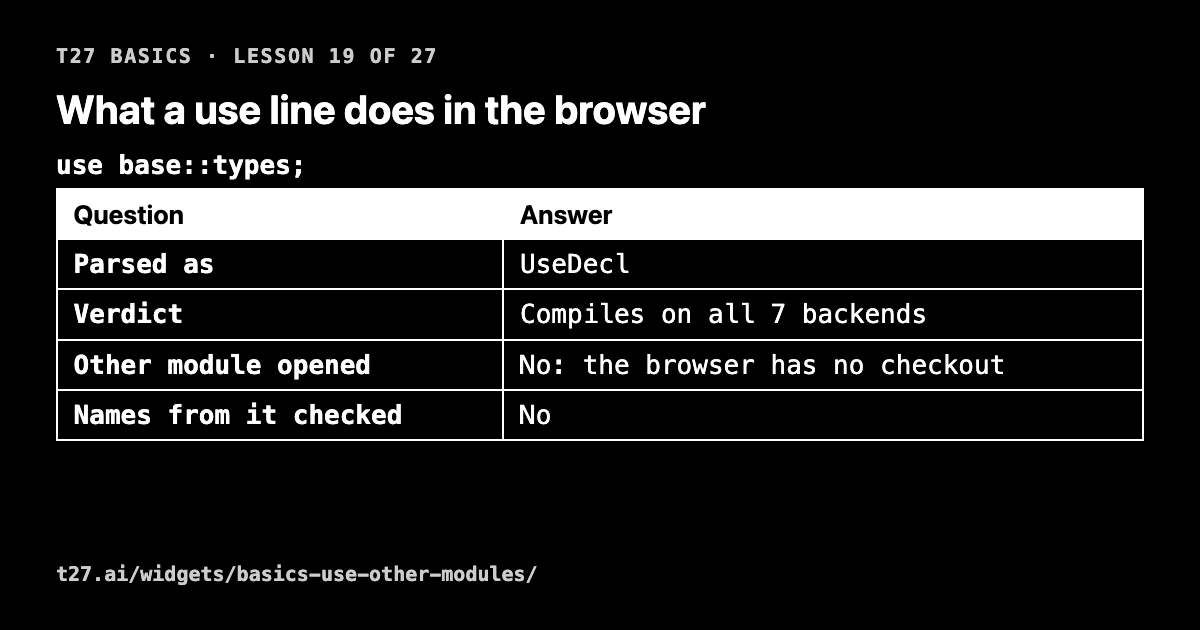
A t27 use line, how the parser reads it, and what the browser compiler leaves unchecked. Lesson 19 of the t27 basics course.
specs/basics/19_use_other_modules.t27
// SPDX-License-Identifier: Apache-2.0
; t27 basics, lesson 19: Using other modules.
; use names another module whose pub names this one may read.

module basics_19_use_other_modules;

use base::types;

pub const USES : u8 = 1;

test one_use_line {
    assert USES == 1;
}
All lessons
Module 1 · A spec file
What a .t27 file holds: a module line, prose lines and comments.
Module 2 · Values and types
Constants, the width of a whole number, and true, false and text.
Module 3 · Arrays, trits and expressions
Lists of values, the three values of a trit, and what operators compute.
Module 4 · Tests and functions
A test block, several small tests in one spec, and a function with typed inputs.
Module 5 · Inside a function
Names with let and var, choices with if and switch, and loops.
Module 6 · Visibility and your own types
What pub shares with other modules, and the structs and enums you declare.
Module 7 · Modules, rules and gen-ts
Reading another module, stating a rule that always holds, and a spec turned into TypeScript.
Module 8 · The compiler and tri
The backends t27c writes, the stages it reads a spec in, and the tri command.
Module 9 · Errors, a program, what next
Reading a compiler error, one small complete program, and the course to take next.